Contents12 sections
This guide was first published in German on handgetestet.de.
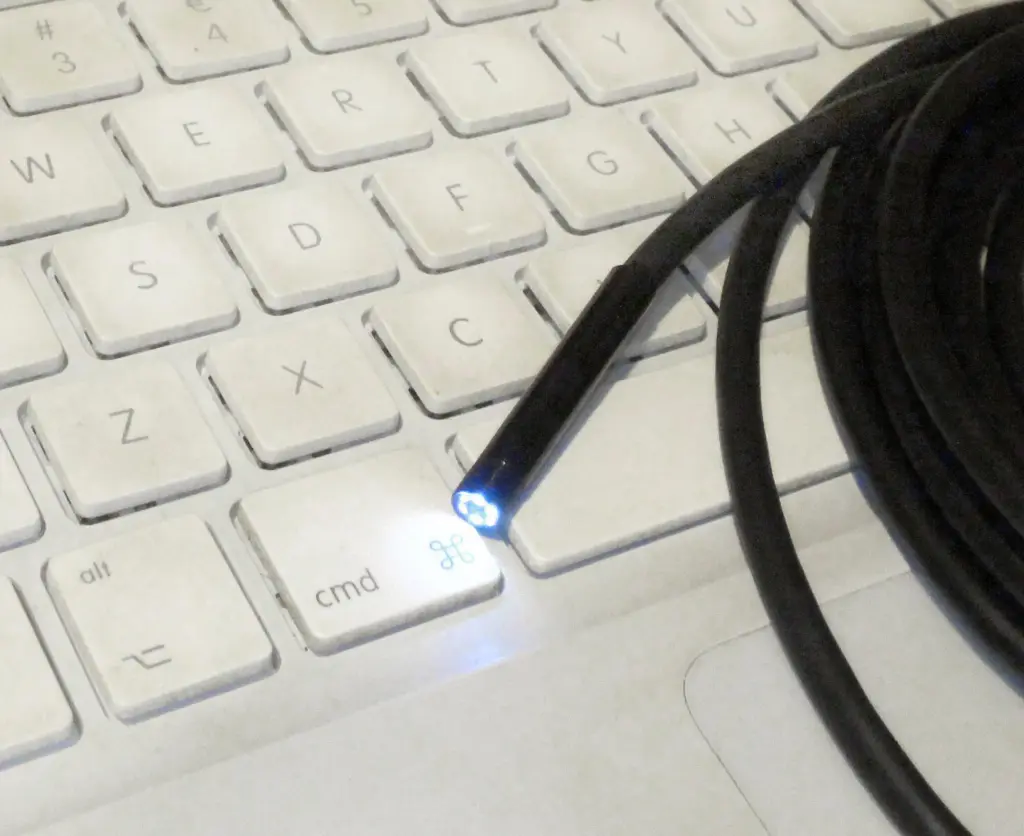
The sink trap is dripping, something is rustling in the cavity behind the pre-wall installation, and the mechanic wants to know what the combustion chamber looks like. For questions like these, an endoscope camera with a 1.5-meter probe, a head of around 8 millimeters and a sealed cable is enough, for example the Bosch GIC 12V-4-23 C. An articulating head is only worth the money if you need to look around corners that the hose alone cannot manage.
Measure the hole first, then choose the camera
The head diameter decides where the camera fits in the first place. A 17-millimeter head like the one on the Ridgid micro CA-350x goes into drain pipes and ventilation ducts, but not through a 10 mm hole in a drywall partition. For that, you need a head under 10 millimeters. For both of its current devices, Bosch also offers an interchangeable cable with a 3.9-millimeter head.
When it comes to probe length, more is not automatically better. Every extra meter of hose has to be stored, cleaned and pushed through tight bends. For the engine bay, furniture and suspended ceilings, 1 to 1.5 meters is enough. Working with extensions, which Ridgid offers up to 9 meters, only becomes interesting for downpipes, underground drain lines or long cable ducts.
Then there is focus. Each of these cameras is only sharp within a narrow range: between 3 and 8 centimeters for Bosch, between 3 and 7 centimeters for Laserliner, and between 1.5 and 10 centimeters for the Teslong TD500. If you want to read a rating plate behind a pipe, you have to get close. A head that is too thick for the gap is of little use then.
Display, app or both?
A built-in display has one simple advantage: your phone stays in your pocket and does not get wet. Wi-Fi models such as the Teslong TD500 or the Ridgid micro CA-350x also send the image to an app, which is handy when working overhead or for sharing with the plumber. Ridgid specifies a wireless range of up to 9 meters.
Every app wants permissions. For connected cameras, the German Federal Office for Information Security (BSI) advises switching off permissions you do not need, such as microphone or location, and installing security updates promptly. The Verbraucherzentrale, Germany’s consumer advice center, recommends allowing access only while the app is in use and turning off location sharing when it serves no purpose. An endoscope app needs neither your contacts nor your whereabouts to do its job.
Waterproof means the probe, not the device
For all devices with a sealed probe mentioned here, IP67 or IP68 on the box only applies to the camera head and cable. Bosch specifies IP54 for the handheld unit, meaning protection against dust and splashing water. Ridgid states that the head and cable of the micro CA-350 are sealed to a depth of 3 meters; the handheld unit must not be submerged. Laserliner writes in its manual that the display unit must not go in water and that the camera head is neither acid-resistant nor fireproof. The Teslong TD500 is a different story. Its user manual describes the device as not waterproof and limits the temperature at the probe to 70 degrees. That makes it the wrong camera for a sink trap.
Two warnings appear in the manuals of Laserliner, Ridgid and Teslong alike. The camera must never go anywhere that could be live. Ridgid and Laserliner require you to de-energize the area first and secure it against being switched back on, and Teslong points out that the metal parts of the probe are conductive. And none of these devices is approved for medical purposes or for examining people or animals. Where cables run inside the wall, a detector for wires and studs helps before you drill.
Six endoscope cameras and their key specs
| Model | Head, probe | Image, display | Probe protection | Best for |
|---|---|---|---|---|
| Bosch GIC 12V-4-23 C | 8.3 mm, 1.5 m, interchangeable cable | 4.3 inches, 800 × 480 | IP67, device IP54 | Home, car, plumbing |
| Bosch GIC 12V-5-27 C | 8.3 mm, 1.5 m, interchangeable cable | 5 inches, 1280 × 720, AutoUp | IP67, device IP54 | Tradespeople who must document their work |
| Laserliner VideoScope One | 9 mm, 1.5 m | 2.7 inches, camera 320 × 240 | IP68 | Occasional look into cavities |
| Laserliner VideoScope XL | 9 mm, 3.5 m | Camera 640 × 480, photos as JPEG | IP68 | Longer pipes and shafts |
| Teslong TD500 | up to 8.5 mm, 1.55 m, head articulates up to 210° | 5 inches, Wi-Fi to app | not waterproof | Engines, gearboxes, dry cavities |
| Ridgid micro CA-350x | 17 mm, 90 cm, expandable to 9 m | 3.5 inches, recordings 640 × 480, Wi-Fi | sealed to 3 m depth | Plumbers, pipes and ducts |
All figures based on manufacturer specifications, data sheets and user manuals.
Bosch GIC 12V-4-23 C
An 8.3-millimeter head on a 1.5-meter cable, a 75-degree field of view and a 4.3-inch display with 800 × 480 pixels. Bosch allows the cable to be submerged for up to 30 minutes in salt water, diesel, gasoline, engine oil, ethanol or AdBlue. Photos and videos go to the computer via USB-C. The camera runs on four AA batteries via an adapter or on a battery from the Bosch 12-volt system, which we cover in our guide to cordless battery systems. The thin 3.9-millimeter cable also fits, but according to Bosch it does not rotate the image automatically.
Bosch GIC 12V-5-27 C
Same head, same cable, bigger screen. The 5-inch display has a resolution of 1280 × 720 pixels, and the AutoUp function keeps the image upright no matter how the head turns in the pipe. A 32 GB microSD card is included. If you need to record damage for customers or the insurance company, this one gives you the clearer picture.
For the occasional search for a ring lost down the drain, the smaller model is enough.
Laserliner VideoScope One
The simplest device on this list. The camera has a resolution of 320 × 240 pixels. That is enough for rough questions, such as whether something is lying in a cavity or a cable is hanging loose. For fine hairline cracks, it is borderline. Laserliner specifies a sealed camera head rated IP68, resistance to gasoline and diesel, and about four hours of operation on four AA batteries. An RCA output lets you send the image to an external monitor.
Laserliner VideoScope XL
More than twice as much hose: 3.5 meters. On top of that, double the camera resolution at 640 × 480 pixels, and photos are saved as JPEG. As on the smaller model, the head measures 9 millimeters and is protected to IP68. A sensible choice for basement drainage and long empty conduits, as long as you can manage with the flexible hose and no articulation.
Teslong TD500
Here the head moves. According to the manual, a wheel on the handle swivels it up to 210 degrees in two directions, and Teslong names engines, combustion chambers and exhaust manifolds as typical applications. It comes with a 5-inch display, a 3000 mAh battery good for about six hours, and Wi-Fi to the Smart Endoscope app. The manual warns to set the wheel back to zero before pulling the probe out and not to bend the hose tighter than a circle. The probe cannot handle water.
Ridgid micro CA-350x
A tool for plumbing businesses. The 17-millimeter aluminum head has four dimmable LEDs, the cable can be extended from 90 centimeters to 9 meters, and the camera connects to Ridgid’s pipe inspection systems. It saves recordings as JPG and MP4 at 640 × 480, and you can add commentary via a Bluetooth headset. According to the Ridgid manual, the cable handles bends down to a 127-millimeter radius. For a hobby workshop in the basement, this is far too much device.
Which camera for which job?
For home and car use with occasional contact with water, we would go for the Bosch GIC 12V-4-23 C: sealed head, approval for fuels and oil, and a thinner cable as an option. If you document damage and show it to customers, take the GIC 12V-5-27 C with the sharper display. For long pipes and shafts, the VideoScope XL is enough. The VideoScope One is meant for a quick look behind a panel.
An articulating head like the one on the Teslong TD500 makes it an engine camera. It has no business in a drain.
The Ridgid micro CA-350x is aimed at businesses that inspect pipes professionally and already have Ridgid equipment in the van.
Found a damp spot but not sure where it comes from? A thermal imaging camera can show whether a warm heating pipe or a cold exterior wall is behind it.
Frequently asked questions
Which head diameter fits through a drilled hole?
For a 10 mm hole in a drywall partition, you need a head under 10 millimeters. A 17-millimeter head like the one on the Ridgid micro CA-350x goes into drain pipes and ventilation ducts, but not into that hole. Bosch also offers an interchangeable cable with a 3.9-millimeter head.
How long should the probe of an endoscope camera be?
For the engine bay, furniture and suspended ceilings, 1 to 1.5 meters is enough. Every extra meter of hose has to be stored, cleaned and pushed through tight bends. Extensions, which Ridgid offers up to 9 meters, only become interesting for downpipes, underground drain lines or long cable ducts.
Is an endoscope camera rated IP67 completely waterproof?
No. For the devices in this comparison, the rating only applies to the camera head and cable. Bosch specifies IP54 for the handheld unit, and Laserliner and Ridgid prohibit submerging the display unit. According to its manual, the Teslong TD500 is not waterproof at all, which makes it the wrong camera for a sink trap.
Endoscope camera with a display or with an app?
A built-in display keeps your phone dry in your pocket. Wi-Fi models such as the Teslong TD500 or the Ridgid micro CA-350x also send the image to an app, which is handy for overhead work or for sharing. According to the German Federal Office for Information Security (BSI), you should switch off app permissions you do not need, such as microphone or location.
What should you watch out for near power lines?
The camera must never go anywhere that could be live. Ridgid and Laserliner require you to de-energize the area first and secure it against being switched back on. Teslong points out that the metal parts of the probe are conductive.
Sources
- Bosch Professional: GIC 12V-4-23 C, technical data
- Bosch Professional: GIC 12V-5-27 C, technical data
- Bosch Professional: GIC 4/5 camera cable, 3.9 mm
- Laserliner: VideoScope One, user manual
- Laserliner: VideoScope XL, user manual
- Laserliner: VideoScope XL, product page
- Teslong: TD500, user manual
- Ridgid: micro CA-350x, data sheet
- Ridgid: micro CA-350, user manual
- BSI (German Federal Office for Information Security): Using smart cameras safely
- Verbraucherzentrale (German consumer advice center): Apps and data protection
Where to buy
- Bosch GIC 12V-4-23 CCheck price at Amazon.deCheck price at Amazon.co.ukCheck price at Amazon.nlCheck price at Amazon.com.beCheck price at Amazon.frCheck price at Amazon.itCheck price at Amazon.esCheck price at Amazon.plCheck price at Amazon.seAvailable in Germany: Amazon.de
- Bosch GIC 12V-5-27 CCheck price at Amazon.deCheck price at Amazon.co.ukCheck price at Amazon.nlCheck price at Amazon.com.beCheck price at Amazon.frCheck price at Amazon.itCheck price at Amazon.esCheck price at Amazon.plCheck price at Amazon.seAvailable in Germany: Amazon.de
- Laserliner VideoScope OneCheck price at Amazon.deCheck price at Amazon.co.ukCheck price at Amazon.nlCheck price at Amazon.com.beCheck price at Amazon.frCheck price at Amazon.itCheck price at Amazon.esCheck price at Amazon.plCheck price at Amazon.seAvailable in Germany: Amazon.de
- Laserliner VideoScope XLCheck price at Amazon.deCheck price at Amazon.co.ukCheck price at Amazon.nlCheck price at Amazon.com.beCheck price at Amazon.frCheck price at Amazon.itCheck price at Amazon.esCheck price at Amazon.plCheck price at Amazon.seAvailable in Germany: Amazon.de
- Teslong TD500Check price at Amazon.deCheck price at Amazon.co.ukCheck price at Amazon.nlCheck price at Amazon.com.beCheck price at Amazon.frCheck price at Amazon.itCheck price at Amazon.esCheck price at Amazon.plCheck price at Amazon.seAvailable in Germany: Amazon.de
- Ridgid micro CA-350xCheck price at Amazon.deCheck price at Amazon.co.ukCheck price at Amazon.nlCheck price at Amazon.com.beCheck price at Amazon.frCheck price at Amazon.itCheck price at Amazon.esCheck price at Amazon.plCheck price at Amazon.seAvailable in Germany: Amazon.de