Contents13 sections
This guide was first published in German on handgetestet.de.
What do the extra bills between the 300- and the 500-euro class actually buy you? Mainly milk that froths itself. You do not automatically get better espresso. If you drink cappuccino every day and share the machine between two or three people, we consider the Krups Evidence EA897B the most sensible purchase among the machines compared here: two milk drinks at once, a 2.3-liter tank and an automatic cleaning program for the milk system. If you do not want a hose in the house, go for the Philips LatteGo 3300 EP3347/90. How the classes compare overall is covered in our guide to fully automatic coffee machines (in German); that is also where you will find the De’Longhi Magnifica Evo, which we will not go over again here. Where the Magnifica Evo stands next to Jura’s entry-level machines is shown in the guide DeLonghi or Jura (in German).
What the extra money really pays for
Stiftung Warentest, the German consumer testing organization, writes that basic machines without a milk system are often every bit as good at espresso as more expensive models. At the same time, it lists good machines with an automatic milk frother for less than half the price of the expensive models in its database. That is exactly where this price range sits. You are paying for convenience.
Here is how the math works. With two milk drinks a day, you get 3,650 cups over five years; that is our assumption. Every 100 euros of extra cost then works out to about 2.7 cents per cup. In return, you no longer froth by hand. If you only drink a cappuccino on Sundays, you get to 260 cups and pay almost 40 cents per cup for every 100 euros. In that case, a cheaper machine plus a milk frother (in German) is the more sober calculation.
First fork in the road: how should the milk get into the glass?
This question matters more than any drink count, because it determines the daily work. In this class, you will come across three approaches.
Krups includes a milk hose with the Evidence and specifies an automatic cleaning program for the milk system. You do little cleaning by hand, but you have to give the program time and keep buying cleaning tablets. With LatteGo, Philips takes the opposite route: two parts, no hose, straight into the dishwasher or under the tap. There is explicitly no automatic cleaning. Siemens sits in between with a removable, dishwasher-safe milk frother; the manufacturer sells an insulated milk container as an accessory.
The Melitta Avanza is a special case. Its Easy Cappuccinatore does froth the connected milk on its own, but you then dispense the coffee in a second step. Melitta lists only espresso and café crème at the touch of a button.
Second fork in the road: how many cups, how many tastes?
For the tank, a rough estimate of 150 milliliters per cup helps: 2.3 liters works out to just over 15 cups, 1.8 liters to twelve, 1.4 liters to nine. Rinse cycles still come off that. Four people with two cups each will therefore be at the tap almost every day with the Siemens.
In the morning, speed counts too. According to Krups, the Evidence makes two cappuccinos in one go. The Philips 5500, on the other hand, stores four profiles plus a guest, which the 3300 cannot do. If two people in your household disagree about strength and milk ratio, profiles are worth more than a two-cup function. Otherwise, they are not.
Third fork in the road: does the machine fit in your kitchen?
According to its data sheet, the Siemens EQ300 is 38.3 centimeters high, 25.1 wide and 43.3 deep; the Philips machines measure 37.1, 24.6 and 43.3 centimeters in the same order. The Melitta Avanza is narrower: 20 centimeters wide and 46 centimeters deep. It can still get tight under wall cabinets, because you top up the beans from above.
And measure your glasses. According to the manufacturer, a maximum of 13 centimeters fits under the Siemens, while Krups states 15.8 centimeters for the Evidence. Tall latte glasses stand or fall by figures like these.
Five machines in this class compared
| Model | Milk system | Drinks | Tank / beans | Best for |
|---|---|---|---|---|
| Krups Evidence EA897B | Hose, automatic cleaning | 8 | 2.3 l / 260 g | Households with several cappuccinos a day |
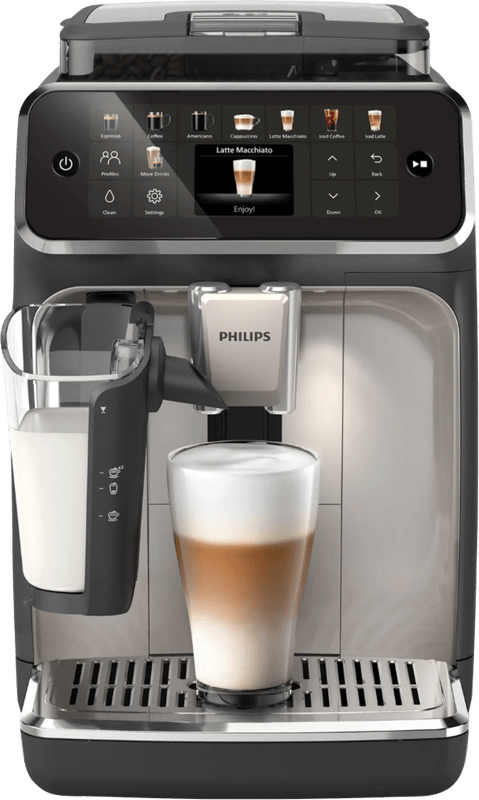
| Philips LatteGo 3300 EP3347/90 | LatteGo, 2 parts, no hose | 6 | 1.8 l / 275 g | If you would rather rinse than wait for programs |
| Philips LatteGo 5500 EP5547/90 | LatteGo, 2 parts, no hose | 20 | 1.8 l / 275 g | Several drinkers with their own preferences |
| Siemens EQ300 TF303E07 | Milk frother, dishwasher-safe | 5 | 1.4 l / 250 g | Small household, simple operation |
| Melitta Avanza | Easy Cappuccinatore | 2 at the touch of a button | 1.5 l / 250 g | Narrow footprint, quiet grinder |
Krups Evidence EA897B
Eight drinks including hot water, three of them with milk. Five grind settings and a stainless steel conical grinder; it is operated with buttons, and favorites can be saved. Krups cites a 62 percent share of recycled plastic and a TÜV Rheinland certificate for microbiological safety. Drawbacks: ground coffee is not supported, user profiles are missing, and the hose remains a part that has to be kept clean. It is currently discounted in the Krups online store. Without a promotion, the recommended retail price sits right at the 500-euro limit.
Philips LatteGo 3300 EP3347/90
The sober choice for anyone against hoses. Twelve grind settings, a ceramic grinder, six drinks including iced coffee, and an AquaClean filter is included. By Philips‘ numbers, one filter lasts 625 cups, because the manufacturer bases its figure of up to 5,000 cups without descaling on eight filter changes. There are no profiles. We cover the series in more detail in the general guide.
Philips LatteGo 5500 EP5547/90
In the Philips online store, it sits exactly at the limit, with the recommended retail price well above it. That does not always apply to retailer prices. In return, you get 20 drinks, four profiles plus a guest and QuickStart for a shorter heat-up time; according to Philips, it is 40 percent quieter thanks to SilentBrew. The milk system is the same as on the 3300. Watch out for the color: the white EP5543/90 costs noticeably more than the black one in the same store.
Siemens EQ300 TF303E07
Five direct-select buttons and a simple display. Espresso, caffè crema, cappuccino and latte macchiato each come at the touch of a button, and frothed milk can be selected on its own. The brewing unit is removable, the drip tray and grounds container can go in the dishwasher, and the ceramic grinder has several settings. At 1.4 liters, however, the tank is the smallest here. It is enough for two people; for four, it becomes a nuisance.
Melitta Avanza
The narrowest machine in this comparison, at 20 centimeters wide. Melitta lists a quiet grinder, hot water and five grind settings. According to the data sheet, descaling once a year is enough, but you should check the conditions for that in the manual. With one-touch milk, the equally wide Latticia OT is priced above the 500-euro limit in the Melitta online store.
How we rank the five
- Several cappuccinos a day, two or more people: Krups Evidence EA897B.
- Milk drinks yes, hose no: Philips LatteGo 3300 EP3347/90.
- Different tastes and quiet operation: Philips LatteGo 5500 EP5547/90, as long as it stays within budget.
- Two people who do not want menus: Siemens EQ300.
- A narrow nook and mostly black coffee: Melitta Avanza.
One piece of contrary advice remains. If you drink almost nothing but espresso, you are paying here for milk technology that will hardly ever run. And if you enjoy the craft, take a look at the portafilter espresso machine. And if your tap water is hard, the guide to the water filter (in German) explains whether a cartridge does any good at all.
What to look for in an offer
The model number matters more than the series name. Siemens sells the EQ300 in several versions at different prices, and with Philips the price even depends on the color. So never compare „the 3300“ with „the Evidence,“ but the full model numbers. And check what is included. Depending on the machine, the filter, milk container and cleaning tablets may be missing.
Frequently asked questions
What does the extra money get you compared with basic fully automatic machines?
Above all, convenience when frothing milk. According to Stiftung Warentest, basic machines without a milk system are often every bit as good at espresso as more expensive models. If you drink two milk drinks a day, the price difference is spread over 3,650 cups in five years. If it is just one cup on Sundays, a cheaper machine with a milk frother makes more sense.
Milk hose or LatteGo: which is easier to clean?
Krups specifies an automatic cleaning program for the Evidence's hose; it takes time and cleaning tablets. Philips LatteGo consists of two parts without a hose that go into the dishwasher or under the tap. It explicitly has no automatic cleaning.
How large should the water tank be?
At 150 milliliters per cup, 2.3 liters works out to just over 15 cups, 1.8 liters to twelve and 1.4 liters to nine, before rinse cycles. Four people with two cups each will therefore be refilling the 1.4-liter Siemens EQ300 almost every day.
Which fully automatic coffee machine suits several people with their own preferences?
The Philips LatteGo 5500 EP5547/90 stores four profiles plus a guest and offers 20 drinks. If two people disagree about strength and milk ratio, profiles are worth more than a two-cup function. According to Philips, it is 40 percent quieter thanks to SilentBrew.
Do tall latte glasses fit under the spout?
That varies considerably. According to the manufacturer, a maximum of 13 centimeters fits under the Siemens EQ300, while Krups states 15.8 centimeters for the Evidence. Measure your glasses before buying; tall latte glasses stand or fall by figures like these.
What should you look for when comparing offers?
The full model number rather than the series name. Siemens sells the EQ300 in several versions, and with Philips the price even depends on the color. Also check what is included: depending on the machine, the filter, milk container and cleaning tablets may be missing.
Sources
- Krups: Evidence EA897B
- Philips: LatteGo 3300 EP3347/90
- Philips: LatteGo 5500 EP5543/90
- Philips: fully automatic coffee machines, product range
- Siemens: EQ300 TF303E07 data sheet
- Siemens: EQ300, product range
- Melitta: Avanza
- Melitta: Latticia OT
- Stiftung Warentest: fully automatic coffee machines tested (freely accessible part)
Where to buy
- Krups Evidence EA897BCheck price at Amazon.deCheck price at Amazon.co.ukCheck price at Amazon.nlCheck price at Amazon.com.beCheck price at Amazon.frCheck price at Amazon.itCheck price at Amazon.esCheck price at Amazon.plCheck price at Amazon.seAvailable in Germany: Amazon.de
- Philips LatteGo 3300 EP3347/90Check price at Amazon.deCheck price at Amazon.co.ukCheck price at Amazon.nlCheck price at Amazon.com.beCheck price at Amazon.frCheck price at Amazon.itCheck price at Amazon.esCheck price at Amazon.plCheck price at Amazon.seAvailable in Germany: Amazon.de
- Philips LatteGo 5500 EP5547/90View at CoolblueAvailable in Germany: CoolblueCheck price at Amazon.deCheck price at Amazon.co.ukCheck price at Amazon.nlCheck price at Amazon.com.beCheck price at Amazon.frCheck price at Amazon.itCheck price at Amazon.esCheck price at Amazon.plCheck price at Amazon.seAvailable in Germany: Amazon.de
- Siemens EQ300 TF303E07View at CoolblueAvailable in Germany: CoolblueCheck price at Amazon.deCheck price at Amazon.co.ukCheck price at Amazon.nlCheck price at Amazon.com.beCheck price at Amazon.frCheck price at Amazon.itCheck price at Amazon.esCheck price at Amazon.plCheck price at Amazon.seAvailable in Germany: Amazon.de
- Melitta AvanzaCheck price at Amazon.deCheck price at Amazon.co.ukCheck price at Amazon.nlCheck price at Amazon.com.beCheck price at Amazon.frCheck price at Amazon.itCheck price at Amazon.esCheck price at Amazon.plCheck price at Amazon.seAvailable in Germany: Amazon.de