Contents12 sections
This guide was first published in German on handgetestet.de.
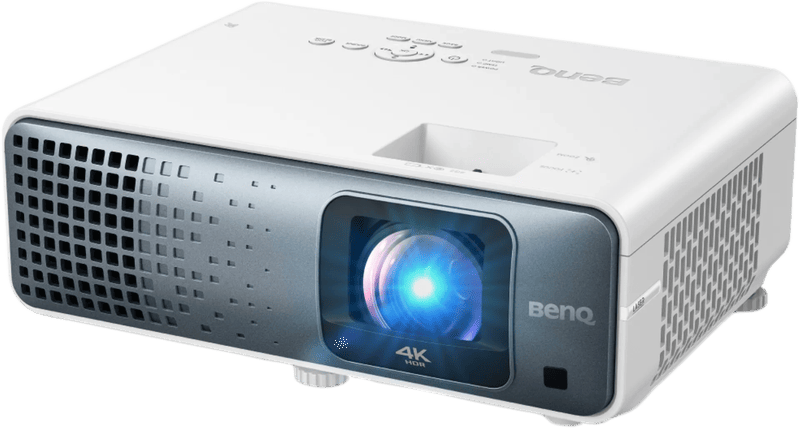
With a gaming projector, the first thing people look at is 4K and the lumen count. What decides how a game actually feels, though, is a third value that often sits in small print on the spec sheet: input lag. If the projector sits at the front of the living room on a sideboard, we recommend the BenQ TK710STi. It throws a 100-inch image from a good one and a half meters away and, according to BenQ, reaches 16.7 milliseconds in 4K at 60 Hz and 4.2 in Full HD at 240 Hz.
Sounds like a minor detail. It isn’t.
Milliseconds, hertz and what actually reaches the controller
Input lag measures how long the projector takes until an incoming frame appears on the wall. At 60 Hz, a single frame lasts 16.7 ms. A device with that value therefore lags about one frame behind the signal. In a racing game on a Sunday evening, that hardly matters. In a fast multiplayer shooter on the PC, it is a different story.
At 240 Hz, a frame shrinks to a little over 4 ms. That is exactly where BenQ and Optoma land, at 4.2 to 4.4 ms. But only in 1080p. If you read „4K and 240 Hz“ on the same product line, take it as either-or: both manufacturers explicitly specify 240 Hz for Full HD; in 4K it stays at 60 Hz and around 17 ms. BenQ even scales 2K signals at 120 Hz down to 1080p.
What does that mean in practice? For role-playing and racing games on a big image, 4K at 60 Hz is entirely enough. If you play competitively, switch the PC to 1080p at 240 Hz. That brings speed and visibly costs sharpness at 100 inches. You cannot have both at once with any of these devices.
How far from the wall does the projector need to be?
Whether a projector fits the room is decided long before the first game. The throw ratio on the spec sheet tells you the distance: ratio times image width. A 100-inch image in 16:9 format is about 2.21 m wide. A device with 1.4:1 therefore needs around 3.1 m, one with 0.5:1 only 1.1 m.
In a typical living room 4 m deep with the sofa against the back wall, that is the difference between „projector on the coffee table“ and „projector behind your head“. The design that sits right below the wall is called ultra short throw and has different strengths. It is covered in our guide to home theater projectors with laser and short throw (in German).
Not all lumens are equal
BenQ and Hisense state ANSI lumens, Epson measures to ISO 21118 and lists color and white brightness separately. Optoma simply writes lumens. The figures are therefore only roughly comparable. A difference of 3,200 versus 3,500 says little; one of 2,800 versus 3,600 says more.
The room matters more than the last hundred lumens. Light walls and daylight cost contrast, and the projection surface plays a part too. How to find the right one is explained in the projector screen guide. Then there is the light source. According to the spec sheets, laser lasts 20,000 to 30,000 hours. Lamps from Epson and Optoma are rated at 4,000 to 4,500 hours in bright mode and then have to be replaced.
Six gaming projectors side by side
| Model | Input lag according to the manufacturer | Brightness, light source | Distance for 100 inches (calculated) | Best for |
|---|---|---|---|---|
| BenQ TK710STi | 4.2 ms (1080p/240 Hz), 16.7 ms (4K/60 Hz) | 3,200 ANSI lumens, laser | approx. 1.5 to 1.8 m | small living room, projector at the front |
| BenQ TK710 | 4.2 ms (1080p/240 Hz), 16.7 ms (4K/60 Hz) | 3,200 ANSI lumens, laser | approx. 2.5 to 3.3 m | ceiling mount above the sofa |
| Optoma UHZ35 | 4.4 ms (1080p/240 Hz), 17 ms (4K/60 Hz) | 3,500 lumens, laser | approx. 3.1 to 5.0 m | large rooms, shelf at the back |
| Optoma UHD35STx | 4.2 ms (1080p/240 Hz), 16.9 ms (4K/60 Hz) | 3,600 lumens, lamp | approx. 1.1 m | very little space in front of the wall |
| Epson EH-TW6250 | under 20 ms | 2,800 lumens (ISO 21118), lamp | approx. 2.9 to 4.8 m | movie nights with the occasional game |
| Hisense C2 Ultra | not specified, up to 240 Hz | 3,000 ANSI lumens, RGB laser | approx. 2.0 to 3.3 m | changing rooms, Xbox |
We calculated the distances from the manufacturers‘ throw ratios. They apply to a 100-inch image without keystone correction.
BenQ TK710STi
Short throw, laser, 3,200 ANSI lumens and the full range of lag figures: 16.7 ms in 4K, 8.3 ms at 1080p with 120 Hz, 4.2 ms at 240 Hz. Two HDMI 2.0b inputs, one of them with eARC for the sound system. According to BenQ, an Android TV stick is included. At 1.2x, the zoom is tight, so the position should be settled before you start drilling.
BenQ TK710
Technically the twin, with the same lag and brightness figures, but a standard lens. The throw ratio of 1.15 to 1.5 and the 1.3x zoom suit a ceiling mount above or behind the sofa. A small vertical lens shift of 10 percent helps with alignment. For tight rooms, it is the wrong choice.
Optoma UHZ35
A lot of light from a small housing: 3,500 lumens, a service life of 30,000 hours according to Optoma, 4.4 ms at 1080p and 240 Hz. In return, it wants distance, at least a good three meters for 100 inches. In a long living room, that is an advantage, because the 1.6x zoom leaves room to play between 1.3 and 9.4 m. The second HDMI input supports eARC. At full load, Optoma states 35 dB.
Optoma UHD35STx
With 0.5:1, it needs only about 1.1 m for 100 inches. No other device in the comparison gets closer to the wall. Brightness and speed are right, at 3,600 lumens and 4.2 ms. It does, however, use a 240-watt lamp that Optoma rates at 4,000 hours in the brightest mode. If you play for several hours every day, you will be buying a replacement after a few years.
Epson EH-TW6250
Epson relies on 3LCD. Here, 4K is created by pixel shift, which Epson calls 4K PRO-UHD. For input lag, Epson specifies under 20 ms. In return, placement is flexible, with a 1.6x zoom and vertical lens shift of plus or minus 60 percent. Android TV is built in. In standard mode, Epson states 36 dB; the BenQ lasers come in at 31 dB. More of a home theater device that you can also game on.
Hisense C2 Ultra
A compact cube on a swiveling stand, with an RGB laser and 3,000 ANSI lumens. Hisense advertises 240 Hz, an automatic game mode and the „Designed for Xbox“ certification. The manufacturer does not give a millisecond figure for game mode online. If you want to compare numbers, you are better off with BenQ and Optoma. For anyone who points the projector at the ceiling sometimes in the living room and sometimes in the bedroom, though, the stand is a real reason to buy it. The 1.67x zoom and an image size of 65 to 300 inches also make it adaptable.
How we would decide
- Room up to about 4 m deep, projector sits at the front on a sideboard: BenQ TK710STi. Laser, fast figures, little distance needed.
- Hardly any space between wall and sofa: Optoma UHD35STx, if you accept changing the lamp.
- Long room, device is meant to go on a shelf at the back or on the ceiling: Optoma UHZ35 or BenQ TK710.
- Mostly movies, the occasional game on the console: Epson EH-TW6250. If you are still looking for the right console, our guide to game consoles can help.
- One device for several rooms and an Xbox: Hisense C2 Ultra, knowing that lag figures are missing.
Our advice before any purchase: take a folding rule, measure the distance from the lens to the wall, and divide the number by 2.21. The result is the throw ratio you need for 100 inches. Only then look at hertz and lumens.
What ambient light does to contrast and what a curtain achieves is covered in the guide to the projector in a bright living room.
If you want to place the projector directly in front of the wall on a lowboard, you will find wall distances and depth requirements in the guide to the laser TV.
Frequently asked questions
What input lag is good for gaming on a projector?
At 60 Hz, one frame lasts 16.7 ms, so a device with that value lags about one frame behind. That is enough for role-playing and racing games. If you play competitively, use 1080p at 240 Hz, where BenQ and Optoma come in at 4.2 to 4.4 ms.
Are there projectors with 4K and 240 Hz at the same time?
No, not among the devices in this comparison. BenQ and Optoma explicitly specify 240 Hz for Full HD; in 4K it stays at 60 Hz and around 17 ms. So when you see 4K and 240 Hz on the same product line, read it as either-or.
How far from the wall does a projector need to be for 100 inches?
Throw ratio times image width gives you the distance. A 100-inch image is about 2.21 m wide. A device with 1.4:1 therefore needs around 3.1 m, one with 0.5:1 only 1.1 m. Measure the distance from the lens to the wall before you buy.
Laser or lamp for a gaming projector?
According to the spec sheets, laser lasts 20,000 to 30,000 hours. Lamps from Epson and Optoma are rated at 4,000 to 4,500 hours in bright mode and then have to be replaced. If you play for several hours every day, you will be buying a replacement for a lamp model after a few years.
Are lumen ratings from different manufacturers comparable?
Only roughly. BenQ and Hisense state ANSI lumens, Epson measures to ISO 21118, and Optoma simply writes lumens. A difference of 3,200 versus 3,500 says little. The room matters more, because light walls and daylight cost contrast.
Sources
- BenQ: TK710STi specifications
- BenQ: TK710 specifications
- Optoma: UHZ35 data sheet (PDF)
- Optoma: UHD35STx data sheet (PDF)
- Epson: EH-TW6250
- ProjectorCentral: Hisense C2 Ultra, data sheet
- Notebookcheck: Hisense C2 Ultra market launch
Where to buy
- BenQ TK710STiView at CoolblueAvailable in Germany: CoolblueCheck price at Amazon.deCheck price at Amazon.co.ukCheck price at Amazon.nlCheck price at Amazon.com.beCheck price at Amazon.frCheck price at Amazon.itCheck price at Amazon.esCheck price at Amazon.plCheck price at Amazon.seAvailable in Germany: Amazon.de
- BenQ TK710Check price at Amazon.deCheck price at Amazon.co.ukCheck price at Amazon.nlCheck price at Amazon.com.beCheck price at Amazon.frCheck price at Amazon.itCheck price at Amazon.esCheck price at Amazon.plCheck price at Amazon.seAvailable in Germany: Amazon.de
- Optoma UHZ35Check price at Amazon.deCheck price at Amazon.co.ukCheck price at Amazon.nlCheck price at Amazon.com.beCheck price at Amazon.frCheck price at Amazon.itCheck price at Amazon.esCheck price at Amazon.plCheck price at Amazon.seAvailable in Germany: Amazon.de
- Optoma UHD35STxCheck price at Amazon.deCheck price at Amazon.co.ukCheck price at Amazon.nlCheck price at Amazon.com.beCheck price at Amazon.frCheck price at Amazon.itCheck price at Amazon.esCheck price at Amazon.plCheck price at Amazon.seAvailable in Germany: Amazon.de
- Epson EH-TW6250Check price at Amazon.deCheck price at Amazon.co.ukCheck price at Amazon.nlCheck price at Amazon.com.beCheck price at Amazon.frCheck price at Amazon.itCheck price at Amazon.esCheck price at Amazon.plCheck price at Amazon.seAvailable in Germany: Amazon.de
- Hisense C2 UltraView at CoolblueAvailable in Germany: CoolblueCheck price at Amazon.deCheck price at Amazon.co.ukCheck price at Amazon.nlCheck price at Amazon.com.beCheck price at Amazon.frCheck price at Amazon.itCheck price at Amazon.esCheck price at Amazon.plCheck price at Amazon.seAvailable in Germany: Amazon.de