Contents12 sections
This guide was first published in German on handgetestet.de.
People rarely buy a grain mill for the motor. They buy it because they want to pour spelt into the hopper in the morning and start a dough with fresh whole grain flour ten minutes later. If you bake regularly, a standalone mill with 360 watts and a millstone of around 100 mm, such as the hawos Novum, serves you well. The grain mill attachment for a stand mixer is a solution for people who only mill occasionally and in small amounts.
The reason comes down to three numbers: the diameter of the stones, grams per minute and the clearance under the outlet. Everything else is a matter of taste, wood or plastic.
What actually happens in the grinding mechanism
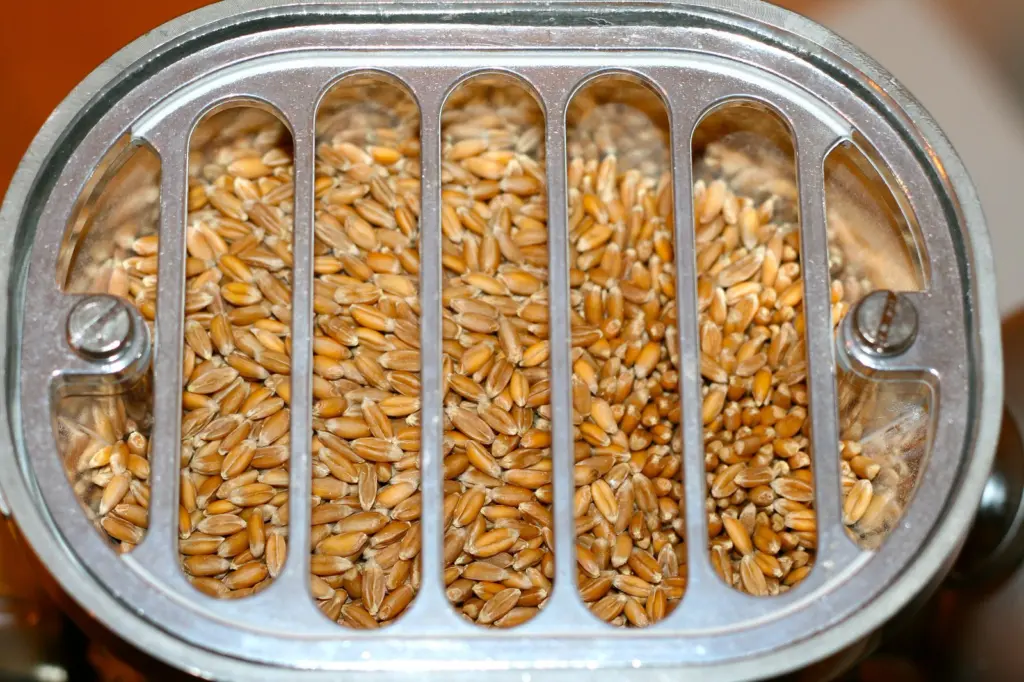
All the mills in this comparison grind with two stones made of corundum ceramic. With hawos, the upper stone is fixed and the lower one rotates. The grain falls through an opening in the upper stone and is ground between the two. The distance between the stones determines the grind setting. hawos adjusts it with a lever, continuously from 1 to 9; on the Mockmill attachment, a dial does the job.
How much difference the stone makes becomes clear within a single brand. The hawos Easy has 70 mm stones and, according to the manufacturer, delivers about 100 g of fine wheat flour per minute, while the Novum with 100 mm reaches about 125 g with the same motor power. That does not sound like much of a difference. For a kilo of flour for two loaves, it is two minutes.
It only becomes really noticeable with a more powerful motor. hawos rates the 600-watt Queen 2 at around 220 g per minute, a good deal more than double. You need that if you bake for a family every week or prepare cracked grain for fresh grain porridge in larger quantities. For one loaf on Saturday, it is a luxury.
What can go into the hopper and what cannot
A look at the user manuals saves you from the most annoying mistake: clogged stones. Both manufacturers call for clean, dry grain and describe the same test: crush a kernel on a hard surface with a spoon. If it cracks loudly, it is dry enough. If it can be pressed flat like an oat flake, it is too moist. Mockmill also advises letting rye rest for at least six months after harvest before it goes into the mill.
With oilseeds, the advice differs. hawos allows flaxseed if you mix it 1:1 with wheat, because oily material would otherwise gum up the millstones. For the Mockmill attachment, by contrast, the manufacturer is clear: no nuts, no sesame, no flax, no poppy seeds. According to the manual, coffee beans can also leave a film on the stones. Both grind corn. hawos explicitly calls for field corn meant for cooking, and Mockmill rules out popcorn corn.
If it happens anyway, the same remedy works for both: run a handful of dry brown rice or wheat through on a coarse setting. Water has no place in the grinding chamber. For cleaning, hawos recommends a vacuum cleaner, with the mill running on a coarse setting.
Fresh flour does not keep forever
The German Nutrition Society (DGE) recommends eating at least a third of your grain products as whole grain. According to the DGE, whole grain keeps you full longer and contains more vitamins and minerals than white flour products, because the bran and germ are retained. Yet it is precisely these parts that make the flour perishable. The German consumer advice center (Verbraucherzentrale) gives a shelf life of two to four weeks for home-milled whole grain flour, compared with about a year for whole kernels, in each case stored dry at 15 to 20 degrees Celsius.
That leads to a simple rule. Store kernels, not flour. Mill what you will bake today.
Six mills, compared soberly
| Model | Motor and millstone | Fine flour per minute (wheat) | Hopper (wheat) | Best for |
|---|---|---|---|---|
| hawos Novum | 360 W, corundum ceramic, Ø 100 mm | approx. 125 g | approx. 600 g | Regular baking, limited space |
| hawos Easy | 360 W, corundum ceramic, Ø 70 mm | approx. 100 g | approx. 560 g | Narrow countertop, wooden housing |
| hawos Queen 2 | 600 W, corundum ceramic, Ø 100 mm | approx. 220 g | approx. 1,500 g | Large quantities, families |
| Mockmill 100 | 360 W, corundum ceramic | approx. 100 g | approx. 1,100 g | Entry level with a large hopper |
| Mockmill Lino 200 | 600 W, corundum ceramic, Ø 90 mm | approx. 200 g | approx. 1.3 kg | Lots of flour, wooden housing |
| Mockmill grain mill attachment for stand mixers | Driven by the stand mixer, corundum ceramic | approx. 60–70 g | approx. 600 g | KitchenAid owners, small amounts |
All figures according to the manufacturers. With rye, oats or spelt, the output varies depending on moisture and grind setting.
hawos Novum
The Novum combines the large 100 mm stone with a compact housing made of Makrolon, that is, plastic. According to the manufacturer, a bowl up to 16 cm tall fits under the outlet, and hawos puts the noise level at about 72 dB. The hopper holds around 600 g, enough for one large loaf. Warranty: ten years for private use. If you want to see wood in your kitchen, this one will not make you happy. Technically, it is the most balanced choice in this list.
hawos Easy
With a footprint of 15 by 15 cm, the Easy is the narrowest mill here. The housing is made of beech multiplex (plywood) finished with linseed oil varnish, and according to hawos the grinding chamber contains no plastic at all. The smaller 70 mm stone costs some speed, and at 560 g the hopper is on the small side. For singles and couples, that works.
hawos Queen 2
The Queen comes with 360 or 600 watts; here we mean the more powerful version. The hopper takes 1.5 kg, the housing is beech multiplex, and it weighs 11.5 kg. The 17 cm clearance under the outlet is practical, since even a tall mixing bowl fits underneath. According to the manufacturer, an overcurrent switch stops the motor after about 20 seconds if a foreign object blocks the stones. If you only bake once a month, you are putting reserves on your counter that you will never need. If you bake two loaves a week, you will notice the difference.
Mockmill 100
The Mockmill 100 delivers about as much as the hawos Easy but has a considerably larger hopper of about 1.1 kg. The housing is plastic, the stones are corundum ceramic, and it weighs around 6 kg. The manufacturer does not give a stone diameter for this model. According to Mockmill, it is designed for normal household quantities, not commercial use.
Mockmill Lino 200
Mock’s counterpart to the Queen 2: 600 watts, 90 mm stones, about 200 g of very fine wheat flour per minute. The housing combines wood with a mineral composite. If you are looking for a powerful mill anyway and like the design, this is a real alternative. At around 38 cm tall, it is lower than the Queen 2, which reaches 45 cm.
Mockmill grain mill attachment for stand mixers
Here the power comes from the stand mixer. The attachment sits on the accessory hub, and the flour trickles down a chute straight into the mixing bowl. According to the manufacturer, it fits stand mixers from KitchenAid, AEG and Electrolux, but not the KitchenAid Artisan Mini. The stones turn at only about 220 revolutions per minute.
That affects speed. Mockmill gives about 60 to 70 g per minute, and that is on the machine’s highest speed. For 500 g of flour, that means seven to a little over eight minutes of running time. According to the manual, you should not mill more than about 2.3 kg in one go; after that, the stand mixer needs a 45-minute break. If your KitchenAid already sits on the countertop and you only mill fresh flour every few weeks, this saves you a second appliance. For daily milling, we recommend a dedicated mill. More on choosing the machine itself is in our stand mixer guide.
How we would decide
- You bake every week and want a mill that simply sits there and runs: hawos Novum.
- The countertop is narrow, the housing should be wood, and you bake for two: hawos Easy.
- Large family, lots of flour for the day’s dough, alternating between cracked grain and flour: hawos Queen 2 or Mockmill Lino 200.
- A large hopper matters more than the last gram of speed: Mockmill 100.
- A KitchenAid is already there, and you mill rarely and in small portions: the Mockmill attachment.
The mill is only the first step. What helps on the countertop after that, from the proofing basket to the dough scraper, is in our bread baking accessories guide. And if you would rather leave the dough to a machine, you can also use the fresh flour in a bread maker (in German).
Frequently asked questions
How much flour does a grain mill produce per minute?
According to hawos, the Easy with 70 mm stones delivers about 100 g of fine wheat flour per minute, and the Novum with 100 mm about 125 g. The 600-watt Queen 2 reaches around 220 g. With rye, oats or spelt, the output varies depending on moisture and grind setting.
Is the grain mill attachment for the KitchenAid worth it?
For occasional milling in small portions, it saves you a second appliance. Mockmill gives about 60 to 70 g per minute on the highest speed, so seven to a little over eight minutes for 500 g of flour. After about 2.3 kg, the stand mixer needs a 45-minute break. For daily milling, the guide recommends a dedicated mill.
How can I tell whether the grain is dry enough?
Both manufacturers describe the same test: crush a kernel on a hard surface with a spoon. If it cracks loudly, it is dry enough. If it can be pressed flat like an oat flake, it is too moist and will clog the stones.
Can I grind flaxseed or nuts in a grain mill?
This is where the advice differs. hawos allows flaxseed mixed 1:1 with wheat, because oily material would otherwise gum up the millstones. For the Mockmill attachment, the manufacturer rules out nuts, sesame, flax and poppy seeds. Both grind corn, but only field corn meant for cooking.
What should you do if the millstones are clogged?
Run a handful of dry brown rice or wheat through on a coarse setting. Water has no place in the grinding chamber. For cleaning, hawos recommends a vacuum cleaner, with the mill running on a coarse setting.
How long does home-milled whole grain flour keep?
The German consumer advice center (Verbraucherzentrale) gives two to four weeks, compared with about a year for whole kernels, in each case stored dry at 15 to 20 degrees Celsius. That leads to a simple rule: store kernels, not flour, and only mill what you will bake today.
Sources
- hawos: Novum, technical data
- hawos: Easy, technical data
- hawos: Queen 1 and 2, technical data
- hawos: User manual Billy, Queen, Mühle (PDF)
- Mockmill: Mockmill 100
- Mockmill: Lino 200
- Mockmill: Grain mill attachment for stand mixers
- Mockmill: Attachment user manual (PDF, English)
- German Nutrition Society (DGE): Grains, grain products and potatoes
- Verbraucherzentrale: Shelf life and storage of dry foods
Where to buy
- hawos Novum (N004, blau)Check price at Amazon.deCheck price at Amazon.co.ukCheck price at Amazon.nlCheck price at Amazon.com.beCheck price at Amazon.frCheck price at Amazon.itCheck price at Amazon.esCheck price at Amazon.plCheck price at Amazon.seAvailable in Germany: Amazon.de
- hawos EasyCheck price at Amazon.deCheck price at Amazon.co.ukCheck price at Amazon.nlCheck price at Amazon.com.beCheck price at Amazon.frCheck price at Amazon.itCheck price at Amazon.esCheck price at Amazon.plCheck price at Amazon.seAvailable in Germany: Amazon.de
- hawos Queen 2Check price at Amazon.deCheck price at Amazon.co.ukCheck price at Amazon.nlCheck price at Amazon.com.beCheck price at Amazon.frCheck price at Amazon.itCheck price at Amazon.esCheck price at Amazon.plCheck price at Amazon.seAvailable in Germany: Amazon.de
- Mockmill 100Check price at Amazon.deCheck price at Amazon.co.ukCheck price at Amazon.nlCheck price at Amazon.com.beCheck price at Amazon.frCheck price at Amazon.itCheck price at Amazon.esCheck price at Amazon.plCheck price at Amazon.seAvailable in Germany: Amazon.de
- Mockmill Lino 200Check price at Amazon.deCheck price at Amazon.co.ukCheck price at Amazon.nlCheck price at Amazon.com.beCheck price at Amazon.frCheck price at Amazon.itCheck price at Amazon.esCheck price at Amazon.plCheck price at Amazon.seAvailable in Germany: Amazon.de
- Mockmill Mahlaufsatz für KitchenAidCheck price at Amazon.deCheck price at Amazon.co.ukCheck price at Amazon.nlCheck price at Amazon.com.beCheck price at Amazon.frCheck price at Amazon.itCheck price at Amazon.esCheck price at Amazon.plCheck price at Amazon.seAvailable in Germany: Amazon.de