Contents14 sections
This guide was first published in German on handgetestet.de.
The packaging of a lawn sprinkler almost always states the area in square meters. For your buying decision, another number matters more: how many liters per hour land on each square meter. For a rectangular lawn up to about 250 m², we consider an adjustable oscillating sprinkler such as the Gardena AquaZoom M the most sensible choice; for large or irregular areas, an impulse sprinkler; and pop-up sprinklers only if pipes are going into the ground anyway.
How much water does a lawn actually need?
The Bayerische Gartenakademie (Bavarian Garden Academy) provides clear figures. You should only water once the lawn shows the first signs of drought stress, but then thoroughly, with about 15 to 20 liters per square meter, so that the root zone is soaked all the way through. According to the Garden Academy, at 20 to 25 °C a lawn evaporates 2 to 3 liters per square meter per day, and at 30 to 35 °C as much as 4 to 7 liters. In a normal summer, one generous watering therefore lasts for six to ten days, but during a heat wave only for two to three.
The upper limit is just as clear. Normally you apply around 10 liters per square meter per hour, no more, or the water runs off the surface. Watering often and lightly trains the lawn to grow shallow roots. The best time to water is in the morning, because much of the water evaporates in the evening and wet grass overnight encourages fungi.
The differences between regions should not be underestimated. For a well-kept lawn, the Garden Academy gives an additional annual requirement of 200 to 250 mm in Würzburg, 100 to 150 mm in Nuremberg and 0 to 30 mm in Munich. One millimeter equals one liter per square meter.
Calculate instead of guessing: liters per hour and square meter
Gardena publishes flow rates for many of its surface sprinklers. With them, you can work out how long a sprinkler needs to run. An example. According to the manufacturer, the AquaZoom M oscillating sprinkler delivers about 1,050 liters per hour at 4 bar of water pressure. Over its largest area of 250 m², that is a little over 4 liters per square meter per hour, so around three and a half hours for 15 liters. If you set it to 100 m², more than 10 liters per hour land on each square meter, and you are done after an hour and a half.
It becomes even clearer with the impulse sprinkler. For its impulse, circular and sector sprinkler, Gardena states about 760 liters per hour at 4 bar. In a full circle with a 12.5 m radius, that is spread over 490 m², or a little over 1.5 liters per square meter per hour. For a thorough watering, it would have to stay in one spot for almost ten hours. A long throw simply does not mean the lawn gets wet faster.
You can check this without any equipment. The Garden Academy recommends placing a shallow dish on the lawn. If there is one centimeter of water in it after an hour, that was 10 liters per square meter.
Oscillating, rotary or impulse?
Oscillating sprinklers move a tube with nozzles back and forth and water a rectangle. Good models let you adjust the reach and width and, if you like, water only one side. That suits the typical townhouse garden with a patio on one side and a flower bed on the other. For newly seeded lawns, the Garden Academy explicitly recommends an oscillating sprinkler with fine nozzles, because coarse drops cause the soil to silt up.
Rotary sprinklers distribute water evenly in a circle through rotating nozzles. They are simple and robust, but inevitably also water paths and the side of the house if the lawn is angular.
Impulse sprinklers, also called sector sprinklers, shoot a jet that a spring-loaded arm advances in short strokes. The sector can be limited, and the throw is long. They suit large areas and slopes, but take patience to adjust and, again, long run times.
Why the throw distance is decided at the faucet
Every area rating only applies at a certain water pressure. In Gardena’s data for the AquaZoom M, the area covered shrinks from 250 m² at 4 bar to 170 m² at 2 bar. If you only have low pressure at the end of a long, thin hose, you get considerably less coverage than the box promises. A simple test beforehand: measure how long it takes to fill a 10-liter bucket at the faucet. If it fills in 30 seconds, the connection delivers 1,200 liters per hour, and the sprinkler cannot distribute more than that. Which hose diameter helps is explained in our garden hose guide (in German).
Wind also throws off the calculation. The longer the throw and the finer the spray, the more the water drifts, the Garden Academy writes. Noticeably less then reaches the edge of the area.
Pop-up sprinklers: only with a plan and pipes
Pop-up sprinklers sit flush with the turf. Water pressure pushes the nozzle up, and after watering a spring pulls it back down. That is convenient, but it takes work: laying pipes, arranging the sprinklers so that their circles overlap, and draining the system before winter. Rain Bird bases its precipitation rates on exactly this arrangement, with sprinklers spaced at half the throw diameter, in other words head to head. A single pop-up sprinkler in the middle of the lawn waters unevenly.
A system like this only shows its advantage with automation, because then watering happens early in the morning without anyone having to get up. How control at the faucet works is explained in our water timer guide.
Six lawn sprinklers and their key specs
| Model | Type | Area and reach according to the manufacturer | Best for |
|---|---|---|---|
| Gardena AquaZoom compact | Oscillating sprinkler | 9 to 216 m², reach 3 to 18 m, width up to 12 m | Small to medium rectangles, including between flower beds |
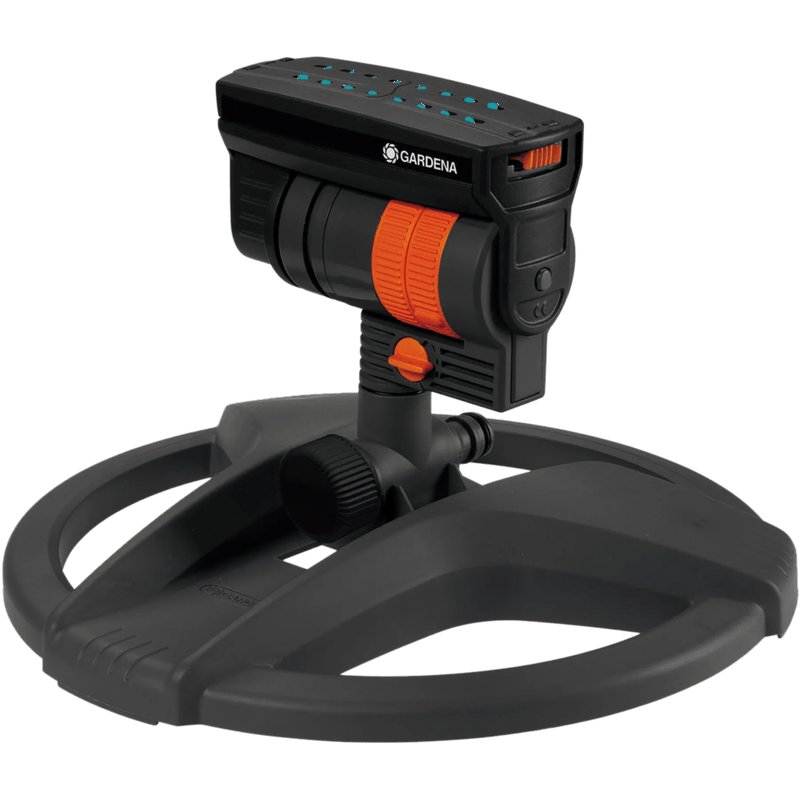
| Gardena AquaZoom M | Oscillating sprinkler | 9 to 250 m², reach 3 to 18 m, width up to 14 m | The typical rectangular home garden |
| Gardena Comfort Mambo rotary sprinkler | Rotary sprinkler | 9 to 310 m², diameter 3 to 20 m | Round or open areas without paths along the edge |
| Gardena Premium impulse, circular and sector sprinkler | Impulse sprinkler on a sled base | 75 to 490 m², radius 5 to 12.5 m, sector 25 to 360° | Large areas, corners, slopes |
| Gardena T 200 pop-up turbine sprinkler | Pop-up sprinkler | 80 to 200 m², reach 5 to 8 m, sector 25 to 360° | Permanently installed Gardena system |
| Rain Bird 5004 Plus | Pop-up gear-driven rotor | Radius 7.6 to 15.2 m, sector 40 to 360°, 1.7 to 4.5 bar | Larger systems with valves and a controller |
Gardena AquaZoom compact
The smallest oscillating sprinkler in the range stands on a round base, which keeps it stable even between flower beds. According to Gardena, reach and width can be adjusted continuously, as can the water volume, and if you like it swings to one side only. The nozzles are made of soft plastic, limescale can be wiped off, and there is a removable strainer at the connection. If a little over 200 m² is enough for you, you need nothing more.
Gardena AquaZoom M
According to the manufacturer, the AquaZoom M covers up to 250 m² at a width of 14 m and stands on extra-wide feet. There is a stainless metal filter at the water connection. Gardena’s service data lists 750 liters per hour at 2 bar and 1,050 liters at 4 bar for it. That lets you plan the run time precisely. For most rectangular gardens, this is our pick.
Gardena Comfort Mambo rotary sprinkler
Rotating nozzle heads distribute the water in a full circle, over up to 310 m² according to Gardena. According to Gardena’s service data, the flow rate at 2 bar is between 900 and 1,550 liters per hour, depending on the nozzle setting. A fine dirt strainer can be removed. It makes little sense on a narrow, angular lawn. There, a lot of water ends up on the paving.
Gardena Premium impulse, circular and sector sprinkler
According to the manufacturer, a plastic sled base with metal inserts keeps it stable even on a slope, and the nozzle is made of brass. You set the sector between 25° and 360° and the radius between 5 and 12.5 m. Several sprinklers can be connected in series using matching faucet connectors. For one corner of a large property in a quarter circle, it is a good tool. For a 150 m² townhouse lawn, it is oversized.
Gardena T 200 pop-up turbine sprinkler
The T 200 is part of the Gardena sprinkler system and connects to the pipe with a 1/2-inch female thread. Four nozzles with different flow rates are available, and according to the manufacturer a memory function finds the set sector again if someone twists the head. The system is only frost-proof if it is drained in winter through a drain valve.
Rain Bird 5004 Plus
A gear-driven rotor from the professional segment. According to the data sheet, it raises the nozzle 10 cm above the housing cap and operates between 1.7 and 4.5 bar. Depending on the nozzle, the flow rate ranges from 3 to 36.6 liters per minute. The „Plus“ version can be shut off right at the head, which is handy when changing nozzles. The connection is a 3/4-inch female thread to the US NPT standard, so clarify the right adapters before buying. For a garden system with valves and a controller, it is a solid foundation; for getting started, it is too involved.
How we would decide
- Rectangular lawn up to about 250 m²: Gardena AquaZoom M, or the AquaZoom compact for smaller areas.
- Newly seeded lawn: an oscillating sprinkler with fine nozzles and short, frequent waterings.
- Open, round area without paths along the edge: Mambo rotary sprinkler.
- Large property or slope: an impulse sprinkler in sector mode, but plan for long run times.
- New installation with pipes and automation: pop-up sprinklers such as the T 200 or the Rain Bird 5004 Plus, always several, head to head.
Whichever sprinkler you choose: a dish on the lawn tells you more after the first hour than any figure on the box.
Frequently asked questions
How much water does a lawn need?
According to the Bayerische Gartenakademie (Bavarian Garden Academy), you should only water once the lawn shows the first signs of drought stress, but then thoroughly, with about 15 to 20 liters per square meter. At 20 to 25 °C, a lawn evaporates 2 to 3 liters per square meter per day. In a normal summer, one generous watering lasts for six to ten days.
How long does a lawn sprinkler need to run?
You can calculate it from the flow rate. According to Gardena, the AquaZoom M delivers about 1,050 liters per hour at 4 bar; over 250 m², that is a little over 4 liters per square meter, so around three and a half hours for 15 liters. A simple check: if there is one centimeter of water in a small dish after an hour, it was 10 liters.
When should you water the lawn?
In the morning, the Garden Academy advises. In the evening, much of the water evaporates, and wet grass overnight encourages fungi. It should not be more than about 10 liters per square meter per hour, or the water runs off the surface. Watering often and lightly trains the lawn to grow shallow roots.
What is the difference between oscillating, rotary and impulse sprinklers?
Oscillating sprinklers water an adjustable rectangle and suit the typical townhouse garden. Rotary sprinklers distribute water evenly in a circle, but on an angular lawn they also water paths. Impulse sprinklers have a long throw and adjustable sectors and suit large areas and slopes, but need long run times.
Why doesn't my sprinkler reach the stated area?
Every area rating only applies at a certain water pressure. According to Gardena, the area covered by the AquaZoom M shrinks from 250 m² at 4 bar to 170 m² at 2 bar. A test helps: if a 10-liter bucket fills in 30 seconds, the faucet delivers 1,200 liters per hour. Wind also throws off the calculation.
Which sprinkler is suitable for newly seeded lawns?
The Garden Academy explicitly recommends an oscillating sprinkler with fine nozzles, because coarse drops cause the soil to silt up. For newly seeded lawns, short, frequent waterings are the right approach instead of the otherwise recommended infrequent, thorough watering.
Sources
- Bavarian Garden Academy: Watering in home and allotment gardens (Report 4)
- Gardena Service: technical data for surface sprinklers
- Gardena: AquaZoom compact oscillating sprinkler
- Gardena: AquaZoom M oscillating sprinkler
- Gardena: Comfort Mambo rotary sprinkler
- Gardena: Premium impulse, circular and sector sprinkler
- Gardena: T 200 pop-up turbine sprinkler
- Rain Bird: 5000 Series Rotors, technical data sheet
Where to buy
- Gardena AquaZoom M (18712)Check price at Amazon.deCheck price at Amazon.co.ukCheck price at Amazon.nlCheck price at Amazon.com.beCheck price at Amazon.frCheck price at Amazon.itCheck price at Amazon.esCheck price at Amazon.plCheck price at Amazon.seAvailable in Germany: Amazon.de
- Gardena AquaZoom compactCheck price at Amazon.deCheck price at Amazon.co.ukCheck price at Amazon.nlCheck price at Amazon.com.beCheck price at Amazon.frCheck price at Amazon.itCheck price at Amazon.esCheck price at Amazon.plCheck price at Amazon.seAvailable in Germany: Amazon.de
- Gardena Comfort Kreisregner MamboCheck price at Amazon.deCheck price at Amazon.co.ukCheck price at Amazon.nlCheck price at Amazon.com.beCheck price at Amazon.frCheck price at Amazon.itCheck price at Amazon.esCheck price at Amazon.plCheck price at Amazon.seAvailable in Germany: Amazon.de
- Gardena Premium Impuls-, Kreis- und SektorenregnerCheck price at Amazon.deCheck price at Amazon.co.ukCheck price at Amazon.nlCheck price at Amazon.com.beCheck price at Amazon.frCheck price at Amazon.itCheck price at Amazon.esCheck price at Amazon.plCheck price at Amazon.seAvailable in Germany: Amazon.de
- Gardena Turbinen-Versenkregner T 200Check price at Amazon.deCheck price at Amazon.co.ukCheck price at Amazon.nlCheck price at Amazon.com.beCheck price at Amazon.frCheck price at Amazon.itCheck price at Amazon.esCheck price at Amazon.plCheck price at Amazon.seAvailable in Germany: Amazon.de
- Rain Bird 5004 PlusCheck price at Amazon.deCheck price at Amazon.co.ukCheck price at Amazon.nlCheck price at Amazon.com.beCheck price at Amazon.frCheck price at Amazon.itCheck price at Amazon.esCheck price at Amazon.plCheck price at Amazon.seAvailable in Germany: Amazon.de