Contents15 sections
This guide was first published in German on handgetestet.de.
Too heavy for whom? That is the first question, because a panel that is too heavy for your back and one that is too heavy for your roof lead to different purchases. For balconies, garden sheds and carports, we consider the Jackery 4x 245W leichte stabile Solarmodule (lightweight rigid solar panels) the most coherent choice: 8.3 kilos each, and rigid at that. Flexible panels mainly make sense on motorhomes and on curved surfaces. If the panel stands on solid ground, glass remains the more sensible design.
Three designs, three weight classes
According to the German consumer advice center (Verbraucherzentrale), a standard glass panel measures about 1.1 by 1.8 meters and weighs a good 20 kilos, which is around 10 kilos per square meter. The JA Solar JAM54D40 weighs 22 kilos for just under 2 square meters and 450 watts.
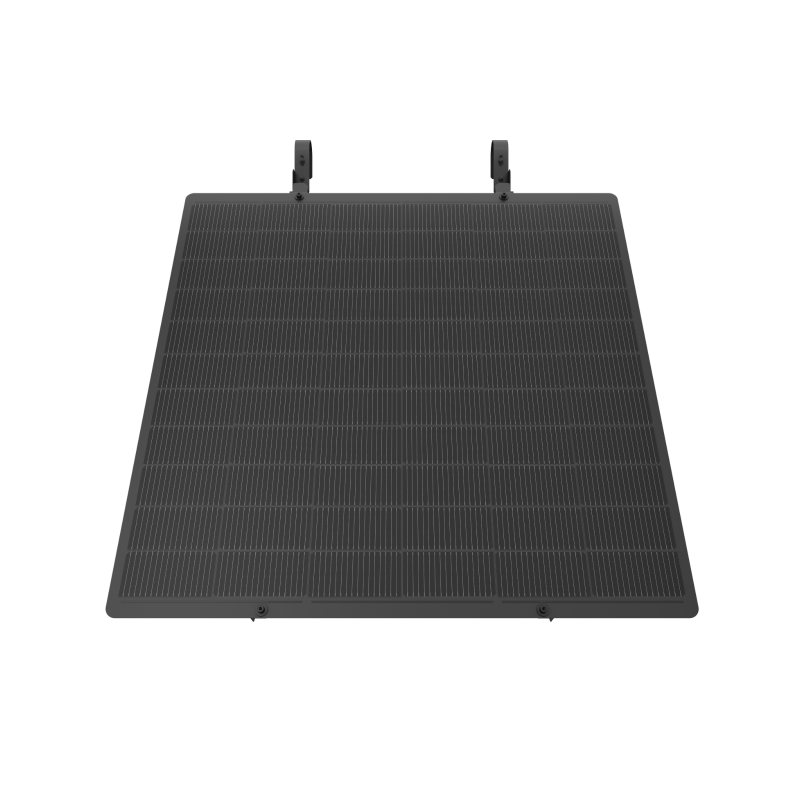
Lightweight rigid covers a range. The 245-watt panel from Jackery is 4 millimeters thin and, according to the manufacturer, around 37 percent lighter than conventional rigid panels. Dimensions are not given in the product details; from 245 watts and an efficiency of up to 25 percent, the calculation comes to about one square meter, so roughly 8 kilos per square meter. That is not a big leap. The Ective BSP 200 Black Lightweight weighs just 4.2 kilos at 1,410 by 700 millimeters, around 4 kilos per square meter, and uses ETFE instead of glass.
Flexible panels go even further: Jackery states 3.2 kilos for 200 watts, EcoFlow 2.3 kilos for 100 watts. So per 100 watts, you carry roughly 5 kilos with glass, 3.4 with the Jackery lightweight panel and 1.6 to 2.3 with flexible panels.
Do lightweight panels last as long as glass?
Probably not. The Verbraucherzentrale usually attributes a somewhat shorter service life to lightweight, flexible panels than to framed panels, and according to its planning guide, glass-glass panels protect better against hail than film-based panels.
Looking at the warranty reveals the differences. For its flex set, Jackery advertises an extended twelve years and 85 percent output after more than 25 years. Ective gives three years on its Flex series and five years at 80 percent output on the Lightweight panel. Ask whether a warranty also applies to glued-on mounting.
The biggest enemy is heat. If a panel is glued directly onto the roof, the heat can hardly escape downward. There are no reliable measurements for individual models. For comparison: for rigid panels on a vehicle roof, Ective requires at least 100 millimeters of air space. A glued panel cannot offer that.
Your mounting location: the balcony
Here the math comes first. Four panels of 245 watts each add up to 980 watts peak. According to the Verbraucherzentrale, however, a normal plug can only be used up to 960 watts peak in Germany; above that, you need a feed-in socket installed by an electrician. If you only want to plug in, mount three panels. The flex set stays below that at 800 watts peak and, according to Jackery, can be attached with ropes or hook-and-loop straps. For a rented apartment that sounds convenient, but the panel must neither come loose nor be damaged in the wind. A flapping sheet on the railing is not something we want to see.
Mounts are compared in detail in our guide to balcony solar mounts. You still need consent from your landlord or the homeowners‘ association, but in Germany, since October 2024, they may only refuse it if the system would be unreasonable.
Your mounting location: garden shed, carport, flat roof
Calculate the whole package. Four lightweight panels weigh 33.2 kilos, the matching Jackery steel mounting frame another 26.5. That makes almost 60 kilos for 980 watts peak. Two glass panels with 900 watts peak come to around 44 kilos, though still without a frame. So on a frame, the weight advantage shrinks considerably, and what remains is easier handling: according to Jackery, one person can manage a panel alone.
And the structural load? No manufacturer can provide reliable values for your roof. Thin rafters on a garden shed or an older carport may barely carry the snow load as it is, and every additional load counts. If in doubt, have a specialist company or structural engineer take a look. The Verbraucherzentrale assumes a stable, asbestos-free roof covering, so with old corrugated sheets on the garage, be sure to clarify this. Do not forget the wind either: lightness is no advantage on a tilted frame, because whatever weighs little lifts off sooner. Jackery states neither wind load nor ballast for the mount. You should ask about this before buying.
Off-grid operation in an allotment garden is a topic of its own; see electricity in the garden shed (in German). If the surface can easily carry glass and the back is unobstructed, read on about bifacial solar panels.
Your mounting location: the motorhome roof
Here every kilo of payload counts, and some roofs are curved. With 21.6 volts open-circuit voltage, 10.8 amps and MC4 connectors, the Ective Lightweight states everything you need for the charge controller. For the Jackery panels, these values are missing from the product details, which is why we do not plan with them for a motorhome. Flexible panels are glued on. Ective describes adhesive strips spaced about 15 centimeters apart and warns that an incorrectly glued panel is difficult to remove again or gets damaged in the process.
If you only need power at the campsite, you can skip the roof entirely: a foldable solar panel stands in the sun while the vehicle is parked in the shade. How the energy then gets into the vehicle’s electrical system is explained in our guide to the power inverter.
The panels and the frame compared
| Model | Design | Output and weight according to the manufacturer | Mounting location |
|---|---|---|---|
| Jackery 4x 245W leichte stabile Solarmodule | lightweight rigid, 4 mm | 4 × 245 W, 8.3 kg each | Balcony, garden shed, carport |
| Jackery Montagehalterung für 4 leichte Solarmodule (mounting frame for 4 lightweight panels) | Steel frame, 30° / 60° | 26.5 kg | Balcony, yard, flat roof, wall |
| Jackery Flexibles Solarpanel Set (200W*4) (flexible solar panel set) | flexible, polymer | 4 × 200 W, 3.2 kg each | Balcony, motorhome |
| Jackery 450Wp Bifaziales Solarmodul (bifacial solar panel) | Glass-glass | 450 Wp | Garden, flat roof with load reserve |
| Ective BSP 200 Black Lightweight | lightweight rigid, ETFE | 200 W, 4.2 kg | Motorhome, van, boat |
| Ective MSP 200 Flex | flexible, 3 mm | 200 W, weight not stated | Curved vehicle roofs |
| EcoFlow 100W Flexibles Solarpanel (flexible solar panel) | flexible, grommets | 100 W, 2.3 kg | Small vehicles, boats |
Jackery 4x 245W leichte stabile Solarmodule
Double-sided fiberglass instead of glass, IP68, designed for minus 40 to 85 degrees Celsius according to Jackery. No warranty period is given in the product details. Ask before buying, and as mentioned: four of them exceed the plug limit.
Jackery Montagehalterung für 4 leichte Solarmodule
Only for lightweight, rigid panels, with a 30 or 60 degree tilt. The warranty runs for one year, and you only need it if the panels are actually mounted on a tilted frame.
Jackery Flexibles Solarpanel Set (200W*4)
The lightest per watt here. Heat and wind exposure remain the open questions, especially with loose attachment.
Jackery 450Wp Bifaziales Solarmodul
The glass counter-check. Where load is not an issue, the longer expected service life speaks for this design. It does not belong on the lightweight mount.
Ective BSP 200 Black Lightweight
With a frame, so it can be mounted with an air gap. For us, the first choice for a motorhome, because the data is complete. It belongs to the more expensive class.
Ective MSP 200 Flex
Bendable up to 30 degrees and, at 1,595 by 710 millimeters, fairly long. Measure your roof between vents and hatches beforehand.
EcoFlow 100W Flexibles Solarpanel
Grommets for hooks allow it to be attached without adhesive. EcoFlow does not state dimensions or warranty period on the product page.
The shortest route to a decision
- Balcony railing with a plug: three Jackery lightweight panels or the flex set.
- Garden shed or carport with verified load reserve: Jackery lightweight panels; for flat mounting, without the heavy frame, as far as the fastening allows.
- Motorhome with a flat roof: Ective Lightweight with an air gap.
- Curved roof: flexible, with heat as the price.
- Solid ground, plenty of space: glass.
Portable power station or permanently installed leisure battery: the trade-offs for a DIY conversion are covered in our guide to power in a camper conversion.
Frequently asked questions
How much does a lightweight solar panel weigh compared with glass?
According to the German consumer advice center (Verbraucherzentrale), a standard glass panel weighs a good 20 kilos, around 10 kilos per square meter. The 245-watt Jackery lightweight panel weighs 8.3 kilos. Per 100 watts, you carry roughly 5 kilos with glass, 3.4 with the Jackery lightweight panel and 1.6 to 2.3 with flexible panels.
Do lightweight solar panels last as long as glass panels?
Probably not. The Verbraucherzentrale attributes a somewhat shorter service life to lightweight, flexible panels than to framed panels, and glass-glass panels protect better against hail. The biggest enemy is heat, especially when a panel is glued directly onto a roof. Ask whether the warranty applies to glued mounting.
How many lightweight panels may I plug in on a balcony?
According to the Verbraucherzentrale, a normal plug can be used up to 960 watts peak. Four panels of 245 watts each add up to 980 watts peak and need a feed-in socket installed by an electrician. If you only want to plug in, mount three. The flexible Jackery set stays below that at 800 watts peak.
Do lightweight solar panels make sense for a garden shed?
Only with verified load reserve. Four lightweight panels weigh 33.2 kilos, the steel Jackery mount another 26.5. Two glass panels come to around 44 kilos without a frame. So the weight advantage shrinks considerably. With thin rafters or an older carport, have a specialist company or structural engineer take a look.
Which lightweight solar panel suits a motorhome?
We plan with the Ective BSP 200 Black Lightweight: 200 watts, 4.2 kilos, with a frame and therefore mountable with an air gap, and all values for the charge controller are stated. For curved roofs, the only option is a flexible panel that is glued on, with heat as the price. Measure the space between vents and hatches beforehand.
Sources
Where to buy
- Jackery 4x 245W leichte stabile SolarmoduleView at JackeryAvailable in Germany: Jackery
- Jackery Montagehalterung für 4 leichte SolarmoduleView at JackeryAvailable in Germany: Jackery
- Jackery Flexibles Solarpanel Set (200W*4)View at JackeryAvailable in Germany: Jackery
- Jackery 450Wp Bifaziales SolarmodulView at JackeryAvailable in Germany: Jackery
- Ective BSP 200 Black LightweightCheck price at Amazon.deCheck price at Amazon.co.ukCheck price at Amazon.nlCheck price at Amazon.com.beCheck price at Amazon.frCheck price at Amazon.itCheck price at Amazon.esCheck price at Amazon.plCheck price at Amazon.seAvailable in Germany: Amazon.de
- Ective MSP 200 FlexCheck price at Amazon.deCheck price at Amazon.co.ukCheck price at Amazon.nlCheck price at Amazon.com.beCheck price at Amazon.frCheck price at Amazon.itCheck price at Amazon.esCheck price at Amazon.plCheck price at Amazon.seAvailable in Germany: Amazon.de
- EcoFlow 100W Flexibles SolarpanelCheck price at Amazon.deCheck price at Amazon.co.ukCheck price at Amazon.nlCheck price at Amazon.com.beCheck price at Amazon.frCheck price at Amazon.itCheck price at Amazon.esCheck price at Amazon.plCheck price at Amazon.seAvailable in Germany: Amazon.de