Price range around 649–899 € · as of 05.11.2026
Price dropping? We'll let you know
Contents13 sections
This guide was first published in German on handgetestet.de.
Before the first screw goes into the sheet metal, a camper build calls for a decision that is hard to undo later: does your power come from a station you can lift out, or from a permanently installed house battery? Our position: as long as a cooler, lights and a laptop set your power needs, a portable power station is enough, and of the models compared here, the strongest case is for the BLUETTI AC180P, which topped the spring 2025 comparison by the German automobile club ADAC with a grade of 2.0 (on the German scale, where 1 is best). A fixed installation only becomes sensible once the pump, heater fan and ceiling light run on the 12-volt system, or if you drive a lot and stay put little.
Three questions before you buy cable
What has to run without you doing anything? A power station only supplies what is plugged into its sockets. A water pump, diesel heater and lighting circuit, on the other hand, want a fixed 12-volt system with fuses. If that is your plan, you need a source that stays connected to it.
How do you travel? If you drive two hours every other day, the alternator recharges almost for free. If you stay in the same spot for ten days, you depend on the sun or on a hookup.
And will the vehicle stay yours? You take a power station with you when you sell and put it on a shelf at home as backup power. A built-in system stays in the van.
If a finished motorhome with an onboard battery is already parked outside, the question is a different one. Then it is about adding capacity, and that is covered in the guide Power station in a motorhome.
How quickly does the power come back?
Consumption is the same in both worlds: we work with an assumed 600 watt-hours a day for two people, just under half of it for the compressor cooler. The figure for your model is in the guide on the cooler on a power station (in German). The difference lies in recharging.
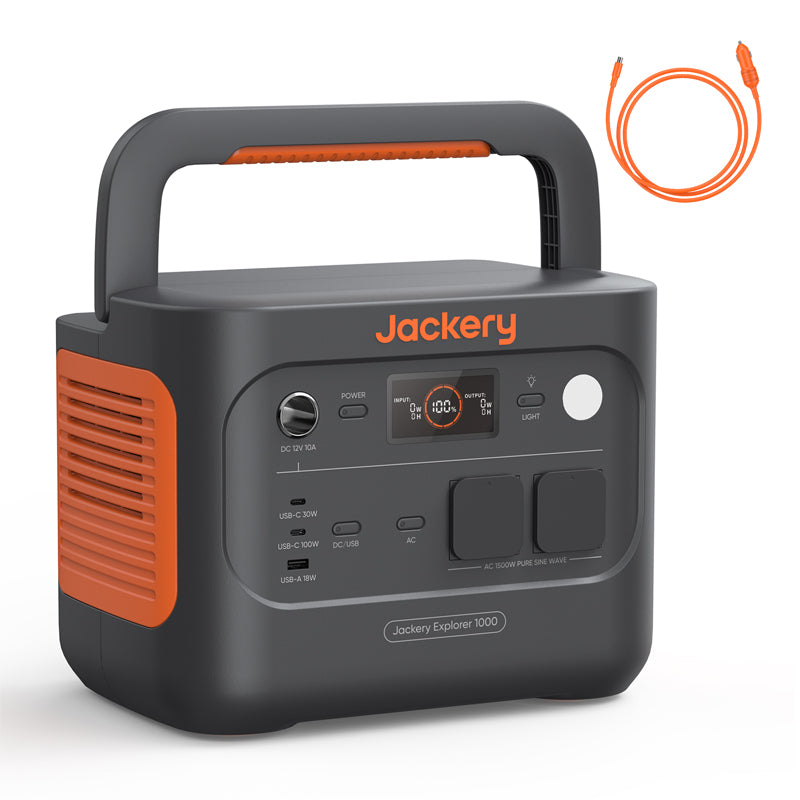
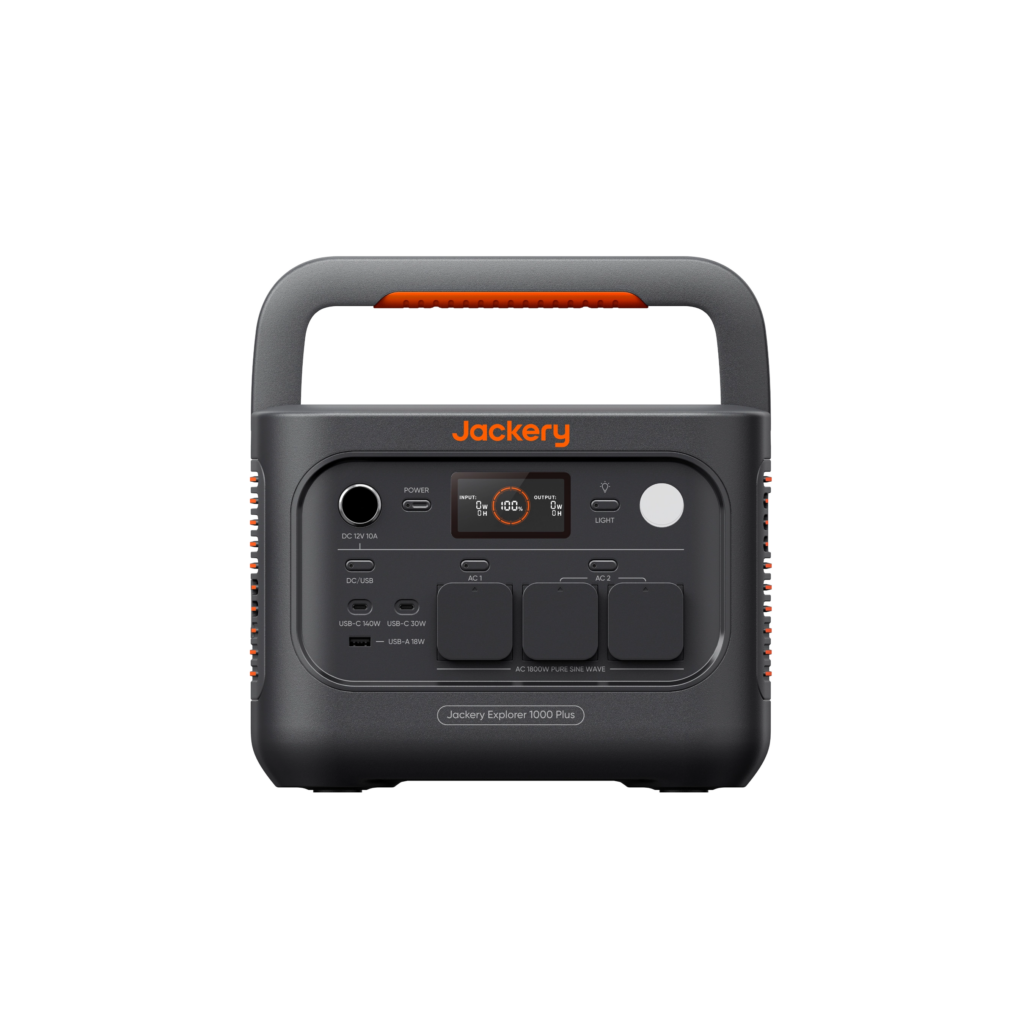
Via the cigarette lighter socket, the Jackery Explorer 1000 Plus v2 needs about twelve hours for 1,024 watt-hours. That is roughly 85 watts, so one day’s need costs about seven hours of driving. For a vacation with two-hour legs, that math does not work.
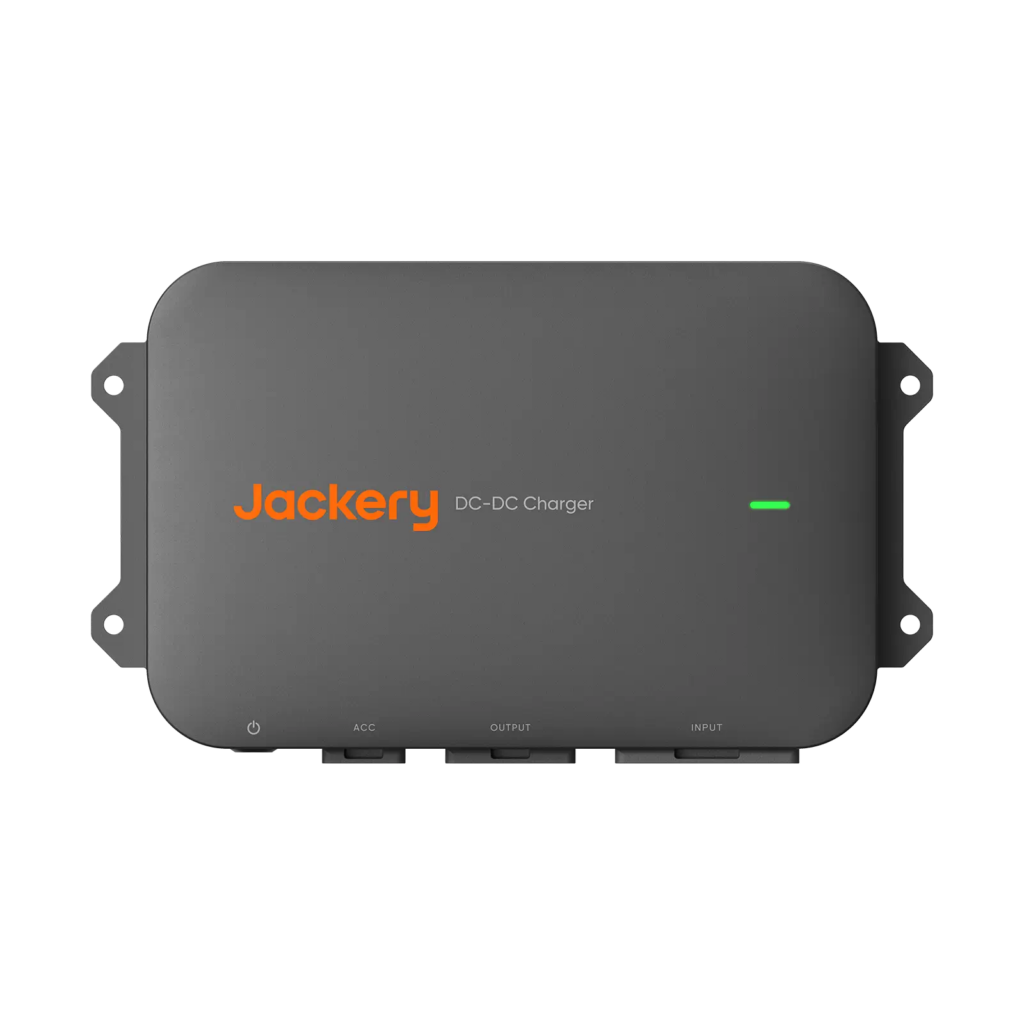
A 30-amp DC-DC charger (charging booster) delivers about 380 watts into a 12.8-volt battery. The same 600 watt-hours are back in after a little over an hour and a half of driving. That is the strongest single reason for a fixed installation. Jackery has narrowed the gap, though: with the company’s own DC-DC charger, the 1000 Plus v2 is supposed to be full in about 2.6 hours. But that charger has to be hard-wired to the battery, which is already half an installation. Cables, fuses and the pitfalls with Euro 6 vehicles are explained in the guide on the charging booster (in German). Lithium batteries are not simply connected straight to the alternator; Victron recommends current limiting, for example via such a booster.
What 200 watts on the roof really deliver
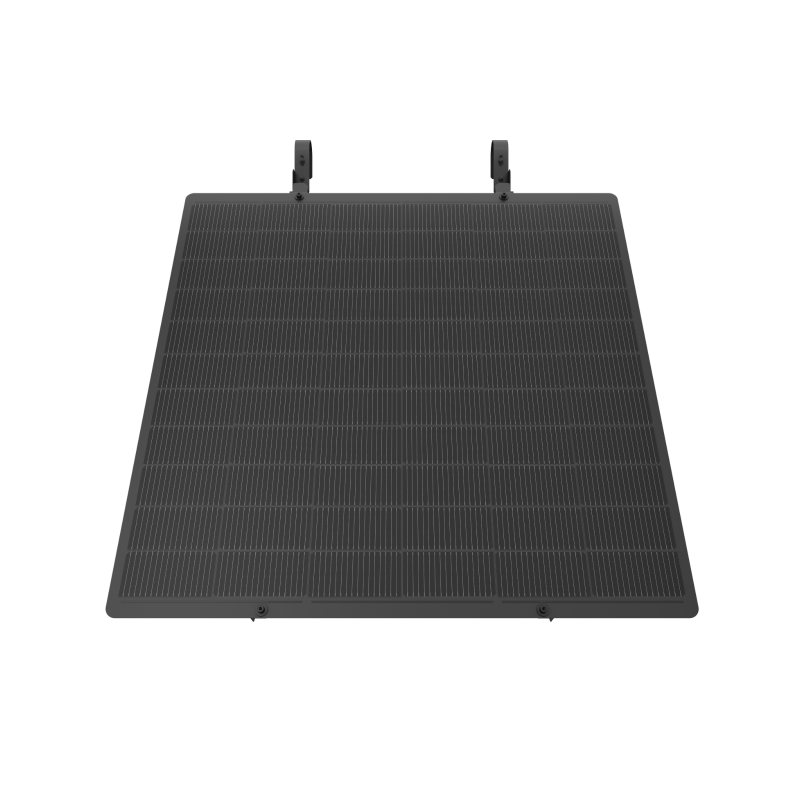
On a panel van, the module lies flat, and that is exactly what costs you. In the off-grid calculator of PVGIS, the European Commission’s solar tool, we entered 200 watts mounted horizontally in Frankfurt, plus a 1.28-kilowatt-hour battery and a need of 600 watt-hours. In June, the need is almost always covered; the battery runs empty on just under 4 percent of days. In April, about 550 watt-hours a day are available, in September 490, in October only 280 and in December 90.
So a roof module carries the summer and nothing else. If you are parked in the fall, you need driving or a hookup. Suitable modules are compared in the guide to lightweight solar panels (in German).
The cost calculation that is often missing
The comparison is misleading if only the station and the battery are in the shopping cart. The station comes with a charge controller, inverter, mains charger and display. With a fixed installation, you pay for every part separately: battery, battery management system, charging booster, solar charge controller, shore power charger, inverter, main fuse, distribution block, heavy cables. With the Victron battery, the battery management system is explicitly extra. Add up the entire parts list before you compare, and factor in a workshop if you will not be doing the connections yourself.
Service life, on the other hand, almost never decides it. Victron states 5,000 cycles at 50 percent depth of discharge. At an assumed 100 nights parked per year, each using half the battery, that would be 50 years. So for a camper, you can cross off the „lasts longer“ argument.
Six building blocks for the build
Specifications according to the manufacturers; for Jackery according to the authorized retailer GreenDrive, for BLUETTI according to the ADAC.
BLUETTI AC180P
The ADAC praised the features and handling and confirmed the continuous output, and according to the test, cables for a car battery and a solar module are included. With 1,440 watt-hours, it covers our 600 watt-hours for about two days after deducting 15 percent conversion loss. The fan gets loud when it charges or discharges at full power; the quiet mode in the app lowers the noise level. It was also the most expensive station in the comparison.
Jackery Explorer 1000 Plus v2
At 10.8 kilograms, the most manageable choice, and according to the retailer it charges down to minus 10 degrees. We do not have a data sheet for it, which is why it is not at the top. The solar input tops out at 400 watts. We deliberately do not list the similarly named Explorer 1000 v2 here: the ADAC downgraded it because its DC inputs are not decoupled and the vehicle’s electrical system can be damaged.
Jackery Explorer 2000 v2
Twice the capacity, but 17.5 kilograms and, according to Jackery, about 24 hours on the car socket. In a van, this is a station for the hookup, not for driving.
Victron LiFePO4 Smart 12,8 V 100 Ah
The battery stores 1,280 watt-hours in 14 kilograms and, with a footprint of 32 by 15 centimeters, fits under a bench seat. It may only be charged from plus 5 degrees; below zero, only 80 percent of capacity remains, and at minus 20 degrees, half. In winter, it therefore belongs in the heated area. It only runs with an external battery management system; for 12 volts with an alternator, Victron names the Smart BMS CL 12/100.
Victron Orion-Tr Smart 12/12-30 and SmartSolar MPPT 100/30
The Orion is galvanically isolated and works with lead-acid and lithium; at 12 volts, the solar charge controller can handle about 400 watts of modules on paper. For the 200 watts in our calculation, that is twice as much as needed.
Rules that apply no matter what you decide
A big battery does not make the gas inspection go away. Since June 19, 2025, all recreational vehicles in Germany with a permanently installed LPG system need an inspection under the German DVGW G 607 standard, every two years and independently of the general vehicle inspection. According to the ADAC, the system may not be operated without proof of inspection. Important for your build: according to the TÜV-Verband, the German association of technical inspection organizations, the inspector also checks for electrical equipment in the gas compartment. So do not run any cable through the gas locker without clearing it with the inspector first. Everything about gas detectors is in a separate guide.
There is no shortcut for the electrics. The TÜV-Verband names undersized cables, missing fuses and loose components as typical defects in self-builds, up to short circuits and fire. Its information sheet 769 on photovoltaics on vehicles covers cables, fuses, the mounting of modules and batteries as well as roof load and weight distribution; information sheet 740 covers the requirements for the motorhome vehicle type. Both are aimed at inspectors but help with a self-build. Clarify registration and approval with an inspector before you drill. Leave the 230-volt side to a qualified specialist.
What kind of builder are you?
- Van with a bed and a cooler, weekends, vehicle possibly sold soon: BLUETTI AC180P, plus a socket and straps, nothing else.
- Winter camper with little storage space: Jackery Explorer 1000 Plus v2, with the Jackery charger if you drive a lot.
- Full build with pump, heater and lighting circuit, often on the move: Victron LiFePO4 Smart 12,8 V 100 Ah with BMS, Victron Orion-Tr Smart 12/12-30 and Victron SmartSolar MPPT 100/30.
- Long stays at a site with a hookup: Jackery Explorer 2000 v2.
If you want to draw 230 volts from the fixed battery, plan the inverter using the guide 12 V to 230 V inverters.
Frequently asked questions
Portable power station or fixed house battery in a camper: which fits?
That depends on what has to run without you doing anything. A power station only supplies what is plugged into its sockets. A water pump, diesel heater and lighting circuit need a fixed 12-volt system with fuses. You can also take a power station with you when you sell the vehicle, while a built-in system stays in the van.
How long does it take to charge a power station from the car socket?
A long time. Via the cigarette lighter socket, the Jackery Explorer 1000 Plus v2 needs about twelve hours for 1,024 watt-hours, so a daily need of 600 watt-hours costs about seven hours of driving. A 30-amp DC-DC charger (charging booster) puts the same amount back in after a little over an hour and a half; that is the strongest reason for a fixed installation.
Is one solar panel on the roof of a panel van enough?
Only in summer. In the PVGIS calculation with 200 watts mounted flat in Frankfurt, the 600 watt-hour need is almost always covered in June. In October, only about 280 watt-hours a day are available, in December 90. If you are parked in the fall, you need driving or a hookup.
Is a fixed installation cheaper because it lasts longer?
Service life almost never decides it. Victron states 5,000 cycles at 50 percent depth of discharge; at an assumed 100 nights parked per year, that would be 50 years. Compare the whole parts list instead: with a fixed installation, you pay separately for the battery management system, charging booster, solar charge controller, shore power charger, inverter, fuses and cables.
Which power station is suitable for winter campers?
According to the retailer, the Jackery Explorer 1000 Plus v2 charges down to minus 10 degrees and, at 10.8 kilograms, is the most manageable choice. The Victron battery, by contrast, may only be charged from plus 5 degrees and belongs in the heated area in winter. The ADAC downgraded the Explorer 1000 v2 because its DC inputs are not decoupled.
What rules apply to gas and electrics in a self-build?
Since June 19, 2025, recreational vehicles with a permanently installed LPG system in Germany need an inspection under the German DVGW G 607 standard every two years. Do not run any cable through the gas locker without clearing it with the inspector. Clarify registration and approval before you drill, and leave the 230-volt side to a qualified specialist.
Sources
- ADAC: Portable power stations tested (spring 2025)
- ADAC: Gas inspection for motorhomes and caravans
- TÜV-Verband: New inspection requirement for LPG systems
- Autohaus: TÜV-Verband information sheet 769
- European Commission: PVGIS, off-grid calculator (our own calculation for Frankfurt)
- Victron Energy: Lithium Battery Smart data sheet (PDF)
- Victron Energy: Lithium Battery Smart manual (PDF)
- Victron Energy: Orion-Tr Smart
- Victron Energy: MPPT charge controller overview (PDF)
- GreenDrive: Explorer 1000 Plus v2 (retailer information)
Where to buy
- BLUETTI AC180PCheck price at Amazon.deCheck price at Amazon.co.ukCheck price at Amazon.nlCheck price at Amazon.com.beCheck price at Amazon.frCheck price at Amazon.itCheck price at Amazon.esCheck price at Amazon.plCheck price at Amazon.seAvailable in Germany: Amazon.de
- Jackery Explorer 1000 Plus v2€599.99≈ £501.48≈ CHF 555.71≈ PLN 2,650.16≈ SEK 6,688.09≈ DKK 4,484.45≈ NOK 6,388.39≈ CZK 14,655.96≈ HUF 221,654≈ RON 3,208.33≈ ISK 82,319≈ $659.51≈ CA$943.12 at Jackery · As of 20.11.View at JackeryAvailable in Germany: JackeryCheck price at Amazon.deCheck price at Amazon.co.ukCheck price at Amazon.nlCheck price at Amazon.com.beCheck price at Amazon.frCheck price at Amazon.itCheck price at Amazon.esCheck price at Amazon.plCheck price at Amazon.seAvailable in Germany: Amazon.de
- Jackery Explorer 2000 v2€748.60≈ £625.69≈ CHF 693.35≈ PLN 3,306.57≈ SEK 8,344.64≈ DKK 5,595.19≈ NOK 7,970.72≈ CZK 18,286.05≈ HUF 276,555≈ RON 4,002.99≈ ISK 102,708≈ $822.86≈ CA$1,176.72 at Jackery · As of 20.11.View at JackeryAvailable in Germany: JackeryCheck price at Amazon.deCheck price at Amazon.co.ukCheck price at Amazon.nlCheck price at Amazon.com.beCheck price at Amazon.frCheck price at Amazon.itCheck price at Amazon.esCheck price at Amazon.plCheck price at Amazon.seAvailable in Germany: Amazon.de
- Victron LiFePO4 Smart 12,8 V 100 AhCheck price at Amazon.deCheck price at Amazon.co.ukCheck price at Amazon.nlCheck price at Amazon.com.beCheck price at Amazon.frCheck price at Amazon.itCheck price at Amazon.esCheck price at Amazon.plCheck price at Amazon.seAvailable in Germany: Amazon.de
- Victron Orion-Tr Smart 12/12-30Check price at Amazon.deCheck price at Amazon.co.ukCheck price at Amazon.nlCheck price at Amazon.com.beCheck price at Amazon.frCheck price at Amazon.itCheck price at Amazon.esCheck price at Amazon.plCheck price at Amazon.seAvailable in Germany: Amazon.de
- Victron SmartSolar MPPT 100/30Check price at Amazon.deCheck price at Amazon.co.ukCheck price at Amazon.nlCheck price at Amazon.com.beCheck price at Amazon.frCheck price at Amazon.itCheck price at Amazon.esCheck price at Amazon.plCheck price at Amazon.seAvailable in Germany: Amazon.de
Still undecided?
Keep comparing at your own pace – every article in this category is checked monthly for new and discontinued models.