Contents14 sections
This guide was first published in German on handgetestet.de.
Three hours on the highway, and in the evening the leisure battery still only shows half full. In vehicles meeting the European Euro 6 emission standard, that is the rule rather than a defect. For a permanently installed leisure battery, we consider a 30-amp DC-DC charger such as the Victron Orion-Tr Smart 12/12-30 the right size; if you take a Jackery power station along instead of a leisure battery, the Jackery DC-DC-Lichtmaschinenladegerät (alternator charger) is the right choice.
Why does the alternator not fully charge my leisure battery?
Because it does not take the leisure battery into account at all. In many motorhomes, the leisure battery is simply connected in parallel to the starter battery via a split-charge relay. Büttner Elektronik describes the consequence: the nearly full starter battery sits close to the alternator and throttles the charging current that the empty leisure battery could easily handle. Long cables with a tight cross-section cost additional voltage.
With Euro 6, the smart alternator comes on top of that. In the manual for the Orion-Tr Smart, Victron writes that on a 12-volt system its voltage fluctuates roughly between 12.5 and 15 volts and that it switches off completely at times, controlled by the vehicle according to power demand and braking energy. Once the starter battery is full, it rests. The empty leisure battery does not count for the control system. A DC-DC charger actively draws the current and, like a mains charger, charges according to the leisure battery’s charging profile.
How much charging current makes sense?
For a battery of around 100 amp-hours, 30 amps are enough in Büttner’s assessment. Votronic recommends the VCC 1212-30 CI for 60 to 200 amp-hours and the 50-amp model for 75 to 320. But more current also means more load on the vehicle side. For the 12/12-30 at full load, Victron calculates about 35 amps at the input; for the VCC 1212-50 CI, Votronic calculates up to 68 amps. If the vehicle’s base electronics are only fused for 30 or 50 amps, the Büttner booster can be turned down by 5 amps according to the manufacturer; Votronic offers adjustable current limits.
Which cable cross-section, which fuse?
This is where it is decided whether the booster can deliver its output at all. For 12 volts, Victron specifies a 60-amp battery protection fuse and the following minimum cross-sections: 6 mm² for half a meter, 10 mm² for one to two meters, 16 mm² from five meters. In the manual’s sample calculation, five meters of cable at 16 mm² lose about 0.4 volts. For the MT LB 30, Büttner requires an adequately sized supply cable of up to 5 meters with 10 mm². Check the terminals. The small Votronic accepts no more than 10 mm².
AGM or LiFePO4: which charging profile do I need?
The one the battery manufacturer specifies. According to Votronic, AGM needs a high voltage level with a defined absorption time and then a moderate float voltage; a temperature sensor on the battery helps with this, and Votronic and Büttner include one. The Victron charges lithium iron phosphate with a fixed constant-voltage time, two hours by default. Votronic warns that a charger for lead-acid batteries may not take full advantage of a LiFePO4 battery. And Victron gives one more reason for the booster: a lithium battery connected directly to the alternator can overload it because of its low internal resistance. If you are converting right now, you will find background on the starter side in our car battery guide (in German).
Do I need a D+ signal?
Often not, but with Euro 6 it is better. The Victron detects a running engine by the voltage. If the smart alternator switches off while driving, the starter battery drops to about 12.6 volts, and the device thinks the engine is off, according to the manual. Then it does not charge. Adjusted thresholds in the app or a signal from the ignition or D+ solve this. Votronic activates its VCC via D+, ignition or voltage as you choose; according to the product information, Jackery evaluates the ACC signal and the voltage.
Can I charge a power station while driving?
Via the cigarette lighter socket, yes, but slowly. With the Explorer 1000 v2, never at the same time as solar: in spring 2025, the German automobile club ADAC downgraded it to „poor“ because its DC inputs are not decoupled and damage to the vehicle’s electrical system is possible. Jackery states about twelve hours of car charging for the Explorer 1000 v2, and the small Explorer 300D draws no more than 96 watts at its car input. A charger on the alternator changes that: according to the manufacturer, Jackery’s DC-DC unit delivers 600 watts. On the 12-volt side, that works out to more than 50 amps, which does not belong in a socket but on the battery and in the hands of a specialist workshop. What the power station then supplies in the van, such as a compressor cooler (in German), is covered in our guide to the power station for camping (in German).
Six DC-DC chargers compared
| Model | Charging current according to manufacturer | Special feature | Best for |
|---|---|---|---|
| Victron Orion-Tr Smart 12/12-30 | 30 A continuous at 40 °C | galvanically isolated, Bluetooth, engine running detection | lead-acid or lithium leisure battery, Euro 6 |
| Votronic VCC 1212-30 CI | max. 30 A, limit 20 A | 280 g, D+, ignition or voltage | 60 to 200 Ah, little space |
| Votronic VCC 1212-50 CI | max. 50 A, limit 39 A | terminals up to 25 mm², four lithium programs | 75 to 320 Ah |
| Büttner MT LB 30 | 30 A, IUoU | detachable control panel, fan | production motorhome with around 100 Ah |
| Büttner MT LB 50 | 50 A, IUoU | same design as MT LB 30 | larger battery bank |
| Jackery DC-DC-Lichtmaschinenladegerät | 600 W | only for Jackery power stations with DC8020 input | van without leisure battery |
Victron Orion-Tr Smart 12/12-30
For most leisure batteries, we consider it the right size. The isolated unit galvanically separates the starter and leisure circuits, can be configured via Bluetooth and has a dedicated setting for smart alternators. It manages 30 amps continuously at 40 degrees, and above that it derates by 3 percent per degree. Drawback: with some Euro 6 vehicles, you have to readjust thresholds or run an ignition signal.
Votronic VCC 1212-30 CI
Small and light, with a temperature sensor included and charging profiles for flooded lead-acid, gel, AGM and LiFePO4. According to Votronic, the input tolerates 10.5 to 16.5 volts. At 73 by 146 millimeters, it also fits under a seat, and the charging current can be limited to 20 amps.
Votronic VCC 1212-50 CI
For large battery banks. Up to 68 amps at the input call for a hefty supply cable; three adjustable limits help avoid overtaxing the vehicle side.
Büttner MT LB 30 and MT LB 50
Both charge according to an IUoU profile and have a selector switch for gel, AGM, LiFePO4 and flooded lead-acid, a battery sensor and a control panel that can be moved into the living area. The housing measures 270 by 223 millimeters, considerably larger than the Votronic.
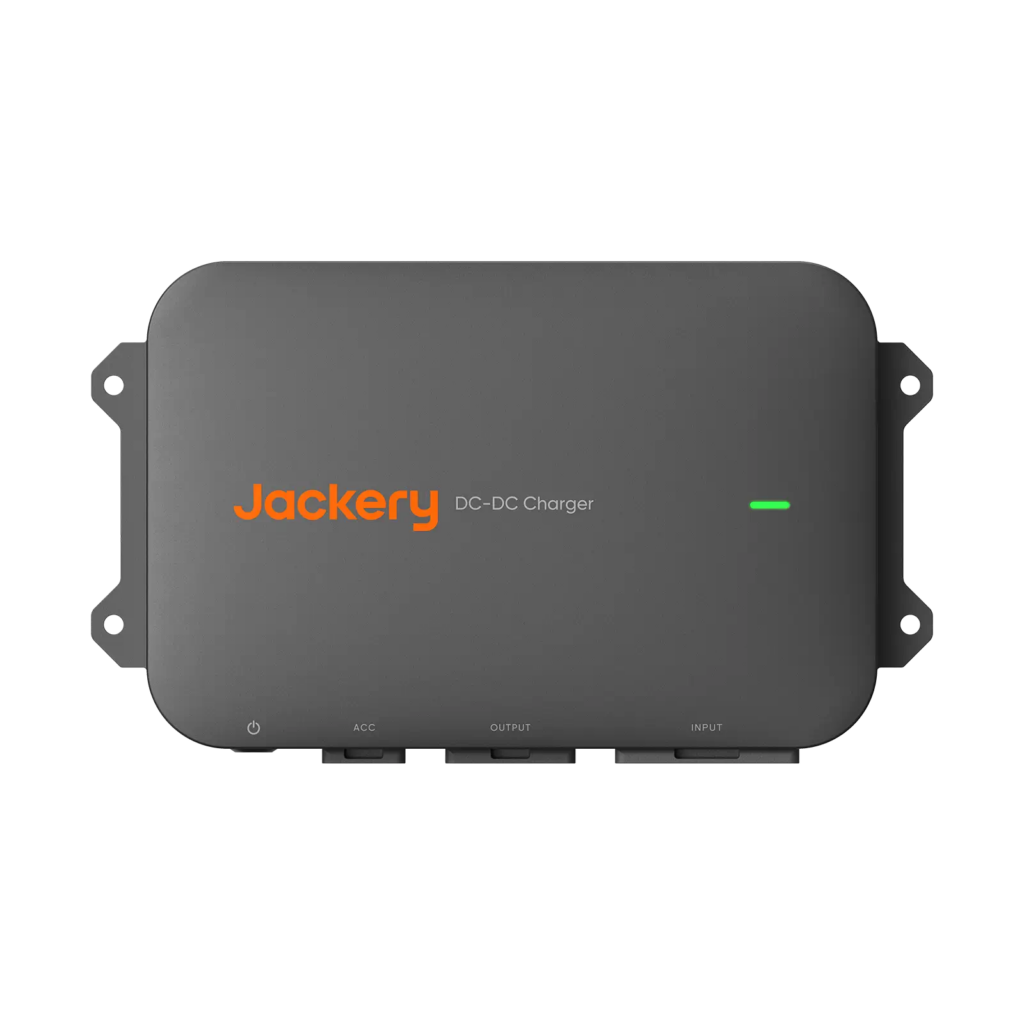
Jackery DC-DC-Lichtmaschinenladegerät
Not a booster for the leisure battery, but a charger for Jackery power stations with a DC8020 input, in 12- or 24-volt vehicles. According to Jackery, it starts and stops automatically, works from minus 20 to 60 degrees and is protected to IP40. Installation should be done by a specialist workshop. Before buying, ask whether your Explorer model is approved.
Which booster suits my vehicle?
- Euro 6 camper van with 100 to 200 Ah: Victron Orion-Tr Smart 12/12-30.
- Little space under the seat: Votronic VCC 1212-30 CI.
- Large lithium bank and powerful alternator: Votronic VCC 1212-50 CI or Büttner MT LB 50.
- Jackery power station instead of a leisure battery: the Jackery DC-DC-Lichtmaschinenladegerät.
More equipment for the road is collected in our guide to camping accessories for motorhomes, and if you want to get 230 volts out of the leisure battery, read on in our inverter guide.
When a portable station makes a sensible addition to the leisure battery is explained in the guide power station in a motorhome.
On the water, things look different, as the guide power station on a boat explains.
Power station or permanently installed leisure battery: the trade-offs for a DIY conversion are in our guide to power in a camper conversion.
Frequently asked questions
Why does the alternator not fully charge the leisure battery?
Often the leisure battery is connected in parallel to the starter battery via a split-charge relay, and the nearly full starter battery throttles the charging current. A smart alternator also fluctuates in voltage and switches off at times. A DC-DC charger actively draws the current and charges according to the leisure battery's charging profile.
How much charging current does a DC-DC charger need?
For a battery of around 100 amp-hours, 30 amps are enough in Büttner's assessment. Votronic recommends its 30-amp model for 60 to 200 amp-hours and the 50-amp model for 75 to 320. More current puts a heavier load on the vehicle side, with up to 68 amps at the input on the VCC 1212-50 CI.
What cable cross-section does a DC-DC charger need?
For 12 volts, Victron specifies a 60-amp fuse and minimum cross-sections of 6 mm² for half a meter, 10 mm² for one to two meters and 16 mm² from five meters. Check the terminals too: the small Votronic accepts no more than 10 mm².
Does a DC-DC charger need a D+ signal?
Often not, but with a smart alternator it is better. The Victron detects a running engine by the voltage. If the alternator switches off while driving, it may think the engine is off and stop charging. Adjusted thresholds in the app or a signal from the ignition or D+ solve this.
Can you connect a LiFePO4 battery directly to the alternator?
Victron warns against it: because of its low internal resistance, a lithium battery can overload the alternator. What matters is the charging profile specified by the battery manufacturer. Victron, Votronic and Büttner offer dedicated LiFePO4 settings.
Can you charge a power station while driving?
Via the cigarette lighter socket, yes, but slowly: about twelve hours for the Explorer 1000 v2. According to the manufacturer, Jackery's DC-DC charger delivers 600 watts, which works out to more than 50 amps. It belongs on the battery and in the hands of a specialist workshop, not in a socket.
Sources
- Victron Energy: Orion-Tr Smart DC-DC charger, isolated
- Victron Energy: Orion-Tr Smart DC-DC charger, isolated, manual (PDF, German)
- Votronic: DC-DC chargers
- Votronic: DC/DC charger brochure 2025 (PDF)
- Votronic: charging programs and charging profiles
- Büttner Elektronik: IUoU charging booster 30 A and 50 A
- Büttner Elektronik: basics of charging boosters
- Jackery product information on the DC-DC-Lichtmaschinenladegerät and the Explorer power stations
- ADAC: portable power stations tested (spring 2025)
Where to buy
- Victron Orion-Tr Smart 12/12-30Check price at Amazon.deCheck price at Amazon.co.ukCheck price at Amazon.nlCheck price at Amazon.com.beCheck price at Amazon.frCheck price at Amazon.itCheck price at Amazon.esCheck price at Amazon.plCheck price at Amazon.seAvailable in Germany: Amazon.de
- Votronic VCC 1212-30 CICheck price at Amazon.deCheck price at Amazon.co.ukCheck price at Amazon.nlCheck price at Amazon.com.beCheck price at Amazon.frCheck price at Amazon.itCheck price at Amazon.esCheck price at Amazon.plCheck price at Amazon.seAvailable in Germany: Amazon.de
- Votronic VCC 1212-50 CICheck price at Amazon.deCheck price at Amazon.co.ukCheck price at Amazon.nlCheck price at Amazon.com.beCheck price at Amazon.frCheck price at Amazon.itCheck price at Amazon.esCheck price at Amazon.plCheck price at Amazon.seAvailable in Germany: Amazon.de
- Büttner MT LB 30Check price at Amazon.deCheck price at Amazon.co.ukCheck price at Amazon.nlCheck price at Amazon.com.beCheck price at Amazon.frCheck price at Amazon.itCheck price at Amazon.esCheck price at Amazon.plCheck price at Amazon.seAvailable in Germany: Amazon.de
- Büttner MT LB 50Check price at Amazon.deCheck price at Amazon.co.ukCheck price at Amazon.nlCheck price at Amazon.com.beCheck price at Amazon.frCheck price at Amazon.itCheck price at Amazon.esCheck price at Amazon.plCheck price at Amazon.seAvailable in Germany: Amazon.de
- Jackery DC-DC-LichtmaschinenladegerätView at JackeryAvailable in Germany: Jackery