Contents14 sections
This guide was first published in German on handgetestet.de.
The cockpit locker is the worst spot on the whole boat, and that is exactly where the power station usually ends up. It belongs in the dry cabin, strapped down, never on deck. For small cabin boats without a large onboard electrical system, we consider the Jackery Explorer 500 v2 the most sensible purchase among the models compared here; if you sail an open boat or expect a lot of spray, look at the Unicraft PPS 600 with sealed sockets. Neither is a replacement for a permanently installed onboard system.
What the manufacturers really say about water and salt
Not much that is encouraging. The manual for the Explorer 3000 includes a hazard warning saying that the unit is intended for indoor use, with Jackery citing a motorhome, tent and cabin as examples. Rain, snow and, explicitly, use in humid environments by the sea or near bodies of water are ruled out. About the SOLIX C1000 Gen 2, Anker writes tersely that it is not waterproof and must be kept away from water and humid environments. We did not find an ingress protection rating for the entire housing on any of the units in this list. According to the manufacturer, the IP65 rating of the Unicraft PPS 600 applies only to the sockets behind their protective flaps.
For long-term storage of the Explorer 2000 Pro, Jackery specifies a maximum of 60 percent humidity. On a boat in the harbor in October, that is wishful thinking. Then there is the fan: stations of this type are air-cooled, and whatever is hanging in the cabin air gets pulled through the housing. If rust or an unusual smell appears, Jackery says the unit should be taken out of service immediately. Victron puts it even more directly for its lithium batteries: water damages the battery; do not continue using it after water damage.
That sets the limit. A cabin with the companionway closed is still acceptable for us. The cockpit, an open fishing boat and an inflatable are not, at least not without protection. If the station has caught a shower of salt water, do not dry it off and keep charging it; ask the manufacturer instead.
Heeling, swell, slipway: how it stays secure
In its manual, Jackery prohibits placing the unit on its side or upside down during operation or storage, and requires it to be secured during transport. If it has fallen over or been exposed to shocks, it should be switched off immediately. A few degrees of heel is not lying on its side. A station that flies out of the locker in a gust is.
Put two straps around the body, not around the handle, as the guide to the portable power station in a motorhome also describes. Place a non-slip mat underneath. Position the station low and centered, but not in the bilge and not in the engine compartment: it is wet or hot there, and Jackery limits charging of the Explorer 3000 to 0 to 45 degrees. Keep the ventilation slots clear. At 31.1 × 20.5 × 15.7 cm, the Explorer 500 v2 fits into many lockers. Do not cover or move it while charging.
Shore power: charging yes, feeding in never
At the dock, you charge the station just like at home, except that the supply is subject to stricter rules. For 230 volts on board, the experts at the German sailing magazine Yacht refer to the standard DIN EN ISO 13297: a residual current device that trips at 30 milliamps belongs in the onboard distribution panel. In unfamiliar harbors, you do not know whether the dock is protected. If there is no RCD on board, a portable unit in the shore power cable is better than nothing, according to the electrician interviewed by Yacht. Cable reels plugged into one another on a CEE adapter are not.
The most dangerous mistake looks harmless: plugging the station into the onboard system with a homemade cable. Anyone generating 230 volts on board with a generator or inverter must technically rule out that the voltage reaches the shore connection. Otherwise it is present on the exposed pins of the CEE plug. So connect loads directly to the station, never via the onboard sockets.
Two side effects. In a thunderstorm, Jackery says the plug should come out of the socket. And via the protective earth conductor, the shore power cable connects your underwater hull to the harbor, which can promote galvanic corrosion; it stops as soon as the cable is unplugged. If you are only charging the station anyway, there is no need to leave it plugged in for days.
Charging underway: 12 volts, alternator, sun
According to Jackery, via the 12-volt socket the Explorer 500 v2 needs six hours, the 300D a little over four, and the Explorer 1000 v2 twelve. Work out where that power comes from. 512 watt hours at 12 volts are more than 40 amp hours. A 60 Ah house battery has nothing to spare for that, so only charge with the engine running. Jackery requires this for cars anyway and prohibits charging on bumpy roads, because a wobbling plug can burn out. For us, a swell is the same thing. For regular charging from the alternator, the guide to the DC-DC charger (in German) explains the principle.
At anchor, that leaves the sun. According to Jackery, the SolarSaga 100W carries an IP68 rating and may get wet; the station may not. So route the cable below deck; Jackery offers a 5-meter extension. For panels that are supposed to disappear back into the locker after the trip, the guide to the foldable solar panel helps.
What makes sense to run on board
A laptop via USB-C, phone, lights, fans and the compressor cooler (in German) on the 12-volt socket. According to Dometic’s table for the older CFX 40W, such a cooler draws around 290 watt hours a day. With the Explorer 500 v2, that is a good day and a half without recharging. You only need 230 volts for devices that cannot do anything else.
Keep away from fan heaters. The starter battery, anchor windlass, navigation and radio do not belong on the station either: anything safety-relevant hangs on the onboard system. If you regularly need 230 volts on board, have a system permanently installed; the basics are in the guide to the inverter. According to the yacht insurer Pantaenius, a large share of onboard fires can be traced back to faulty electrics, and the experts warn in particular about the 12-volt side of inverters.
Six candidates for on board
| Model | Key specs according to the manufacturer | Protection against moisture | Best for |
|---|---|---|---|
| Jackery Explorer 500 v2 | 512 Wh, 500 W, 5.7 kg | no rating stated | Cabin boat, weekends |
| Unicraft PPS 600 | 512 Wh, 600 W, 7 kg | Sockets IP65 with flaps | open boat, spray nearby |
| Jackery Explorer 300D | 288 Wh, no 230 V, 2.5 kg | no rating stated | 12 V and USB-C only |
| Jackery Explorer 1000 v2 | 1,070 Wh, 1,500 W, 10.8 kg | no rating stated | Week-long trips, do not charge from the onboard system |
| Anker SOLIX C1000 Gen 2 | 1,024 Wh, 2,000 W, 11.3 kg | not waterproof according to Anker | powerful 230 V devices in the harbor |
| Jackery SolarSaga 100W | Solar panel, 100 W, 3.6 kg | IP68 | Charging at anchor |
Jackery Explorer 500 v2
Small enough for the locker, light enough to take home with you in the evening. On board, that is worth more than power. LiFePO4 cells, 6,000 cycles to 70 percent, operation and charging from -20 to 45 degrees according to Jackery. Weaknesses: 500 watts, no protection rating, and the 12-volt socket delivers a maximum of 10 amps.
Unicraft PPS 600
Stürmer’s workshop brand calls its stations rugged and suitable for outdoor use and specifies IP65 with protective flaps for the sockets. That applies to the sockets, not the whole unit. With over 2,500 cycles to 80 percent and an operating range of -10 to 40 degrees, it otherwise falls short of the Jackery. It does not replace a waterproof box.
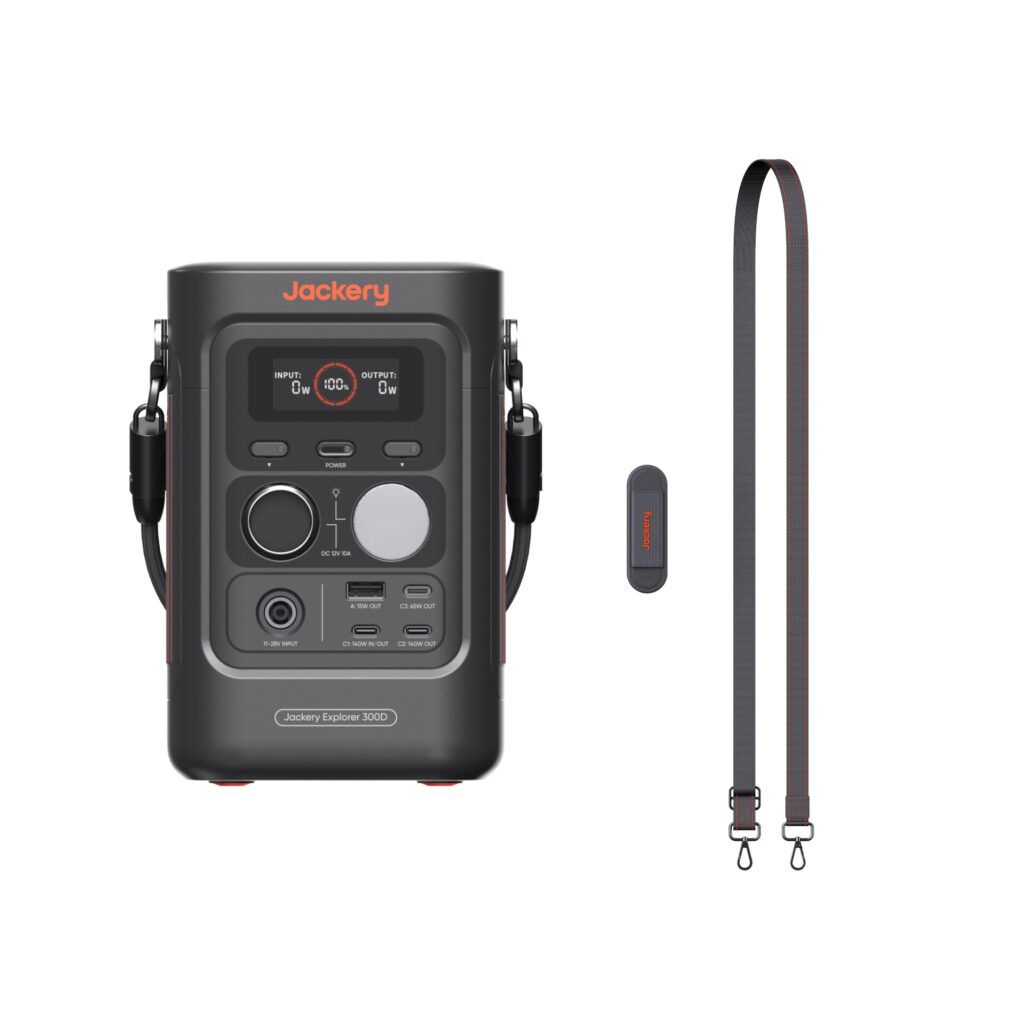
Jackery Explorer 300D
For many boats, the simplest solution. No 230-volt socket, but USB-C and 12 volts, and that is often all you need. 2.5 kg, 288 Wh, no inverter running in the background. If you bring along even a shaver with a mains plug, this is the wrong choice.
Jackery Explorer 1000 v2
Twice the capacity for longer trips, but 10.8 kg and operation only up to 40 degrees. On the 12-volt socket, a full charge takes twelve hours. For boats without a solar panel, that is slow going. In spring 2025, the German automobile club ADAC downgraded the Explorer 1000 v2 to „poor“ because its two DC inputs are not decoupled. So never charge it via solar and the 12-volt onboard system at the same time.
Anker SOLIX C1000 Gen 2
The most powerful inverter in this list. According to Anker, it is fully charged in 49 minutes on shore power, but charging is only permitted from 0 degrees and is fastest above 20 degrees. In spring and fall in the cabin, it is therefore considerably slower. It, too, belongs somewhere dry.
Jackery SolarSaga 100W
The only item in this lineup that, according to the manufacturer, can handle rain. 100 watts only fill an empty station on a good sunny day, but in summer they keep the cooler running.
Which boat, which solution?
- Cabin boat, weekends, laptop and cooler: Explorer 500 v2, strapped down, taken home with you.
- Open boat or inflatable: Unicraft PPS 600 sheltered from spray, or better still the 300D in a box, taken out only when needed.
- Only phone, laptop, 12-volt devices: Explorer 300D.
- Weeks on board: a permanent lithium system from a marine electrician. A portable power station is the wrong approach then.
In winter, it does not belong on the boat but somewhere dry in the house (in German).
Frequently asked questions
Is a portable power station on a boat waterproof?
No. In the manual for the Explorer 3000, Jackery explicitly rules out use in humid environments by the sea or near bodies of water, and Anker calls the SOLIX C1000 Gen 2 not waterproof. None of the manufacturers in the comparison specifies an ingress protection rating for the housing. With the Unicraft PPS 600, IP65 applies only to the sockets.
Where do I put the power station on the boat?
Low and centered in the dry cabin, with two straps around the body and a non-slip mat underneath. Not in the bilge and not in the engine compartment, where it is wet or hot. Jackery prohibits laying the unit on its side. Keep the ventilation slots clear.
May I charge the power station on shore power?
Charging, yes, just like at home, with a 30 milliamp residual current device on board, as the standard DIN EN ISO 13297 requires. Feeding power in, never: the station must not be connected to the onboard system via a homemade cable, otherwise voltage can be present on the exposed pins of the CEE plug. Connect loads directly to the station.
Can I charge the power station from the 12-volt onboard system?
Only with the engine running. According to Jackery, the Explorer 500 v2 needs six hours via the 12-volt socket, and 512 watt hours at 12 volts are more than 40 amp hours. A 60 Ah house battery has nothing to spare for that. With the Explorer 1000 v2, never charge via solar and the onboard system at the same time.
What can be connected to the power station on board?
A laptop via USB-C, phone, lights, fans and the compressor cooler on the 12-volt socket. Keep away from fan heaters. The starter battery, anchor windlass, navigation and radio belong on the onboard system, because anything safety-relevant does not hang on a portable station.
Which power station is enough for a phone and laptop on board?
For many boats, the Jackery Explorer 300D is the simplest solution: no 230-volt socket, but USB-C and 12 volts, 2.5 kg and 288 Wh, with no inverter running in the background. If you bring along even a shaver with a mains plug, though, it is the wrong choice.
Sources
- Yacht: Shore connection, how to bring shore power on board safely
- Jackery: Explorer 3000 manual (PDF)
- Jackery: Explorer 2000 Pro manual (PDF)
- Jackery: Explorer 500 v2
- Jackery: Explorer 300D
- Jackery: Explorer 1000 v2
- Jackery: SolarSaga 100W
- Anker: SOLIX C1000 Gen 2
- Unicraft: Catalog pages, power stations (PDF)
- Victron Energy: Safety precautions for lithium batteries
- Dometic: CFX3 45 compressor cooler
- ADAC: Portable power stations tested (spring 2025)
Where to buy
- Jackery Explorer 500 v2View at JackeryAvailable in Germany: JackeryCheck price at Amazon.deCheck price at Amazon.co.ukCheck price at Amazon.nlCheck price at Amazon.com.beCheck price at Amazon.frCheck price at Amazon.itCheck price at Amazon.esCheck price at Amazon.plCheck price at Amazon.seAvailable in Germany: Amazon.de
- Jackery Explorer 300DView at JackeryAvailable in Germany: JackeryCheck price at Amazon.deCheck price at Amazon.co.ukCheck price at Amazon.nlCheck price at Amazon.com.beCheck price at Amazon.frCheck price at Amazon.itCheck price at Amazon.esCheck price at Amazon.plCheck price at Amazon.seAvailable in Germany: Amazon.de
- Jackery Explorer 1000 v2View at JackeryAvailable in Germany: JackeryCheck price at Amazon.deCheck price at Amazon.co.ukCheck price at Amazon.nlCheck price at Amazon.com.beCheck price at Amazon.frCheck price at Amazon.itCheck price at Amazon.esCheck price at Amazon.plCheck price at Amazon.seAvailable in Germany: Amazon.de
- Jackery SolarSaga 100WView at JackeryAvailable in Germany: JackeryCheck price at Amazon.deCheck price at Amazon.co.ukCheck price at Amazon.nlCheck price at Amazon.com.beCheck price at Amazon.frCheck price at Amazon.itCheck price at Amazon.esCheck price at Amazon.plCheck price at Amazon.seAvailable in Germany: Amazon.de
- Unicraft PPS 600Check price at Amazon.deCheck price at Amazon.co.ukCheck price at Amazon.nlCheck price at Amazon.com.beCheck price at Amazon.frCheck price at Amazon.itCheck price at Amazon.esCheck price at Amazon.plCheck price at Amazon.seAvailable in Germany: Amazon.de
- Anker SOLIX C1000 Gen 2Check price at Amazon.deCheck price at Amazon.co.ukCheck price at Amazon.nlCheck price at Amazon.com.beCheck price at Amazon.frCheck price at Amazon.itCheck price at Amazon.esCheck price at Amazon.plCheck price at Amazon.seAvailable in Germany: Amazon.de