Contents10 sections
This guide was first published in German on handgetestet.de.
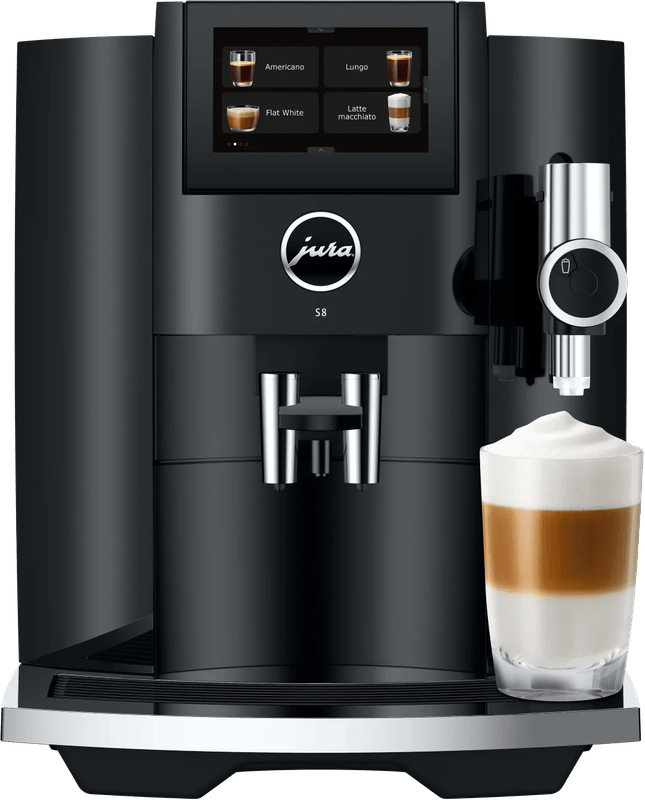
In the premium class, what you mainly buy with a super-automatic coffee machine is less work. Automatic milk cleaning, large touch displays, cold brew and grinders that adjust themselves. For most households that drink milk coffee in the morning, we consider the JURA S8 the most sensible choice in this price range: compact, with a touchscreen and a milk system that rinses itself at the touch of a button. If you want to stay just above the threshold, the JURA E8 gives you almost the same technology with buttons instead of a touchscreen.
If all you want is good coffee for two people, a considerably cheaper machine is often enough. Our guide to budget super-automatic machines shows where the line is.
What the extra money actually pays for
What separates expensive machines from mid-range ones is mostly found in the list of features. Three areas count.
First, the milk. A milk system quickly builds up germs if it is not cleaned. Stiftung Warentest, the German consumer testing organization, advises rinsing it after every cappuccino or latte macchiato and points out that, despite the automatic function, individual parts must be cleaned by hand regularly according to the manual. All JURA models here have automatic milk system cleaning at the touch of a button. With the other manufacturers, it is worth checking the manual to see how many parts you will be carrying to the sink.
Then the brewing unit. With a permanently installed brewing unit, as JURA uses, a cleaning program does the work, according to Warentest. According to many manufacturers, removable brewing units should be rinsed under running water about once a week. What both approaches mean for maintenance and running costs is compared in our guide DeLonghi or Jura (in German).
Both work.
And finally, descaling. Here there is a point that hardly any brochure mentions. According to a Stiftung Warentest report from October 2026, JURA and Siemens recommend descaling tablets containing sulfamic acid. The substance is poorly biodegradable and is not removed in sewage treatment plants. De’Longhi, Philips and Saeco, on the other hand, rely on descalers with lactic or citric acid. If that matters to you, you should know it before buying.
Five premium super-automatic machines side by side
| Model | Drinks according to manufacturer | Milk | Operation | Best for |
|---|---|---|---|---|
| JURA S8 Piano Black (EB) | 27 | tube, automatic cleaning | 4.3-inch touchscreen | families, small kitchens |
| JURA E8 Piano White (ED) | 27 | tube, automatic cleaning | 3.5-inch display with buttons | entry into the premium class |
| JURA Z10 Aluminium White (EB) | 51, including cold-extracted | tube, automatic cleaning | 4.3-inch touchscreen | cold brew fans, changing beans |
| Siemens EQ900 iAroma TQ925E03 | 41 | integrated 0.7 l container | 6.8-inch touchscreen, app | many users, large bean supplies |
| De’Longhi Eletta Ultra ECAM470.85.MB | 51, including cold brew | LatteCrema Hot & Cool carafe | 4.3-inch touchscreen, app | cold milk drinks, acid-based descaler |
Before ordering: tape measure and power outlet
Expensive super-automatic machines are often wider and heavier than mid-range ones. According to the data sheet, the JURA E8 needs only 27 centimeters of width, the S8 28. The Z10 measures 32 centimeters, the Siemens 31.5 centimeters with a height of 39.2 centimeters. Measure the space under the wall cabinet and leave room for the lid of the bean container. When it comes to power, the machines are close to one another. JURA and Siemens state 1,450 to 1,500 watts. Standby mode is more interesting. For all three JURA models, the manufacturer states 0 watts in standby, and the E8 carries energy efficiency class A with 57.6 kWh per year. Siemens and De’Longhi do not state a standby value on their product pages.
JURA S8: the sensible compromise
The S8 is 28 centimeters wide and weighs 9.8 kilograms. At 34.8 centimeters tall, it also fits under low wall cabinets. JURA states 27 specialties, a P.A.G.2 grinder, a 1.9-liter water tank and a 280-gram bean container. It is operated via a 4.3-inch touchscreen. According to the data sheet, it draws 0 watts in standby. The Wi-Fi module for the app is not included; it is available as an accessory. For households with two to four coffee drinkers, this set of features is well balanced.
JURA E8: the same basis, less screen
Technically, the E8 is close to the S8: same grinder, same number of specialties, same tank size. Instead of a touchscreen, it has a 3.5-inch color display with buttons. According to JURA, the ED version is from model year 2025 and carries energy efficiency class A with 57.6 kWh per year. A milk carafe is not included, only a milk tube. If you can live with buttons, you save money compared with the S8.
JURA Z10: for bean switchers and cold brew
The Z10 is the first choice if you often buy different beans. According to JURA, its P.R.G.2+ grinder automatically adjusts the grind size and grind quantity. There is also a process for cold-extracted drinks. 51 specialties, a 2.4-liter water tank and a weight of 12.3 kilograms show that this is a large machine. For people who only drink cappuccino, that is too much machine.
Siemens EQ900 iAroma TQ925E03: the largest display
Siemens relies on a 6.8-inch touch display, an integrated 0.7-liter milk container and a 375-gram bean container. According to the data sheet, the ceramic grinder can be set in six levels. There are 41 drinks to choose from, some of them only via the Home Connect app. At 31.5 centimeters wide and 12 kilograms, it needs space. One drawback is the sulfamic acid descaler that Siemens recommends.
De’Longhi Eletta Ultra: cold drinks without detours
The Eletta Ultra offers 51 drinks, including cold brew and cold brew latte, and the LatteCrema Hot & Cool milk system, which according to the manufacturer prepares warm and cold milk foam. The water tank holds 1.8 liters. According to De’Longhi, thanks to its Silent technology, it brews up to 65 percent more quietly than the company’s own machines without this technology. How much manual work the milk carafe involves is something you should check in the manual before ordering. For households that like to drink cold coffee in summer, it is the most interesting machine on this list.
How we would decide
- Milk coffee in the morning, little space, little cleaning: JURA S8.
- Same technology, smaller budget: JURA E8 in the ED version.
- Changing beans, occasional cold brew, room on the countertop: JURA Z10.
- Cold milk drinks and a descaler without sulfamic acid: De’Longhi Eletta Ultra.
- Large household that likes to order via app: Siemens EQ900.
A note on the versions. JURA sells the same model names in several versions, marked with suffixes such as EA, EB or ED. The features can differ between them. When buying, check the suffix in the product name. Whether an espresso machine with a portafilter might suit your kitchen better after all is answered in our guide super-automatic or portafilter machine (in German). A broad overview of all price ranges is provided in our super-automatic coffee machine guide (in German).
Frequently asked questions
Is an expensive super-automatic coffee machine worth it?
For good coffee for two people, a considerably cheaper machine is often enough. The extra money mainly goes into less work: automatic milk system cleaning, large touch displays, cold brew and grinders that adjust themselves. If you do not need that, you are better off saving.
How often does the milk system need to be cleaned?
Stiftung Warentest, the German consumer testing organization, advises rinsing it after every cappuccino or latte macchiato, because otherwise germs build up quickly. Despite the automatic function, individual parts must be cleaned by hand regularly according to the manual. All JURA models in the comparison rinse the milk system at the touch of a button.
Which descaler is more environmentally friendly?
JURA and Siemens recommend tablets containing sulfamic acid, which is poorly biodegradable and is not removed in sewage treatment plants. De'Longhi, Philips and Saeco rely on lactic or citric acid. If that matters to you, you should know it before buying.
Which super-automatic machine is best for changing beans and cold brew?
The JURA Z10. According to JURA, its grinder automatically adjusts the grind size and grind quantity, and there is also a process for cold-extracted drinks. At 12.3 kilograms and 32 centimeters wide, however, it is large. For people who only drink cappuccino, that is too much machine.
Will a large super-automatic machine fit under the wall cabinet?
Measure beforehand. The JURA E8 needs only 27 centimeters of width, the S8 28, and at 34.8 centimeters tall the S8 also fits under low wall cabinets. The Siemens EQ900 is 39.2 centimeters tall. Leave room for the lid of the bean container.
What do suffixes like EB or ED mean at JURA?
JURA sells the same model names in several versions, marked with suffixes such as EA, EB or ED. The features can differ between them. When buying, check the suffix in the product name.
Sources
- JURA: S8 Piano Black (EB)
- JURA: E8 Piano White (ED)
- JURA: Z10 Aluminium White (EB)
- Siemens: EQ900 iAroma TQ925E03
- De’Longhi: Eletta Ultra ECAM470.85.MB
- Stiftung Warentest: Cleaning super-automatic coffee machines (July 27, 2026)
- Stiftung Warentest: Descaling super-automatic coffee machines in an environmentally friendly way (October 29, 2026)
Where to buy
- JURA S8 Piano Black (EB)View at CoolblueAvailable in Germany: Coolblue
- JURA E8 Cosmic Black (ED)View at CoolblueAvailable in Germany: Coolblue
- JURA Z10 Aluminium White (EB)View at CoolblueAvailable in Germany: Coolblue
- Siemens EQ900 iAroma TQ925E03View at CoolblueAvailable in Germany: Coolblue
- De'Longhi Eletta Ultra ECAM470.85.MBView at CoolblueAvailable in Germany: Coolblue