Contents12 sections
This guide was first published in German on handgetestet.de.
What does Wi-Fi actually do for an air purifier? An app for switching it on, hardly anything. The benefit lies elsewhere: a connected device only runs when it is needed, and that decides the filter bill. We do not give a clear recommendation here: the integration with Home Assistant and ioBroker that makes the BOLD Sander for 43 m² interesting is so far only a claim by the retailer ELV (German retailer). If you use one of these systems, check it before buying, and the device should not run around the clock anyway.
The basics of HEPA, CADR and noise are covered in our guide to buying an air purifier. This one is about three questions that get too little attention there.
How large can the room really be?
The Hama example shows the problem with a single device. For the same air purifier, the manual states 21 m² under the AHAM standard and 65 m² under NRCC, and the online store only says „up to 65 m².“ Both are correct; the calculation behind them is simply different. Divide the CADR by the room volume and you can see what actually happens: 250 m³/h in 65 m² with a 2.50-meter ceiling results in 1.5 air changes per hour, compared with 4.8 in 21 m².
For the table below, we consistently assumed a 2.50-meter ceiling and five air changes. That is the stricter calculation. The range given on the BOLD devices is more honest; its upper limit works out to a little over 3 air changes. So a 30 m² living room does not need the largest model.
What do the sensors measure, and what not?
A dust sensor detects particles. It does not detect carbon dioxide, and the air purifier cannot remove it anyway, any more than it can remove water vapor. The German Environment Agency (Umweltbundesamt) explicitly points this out and regards such devices only as a supplement to airing out the room. So a green light on the device says nothing about whether the air in the bedroom is stale. For that, the room needs a CO2 meter (in German).
Then there is accuracy. In the manual, BOLD itself describes the PM2.5 figure on the Sander as „for reference only,“ and at very high humidity, condensation can form in the sensor and produce false readings. It needs cleaning every two months. So do not hang your automation blindly on a single value. Temperature and humidity on the Sander’s display are fine for orientation, but for questions about mold, a separate hygrometer at the critical spot is more meaningful.
How much do the filters cost per year?
This is where it gets uncomfortable. In the manual, BOLD only writes that the HEPA and activated carbon filters should be replaced at least once a year. ELV, on the other hand, states a service life of 2,000 hours for the filter sets. Around the clock, that is 83 days, so a good four sets per year. At ELV, each set costs about a third of the device. Continuous operation therefore eats up more in twelve months than the air purifier itself cost.
At ten hours a day, one set lasts 200 days; at five and a half hours, a whole year. Only then do both figures fit together. This is exactly where a smart home earns its keep: a schedule that switches it off at night, starting only when pollen is flying or when nobody is airing the room, switching off when a window is open. Philips and Dyson state one year but base this on their own usage assumptions, and Philips adds that the service life depends on air quality and use. The figures therefore cannot be compared directly. For the Hama device, we found no information on service life. After replacing the filter, you reset the counter manually in the app.
Electricity matters less. If 33 watts run continuously for a year, that is around 290 kWh, and that is at the highest setting. In automatic mode, the figure is lower.
Six devices, calculated the same way
| Model | CADR | Room at 5 air changes | Sensors | Integration | Filter according to supplier |
|---|---|---|---|---|---|
| BOLD Sander 43 m² | 360 m³/h | about 29 m² | Dust sensor, PM2.5 display | Smart Life (Tuya), Alexa, Google, according to ELV Home Assistant and ioBroker | ELV: 2,000 hours, BOLD: at least annually |
| BOLD Sander 31 m² | 260 m³/h | about 21 m² | Dust sensor, PM2.5 display | same as Sander 43 m² | BOLD: at least annually |
| BOLD Sander 61 m² | 510 m³/h | about 41 m² | Dust sensor, PM2.5 display | same as Sander 43 m² | ELV: 2,000 hours, BOLD: at least annually |
| Hama Smart Luftreiniger | 250 m³/h | about 20 m² | Auto setting, no reading specified | Hama app, Alexa, Google | not specified |
| Philips PureProtect 3200 AC3220/10 | 520 m³/h (GB/T) | about 42 m² | PM2.5 and allergens | Air+ app, Alexa, Google | 1 year, depending on air and use |
| Dyson Purifier Cool PC1 | not specified | cannot be calculated | Sensors, live readings in the app | MyDyson app, Alexa, Google, Siri | 1 year |
BOLD Sander 43 m²
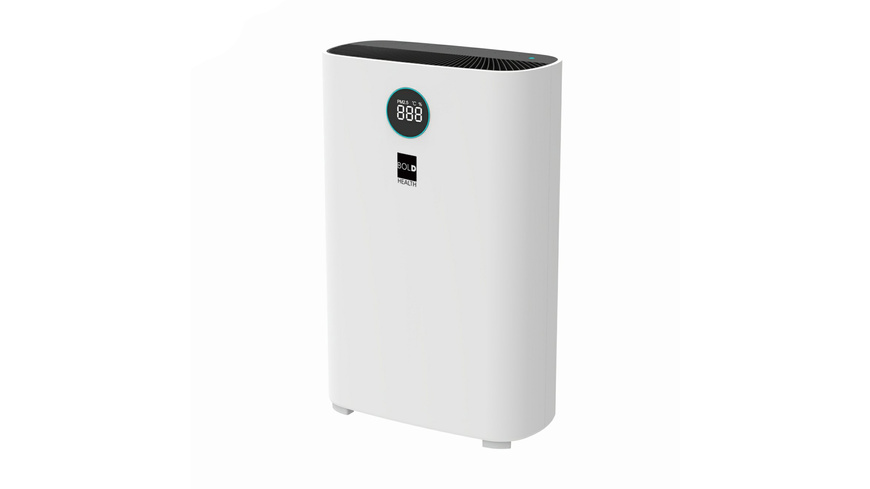
The middle model is the compromise of the range. CADR of 360 m³/h at 33 watts, noise level of 20 to 60 dB(A), plus a pre-filter, HEPA 13, activated carbon and a UV-C stage that can be switched off. ELV lists Tuya, Alexa, Google Assistant, Home Assistant and ioBroker as compatible. That would be the reason to choose it, because Philips and Dyson do not mention Home Assistant. However, this is only backed by the retailer; we did not have a data sheet or an independent measurement. And the connection runs through the Tuya cloud, with the Home Assistant integration working as „cloud push.“ No internet, no automation. At 7.2 kilos and 63.5 centimeters tall, it does not blend into the room.
One quirk affects automations in particular. According to the manual, ionization is active every time the device is switched on and can only be turned off by pressing the UV button for five seconds. If the device is connected to a switchable outlet, you have to expect it to run again after every start. The German Environment Agency had no data on the effectiveness of such technology. For placement, BOLD requires 50 centimeters of space on the left and right, 10 at the back and 100 from a TV; kitchens and bathrooms are ruled out.
BOLD Sander 31 m²
For bedrooms up to just over 20 m². 23 watts, 5.2 kilos, otherwise the same features. The filter set costs almost as much as for the middle model, so relative to the device it is the most expensive.
BOLD Sander 61 m²
Makes sense in an open-plan living area. 66 watts and up to 65 dB(A) are a different league, and 9.7 kilos is not something you casually carry from room to room. The set costs noticeably more than that of the smaller devices.
Hama Smart Luftreiniger
It connects via 2.4 GHz Wi-Fi. The app and voice commands cover on, off, fan level, timer and light. Hama does not mention anything more; there is no word of particulate readings or interfaces to other systems. For 20 m² and modest demands on automation, that is enough. If you want to build rules, you will quickly hit the limits of the manufacturer’s app.
Philips PureProtect 3200 AC3220/10
On paper, the most powerful: 520 m³/h, 15 to 47.5 dB(A), scheduling in the app. As a pure air purifier in the living room, it comes out ahead thanks to its low noise level. For switching rules, you are limited to the Air+ app, Alexa and Google. The CADR is measured according to the Chinese GB/T standard and therefore cannot be compared directly with every value.
Dyson Purifier Cool PC1
It is the only one here for which the manufacturer mentions Siri, and it is also a fan. Dyson does not state a CADR, which is why the room column stays empty. The manufacturer gives the noise level as 38 to 56 dBA. For the bedroom, that is not good enough for us.
How we would decide
Calculate first: room volume times five gives the required CADR. Then estimate the running time. At under eight hours a day and with Home Assistant or ioBroker in the house, the Sander in the size that matches the room is the right fit. If the device is to run continuously and above all quietly, the Philips is the better choice. Choose the Hama if app and voice control are enough. For Home Assistant without Tuya: Levoit offers the VeSync integration with the Core 300S, 400S and 600S, including PM2.5 readings and remaining filter life.
If you have allergies or asthma, consult a doctor before use. An air purifier does little against dust on the floor anyway; for that, our article on robot vacuums for allergy sufferers is a better fit.
Frequently asked questions
How large can the room be for an air purifier?
Divide the CADR by the room volume. For the same device, Hama states 21 m² under AHAM and 65 m² under NRCC. With 250 m³/h in 65 m² and a 2.50-meter ceiling, you only get 1.5 air changes per hour, compared with 4.8 in 21 m². This guide consistently calculates with five air changes.
Does an air purifier also measure CO2?
No. A dust sensor detects particles, and an air purifier removes carbon dioxide no more than it removes water vapor. The German Environment Agency regards such devices only as a supplement to airing out the room. A separate CO2 meter shows whether the air in the bedroom is stale.
How much do air purifier filters cost per year?
That depends on the running time. ELV (German retailer) states 2,000 hours for the BOLD filter sets; around the clock, that is 83 days, or a good four sets per year. The filters then cost more than the device itself. At five and a half hours a day, one set lasts a whole year.
How reliable is the particulate sensor in an air purifier?
In the manual, BOLD itself describes the PM2.5 figure on the Sander as for reference only. At very high humidity, condensation can form in the sensor and produce false readings, and it needs cleaning every two months. So do not hang automations blindly on a single value.
Does the BOLD Sander work with Home Assistant?
According to ELV, yes, but this is only backed by the retailer. The connection runs through the Tuya cloud, the integration works as cloud push, and without internet there is no automation. In addition, ionization is active every time the device is switched on, so on a switchable outlet it runs again after every start.
How much electricity does an air purifier use?
Less than the filters cost. If 33 watts run continuously for a year, that is around 290 kWh, and that is at the highest setting. In automatic mode, the figure is lower. If you have allergies or asthma, consult a doctor before use.
Sources
- German Environment Agency: Portable air purifiers only as a supplement to ventilation
- Die Bold GmbH: Sander user manual
- ELV: BOLD Sander 25 to 43 m² (retailer information)
- ELV: BOLD Sander 20 to 31 m² (retailer information)
- ELV: BOLD Sander 35 to 61 m² (retailer information)
- ELV: Filter set for Sander 43 m²
- ELV: Hama Smart Luftreiniger
- Hama: Smart air purifier user manual
- Philips: PureProtect 3200 Series AC3220/10
- Dyson: Purifier Cool PC1
- Home Assistant: Tuya integration
- Home Assistant: VeSync integration
Where to buy
- BOLD Sander 43 m²View at ELVAvailable in Germany: ELVCheck price at Amazon.deCheck price at Amazon.co.ukCheck price at Amazon.nlCheck price at Amazon.com.beCheck price at Amazon.frCheck price at Amazon.itCheck price at Amazon.esCheck price at Amazon.plCheck price at Amazon.seAvailable in Germany: Amazon.de
- BOLD Sander 31 m²View at ELVAvailable in Germany: ELVCheck price at Amazon.deCheck price at Amazon.co.ukCheck price at Amazon.nlCheck price at Amazon.com.beCheck price at Amazon.frCheck price at Amazon.itCheck price at Amazon.esCheck price at Amazon.plCheck price at Amazon.seAvailable in Germany: Amazon.de
- BOLD Sander 61 m²View at ELVAvailable in Germany: ELVCheck price at Amazon.deCheck price at Amazon.co.ukCheck price at Amazon.nlCheck price at Amazon.com.beCheck price at Amazon.frCheck price at Amazon.itCheck price at Amazon.esCheck price at Amazon.plCheck price at Amazon.seAvailable in Germany: Amazon.de
- Hama Smart LuftreinigerView at ELVAvailable in Germany: ELV
- Philips PureProtect 3200 AC3220/10Check price at Amazon.deCheck price at Amazon.co.ukCheck price at Amazon.nlCheck price at Amazon.com.beCheck price at Amazon.frCheck price at Amazon.itCheck price at Amazon.esCheck price at Amazon.plCheck price at Amazon.seAvailable in Germany: Amazon.deView at CoolblueAvailable in Germany: Coolblue
- Dyson Purifier Cool PC1Check price at Amazon.deCheck price at Amazon.co.ukCheck price at Amazon.nlCheck price at Amazon.com.beCheck price at Amazon.frCheck price at Amazon.itCheck price at Amazon.esCheck price at Amazon.plCheck price at Amazon.seAvailable in Germany: Amazon.de