Contents11 sections
This guide was first published in German on handgetestet.de.
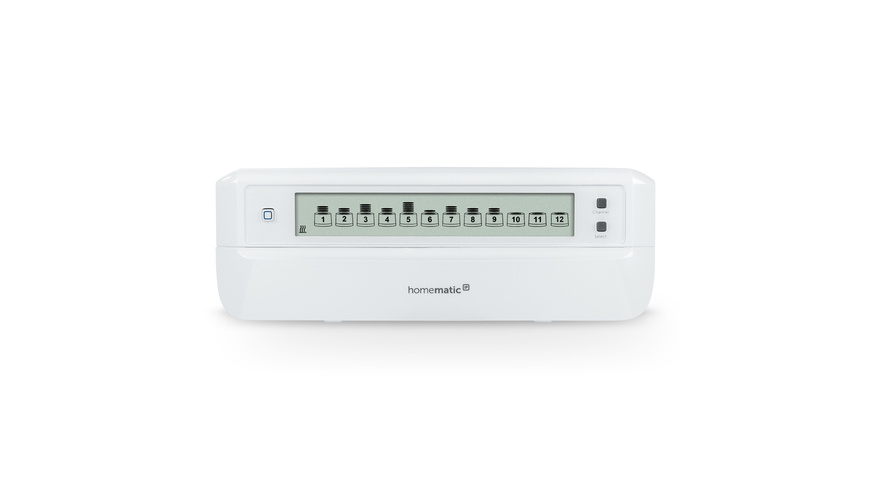
Anyone who wants to make underfloor heating smart often buys a stylish wall thermostat first. Yet the decision is usually made one floor down, in the manifold cabinet. For most existing homes with a heating manifold, we consider a wireless actuator directly at the manifold the cleanest approach, ideally with motorized valve actuators as with the Homematic IP HmIP-FALMOT-C12. A smart room thermostat is enough if only one or two rooms need to run differently.
Two places where you can intervene
A water-based underfloor heating system has two components. In the room, a thermostat hangs on the wall. At the manifold, small valve actuators sit on the valves and open or close the heating circuit. In conventional systems, there is a terminal strip in between, where each wall thermostat switches its actuators via a 230-volt cable.
That gives you two retrofit options. Either you replace the thermostat in the flush-mounted wall box with a smart model that keeps switching the existing wire. That is how tado, Bosch and Eve work. Or you swap the terminal strip for an actuator controller that drives the valve actuators itself and receives its commands wirelessly from wall thermostats. That is the approach taken by Homematic IP and Danfoss Icon2.
The first option is the smaller intervention. It reaches its limit, however, if there is no cable to the manifold in a room or if one thermostat is supposed to serve several circuits. The second option makes the manifold the hub and requires no new wiring in the living spaces.
Thermal or motorized: the underestimated difference
Most manifolds carry thermal valve actuators. They only know open and closed and are switched in cycles. That works, but it requires proper hydronic balancing; otherwise the bathroom at the end of the long pipe gets too little water. In its comparison overview, eQ-3 explicitly states that balancing the heating circuits remains necessary with the 230-volt actuator controllers and thermal actuators.
Motorized actuators adjust the valve continuously. According to Homematic IP, the HmIP-FALMOT-C12 balances the circuits dynamically and on its own, which according to the manufacturer has been confirmed by the Fraunhofer IEE research institute. Danfoss also advertises automatic balancing for the Icon2, in its case through refined cycling.
A warning belongs here. A screed several centimeters thick stores a lot of heat and reacts correspondingly slowly. If you schedule a new temperature every hour, you are asking more of the system than it can deliver. A few changes a day make more sense.
Work on 230-volt wiring is a job for a qualified electrician. Bosch explicitly requires this for its thermostat, and the same applies to every other device in the wall box or at the manifold.
Six systems for underfloor heating
| Model | Installation location | Actuators and circuits | Wireless and hub | Best for |
|---|---|---|---|---|
| Homematic IP HmIP-FALMOT-C12 | Manifold | 12 circuits, HmIP-VDMOT motorized actuators | Homematic IP wireless; Access Point or wall thermostat | Whole house, system without proper balancing |
| Homematic IP HmIP-FAL230-C6 | Manifold | 6 zones, up to 9 thermal 230 V actuators | Homematic IP wireless; Access Point or wall thermostat | Apartment, keeping existing actuators |
| Danfoss Icon2 | Manifold | 15 outputs, 230 V (24 V with module) | Zigbee wireless or two-wire; app via gateway | New builds and renovations with an installer |
| tado Smart Thermostat X | Wall (replacing old thermostat) | Switches existing wire | Thread and Matter; Bridge X or border router | Individual rooms, app users |
| Bosch Smart Home Room Thermostat II 230 V | Flush-mounted wall box | Relay 3 A resistive, 1 A inductive | Zigbee 3.0; Controller II | Households with Bosch Smart Home |
| Eve Thermostat | Wall (replacing old thermostat) | Triac up to 15 W or relay | Thread and Matter; Matter hub | Apple or Google households without cloud |
Homematic IP HmIP-FALMOT-C12: the manifold helps regulate
The actuator controller drives up to twelve heating circuits, each with one HmIP-VDMOT motorized valve actuator, sold separately. According to the manufacturer, it is powered by 230 V or 24 V DC. Without an Access Point, it runs in stand-alone mode with the HmIP-WTH-2 wall thermostat, and settings are then made on the thermostat. If you want the app, add the Access Point. With the Multi IO Box, according to Homematic IP, the system can also cool, provided a heat pump supports it. For an entire floor, we consider it the most coherent solution, because balancing is taken care of at the same time.
Homematic IP HmIP-FAL230-C6: when the actuators are to stay
Six zones, up to nine thermal 230-volt actuators. If the controller is to switch a circulation pump, eight remain. The advantage is simple: the existing actuators on the manifold can stay, and only the terminal strip is replaced. According to the manufacturer, it works stand-alone with the HmIP-WTH-B wall thermostat; for the app and voice control, you need the Access Point. For homes with more rooms, the same technology is available as the HmIP-FAL230-C10 with ten zones.
In new builds with empty conduits, Homematic IP Wired is worth a look. The HmIPW-FALMOT-C12 connects to the 24-volt bus and requires the HmIPW-DRAP Wired Access Point and the HmIPW-WTH Wired wall thermostat. No wireless, no batteries. That is a decision for the shell construction phase, not for retrofitting.
Danfoss Icon2: the heating installer’s system
Icon2 is building technology rather than a gadget. According to the data sheet, the main controller has 15 outputs for one valve actuator each, switches a pump and reports heat demand to the boiler. Room thermostats can be connected via Zigbee wireless or a 24 V two-wire line, including a mix of both. The Ally app requires an additional gateway. The extended version 088U2110 can also control the flow temperature if desired. We see Icon2 in new builds and renovations with an installer who knows the system.
tado Smart Thermostat X: room by room
According to tado, the wired version replaces the existing room thermostat of a water-based underfloor heating system. You need one unit per room. In the app, you can select a dedicated control mode for underfloor heating that switches less frequently and, according to the manufacturer, is free of charge. The units communicate via Thread. If there is no Thread border router in the house, add the Bridge X, because the bridge from the older V3+ series does not work. The AI Assist subscription is optional. If you already use tado on your radiators, you stay in one app this way.
Bosch Smart Home Room Thermostat II 230 V
A flush-mounted thermostat for households that already use Bosch Smart Home. According to Bosch, without the Controller II only basic functions remain. The relay switches up to 3 A resistive and 1 A inductive load, and the wall box must be at least 35 mm deep. The unit also measures humidity. Damp rooms are off-limits, as the protection rating only goes up to IP21.
Eve Thermostat: Matter instead of a manufacturer cloud
Eve builds its thermostat exclusively for water-based 230-volt underfloor heating. It switches thermal actuators silently via a triac, but only up to 15 W. If many actuators are connected to one thermostat, use the relay instead, with up to 5 A resistive load. Control runs via Matter and Thread, and you need a hub with a Matter controller and border router, such as an Apple TV. You set up schedules in the Eve app. The thermostat cannot control electric underfloor heating.
How we would decide
- Older or existing home with a manifold and unevenly heated rooms: HmIP-FALMOT-C12 with motorized actuators and one wall thermostat per room.
- Apartment with working 230-volt actuators and few rooms: HmIP-FAL230-C6, and the actuators stay on the manifold.
- New build, heating installer on board: Danfoss Icon2 or Homematic IP Wired.
- Only the bathroom or living room is to become smart, and the cable to the terminal strip is already there: tado, Bosch or Eve, depending on your existing hub.
Before buying, take a look in the manifold cabinet. Count the circuits and note whether the actuators run on 230 V or 24 V. Then you will know which actuator controller fits. For radiators in the same house, you will find advice in our guide to smart radiator thermostats (in German). If you are only looking for a single wall unit, there is a wider selection in the smart room thermostat guide, and which hub suits which wireless standard is covered in our article on the smart home hub.
How a wall thermostat and underfloor heating controller work together over a bus line instead of wirelessly is shown in the guide to Homematic IP Wired.
If only a single actuator on the manifold is faulty, the guide to replacing a valve actuator explains NC, NO, voltage and stroke.
The ready-made Homematic IP bundles are sorted out in the guide to Homematic IP heating sets (in German).
How long a simple room thermostat lasts is shown in our long-term review of the Eberle RTR-E over eleven years.
Frequently asked questions
Actuator at the manifold or smart thermostat: what is the difference?
A smart thermostat replaces the old unit in the flush-mounted wall box and keeps switching the existing wire; that is how tado, Bosch and Eve work. An actuator replaces the terminal strip at the manifold, controls the valve actuators itself and receives commands wirelessly; that is the approach taken by Homematic IP and Danfoss Icon2.
Which is better: thermal or motorized valve actuators?
Thermal actuators only know open and closed and require proper hydronic balancing. Motorized actuators adjust the valve continuously. With the HmIP-FALMOT-C12, according to Homematic IP, they balance the circuits dynamically and on their own.
Can I keep my existing valve actuators?
With the Homematic IP HmIP-FAL230-C6, yes: it switches six zones with up to nine thermal 230-volt actuators, and only the terminal strip is replaced. According to eQ-3, however, balancing the heating circuits remains necessary with thermal actuators. For more rooms, there is the HmIP-FAL230-C10.
How often should underfloor heating change temperature?
Rarely. A screed several centimeters thick stores a lot of heat and reacts slowly. If you schedule a new temperature every hour, you are asking more of the system than it can deliver. A few changes a day make more sense, and tado offers a dedicated control mode for this.
Can I connect a smart thermostat for underfloor heating myself?
No, work on 230-volt wiring is a job for a qualified electrician. Bosch explicitly requires this for its thermostat, and the same applies to every other device in the wall box or at the manifold.
What should I check in the manifold cabinet before buying?
Count the heating circuits and note whether the actuators run on 230 V or 24 V. That determines which actuator controller fits. The HmIP-FALMOT-C12, for example, controls up to twelve circuits, and the Danfoss Icon2 has 15 outputs.
Sources
- Homematic IP: Underfloor heating actuator, 12 channels, motorized (HmIP-FALMOT-C12)
- Homematic IP: Underfloor heating controller, 6 channels, 230 V (HmIP-FAL230-C6)
- Homematic IP: Wired underfloor heating controller, 12 channels, motorized (HmIPW-FALMOT-C12)
- eQ-3: Comparison of Homematic IP underfloor heating actuators (PDF)
- Danfoss: Icon2 main controller data sheet (PDF, retailer copy)
- tado: How tado X controls underfloor heating systems
- tado: Smart Thermostat X for boilers and underfloor heating
- Bosch Smart Home: Help for the Room Thermostat II 230 V
- Eve: Eve Thermostat
Where to buy
- Homematic IP HmIP-FALMOT-C12View at ELVAvailable in Germany: ELVCheck price at Amazon.deAvailable in Germany: Amazon.de
- Homematic IP HmIP-FAL230-C6Check price at Amazon.deAvailable in Germany: Amazon.de
- Homematic IP Stellantrieb HmIP-VDMOTCheck price at Amazon.deAvailable in Germany: Amazon.de
- Homematic IP Wandthermostat HmIP-WTH-2Check price at Amazon.deAvailable in Germany: Amazon.de
- Danfoss Icon2Check price at Amazon.deAvailable in Germany: Amazon.de
- tado Smart Thermostat X verkabeltCheck price at Amazon.deAvailable in Germany: Amazon.de
- Bosch Smart Home Raumthermostat II 230 VCheck price at Amazon.deAvailable in Germany: Amazon.de
- Eve ThermostatCheck price at Amazon.deAvailable in Germany: Amazon.de