Contents11 sections
This guide was first published in German on handgetestet.de.
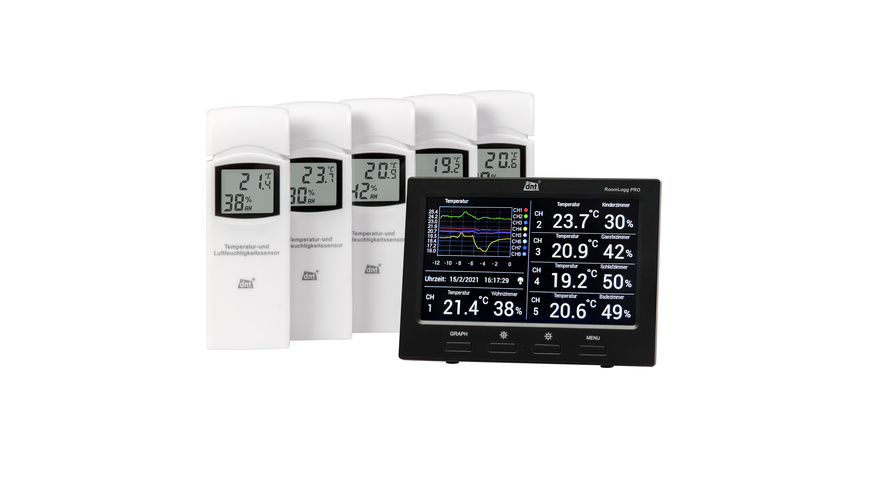
A single reading proves little. If you want to know why the corner of your bedroom is turning black, you need temperature and humidity over weeks and at several points at the same time. For the home, we therefore consider the dnt RoomLogg PRO with five wireless sensors the most sensible purchase. If only a single location matters, the ELV UTD100 measures more accurately according to its data sheet and costs considerably less.
A data logger records independently and delivers a file at the end. That sets it apart from the smart thermo-hygrometer, which mainly shows the current moment in the app. And from the moisture meter, which measures in walls or wood, not in the air.
Five loggers for temperature and humidity
| Model | Accuracy | Memory | Readout | Suitable for |
|---|---|---|---|---|
| dnt RoomLogg PRO | ±1 °C, ±5 % RH | microSD (not included) | CSV, PC software | several rooms at the same time |
| ELV UTD100 | ±0.5 °C, ±3 % RH | 24,000 per variable | USB, PDF and spreadsheet | one measuring point for up to about three months |
| TFA LOG32 TH | from ±0.5 °C, from ±3 % RH | 60,000 per variable | USB, PDF without software | documentation with factory certificate |
| Trotec BL30 | 2 °C, 3.5 % RH | 16,000 per variable | USB, software | ring memory, display |
| Lascar EL-USB-2 | 0.45 °C, 3 % RH | 16,382 per variable | USB, software for Windows | basement and wine storage over months |
What does the German Environment Agency say?
Its mold guideline considers simple thermo-hygrometers suitable for a rough assessment. Meaningful results come from long-term measurements over several weeks, usually in the cold season, at the important points: the suspected cool surface, the room air and, where applicable, the outdoor air. That is already three measuring points. A single logger cannot do that.
And there is no fixed limit for room air. What matters is the humidity at the surface. According to the guideline, 70 to 80 percent there is enough if it persists; below about 70 percent, no mold grows. Two calculation examples from the paper show how far apart room and wall can be. At 22 °C and 50 percent in the room, a wall at 14.5 °C sees 80 percent. Behind a wardrobe in an exterior corner, 60 percent room humidity at 20 °C even becomes 88 percent.
Does the curve help in a dispute with the landlord?
It helps you understand what is happening, but it is not an expert report. According to the German Environment Agency, surface humidity is calculated from the indoor climate and measured wall temperatures, and the agency considers longer measurements on the walls a job for experts. Also bear in mind: according to the guideline, the logger also records ventilation behavior. So the curve also shows when your window stayed closed. That can speak for you or against you. If you want the cause clarified, you can find points of contact through the consumer advice center (Verbraucherzentrale), a tenants‘ association or the public health office.
How long does the memory last?
Assume five minutes between two measurements, because indoor climate rarely needs finer resolution; at that rate, 24,000 values fill just under 12 weeks, 16,000 values about 8 weeks and 60,000 values a good 29 weeks. With the UTD100, the coin cell is more likely to be the limit; ELV gives a runtime of around three months. For the course of a year in the basement, choose longer intervals; one hour is enough there.
dnt RoomLogg PRO: three points and more
Five sensors transmit wirelessly to one station, and up to eight are possible. That way, the room, the cold corner, the neighboring room and the outdoors all run on one clock. According to ELV, the sensors are rated IPX3, and the data ends up as CSV on the microSD card. You buy the card separately, plus two AA batteries per sensor. At ±5 percent for humidity, it is the least accurate here. For comparing the measuring points, that matters less than for the absolute value, especially as the sensors can be calibrated.
ELV UTD100: small, no installation
Plug it into a Windows computer after the measurement, and it delivers a PDF and an Excel spreadsheet. Eight markers can be set, for example when you move it. Be careful in damp basements. According to the data sheet, IP65 does not apply to the sensor area, and the operating range in the manual is given as less than 80 percent, in the data sheet as less than 90 percent. The manual only names Windows as the operating system.
TFA LOG32 TH: PDF without software
Preprogrammed, it measures every five minutes and outputs a PDF without software; the manufacturer TFA explicitly mentions mold damage as an application. A factory certificate is included. A status LED and an alarm LED serve as the display. Nothing more.
Trotec BL30: with a display
Trotec gives a logging interval of one second to 24 hours and optional ring recording, in which the oldest values are overwritten. The temperature specification of 2 °C is the widest in this lineup. For the question of the dew point on the wall, that is noticeable.
Lascar EL-USB-2: the long-runner
Three years of battery life at 25 °C and one measurement per minute, IP67 with the cap fitted, dew point in the evaluation. That makes it suitable for the wine cellar, where it is a matter of months. Your wine merchant can tell you which target values apply to your bottles; the logger shows whether the cellar maintains them.
Basement, heating, home: how we would buy
In summer, ventilating can be exactly what makes the basement damp. The German Environment Agency advises ventilating only when it is not warmer outside than inside. With one sensor inside and one outside, you see that immediately, and whether a dehumidifier becomes necessary as well. For the heating, a single logger is enough: the curve shows when the room gets warm in the morning and whether the thermostats do what they are set to.
- Suspected mold in a rented apartment: RoomLogg PRO, with sensors in the cold corner, in the room and outdoors.
- One room, one winter: ELV UTD100.
- Documentation for third parties: TFA LOG32 TH with factory certificate.
- Wine cellar over a year: Lascar EL-USB-2.
If you are planning a sauna in the basement, measure humidity and temperature there first; what else the room needs is in the guide to the indoor sauna.
How far apart three identical wireless thermometers in the same place can be is shown in our review of the Govee H5075.
Frequently asked questions
What is the difference between a data logger and a thermo-hygrometer?
A data logger records independently and delivers a file at the end. A smart thermo-hygrometer mainly shows the current moment in the app. A moisture meter, in turn, measures in walls or wood, not in the air.
How many measuring points do you need if you suspect mold?
At least three. The mold guideline of the German Environment Agency (Umweltbundesamt) calls for long-term measurements over several weeks at the suspected cool surface, in the room air and, where applicable, outdoors. A single logger cannot do that, but a system with several wireless sensors such as the RoomLogg PRO can.
At what humidity does mold grow?
There is no fixed limit for room air; what matters is the humidity at the surface. According to the guideline, 70 to 80 percent there is enough if it persists. On a wall at 14.5 °C, 50 percent room humidity at 22 °C already becomes 80 percent.
Does a measurement curve help in a dispute with the landlord?
It helps you understand what is happening, but it is not an expert report. The logger also records ventilation behavior, so the curve can speak for or against you. If the cause needs to be clarified, the consumer advice center (Verbraucherzentrale), a tenants' association or the public health office are points of contact.
How long does a data logger's memory last?
At a five-minute measuring interval, 24,000 values fill just under 12 weeks, 16,000 values about 8 weeks and 60,000 values a good 29 weeks. With the ELV UTD100, the coin cell is more likely to be the limit; ELV gives around three months. In the basement, an interval of one hour is enough.
Which logger suits a wine cellar?
The Lascar EL-USB-2. According to the manufacturer, its battery lasts three years at 25 °C and one measurement per minute, it is protected to IP67 with the cap fitted, and it shows the dew point in the evaluation. Your wine merchant can tell you which target values apply to the bottles.
Sources
- Umweltbundesamt: Mold guideline
- ELV: dnt RoomLogg PRO
- ELV: UTD100
- ELV: UTD100 manual (PDF)
- UTD100 data sheet (PDF)
- TFA Dostmann: LOG32 TH
- Trotec: BL30
- Lascar: EL-USB-2 data sheet (PDF)
Where to buy
- dnt RoomLogg PROView at ELVAvailable in Germany: ELV
- ELV UTD100View at ELVAvailable in Germany: ELV
- TFA LOG32 THCheck price at Amazon.deAvailable in Germany: Amazon.de
- Trotec BL30Check price at Amazon.deAvailable in Germany: Amazon.de
- Lascar EL-USB-2Check price at Amazon.deAvailable in Germany: Amazon.de