
Contents11 sections
This guide was first published in German on handgetestet.de.
Most weather stations do not measure incorrectly. They are mounted incorrectly. On a sunny house wall, an outdoor sensor will quickly read several degrees too high in summer, and even the most expensive display will not change that. If you want wind, rain and an app, the Bresser WLAN ClearView with 7-in-1 sensor offers the most balanced package according to the manufacturer’s specifications: a color display indoors, a single combination sensor outdoors and uploads to Weather Underground, Weathercloud and AWEKAS.
From radio thermometer to full measuring setup
There is no one-size-fits-all device. At one end is the radio thermometer with a weather icon, at the other the setup that sends wind gusts to the internet every few seconds.
The first fork in the road is the connection. A pure radio weather station shows everything on the display indoors and needs no internet; a Wi-Fi station also sends the readings to an app, even when you are away from home. Then there is the scope. For frost warnings and knowing when to air out the house, temperature and humidity are enough. Wind and rain, on the other hand, need a sensor that stands free on a mast, and that is more effort than many people plan for when they buy.
If you want to share your data with others, check beforehand where the station can upload to. Bresser names Weather Underground, Weathercloud and AWEKAS; Ecowitt also names WOW from the UK Met Office and custom servers. Netatmo relies on its own weather map.
That leaves power outdoors. Batteries in the sensor mean trips up the ladder. Solar cells with backup storage, as on Davis and Ecowitt units, largely spare you that.
What the German Weather Service considers a good location
The German Weather Service (Deutscher Wetterdienst, DWD) describes exactly how measurements are taken in its guideline for automatic weather stations. For the garden, these are guidelines, not requirements. But they explain why two stations on the same street often report different values.
The DWD measures temperature and humidity at a height of 2 m above the ground, in a shelter protected from radiation and weather, ideally over a lawn. The measuring point should lie outside any shadows as soon as the sun is higher than 7 degrees. Because of reflection and heat radiation, walls and house fronts should be at least 10 m away; according to the DWD, roofs, patios and concrete slabs are exceptions only.
For rain, the standard is a horizontal collecting surface at a height of 1 m (up to 500 m above standard elevation zero, the German NHN datum). The distance from obstacles is at least twice their height, preferably four times, and the ground is lawn or gravel, not concrete, because of splashing water. Finally, wind is measured at a height of 10 m, at a distance from obstacles of at least ten times their height.
In a townhouse garden, nobody can fully achieve that. So be pragmatic: do not put the sensor on the south-facing wall, not over paving, not under the porch roof. A post over a lawn with some distance from the house does more than any software update. And an anemometer at a height of 2 m between hedges will inevitably show less wind than the nearest DWD station. Not a defect. Location.
Six weather stations available today
| Model | Connection | Outdoor readings | Weather services according to the manufacturer | Best for |
|---|---|---|---|---|
| Bresser WLAN ClearView 7-in-1 | 868 MHz, Wi-Fi, app | Temperature, humidity, wind, rain, UV, light | Weather Underground, Weathercloud, AWEKAS | Indoor display plus app |
| Ecowitt Wittboy GW2001 | Wi-Fi or LAN cable, app | Temperature, humidity, wind (ultrasonic), rain, UV, light | Ecowitt, Weather Underground, Weathercloud, WOW, custom server | Data enthusiasts and smart home tinkerers |
| Netatmo Smart Weather Station | Radio to indoor module, Wi-Fi, app | Temperature, humidity; wind and rain as accessories | Netatmo’s own weather map | App users who don’t want to tinker |
| Davis Vantage Vue with WeatherLink Console | Radio up to 300 m line of sight, Wi-Fi | Temperature, humidity, wind, rain | WeatherLink, Weather Underground, CWOP | High-end long-term measurement |
| Technoline WS 1700 | Radio, DCF77 clock | Temperature, humidity, wind, rain (three sensors) | No internet connection mentioned | Wind and rain without internet |
| Technoline WS 6767 | Radio, DCF77 clock | Temperature, humidity | None | Beginners, kitchen and hallway |
Bresser WLAN ClearView with 7-in-1 sensor
According to Bresser, the combination sensor measures wind speed, wind direction, temperature, humidity, precipitation, UV index and light intensity, and it transmits on 868 MHz over up to 150 m to the base unit with its 8.3-inch color display. Via Wi-Fi, the data goes to Weather Underground, Weathercloud and AWEKAS; setup is done in the app. Batteries for the sensor are not included in the box. Because wind and rain sit at a single point, this is convenient, but compared with separate sensors it is a compromise.
Ecowitt Wittboy GW2001
The package includes the GW2000 gateway and the WS90 outdoor sensor with ultrasonic wind measurement, a piezoelectric rain gauge and solar power. According to the manual, the gateway connects via Wi-Fi or LAN cable and uploads to ecowitt.net, Weather Underground, Weathercloud, WOW and a server of your choice. There is no display; everything runs through the app and web interface. A piece of advice from the manufacturer itself is revealing: if accurate rainfall amounts matter, Ecowitt recommends the additional WH40 tipping-bucket rain gauge. That says a lot about the limits of piezo measurement.
Netatmo Smart Weather Station
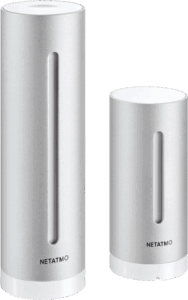
Netatmo keeps the indoor and outdoor modules separate. In addition to temperature, humidity and air pressure, the indoor module also measures air quality and indicates the CO2 level with a colored light. If indoor climate is more your concern, the article on CO2 monitors (in German) is worth a read. Wind and rain gauges are added separately, which makes the system considerably more expensive. The data appears in the app and on the Netatmo weather map; Netatmo does not mention a direct upload to Weather Underground.
Davis Vantage Vue with WeatherLink Console
Among amateur meteorologists, Davis is considered the benchmark. According to the manufacturer, the sensor unit runs on solar power, a supercapacitor and a lithium backup, transmits up to 300 m line of sight and updates wind readings every 2.5 seconds. The new WeatherLink Console has a color touchscreen and Wi-Fi, and it shares data with Weather Underground and the CWOP network. In many gardens, the location offers less than this station is capable of. The older 6250EU version was most recently listed as unavailable at Amazon.de.
Technoline WS 1700
Three separate wireless sensors: a thermo-hygro transmitter, a rain gauge and an anemometer. The base unit shows wind chill, dew point, the air pressure trend over the past 12 hours and rainfall per hour, per day and in total, plus a DCF77 radio-controlled clock. Technoline says nothing about an app or uploads. If you only want to read wind and rain at the kitchen table, you won’t miss them either.
Technoline WS 6767
Outdoor transmitter, indoor and outdoor temperature, humidity, a weather trend based on the air pressure history, radio-controlled clock. That is all the classic radio weather station has. To find out whether the windshield is iced over in the morning, it is easily enough.
How we would decide
Indoor display and app, wind and rain included: that is what the Bresser WLAN ClearView 7-in-1 stands for. If you want to process data further, connect your smart home and feed many services, go for the Ecowitt Wittboy; for devices that suit garden irrigation, see irrigation controllers.
If indoor climate matters more than storm gusts and the app should look good, then choose Netatmo and add wind and rain only if needed. The Davis Vantage Vue belongs in an open location with measurement series over many years. On a balcony, its effort is not worth it.
No Wi-Fi? The Technoline WS 1700 with wind and rain, otherwise the simple WS 6767.
If the station is meant to control roller shutters, heating or lighting, clarify beforehand which hub can actually read the data. The article on the smart home hub helps with this preliminary decision.
If the station is meant to operate roller shutters or awnings, the transmission interval and the hub are what count. The guide to the professional weather station for the smart home covers that.
Frequently asked questions
Where should the outdoor sensor of a weather station be mounted?
Not on the south-facing wall, not over paving and not under the porch roof. A post over a lawn with some distance from the house does more than any software update. The German Weather Service (DWD) measures temperature at a height of 2 m and keeps house walls at least 10 m away; for the garden, these are guidelines.
Radio weather station or Wi-Fi weather station?
A pure radio weather station shows everything on the display indoors and needs no internet, for example the Technoline WS 1700 or WS 6767. A Wi-Fi station also sends the readings to an app, even when you are away from home, and can upload them to weather services.
Why does my weather station show less wind than the weather service?
It is usually down to the location, not a defect. The DWD measures wind at a height of 10 m, at a distance from obstacles of at least ten times their height. An anemometer at a height of 2 m between hedges will inevitably show less wind than the nearest DWD station.
Do outdoor sensors need batteries?
Many do, and batteries in the sensor mean trips up the ladder. Solar cells with backup storage, as on Davis and Ecowitt units, largely spare you that. With the Bresser WLAN ClearView, the batteries for the sensor are not included in the box.
How accurate is a piezo rain gauge?
Ecowitt itself recommends the additional WH40 tipping-bucket rain gauge alongside the Wittboy's piezoelectric sensor for accurate rainfall amounts. That says a lot about the limits of piezo measurement. For rain, the DWD specifies a horizontal collecting surface at a height of 1 m above lawn or gravel.
Which weather station is suitable for smart homes and data enthusiasts?
The Ecowitt Wittboy GW2001 connects via Wi-Fi or LAN cable and uploads to Ecowitt, Weather Underground, Weathercloud, WOW and a server of your choice. There is no display; everything runs through the app and web interface. Clarify beforehand which smart home hub can read the data.
Sources
- German Weather Service (DWD): Guideline for automatic secondary weather stations (LP DG1110, September 2020)
- German Weather Service (DWD): Weather and precipitation station with automatic sensors
- Bresser: WLAN ClearView weather station with 7-in-1 professional sensor
- Ecowitt: GW2000 gateway manual
- Netatmo: Smart Weather Station
- Davis Instruments: Vantage Vue
- Davis Instruments: WeatherLink Console
- Technoline: WS 1700
Where to buy
- Bresser WLAN ClearView Wetterstation 7-in-1Check price at Amazon.deAvailable in Germany: Amazon.de
- Ecowitt Wittboy GW2001Check price at Amazon.deAvailable in Germany: Amazon.de
- Netatmo Smarte WetterstationView at CoolblueAvailable in Germany: CoolblueCheck price at Amazon.deAvailable in Germany: Amazon.de
- Davis Vantage Vue mit WeatherLink ConsoleCheck price at Amazon.deAvailable in Germany: Amazon.de
- Technoline WS 1700Check price at Amazon.deAvailable in Germany: Amazon.de
- Technoline WS 6767Check price at Amazon.deAvailable in Germany: Amazon.de