
Contents12 sections
This guide was first published in German on handgetestet.de.
A window cleaning robot will not take care of all your windows for you. You move it from pane to pane, secure it with the tether and often wipe the corners by hand afterward. For large, hard-to-reach glass surfaces, we consider the Ecovacs Winbot W2S Omni the most sensible choice because, according to Ecovacs, it works with a built-in battery and stays attached to the glass for half an hour during a power outage. If it is mainly about regular windows with muntins and frames, a cordless window vacuum such as the Kärcher WV 2 Universal Care is faster and much cheaper.
How a robot holds on to the glass
By suction. Anything that interferes with it decides between success and frustration.
Any robot can fall off, for example if the pane is wet, sticky or cracked. That is why a safety tether is part of the package. Hobot supplies a 4.5 m tether that, according to the manufacturer, withstands 200 kg of tensile load. With Ecovacs, the reinforced power cable acts as the safety line; the station is additionally secured to furniture or a railing with a short tether. On the outside of a window, the tether always belongs on a fixed anchor point.
What happens if the power fails or the plug slips out? Then the robot has to keep up its suction. The Hobot 2S lasts about 20 minutes according to the manufacturer and signals with a warning tone; Ecovacs states 30 minutes for the W2S Omni and Winbot mini. The new Ecovacs models with a battery in the station run without an outlet anyway.
A word on safety: if you clean the outside of windows on upper floors, do not rely on suction and sensors alone. In their manuals, the manufacturers require the tether to be attached before starting. Stick to that, even on the tenth window.
Frames, corners, small panes
Glass railings, shower screens and all-glass doors have no edge for the robot to bump into. It has to detect the edge through the loss of pressure. Ecovacs explicitly lists frameless windows for the W3 Omni and the Winbot mini; Hobot uses a dedicated edge sensor for this.
Corners remain manual work. No robot cleans them completely. Square devices get closer than round ones, and on the W2S and W3, Ecovacs lowers a rotating brush at the edges. A narrow strip is still left for the cloth.
Small panes between muntins are out. According to the manufacturer, the large Winbots need at least 30 × 40 cm of glass, the Winbot mini 22 × 25 cm.
Seven devices for glass, two designs
| Model | Power supply | Safety according to manufacturer | Best for |
|---|---|---|---|
| Ecovacs Winbot W3 Omni | Battery up to 130 min or mains, station | Tether up to 100 kg, approved for frameless glass | large and frameless glass surfaces |
| Ecovacs Winbot W2S Omni | Battery 110 min or mains, station | Tether up to 100 kg, 30 min power outage protection | conservatories, window fronts |
| Ecovacs Winbot mini | Power cable, 3,000 mAh backup | 3.3 m tether, 30 min backup, frameless | small panes from 22 × 25 cm |
| Hobot 2S | Power cable 5 m | 4.5 m tether up to 200 kg, 20 min backup | classic windows, glass railings |
| Kärcher WV 6 Plus | Battery 100 min, approx. 300 m² | Handheld device | many windows in one go |
| Kärcher WV 5 Ultra Care | Battery 45 min, approx. 135 m² | Handheld device | muntins, shower, edges |
| Kärcher WV 2 Universal Care | Battery 35 min, approx. 105 m² | Handheld device | apartment with regular windows |
Ecovacs Winbot W3 Omni: the flagship
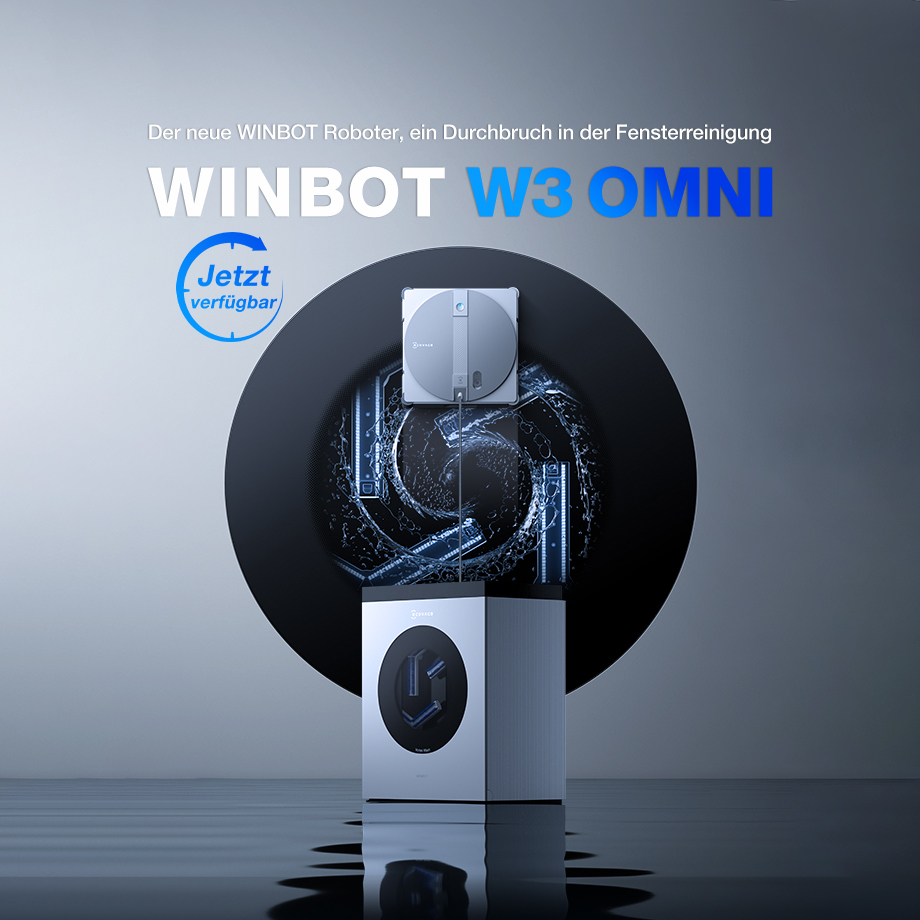
The current flagship from Ecovacs. On battery, the robot runs for up to 130 minutes according to the manufacturer, and it also works on mains power. After use, the station washes the mopping pads with 16 nozzles; it weighs around 10 kg. It is explicitly approved for frameless windows. Without glass railings, you are paying a lot here for the pad washing.
Ecovacs Winbot W2S Omni: battery in the station
The station houses a 4,500 mAh battery, good for about 110 minutes according to Ecovacs. So you do not need an outlet near the window. During a power outage, the robot stays attached for another 30 minutes. The 5.5 m DC cable is a composite cable, and the station weighs just over 5 kg. The manual requires a level, seamless surface for the station and rules out tiles with grout joints, so check this beforehand, especially in a conservatory. Ecovacs makes no explicit statement about frameless panes for the W2S. For glass railings, the W3 Omni or the mini is therefore the safer choice.
Ecovacs Winbot mini: for small panes
21.5 cm edge length, 1.3 kg. That means it fits panes that are too small for the large models. During a power outage, a 3,000 mAh battery keeps it on the glass for 30 minutes according to the manufacturer, and the tether is 3.3 m long. Frameless windows are approved. It runs on a cable and has no station. You wash the pads yourself.
Hobot 2S: corded, with a long tether
The Hobot runs on a 5 m power cable and, according to the manufacturer, moves at 12 cm per second, or about 2.4 minutes per square meter. During a power outage, a built-in backup keeps it on the pane for about 20 minutes according to the manufacturer, and an edge sensor detects frameless edges through air loss. Spraying is done ultrasonically from two nozzles. It pays to look closely at the seller, because on Amazon it also appears under trade names such as Sichler.
Kärcher WV 6 Plus: the longest runtime
No Kärcher window vacuum runs longer: 100 minutes, enough for about 300 m² of glass according to the manufacturer. It weighs 0.8 kg, and the dirty water tank holds 150 ml. In a single-family home with many windows, one charge is usually enough for the whole round.
Kärcher WV 5 Ultra Care: right up to the edge
New in the range is the flexible Xtra!Flex silicone lip, which according to Kärcher reaches right up to edges and frames. A runtime of 45 minutes is enough for about 135 m². The drawback is the charging time. According to Kärcher, it takes 345 minutes, charging via USB-C.
Kärcher WV 2 Universal Care: the entry point
35-minute battery, about 105 m² per charge, 0.6 kg, 120 ml tank and the same 280 mm suction nozzle as the larger models. That is enough for an apartment with regular windows. According to Kärcher, the battery is replaced by the service department.
Robot or vacuum: how we would decide
A window cleaning robot saves time mainly on large, hard-to-reach surfaces. Conservatories, lift-and-slide doors, glass fronts in the stairwell. For older windows with muntins, it is the wrong purchase. With a spray bottle and a window vacuum, you will be done there in half the time, because you do not have to keep repositioning it.
Large window fronts without a nearby outlet point to the Ecovacs Winbot W2S Omni, because it combines a battery with power outage protection. For glass railings, shower screens and frameless panes, that leaves the Winbot W3 Omni or, for small surfaces and a tight budget, the Winbot mini; both are explicitly approved for this. Classic windows with frames and mains power within reach? Then the Hobot 2S with its long safety tether.
In an apartment, the Kärcher WV 2 Universal Care is the cheaper route. It costs a fraction of a robot and gets into every corner. In a house with many windows, the 100-minute runtime makes the case for the WV 6 Plus.
If you want the floor to be cleaned automatically as well as the windows, continue with the robot vacuum with mopping function. For the crumbs under the windowsill, a cordless vacuum cleaner helps. And if you want to vacuum and mop hard floors in one go, read on about the wet-dry vacuum.
For special cases: robots in the conservatory and on roof windows.
More on this: Winbot models compared and safety on exterior panes.
There is more on care in the guide on window cleaning robot maintenance.
Frequently asked questions
Is a window cleaning robot worth it for older windows with muntins?
Not really. Small panes between muntins are out; according to the manufacturer, the large Winbots need at least 30 × 40 cm of glass. With a spray bottle and a window vacuum, you will be done with such windows in half the time, because you do not have to keep repositioning the robot.
Can a window cleaning robot fall off the glass?
Yes, for example if the pane is wet, sticky or cracked. That is why a safety tether is part of the package, and the manufacturers want it attached before starting. Hobot supplies a 4.5 m tether rated for 200 kg of tensile load; with Ecovacs, the reinforced power cable acts as the safety line.
What happens during a power outage?
The robot has to keep up its suction to stay attached. Ecovacs states a 30-minute backup for the W2S Omni and Winbot mini; the Hobot 2S lasts about 20 minutes according to the manufacturer and signals with a warning tone. The Ecovacs models with a battery in the station do not need an outlet near the window anyway.
Which window cleaning robot is suitable for glass railings and frameless panes?
Ecovacs explicitly approves frameless windows for the Winbot W3 Omni and the Winbot mini. The mini also fits small panes from 22 × 25 cm. Hobot detects frameless edges through air loss with a dedicated edge sensor. For the W2S Omni, Ecovacs gives no explicit statement on this.
Does a robot clean the corners too?
Not completely; corners remain manual work. Square devices get closer than round ones, and on the W2S and W3, Ecovacs lowers a rotating brush at the edges. A narrow strip is still left for the cloth, so expect some touch-up work by hand.
Which Kärcher window vacuum is enough for a house with many windows?
According to the manufacturer, the Kärcher WV 6 Plus runs for 100 minutes, enough for about 300 m² of glass. In a single-family home, one charge is usually enough for the whole round. For an apartment with regular windows, the WV 2 Universal Care with its 35-minute battery is sufficient.
Sources
- Ecovacs: Winbot W3 Omni
- Ecovacs: Winbot W2S Omni
- Ecovacs: Winbot mini
- Ecovacs: Winbot overview and notes on glass types
- Hobot: HOBOT-2S
- Kärcher: WV 6 Plus
- Kärcher: WV 5 Ultra Care
- Kärcher: WV 2 Universal Care
Where to buy
- Ecovacs Winbot W2S OmniView at EcovacsAvailable in Germany: EcovacsCheck price at Amazon.deCheck price at Amazon.co.ukCheck price at Amazon.nlCheck price at Amazon.com.beCheck price at Amazon.frCheck price at Amazon.itCheck price at Amazon.esCheck price at Amazon.plCheck price at Amazon.seAvailable in Germany: Amazon.de
- Ecovacs Winbot W3 OmniCheck price at Amazon.deCheck price at Amazon.co.ukCheck price at Amazon.nlCheck price at Amazon.com.beCheck price at Amazon.frCheck price at Amazon.itCheck price at Amazon.esCheck price at Amazon.plCheck price at Amazon.seAvailable in Germany: Amazon.deView at CoolblueAvailable in Germany: Coolblue
- Ecovacs Winbot miniCheck price at Amazon.deCheck price at Amazon.co.ukCheck price at Amazon.nlCheck price at Amazon.com.beCheck price at Amazon.frCheck price at Amazon.itCheck price at Amazon.esCheck price at Amazon.plCheck price at Amazon.seAvailable in Germany: Amazon.deView at EcovacsAvailable in Germany: Ecovacs
- Hobot 2SCheck price at Amazon.deCheck price at Amazon.co.ukCheck price at Amazon.nlCheck price at Amazon.com.beCheck price at Amazon.frCheck price at Amazon.itCheck price at Amazon.esCheck price at Amazon.plCheck price at Amazon.seAvailable in Germany: Amazon.de
- Kärcher WV 6 PlusCheck price at Amazon.deCheck price at Amazon.co.ukCheck price at Amazon.nlCheck price at Amazon.com.beCheck price at Amazon.frCheck price at Amazon.itCheck price at Amazon.esCheck price at Amazon.plCheck price at Amazon.seAvailable in Germany: Amazon.de
- Kärcher WV 5 Ultra CareCheck price at Amazon.deCheck price at Amazon.co.ukCheck price at Amazon.nlCheck price at Amazon.com.beCheck price at Amazon.frCheck price at Amazon.itCheck price at Amazon.esCheck price at Amazon.plCheck price at Amazon.seAvailable in Germany: Amazon.de
- Kärcher WV 2 Universal CareCheck price at Amazon.deCheck price at Amazon.co.ukCheck price at Amazon.nlCheck price at Amazon.com.beCheck price at Amazon.frCheck price at Amazon.itCheck price at Amazon.esCheck price at Amazon.plCheck price at Amazon.seAvailable in Germany: Amazon.deView at CoolblueAvailable in Germany: Coolblue