Contents10 sections
This guide was first published in German on handgetestet.de.
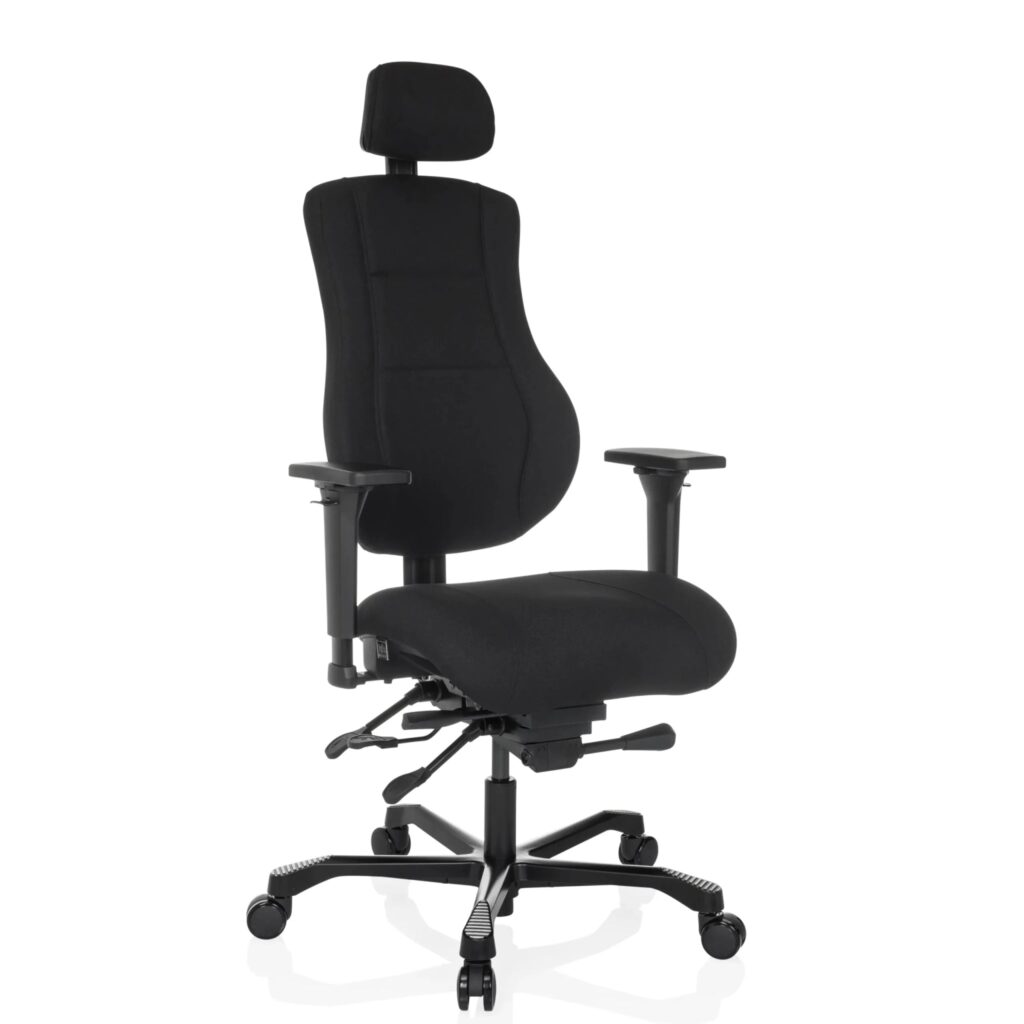
In a control room, at a hospital reception desk or in a data center, someone else sits in the chair at night than in the morning. That is exactly what sets a 24-hour chair apart from a good office chair: it has to support several people with different body dimensions, without a break, and adjust to each of them in seconds. For changing occupants, we consider the 24 HOURS BASIC from hjh OFFICE the most sensible buy. It adjusts seat depth, seat tilt, backrest height and armrests in four directions, and according to the manufacturer it is suitable for all floors.
What does „24 hours“ actually mean?
It is not a protected term. Manufacturers state a „sitting duration,“ meaning the daily usage time the chair is designed for. For most office chairs in the hjh range, that figure is eight hours. hjh itself describes what changes at 24 hours: a reinforced mechanism, upholstery with high abrasion resistance and often a six-star base. As a buyer, you can hardly verify any of this. That is why it pays to look at figures you can compare: load capacity, the fabric’s Martindale rub count and the warranty.
The basic framework is the same as for any work chair. The DGUV principle 315-411 of the German Social Accident Insurance calls for a synchronous mechanism, in which seat and backrest move in coordination, and a backrest counterpressure that can be adapted to body weight, either by hand while seated or automatically. For shift work, this point is crucial. If the night shift weighs 60 kilograms and the early shift 110, a wrongly adjusted chair either tips back too easily or does not give at all.
Six chairs for continuous use
| Model | Mechanism | Load capacity / warranty | Casters according to hjh | Best for |
|---|---|---|---|---|
| hjh 24 HOURS BASIC | Combination of knee-tilt, permanent-contact and synchronous mechanism | 150 kg / 4 years | unbraked, all floors | Changing occupants, including shorter people |
| hjh 24 HOURS F | Knee-tilt mechanism, folding backrest | 200 kg / 4 years | not specified | Control rooms with little space, heavy users |
| hjh 24 HOURS Leder | Knee-tilt mechanism | 150 kg / 4 years | unbraked, carpet only | Prestigious workstations with carpet |
| hjh 24 HOURS I | Knee-tilt mechanism | 150 kg / 4 years | unbraked, carpet only | As above, with fabric upholstery |
| hjh RESISTIO XXL | Synchronous mechanism | 200 kg / 24 months | load-dependent braking, all floors | Hard floors, heavy users |
| hjh Titanor Ergo | Synchronous mechanism | 200 kg / 24 months | unbraked, all floors | Mesh back, smaller budget |
hjh 24 HOURS BASIC
Despite the name, this is the chair with the most adjustments. hjh describes a mechanism that combines knee-tilt, permanent-contact and synchronous movement. On top of that come seat depth, continuously variable seat tilt, a height-adjustable backrest, a headrest adjustable in height and angle, and 4D armrests. The seat height ranges from 45 to 59 centimeters, and hjh gives the range of body heights as 160 to 220 centimeters. At 44 centimeters, however, the seat is the narrowest in this comparison.
hjh 24 HOURS F
According to hjh, the top model of the series supports 200 kilograms and itself weighs 39.1 kilograms. One special feature: using two knobs, the backrest can be folded forward all the way to horizontal, at which point the chair measures only 60 centimeters in height. That helps under consoles or during cleaning. Seat depth and armrest angle are continuously adjustable, but the seat height only starts at 50 centimeters. hjh gives the body height as 170 to 215 centimeters. For shorter colleagues, that is too high.
hjh 24 HOURS (leather) and 24 HOURS I
Both models are identical except for the upholstery: leather on the 24 HOURS, a fabric rated at 200,000 Martindale rubs on the 24 HOURS I. The backrest locks in 17 positions, the armrests fold up out of the way, and the polished aluminum base has six arms. According to hjh, both meet the safety-related requirements of the European standard DIN EN 1335 parts 2 and 3. We see a catch with the casters. They are unbraked and intended for carpet only; on hard floors, you need hard-floor casters. hjh does not list a seat depth adjustment for either model.
hjh RESISTIO XXL
If you want a true synchronous mechanism and have hard floors, this is where you end up. The RESISTIO XXL supports 200 kilograms, is designed for 24 hours and has load-dependent braked casters that do not roll away when unloaded. Seat depth and seat tilt are adjustable, and according to the manufacturer the fabric withstands 500,000 Martindale rubs. At 24 months, the warranty is shorter than for the 24 HOURS series. More on this in our guide to the XXL office chair.
hjh Titanor Ergo
The least expensive chair with a 24-hour rating. Mesh back, synchronous mechanism with up to 120 degrees of recline, 3D armrests, adjustable seat depth and a load capacity of 200 kilograms. According to hjh, the upholstery withstands 200,000 Martindale rubs. The casters are unbraked. In a room where someone gets up and sits down again around the clock, we would change that.
What we look for at shared workstations
A chair for three shifts is only as good as its smallest setting. Check the lowest seat height first. For office work chairs, the DGUV principle specifies a range starting at 40 centimeters, while several 24-hour models only start at 48 or 50. Shorter employees then need a footrest, and there has to be room for it at the console.
Second: how quick is the weight adjustment? A knob that takes twenty turns of cranking will no longer be touched after the third shift change. Sitting in the chair yourself is worth more here than any spec sheet.
Third, the floor. Unbraked carpet casters on tiles are a slipping hazard in continuous use, and the DGUV principle requires protection against unintentional rolling away. According to the DGUV principle, chair casters must be replaceable without tools or with simple aids. Ideally, order the right casters at the same time. For delicate floors, a floor protection mat (in German) helps.
And fourth, the base. A work chair must be stable in every sitting position, the principle states, taking into account the maximum weight specified by the manufacturer. The three models of the classic 24 HOURS series stand on six arms with a diameter of 76 centimeters. The BASIC makes do with five arms and 65 centimeters, but it is also only approved for up to 150 kilograms. A wider base needs more space under the console. In cramped control rooms with footrails and cable ducts, you should measure this beforehand.
Our recommendations by use case
- Control room or reception desk with many different users: 24 HOURS BASIC.
- Heavy users and little space under the console: 24 HOURS F with folding backrest.
- Hard floors and a preference for a synchronous mechanism: RESISTIO XXL.
- Carpet and leather upholstery for the head of operations at headquarters: 24 HOURS.
- Limited budget: Titanor Ergo, retrofitted with braked casters.
For a home office with eight hours a day, none of these chairs is necessary. A model from our guide to the ergonomic office chair is usually enough there.
Where the real difference between an executive chair and an ergonomic chair lies is explained in our executive chair guide.
Frequently asked questions
What does 24 hours mean for an office chair?
It is not a protected term. Manufacturers state a sitting duration, meaning the daily usage time the chair is designed for. For 24 hours, hjh lists a reinforced mechanism, abrasion-resistant upholstery and often a six-star base. What you can compare is load capacity, the abrasion rating of the fabric and the warranty.
What should I look for in a chair for shift work?
First, the lowest seat height: the German DGUV principle 315-411 specifies a range starting at 40 centimeters, while several 24-hour models only start at 48 or 50. Then a quick weight adjustment, because the night shift might weigh 60 kilograms and the early shift 110. Sitting in the chair yourself helps more than any spec sheet here.
Which casters does a 24-hour chair need on hard floors?
Braked hard-floor casters. Unbraked carpet casters on tiles are a slipping hazard in continuous use, and the DGUV principle requires protection against rolling away. The RESISTIO XXL has load-dependent braked casters; on the 24 HOURS and 24 HOURS I, they are intended for carpet only. Order suitable casters at the same time.
Which 24-hour chair fits under a cramped console?
The hjh 24 HOURS F. Its backrest can be folded forward all the way to horizontal, at which point the chair measures only 60 centimeters in height. According to hjh, it supports 200 kilograms. The seat height, however, only starts at 50 centimeters, which is too high for shorter colleagues.
Do I need a 24-hour office chair for my home office?
No. None of these chairs is necessary for eight hours a day; an ergonomic office chair is usually enough there. The 24-hour models are aimed at control rooms, reception desks or data centers, where someone else sits in the chair at night than in the morning.
Sources
- DGUV principle 315-411: quality criteria for office workstations, July 2022 (German)
- hjh OFFICE: 24 HOURS BASIC
- hjh OFFICE: 24 HOURS F
- hjh OFFICE: 24 HOURS leather
- hjh OFFICE: 24 HOURS I
- hjh OFFICE: RESISTIO XXL
- hjh OFFICE: Titanor Ergo
Where to buy
- hjh 24 HOURS BASICView at buerostuhl24Available in Germany: buerostuhl24
- hjh 24 HOURS FView at buerostuhl24Available in Germany: buerostuhl24
- hjh 24 HOURS LederView at buerostuhl24Available in Germany: buerostuhl24
- hjh 24 HOURS IView at buerostuhl24Available in Germany: buerostuhl24
- hjh RESISTIO XXLView at buerostuhl24Available in Germany: buerostuhl24
- hjh Titanor ErgoView at buerostuhl24Available in Germany: buerostuhl24