Contents11 sections
This guide was first published in German on handgetestet.de.
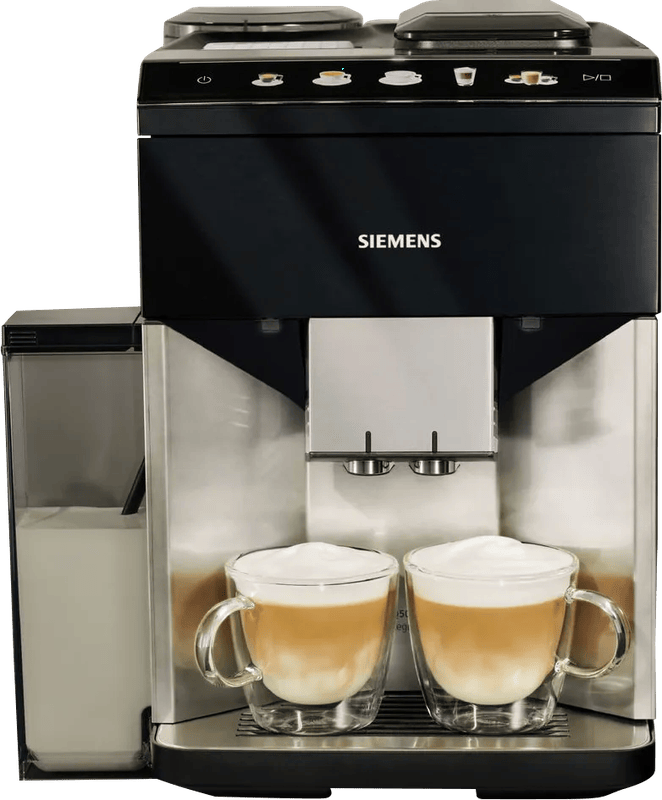
A quarter to seven, two cappuccinos, the bus leaves at twenty past. In this scene the bean-to-cup machine wins, and clearly so. If you want a milk coffee every morning and have no desire to practice, you are better served by a bean-to-cup machine such as the Siemens EQ.500 integral than by a portafilter machine. The Philips Series 3300 LatteGo fits if a small milk container is enough. We only recommend a portafilter machine if you enjoy the craft itself. In between sits the Sage Barista Touch, whose list price is well above that of the Philips.
How much time the portafilter machine costs every morning
Let us do the math. Our assumption: two cappuccinos on a portafilter machine take around five minutes including grinding, distributing, tamping, pulling the shots, frothing the milk and knocking out the puck. On a bean-to-cup machine, including setting out the cups and putting the milk container away, it is about two. That leaves a difference of three minutes a day.
Sounds like very little. Over a year, that is 3 × 365 = 1,095 minutes, a little over 18 hours. For people who enjoy it as a morning ritual, that is time well spent. For everyone else, it is more than two working days at the kitchen counter. In our view, that is a more honest question than any debate about taste.
Stiftung Warentest (German consumer testing organization) headlines portafilter machines as „espresso machines for tinkerers“ and says good espresso requires good beans, practice and a sure touch. Take that literally. The grind size has to suit the bean, and a new roast often means a new setting.
Does it really taste better from a portafilter machine?
It can, but it does not have to. A portafilter machine has the higher ceiling, but also the lower floor. The Sage Barista Touch offers 30 grind settings, the Barista Express 16, the Siemens six. More settings, however, only help those who know how to use them.
Bean-to-cup machines also differ widely. In the Warentest comparison, the machines sometimes delivered noticeably different quality from the same beans, as judged by coffee sommeliers. Interesting for the budget-minded: simple machines without a milk system often hardly lag behind the expensive ones at the main task. So the money goes mainly into milk and convenience, less into the espresso.
Beans, grinder, counter space: the bill after the purchase
Sage plans on 18 grams of coffee per shot. At two drinks a day, that is 36 grams, around 13 kilograms a year. If we assume about 10 grams per cup for the bean-to-cup machine, we end up at a little over 7 kilograms. The espresso from the double basket is stronger, though, so this is not a like-for-like comparison. For the household budget, the difference still counts.
Then there is the grinder. Both Sage machines grind themselves, classic single-boiler machines do not, and this is where many cost comparisons fall apart: the portafilter machine looks inexpensive until a suitable espresso grinder is added. Scale, milk jug and tamper are covered in our guide to portafilter accessories.
When it comes to space, the picture reverses. Both are the same width, but according to the manufacturer the Sage Barista Express takes up 35.1 centimeters of depth on the countertop, while the Siemens needs 44.8 according to its data sheet. On a 60-centimeter-deep countertop, that is the difference between space behind it and the outlet getting in the way. Also measure the height: 37.3 centimeters for the Siemens, 40.4 for the Barista Express, 41 for the Barista Touch, each without clearance for refilling.
Who cleans what?
Neither system stays clean on its own. With a bean-to-cup machine, the work is hidden inside the appliance, which is why the brewing unit should be removable and the milk system dishwasher-safe. That is the case with the Siemens: according to the data sheet, the brewing unit can be removed, the milk container, milk frother, drip tray and coffee grounds container are dishwasher-safe, and after every milk drink autoMilk Clean cleans the milk path with steam. Philips lists two parts without tubing for LatteGo.
With a portafilter machine, the mess builds up immediately, but at least you can see it. Knock out the puck, rinse the basket, wipe the steam wand, and do it after every shot. Sage includes a cleaning kit with its machines.
Two points are rarely considered when buying. According to Stiftung Warentest, Siemens recommends descaling tablets with sulfamic acid, which wastewater treatment plants do not filter out; Philips, by contrast, relies on agents with lactic or citric acid. And in the 2021 portafilter comparison, two entry-level models failed because they flushed too much lead into the cup after descaling. So always rinse thoroughly after descaling. How hard your water is and whether a water filter (in German) helps is best sorted out before the first shot.
Four machines, two paths and a middle ground
| Model | Type | Grinder according to the manufacturer | Milk | Who it is for |
|---|---|---|---|---|
| Siemens EQ.500 integral TQ517D03 | Bean-to-cup machine | Ceramic, 6 settings | 0.7 l container, push of a button | Households with a daily milk coffee |
| Philips Serie 3300 LatteGo EP3343/50 | Bean-to-cup machine | Ceramic, 12 settings | LatteGo, push of a button | One or two milk drinks a day |
| Sage Barista Touch | Portafilter machine with automation | Built-in, 30 settings | Automatic steam wand, 40–75 °C | Curious users who do not want to practice frothing |
| Sage Barista Express | Portafilter machine, Thermocoil | Built-in, 16 settings | Manual steam wand | Beginners without an extra grinder |
This is deliberately not a best-of list, and pure single-boiler machines are not included here. Once you have chosen a path, you will find the full selection in our guide buying a bean-to-cup machine (in German) or in portafilter machines from single boiler to dual boiler.
Siemens EQ.500 integral TQ517D03
Two cappuccinos at the same time: that is exactly the morning scene from the beginning. The data sheet lists double dispensing for milk drinks too, ten specialties including milk foam and hot water, 1.9 liters of water, 270 grams of beans and room for glasses up to 14 centimeters tall. According to Siemens, the container holds 0.7 liters of milk. Only six grind settings and the descaler are its weak points. If you experiment a lot with beans, you will quickly hit its limits. We do not cite a test rating for this exact model. This assessment is based on the data sheet and on how well it fits this scene.
Philips Serie 3300 LatteGo EP3343/50
Six drinks, twelve grind settings, ceramic grinder. Philips states that LatteGo can be cleaned in ten seconds under running water. The milk container holds 0.26 liters, much less than on the Siemens, but enough for two cups. If you only drink one milk coffee a day, you do not need more.
Sage Barista Touch
The middle ground. Grinding and dosing happen at the push of a button, but you still fill, tamp and lock in the portafilter yourself. The steam wand takes care of the milk, temperature and texture are adjustable, and eight custom drinks can be saved. That removes the hardest skill to learn, not the handling. By list price it is well above the Philips, and it is not faster than a bean-to-cup machine in the morning either.
Sage Barista Express
Built-in grinder, temperature held at 93 degrees by PID control: that is how Sage describes the machine. You froth the milk by hand. That takes practice. If you rarely drink milk anyway, this machine gets you into portafilter brewing without buying anything extra.
Three questions, then the decision is made
First: do you mostly drink milk coffee? Then the bean-to-cup machine has the edge, because good frothing on a portafilter machine has the longest learning curve. If you only froth milk now and then, a separate milk frother (in German) will do.
Second: would you voluntarily spend 20 minutes on the weekend adjusting the grind? If not, the question is answered.
Third: how many drinks do you make in a row? With four cups back to back, a single-boiler machine loses time because the boiler has to switch between brewing and steam. The Siemens with its double dispensing then has the advantage.
Yes to the craft and no to milk coffee leads to the Barista Express. No to the craft leads to the Siemens or, if you rarely make more than two milk drinks, to the Philips Series 3300. That leaves the Sage Barista Touch for anyone who wants a portafilter machine but not the milk-frothing course.
How a portafilter machine works in everyday life after years of use is described in our long-term review of the De’Longhi Dedica: espresso from the basket, cappuccino with the steam nozzle.
Frequently asked questions
How much more time does a portafilter machine take than a bean-to-cup machine?
Assuming five minutes for two cappuccinos on a portafilter machine versus about two on a bean-to-cup machine, that leaves a difference of three minutes a day. Over a year, that adds up to 1,095 minutes, a little over 18 hours. If you enjoy it as a morning ritual, you lose nothing; for everyone else, it is more than two working days.
Does espresso from a portafilter machine taste better?
It can, but it does not have to. A portafilter machine has the higher ceiling, but also the lower floor. Stiftung Warentest (German consumer testing organization) says good espresso requires good beans, practice and a sure touch. Bean-to-cup machines, too, sometimes delivered noticeably different quality from the same beans.
What does a portafilter machine cost after the purchase?
Mainly beans and, if needed, a grinder. Sage plans on 18 grams per shot, which at two drinks a day comes to around 13 kilograms a year. For the bean-to-cup machine, the guide assumes about 7 kilograms. Classic single-boiler machines do not grind themselves, so a suitable espresso grinder has to be added.
How much cleaning do bean-to-cup and portafilter machines need?
Neither stays clean on its own. On the Siemens EQ.500, the brewing unit can be removed, the milk parts are dishwasher-safe, and after every milk drink steam cleans the milk path. With a portafilter machine, you knock out the puck after every shot, rinse the filter basket and wipe the steam wand.
What kind of machine is the Sage Barista Touch?
A middle ground. Grinding and dosing happen at the push of a button; filling, tamping and locking in the portafilter you do yourself. An automatic steam wand with adjustable temperature and texture takes care of the milk. That removes the hardest skill to learn, not the handling, and it is not faster than a bean-to-cup machine in the morning.
How much space does a portafilter machine need compared to a bean-to-cup machine?
According to the manufacturer, the Sage Barista Express takes up 35.1 centimeters of depth on the countertop, while the Siemens EQ.500 needs 44.8 according to its data sheet. In height, the Siemens at 37.3 centimeters is lower than the Barista Express at 40.4. Allow extra clearance above for refilling.
Sources
- Siemens: EQ.500 integral TQ517D03
- Siemens: TQ517D03 data sheet (PDF)
- Philips: Serie 3300 LatteGo EP3343/50
- Sage: the Barista Touch
- Sage: the Barista Express
- Stiftung Warentest (German consumer testing organization): bean-to-cup machines tested
- Stiftung Warentest: portafilter machines tested
- Stiftung Warentest: descaling bean-to-cup machines in an environmentally friendly way
Where to buy
- Siemens EQ.500 integral TQ517D03View at CoolblueAvailable in Germany: CoolblueCheck price at Amazon.deAvailable in Germany: Amazon.de
- Philips Serie 3300 LatteGo EP3343/50View at CoolblueAvailable in Germany: CoolblueCheck price at Amazon.deAvailable in Germany: Amazon.de
- Sage Barista TouchCheck price at Amazon.deAvailable in Germany: Amazon.de
- Sage Barista ExpressCheck price at Amazon.deAvailable in Germany: Amazon.de