Contents15 sections
This guide was first published in German on handgetestet.de.
The package says 8 mm, the drill bit measures 7.9. With a folding rule, you would never notice. For drill bits, screws, pipes and sheet metal, we recommend a digital caliper with a 150 mm measuring range, specifically the Mitutoyo 500-181-30. Room dimensions remain the job of the folding rule and tape measure, angles that of the protractor. In this discipline, there is no single tool for everything, and if you try anyway, you end up measuring either too roughly or too awkwardly.
Which tool measures what?
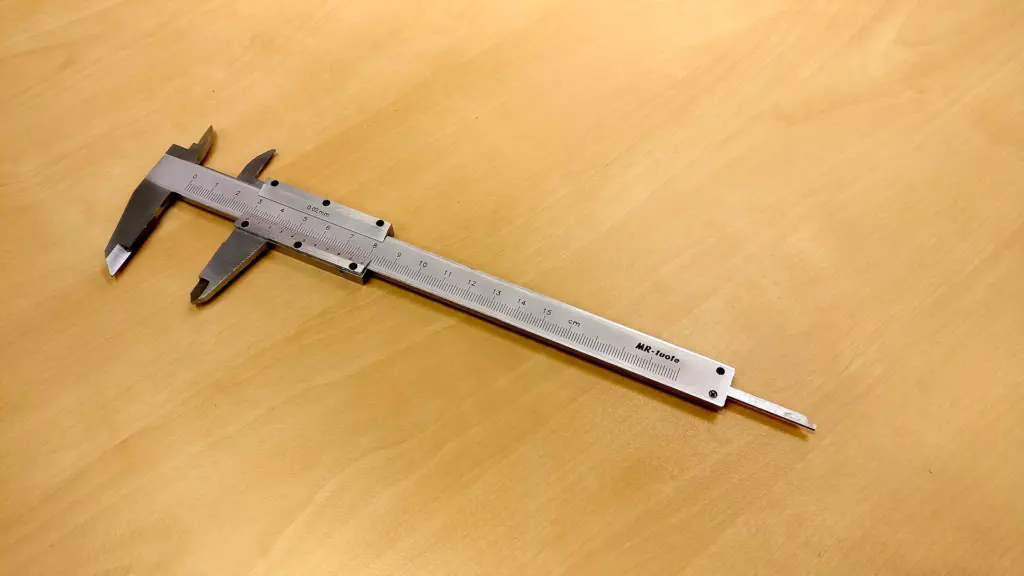
A caliper measures outside, inside and depth. With it, you check the diameter of a threaded rod, the width of a bore and how deep a blind hole is. The 150 mm range is enough for screws, wall plugs, copper pipes and trim strips. The folding rule handles dimensions up to 2 m, such as a door reveal or a shelf board. The tape measure goes further and hugs curves. And the protractor tells you whether the corner in an old building really is 90 degrees. You should not bet on it.
What does ±0.02 mm on the data sheet mean?
The display shows hundredths. That does not mean the device measures accurately to the hundredth. What counts is the maximum permissible error, which Mitutoyo specifies as E MPE: ±0.02 mm for the digital models, ±0.05 mm for the 530-101 vernier caliper. For certain types of measurement, the manufacturer gives a second, larger value (S MPE), which is ±0.04 mm for the digital models. On wood, that makes no difference. On a ball bearing that needs a snug fit on its shaft, it does.
Before every important measurement, check the zero point with the jaws closed and wipe the measuring faces. A chip caught in between distorts the result more than any tolerance. And do not press hard; the caliper measures, it does not clamp.
When does a caliper need IP67?
IP67 means dust-tight and protected against temporary immersion. Mitutoyo therefore also offers the 150 mm caliper as the CoolantProof version 500-706-20, with the same error limits and the same weight of 168 g. That makes sense at a lathe with coolant, in the garage with oily parts or on a boat. In a dry woodworking shop, the version without a protection rating is sufficient, as long as you do not leave the caliper lying in the dust after sanding.
Class I, II or III: how accurate are folding rules and tape measures?
The classes come from the European Measuring Instruments Directive 2014/32/EU, Annex MI-008. There, the permissible deviation is given as the formula a + b × L, where L is rounded up to the next full meter and 20 °C is the reference temperature. Class I allows 0.1 mm plus 0.1 mm per meter, class II 0.3 plus 0.2, and class III 0.6 plus 0.4. Sounds dry. But do the math once: a class III folding rule may be off by 1.4 mm over 2 m, a class II tape measure by 0.9 mm over 3 m, and a class I tape by only 0.6 mm over 5 m.
For wallpaper and flooring, that does not matter. If you are planning drawer fronts with a 2 mm gap, you should go for the better class. By the way, if the end hook on a tape measure moves, that is not a defect. It slides by its own thickness so that inside and outside measurements are correct.
Digital or classic: which protractor?
A digital protractor shows its strength where you transfer angles to a miter saw, that is, for baseboards, stair stringers and sloped ceilings. It measures the angle between two walls and calculates the miter from it. For occasional 45-degree cuts, a simple sliding bevel is enough. Whether a surface is level is answered by a good bubble vial anyway; more on that in our guide to spirit levels. A cross-line laser lays out long lines on a wall faster than any protractor.
7 measuring tools compared
Mitutoyo 500-181-30: the caliper for the workbench
Measuring range 0 to 150 mm, display in hundredths, maximum permissible error ±0.02 mm. Mitutoyo includes a manufacturer’s inspection certificate and states around five years for the SR44 coin cell under normal use. This model has no data output. In a home workshop, you will only miss it if you collect series of measurements on a computer.
Mitutoyo 500-706-20: the same, but sealed
Same error limits, same battery, same weight, plus IP67 protection. According to the data sheet, nothing else distinguishes the two models. We consider it the right choice as soon as oil, coolant emulsion or rain comes into play. Otherwise, you are paying for protection you do not need.
Mitutoyo 530-101: read instead of switching on
The vernier caliper needs no battery and gives an immediate reading even after years in a drawer. The graduation is 0.05 mm, the maximum permissible error ±0.05 mm. A locking screw on top holds the measurement when you take the caliper off the workpiece. Reading the vernier scale takes practice, and with weak eyesight it becomes tedious.
Bosch Professional GAM 220 MF: calculates the miter
Two 40 cm legs, a measuring range of 0 to 220 degrees, accurate to ±0.1 degrees according to Bosch. The device calculates simple and compound cross-cut and miter angles and stores frequently used values. According to the manufacturer, four AA batteries last about 80 hours. At around 1.2 kg, it is not a pocket tool.
Wiha Longlife 2 m: a folding rule that does not swell
Wiha makes the segments from glass-fiber-reinforced polyamide, which according to the manufacturer does not swell on contact with water and is resistant to chemicals. The joints with spring rods are said to stay free of play, and they lock in at 90 degrees. The graduation is deeply embossed, and the tens are in red. With accuracy class III, however, it is one of the coarser tools in this comparison; up to 1.4 mm of deviation over 2 m is permitted.
Hultafors PR 5 m: the accurate tape
For the PR series, Hultafors cites type-examination to EU class I, the tightest of the three classes. The blade is 19 mm wide and lacquered, and the stainless steel end hook has a reinforcement plate. A brake holds the blade without shifting it, and a metal eyelet takes a safety lanyard for work at height. If you build furniture, you measure more accurately with it over 5 m than with a folding rule over 2 m.
Hultafors Talmeter 3 m: measuring and marking
The Talmeter is a specialist. Using the housing, you measure inside and outside dimensions and mark them directly; the back of the blade carries a diameter scale, and with the compass function you draw circles for pipe penetrations. Hultafors cites EU class II. We would not make it the only tape measure in the toolbox. At 3 m, it is simply too short for room dimensions.
How we would decide
- Home workshop, 3D printer, bike maintenance: Mitutoyo 500-181-30.
- Lathe, engine bay, boat dock: Mitutoyo 500-706-20 with IP67.
- A caliper for the drawer that never runs flat: Mitutoyo 530-101.
- Baseboards, stairs, attic conversion: Bosch GAM 220 MF.
- Room dimensions up to 5 m with furniture-making precision: Hultafors PR 5 m, plus the Wiha Longlife for quick reach.
- Drywall with pipe penetrations: Hultafors Talmeter.
Frequently asked questions
How accurate is a digital caliper really?
The display shows hundredths, but what counts is the maximum permissible error. Mitutoyo specifies ±0.02 mm for its digital models and ±0.05 mm for the 530-101 vernier caliper. Before important measurements, check the zero point with the jaws closed and wipe the measuring faces; a metal chip distorts the result more than any tolerance.
When does a caliper need IP67?
IP67 means dust-tight and protected against temporary immersion. That makes sense at a lathe with coolant, in the garage with oily parts or on a boat. The Mitutoyo 500-706-20 has the same error limits as the 500-181-30. In a dry woodworking shop, the version without a protection rating is sufficient.
What do class I, II and III mean for folding rules and tape measures?
The classes come from the European Measuring Instruments Directive 2014/32/EU and define the permissible deviation. A class III folding rule may be off by 1.4 mm over 2 m, a class I tape measure by only 0.6 mm over 5 m. For furniture with a 2 mm gap, the better class is worth it.
Digital or classic caliper?
The digital Mitutoyo 500-181-30 shows hundredths directly, and according to the manufacturer the coin cell lasts around five years. The 530-101 vernier caliper needs no battery and gives an immediate reading even after years in a drawer. Reading the vernier scale does take practice, though.
When is a digital protractor worth it?
Wherever angles are transferred to a miter saw: baseboards, stair stringers, sloped ceilings. According to the manufacturer, the Bosch GAM 220 MF measures to ±0.1 degrees and calculates simple and compound miter angles. For occasional 45-degree cuts, a simple sliding bevel is enough.
Is a loose end hook on a tape measure a defect?
No, it is intentional. The end hook slides by its own thickness so that inside and outside measurements are correct. For room dimensions up to 5 m with furniture-making precision, this guide names the Hultafors PR with EU class I, the tightest of the three classes.
Sources
- Mitutoyo: 500-181-30 data sheet
- Mitutoyo: 500-706-20 CoolantProof IP67 data sheet
- Mitutoyo: 530-101 data sheet
- Bosch Professional: GAM 220 MF
- Wiha: Longlife 2 m folding rule
- Hultafors: PR tape measure
- Hultafors: Talmeter 2 m/3 m
- Directive 2014/32/EU, Annex MI-008 (material measures of length)
Where to buy
- Mitutoyo 500-181-30Check price at Amazon.deCheck price at Amazon.co.ukCheck price at Amazon.nlCheck price at Amazon.com.beCheck price at Amazon.frCheck price at Amazon.itCheck price at Amazon.esCheck price at Amazon.plCheck price at Amazon.seAvailable in Germany: Amazon.de
- Mitutoyo 500-706-20Check price at Amazon.deCheck price at Amazon.co.ukCheck price at Amazon.nlCheck price at Amazon.com.beCheck price at Amazon.frCheck price at Amazon.itCheck price at Amazon.esCheck price at Amazon.plCheck price at Amazon.seAvailable in Germany: Amazon.de
- Mitutoyo 530-101Check price at Amazon.deCheck price at Amazon.co.ukCheck price at Amazon.nlCheck price at Amazon.com.beCheck price at Amazon.frCheck price at Amazon.itCheck price at Amazon.esCheck price at Amazon.plCheck price at Amazon.seAvailable in Germany: Amazon.de
- Bosch Professional GAM 220 MFCheck price at Amazon.deCheck price at Amazon.co.ukCheck price at Amazon.nlCheck price at Amazon.com.beCheck price at Amazon.frCheck price at Amazon.itCheck price at Amazon.esCheck price at Amazon.plCheck price at Amazon.seAvailable in Germany: Amazon.de
- Wiha Longlife 2 mCheck price at Amazon.deCheck price at Amazon.co.ukCheck price at Amazon.nlCheck price at Amazon.com.beCheck price at Amazon.frCheck price at Amazon.itCheck price at Amazon.esCheck price at Amazon.plCheck price at Amazon.seAvailable in Germany: Amazon.de
- Hultafors PR 5 mCheck price at Amazon.deCheck price at Amazon.co.ukCheck price at Amazon.nlCheck price at Amazon.com.beCheck price at Amazon.frCheck price at Amazon.itCheck price at Amazon.esCheck price at Amazon.plCheck price at Amazon.seAvailable in Germany: Amazon.de
- Hultafors Talmeter 3 mCheck price at Amazon.deCheck price at Amazon.co.ukCheck price at Amazon.nlCheck price at Amazon.com.beCheck price at Amazon.frCheck price at Amazon.itCheck price at Amazon.esCheck price at Amazon.plCheck price at Amazon.seAvailable in Germany: Amazon.de
Still undecided?
Keep comparing at your own pace – every article in this category is checked monthly for new and discontinued models.