Contents13 sections
This guide was first published in German on handgetestet.de.
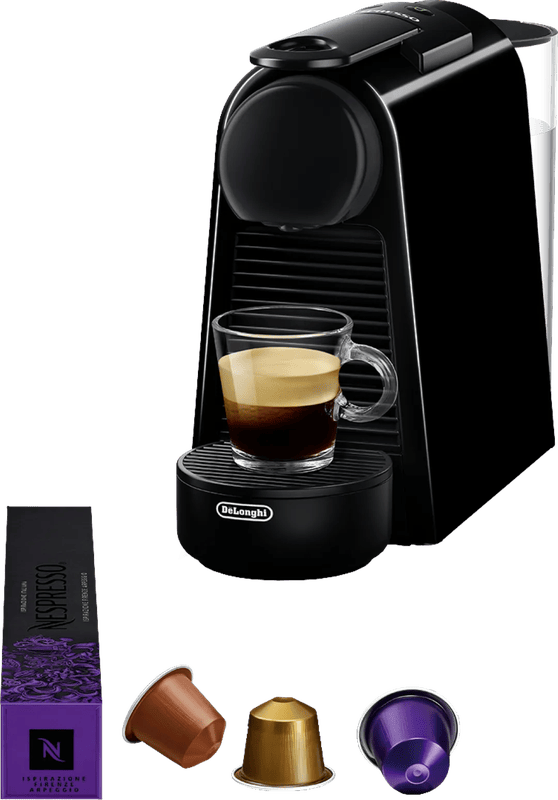
You buy a capsule machine once. You buy the capsules for years, and that is exactly where the real costs arise. So if you choose the machine by looks or by a sale price, what you are mainly committing to is a capsule system. If you mostly drink espresso and small cups, a simple machine for Nespresso Original such as the Essenza Mini is the most sensible pick. Large mugs point more toward Vertuo, and milk drinks from capsules toward Dolce Gusto or Tassimo.
Four systems that are not compatible with each other
A Vertuo capsule will not run in an Original machine, and a Dolce Gusto capsule will not run in a Tassimo. That is why your drinking habits decide. The spec sheet comes later.
Nespresso Original is the classic espresso system with aluminum capsules. According to Nespresso, espresso (40 ml) and lungo (110 ml) are preprogrammed; it is not built for mug-sized coffee.
With Nespresso Vertuo, according to Nespresso, the machine reads a barcode on the capsule rim and then sets the volume and brewing accordingly. Depending on the model, this ranges from espresso to a carafe. In return, you are tied to capsules with this code.
Nescafé Dolce Gusto relies on plastic capsules and a large selection of milk, cocoa and cold drinks; according to Krups, the machines work at up to 15 bar. Tassimo from Bosch uses T-Discs with coffee, tea, cocoa and milk drinks. According to Bosch, every drink is made at the push of a button.
Just one big mug in the morning? Then the Original system will not make you happy. Conversely, if you drink almost nothing but espresso, with Vertuo you are paying for options that go unused.
The math behind the cup
Capsule prices change all the time. So instead of amounts, here is how to do the calculation.
- Divide the price of a pack of your favorite variety by the number of drinks, not capsules. With some milk drinks, two capsules make one cup, and the pack then lists fewer servings than capsules.
- Multiply the amount per cup by your cups per day and by 365. At two cups a day, that is 730 cups a year.
- Descaler and, where applicable, water filters come on top.
- Compare the result with the purchase price of the machine. In almost every household, the capsules cost more than the machine after just a few months.
At several cups a day, the math tips. A machine for whole beans can then pay off sooner despite its higher purchase price; details are in the article on fully automatic espresso machines (in German). If you want the espresso entirely in your own hands, a portafilter espresso machine is the way to go, and for freshly ground coffee you need a suitable coffee grinder.
Where does the empty capsule go?
Capsules create a lot of packaging per cup. The German environmental organization Deutsche Umwelthilfe estimates packaging waste from coffee capsules in Germany for 2022 at around 9,700 metric tons. It also criticizes the fact that aluminum from capsules in residual waste is incinerated and thus lost.
For Germany, Nespresso names the yellow recycling bin (Gelbe Tonne), the yellow bag (Gelber Sack) or the recyclables bin (Wertstofftonne), explicitly including the coffee grounds. According to the manufacturer, a Nespresso boutique will also take back used capsules. According to Nespresso, Original capsules are made of 80 percent recycled aluminum, and most Vertuo capsules of 85 percent. According to the manufacturer, Dolce Gusto capsules are licensed with Der Grüne Punkt (the German dual system for packaging recycling) and also belong in the yellow bin. For Tassimo, the manufacturer gives no such guidance for Germany. There, whatever is printed on the packaging applies.
The general rule from Der Grüne Punkt is: capsules from manufacturers that take part in the dual system belong in the yellow bin. According to Der Grüne Punkt, however, capsules that have not been emptied legally count as residual waste; here the manufacturer’s guidance differs, and if in doubt, the information from your local waste disposal service applies. Capsules advertised as compostable, on the other hand, go in the residual waste, because they are not wanted in the yellow bin or in most organic waste bins.
Seven capsule machines you can find on Amazon
| Model | System | Key specs according to the manufacturer | Best for |
|---|---|---|---|
| Nespresso Essenza Mini | Nespresso Original | 0.6 l tank, espresso and lungo, 2.3 kg | Espresso drinkers with little space |
| Nespresso Vertuo Pop | Nespresso Vertuo | 0.6 l tank, barcode recognition, mugs up to 230 ml | Anyone who wants espresso and mugs |
| Nespresso Vertuo Next | Nespresso Vertuo | 1.1 l tank, up to a 535 ml carafe | Households with large amounts of coffee |
| Krups Dolce Gusto Genio S Plus | Dolce Gusto | 0.8 l tank, up to 15 bar, XL up to 300 ml, four temperature levels | Families who want milk drinks and cocoa |
| Krups Dolce Gusto Piccolo XS | Dolce Gusto | 0.8 l tank, up to 15 bar, water volume set by lever | Getting into the system, second machine |
| Bosch Tassimo Finesse friendly | Tassimo | 0.7 l tank, IntensityBoost, 1,400 W | Tassimo newcomers with a small kitchen |
| Bosch Tassimo My Way 2 | Tassimo | 1.3 l tank, Brita filter, adjustable strength, volume and temperature | Several people with their own tastes |
Nespresso Essenza Mini: little machine, lots of choice
The Essenza Mini is built by De’Longhi and Krups, and the models differ mainly in color and housing. According to Nespresso, the tank holds 0.6 liters, the machine weighs 2.3 kg and heats up in around 30 seconds. Two buttons, two sizes. Milk? For that, you need a separate milk frother.
Nespresso Vertuo Pop: Vertuo in a small format
Nespresso makes no Vertuo model smaller than the Vertuo Pop. According to the manufacturer, its tank holds 0.6 liters, and it brews everything from espresso to a 230 ml mug. It cannot do carafes. With several mugs in the morning, that means refilling water often.
Nespresso Vertuo Next: bigger tank, more sizes
With a 1.1-liter tank according to Nespresso and sizes up to a 535 ml carafe, the Vertuo Next is the more sensible Vertuo machine as soon as two or three people drink large cups. According to the listing for the Krups version, it can connect via Bluetooth and Wi-Fi.
Krups Dolce Gusto Genio S Plus: more settings
The Genio S Plus doses the water automatically. Krups cites four temperature levels, an XL function up to 300 ml and an espresso boost function, and adds that the machine can be repaired for 15 years. It makes sense in families where cappuccino, cocoa and espresso should all come from the same machine.
Krups Dolce Gusto Piccolo XS: getting started with a lever
Here you set the water volume yourself with a lever. According to the user manual, the Piccolo XS works at up to 15 bar with a 0.8-liter tank, and according to the manufacturer it switches itself off about one minute after brewing. To try out the system first, that is enough.
Bosch Tassimo Finesse friendly: slim and quickly ready
The Finesse friendly is the current version of the Finesse; Bosch lists some older Finesse models as no longer available. According to Bosch, it has a 0.7-liter tank, an IntensityBoost function and a housing made of 60 percent recycled plastic. Bosch cites more than 70 drinks in the Tassimo range.
Bosch Tassimo My Way 2: for households with special requests
According to Bosch, strength, volume and temperature can be adjusted on the My Way 2, and it saves personal preferences. A Brita filter sits in the 1.3-liter tank. If you drink alone, you do not need that. But if everyone in the household likes their coffee differently, that is exactly the reason for this model.
From drinking habits to the right machine
Mainly espresso and little space: Nespresso Essenza Mini, the simplest machine with the most widespread system. If a big mug is part of your morning, the Vertuo Pop is enough for one person, and the Vertuo Next for several coffee drinkers.
For milk drinks and cocoa in the family, a lot speaks for the Dolce Gusto Genio S Plus, although with milk drinks you should calculate by servings rather than capsules. Tea and coffee from one machine come from the Tassimo Finesse friendly, or from the My Way 2 when there are several tastes to satisfy.
And at more than three cups a day, the rule is: work out the capsule costs honestly. In the long run, a fully automatic machine is then often the cheaper solution.
For single-person households, it helps to compare with our guide to fully automatic espresso machines for singles.
Frequently asked questions
Which capsule system suits me?
That depends on your drinking habits, because the systems are not compatible with each other. Nespresso Original is built for espresso and lungo; depending on the model, Vertuo ranges from espresso to a carafe. Dolce Gusto and Tassimo offer many milk, cocoa and tea drinks.
How do I calculate the cost per cup with capsule machines?
Divide the pack price by the number of drinks, not capsules, because some milk drinks need two capsules. Multiply by cups per day and by 365; at two cups a day, that is 730 a year. Descaler and water filters come on top.
When is a fully automatic espresso machine cheaper than a capsule machine?
At several cups a day, the math tips. From more than three cups a day, you should honestly work out the capsule costs; in the long run, a bean-to-cup machine for whole beans is then often the cheaper solution despite its higher purchase price.
Where do used coffee capsules go?
For Germany, Nespresso names the yellow recycling bin (Gelbe Tonne) or the recyclables bin (Wertstofftonne), including the coffee grounds; Nespresso boutiques also take capsules back. According to the manufacturer, Dolce Gusto capsules also belong in the yellow bin. According to Der Grüne Punkt, capsules that have not been emptied legally count as residual waste; if in doubt, your local waste disposal service has the final word.
What is the difference between Nespresso Original and Vertuo?
According to Nespresso, Original has espresso at 40 ml and lungo at 110 ml preprogrammed. With Vertuo, the machine reads a barcode on the capsule rim and sets the volume and brewing accordingly; in return, you are tied to capsules with this code. The Vertuo Next goes up to a 535 ml carafe.
Do compostable capsules go in the organic waste bin?
No. Capsules advertised as compostable belong in the residual waste, because they are not wanted in the yellow bin or in most organic waste bins. That applies regardless of the system.
Sources
- Nespresso: Recycling in Germany
- Nespresso: Machine comparison (tank, cup sizes, weight)
- Nespresso: Barcodes on Vertuo capsules
- Krups: Genio S Plus KP340B
- Dolce Gusto: Piccolo XS user manual
- Dolce Gusto: Recycling
- Bosch: Tassimo Finesse friendly TAS162E
- Bosch: Tassimo My Way 2 TAS6504
- Der Grüne Punkt: Disposing of coffee capsules
- Deutsche Umwelthilfe: Coffee capsules
Where to buy
- Nespresso Essenza Mini (Krups XN1108, schwarz)Check price at Amazon.deCheck price at Amazon.co.ukCheck price at Amazon.nlCheck price at Amazon.com.beCheck price at Amazon.frCheck price at Amazon.itCheck price at Amazon.esCheck price at Amazon.plCheck price at Amazon.seAvailable in Germany: Amazon.deTry a sample at CoolblueTry a sample at Coolblue
- Nespresso Vertuo PopCheck price at Amazon.deCheck price at Amazon.co.ukCheck price at Amazon.nlCheck price at Amazon.com.beCheck price at Amazon.frCheck price at Amazon.itCheck price at Amazon.esCheck price at Amazon.plCheck price at Amazon.seAvailable in Germany: Amazon.de
- Nespresso Vertuo NextCheck price at Amazon.deCheck price at Amazon.co.ukCheck price at Amazon.nlCheck price at Amazon.com.beCheck price at Amazon.frCheck price at Amazon.itCheck price at Amazon.esCheck price at Amazon.plCheck price at Amazon.seAvailable in Germany: Amazon.de
- Krups Dolce Gusto Genio S PlusCheck price at Amazon.deCheck price at Amazon.co.ukCheck price at Amazon.nlCheck price at Amazon.com.beCheck price at Amazon.frCheck price at Amazon.itCheck price at Amazon.esCheck price at Amazon.plCheck price at Amazon.seAvailable in Germany: Amazon.deView at CoolblueAvailable in Germany: Coolblue
- Krups Dolce Gusto Piccolo XSCheck price at Amazon.deCheck price at Amazon.co.ukCheck price at Amazon.nlCheck price at Amazon.com.beCheck price at Amazon.frCheck price at Amazon.itCheck price at Amazon.esCheck price at Amazon.plCheck price at Amazon.seAvailable in Germany: Amazon.deView at CoolblueAvailable in Germany: Coolblue
- Bosch Tassimo Finesse friendlyCheck price at Amazon.deCheck price at Amazon.co.ukCheck price at Amazon.nlCheck price at Amazon.com.beCheck price at Amazon.frCheck price at Amazon.itCheck price at Amazon.esCheck price at Amazon.plCheck price at Amazon.seAvailable in Germany: Amazon.de
- Bosch Tassimo My Way 2Check price at Amazon.deCheck price at Amazon.co.ukCheck price at Amazon.nlCheck price at Amazon.com.beCheck price at Amazon.frCheck price at Amazon.itCheck price at Amazon.esCheck price at Amazon.plCheck price at Amazon.seAvailable in Germany: Amazon.de
- Nespresso Essenza MiniView at CoolblueAvailable in Germany: Coolblue