Contents12 sections
This guide was first published in German on handgetestet.de.
Mold rarely grows where the hygrometer is. If you put a meter in the middle of a shelf and contentedly read 52 percent, you know little about the corner behind the wardrobe. Which device fits therefore depends on your home: several critical spots call for a kit with wireless sensors such as the dnt RoomLogg PRO, a single problem room for a warning device such as the TFA Schimmelradar 30.5032. We do not crown a winner, as we know of no independent measurements of these sensors. And none of them will dry the wall.
What humidity is still okay?
Two reputable sources, two figures, and both are right. In its mold guide, the German Environment Agency (Umweltbundesamt) draws the outer limit: indoor air should not permanently exceed 65 to 70 percent relative humidity, rather less in winter, and directly at the wall surface not 80 percent. There, about 80 percent is enough for mold to grow, even if nothing looks visibly wet.
The Verbraucherzentrale, the German consumer advice center, is stricter because it thinks in terms of everyday life. According to its information, 40 to 60 percent is comfortable. If humidity regularly exceeds 50 percent in winter, the risk of mold rises, and at the wall it should not climb above 70 percent in the first place. In a well-insulated house, a value around 60 percent may cause no problems for a while. In a poorly insulated building, even 40 percent can be too much on cold days.
As a working rule for winter, this holds up: aim for below 50 percent in the middle of the room, act from 60 percent, treat 65 percent as an alarm. The right value depends on your wall.
Why the dew point tells you more than the percentage
When air cools at a surface, the relative humidity there rises, even though no new moisture is added. The dew point is the temperature at which water condenses. For mold, though, the threshold before that already counts. We calculated it with the common Magnus approximation for a room at 20 degrees Celsius, assuming the air is equally humid everywhere:
- 50 percent in the room: dew point 9.3 degrees; at the wall, 80 percent is reached at 12.6 degrees and 70 percent at 14.7 degrees.
- 60 percent in the room: dew point 12.0 degrees, 80 percent at 15.4 degrees, 70 percent at 17.5 degrees.
- 65 percent in the room: dew point 13.2 degrees, 80 percent at 16.7 degrees, 70 percent at 18.8 degrees.
That explains the trouble in older buildings. At 60 percent, an exterior corner at just over 15 degrees is enough to reach the Environment Agency’s 80 percent. You can determine the surface temperature with an infrared thermometer, pointed at the coldest spot once in the morning. If it is close to the 70 percent value, that is where the sensor belongs.
Where the manufacturers in this comparison give a value at all, it is ±4 to ±5 percentage points. If the display shows 60 percent, it could be 55 or 65, and the 70 percent threshold at the wall then lies somewhere between about 16 and just under 19 degrees. Such sensors are good for trends and comparisons.
Where should the sensor go?
One sensor belongs in the middle of the room or on an interior wall, at a distance from radiator and window. A second goes in the spot you worry about: the exterior wall corner in the bedroom, the window reveal, the back of the wardrobe. It still measures the air and not the wall, just the cool air directly in front of it. If the corner stays significantly more humid than the room over time, the cause is the cold surface or a lack of air movement. The German Environment Agency advises leaving around 10 centimeters between furniture and exterior walls.
You then set a separate alarm value for each measuring point, for example 60 percent in the room and 70 percent in the corner. These are starting values derived from the figures above; after two cold weeks, feel free to adjust them.
Five devices that make ventilating and heating visible
| Model | Measuring points | Humidity accuracy | Warning | Best for |
|---|---|---|---|---|
| dnt RoomLogg PRO | 5 wireless sensors, expandable to 8 | ±5% | Alarm values per sensor, dew point, history | Several rooms, critical corners |
| Homematic IP 3er-Set HmIP-STHD | 3 sensors, hub required | Not specified | Display on the device and in the app | Existing Homematic IP system |
| Homematic IP Starter Set Raumklima | 1 wall thermostat, hub included | Not specified | Display on the device and in the app | Getting into the system, heating included |
| TFA Schimmelradar 30.5032 | 1 device | ±4% (30–80%) | Tone and LED from 65%, dew point, 24-hour graph | One problem room |
| TFA Cosy 30.5019 | 1 device | ±5% | Colored comfort zones only | First overview, small budget |
dnt RoomLogg PRO
A base station with a color display and five thermo-hygro sensors in the package; three more can be added. According to the data sheet, each sensor reports every 60 seconds, you set alarm values for temperature and humidity per sensor, and the display shows dew point and history over 12 to 72 hours. That lets you watch room and corner at the same time. According to ELV, a German electronics retailer, the display can also be calibrated. Less pleasing are the ±5 percent tolerance, the Windows software for analysis and ten AA batteries that are not included; ELV gives up to twelve months of battery life per sensor. The data sheet lists no app, so the alarm stays at the station. For documenting conditions over weeks, there is more in the guide to the temperature data logger (in German).
Homematic IP 3er-Set HmIP-STHD
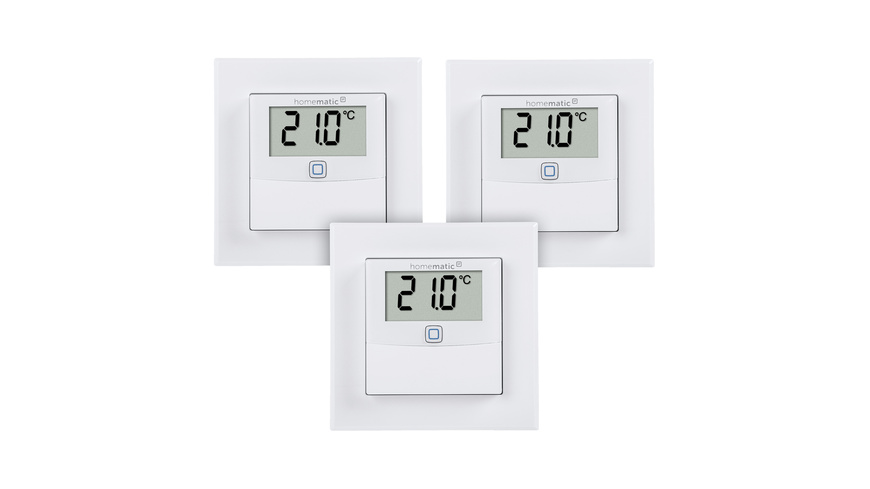
Three small wall sensors with a display that pass temperature and humidity to the Homematic IP app. According to the manufacturer, the batteries typically last two years and are included. The 3-pack does not work on its own, though; it needs an Access Point or a CCU3. How the system is set up is covered in the guide to Homematic IP. The manufacturer does not state humidity accuracy online, and the sensor is mainly intended for heating control. If you already use the system, it is a convenient way to add measuring points. We would not get into the system just because of mold.
Homematic IP Starter Set Raumklima
This set includes what the 3-pack lacks: the Access Point 2, plus a wall thermostat with humidity sensor and a switch and metering plug for up to 3,000 watts. According to ELV, the thermostat shows target and actual temperature as well as humidity. For mold, however, that means only one measuring point, and a wall thermostat rarely hangs in the cold corner. It makes sense if you want to control your heating anyway and will buy more sensors later.
TFA Schimmelradar 30.5032
A circular graph shows the peak values of the last 24 hours, a smiley stands for 40 to 60 percent, and from 65 percent, according to the manual, an alarm tone sounds for one minute while a red light keeps flashing. That makes it a useful ventilation traffic light for one room. The threshold is fixed, though. For a poorly insulated room in winter, the alarm comes rather late, and if you want to see the humidity in the corner, you have to hang the whole device there.
TFA Cosy 30.5019
You do not need more than this to find out whether your home has a moisture problem at all. The Cosy shows temperature and humidity, maximum and minimum values and colored comfort zones; data sheet: ±5 percent. Alarm, dew point and history are missing. Read it for a month, then decide.
What no sensor will do for you
A reading does not replace the window. According to the German Environment Agency, a three-person household releases about 6 to 14 kilograms of water a day; someone has to get it out. According to the Environment Agency, shock ventilation means 5 to 10 minutes, while the Verbraucherzentrale says 3 to 5 minutes is enough on cold winter days. Heat to at least 16 to 18 degrees during the day, including in rarely used rooms. In a basement in summer, the logic is reversed: there, warm, humid outdoor air brings water in, you ventilate early in the morning, and a dehumidifier can make more sense.
If humidity keeps climbing despite proper ventilation, look for the cause in the building: cracks, a leaking roof, pipes, rising damp. Indoor air sensors do not measure moisture in masonry, for that there are moisture meters, and they do not find hidden mold. Models with an app are in the comparison of smart thermo-hygrometers.
If there is already mold, do not start by measuring. The German Environment Agency recommends identifying the cause and removing the mold; for more than about 20 to 50 square centimeters, you should act without lengthy analysis, and larger areas belong in professional hands. Anyone with allergies, respiratory conditions or a weakened immune system should not do the remediation themselves. If you have symptoms, your family doctor is the right place to go.
What suits which home
- Older building or house with several cold exterior corners: dnt RoomLogg PRO, sensors in room and corner, review two weeks of history.
- Rented apartment with one problem room: TFA Schimmelradar 30.5032.
- Homematic IP is already running: Homematic IP 3er-Set HmIP-STHD.
- Smart heating is planned anyway: Homematic IP Starter Set Raumklima.
- Well-insulated apartment, just an uneasy feeling: TFA Cosy 30.5019.
If you want to compare indoor climate readings, you need devices that measure the same way; in our review of the Govee H5075, three thermometers were more than half a degree apart.
Frequently asked questions
What humidity is too high for mold?
According to the German Environment Agency, indoor air should not permanently exceed 65 to 70 percent, and the wall surface not 80 percent. The Verbraucherzentrale names 40 to 60 percent as comfortable; above 50 percent in winter, the risk rises. As a working rule: aim for below 50 percent, act from 60 percent, treat 65 percent as an alarm.
Why does the dew point matter for mold?
On cool surfaces, relative humidity rises without any water being added. At 20 degrees and 60 percent in the room, an exterior corner at just over 15 degrees already reaches the 80 percent that is enough for mold. Measure the surface temperature of the coldest spot in the morning with an infrared thermometer.
Where should a hygrometer go to prevent mold?
One sensor belongs in the middle of the room or on an interior wall, away from radiator and window. A second goes in the spot you worry about, such as the exterior wall corner in the bedroom or behind the wardrobe. Set separate alarm values, for example 60 percent in the room and 70 percent in the corner.
How accurate are home humidity sensors?
Where manufacturers state a value, it is ±4 to ±5 percentage points. If the display shows 60 percent, it could be 55 or 65. Such sensors are good for trends and comparisons, not for exact limits. They do not measure moisture in masonry, and they do not find hidden mold.
Is Homematic IP worth it as a mold warning system?
Only if the system is already running or smart heating is planned. The HmIP-STHD 3-pack needs an Access Point or a CCU3 and is mainly intended for heating control; the manufacturer does not state humidity accuracy. We would not get into the system just because of mold.
What should you do if there is already mold?
Do not start by measuring; identify the cause and remove the mold. According to the German Environment Agency, for more than about 20 to 50 square centimeters you should act without lengthy analysis, and larger areas belong in professional hands. Anyone with allergies, respiratory conditions or a weakened immune system should not do the remediation themselves. If you have symptoms, see your family doctor.
Sources
- German Environment Agency: guide to mold in the home (in German)
- German Environment Agency: mold in the home, brochure as PDF (in German)
- German Environment Agency: proper ventilation prevents mold (in German)
- Verbraucherzentrale: heating and ventilating the right way (in German)
- dnt: RoomLogg PRO data sheet
- ELV: dnt RoomLogg PRO
- Homematic IP: HmIP-STHD data sheet
- Homematic IP: HmIP-STHD manual
- ELV: Homematic IP 3er-Set HmIP-STHD
- ELV: Homematic IP Starter Set Raumklima
- TFA Dostmann: Schimmelradar 30.5032 manual
- TFA Dostmann: Cosy 30.5019 data sheet
Where to buy
- dnt RoomLogg PROView at ELVAvailable in Germany: ELVCheck price at Amazon.deAvailable in Germany: Amazon.de
- Homematic IP 3er-Set HmIP-STHDView at ELVAvailable in Germany: ELVCheck price at Amazon.deAvailable in Germany: Amazon.de
- Homematic IP Starter Set RaumklimaView at ELVAvailable in Germany: ELV
- TFA Schimmelradar 30.5032Check price at Amazon.deAvailable in Germany: Amazon.de
- TFA Cosy 30.5019Check price at Amazon.deAvailable in Germany: Amazon.de