Contents14 sections
This guide was first published in German on handgetestet.de.
Eight strengths in the set, two of them actually in use: that is how many ND purchases end. For video, what you mainly need is one strength that brings the shutter speed down to around 1/50 second on a bright day. On the DJI Mini 5 Pro, the original DJI set with ND8, ND32 and ND128 is therefore usually the sensible place to start; on a mirrorless camera, a variable ND filter with hard stops.
Gray glass and the matter of motion blur
An ND filter is neutral gray glass. It absorbs light, leaves colors alone and so allows longer shutter speeds.
Why that matters for video is explained by the 180-degree rule. The shutter speed should be roughly the reciprocal of twice the frame rate: 1/50 s at 25 frames per second, 1/60 s at 30 frames, 1/120 s at 60 frames. Movement then blurs the way the eye knows it from the cinema. At 1/4000 s, on the other hand, every single frame is razor-sharp. That is exactly what makes pans and waves look choppy.
How much filter does the midday sun call for?
Let’s do a quick calculation. According to the old „Sunny 16“ rule of thumb, in full sun at ISO 100 and f/16 you expose at 1/100 s. A drone camera with an f/1.8 aperture gets about six stops more light and ends up at around 1/8000 s. Getting to 1/50 s takes a good seven stops, and that corresponds to an ND128. On cloudy days ND16 or ND32 is enough, at dusk ND4 or ND8.
The number on the filter follows a simple logic. ND8 halves the light three times, so it amounts to three stops. ND16 is four, ND32 five, ND64 six, ND128 seven, ND1000 about ten stops.
Fixed, variable or with a polarizer
Fixed filters have exactly one strength and a simple optical design. A variable ND consists of two polarizing glasses that are rotated against each other. That is convenient. At strong settings and with wide-angle lenses, however, a dark cross can appear in the image, which is why good models limit the rotation with hard stops.
Combination filters of ND and polarizer (ND/PL) cut reflections from water and glass and make foliage more saturated. On a drone, though, their effect changes with every turn relative to the sun. For long pans, a plain ND is often the more consistent choice.
Will it even fit my device?
Drone filters are built for exactly one model. DJI explicitly approves the Mini 5 Pro set only for this model, and weight plays a role too, because the gimbal has to carry it. On a camera, the diameter is printed with the ⌀ symbol on the lens or the lens cap. If you have several lenses, buy for the largest thread and use an adapter ring (step-up) on the smaller ones.
Which drone suits you in the first place is covered in our piece on buying a drone (in German). If you would rather fly with goggles, start with the article on FPV drones for beginners.
Seven ND filters for drones and cameras
| Model | Fits | Strengths according to the manufacturer | Best for |
|---|---|---|---|
| DJI Mini 5 Pro ND filter set | DJI Mini 5 Pro | ND8, ND32, ND128 | Mini owners who mainly shoot video at 1/50 s |
| Freewell All Day 6er-Pack | DJI Mini 5 Pro | ND16, ND32, ND64, ND256, ND512, ND1000 | Anyone also planning long exposures from the air |
| Freewell Bright Day 6er-Pack ND/PL | DJI Mini 5 Pro | ND8/PL to ND256/PL | Coasts, lakes, cities with lots of glass |
| PolarPro Shutter Collection | DJI Mavic 4 Pro | ND4, ND16, ND64 | Mavic pilots who want a few clearly graded filters |
| K&F Concept ND set for Mavic 4 Pro | DJI Mavic 4 Pro | ND8, ND16, ND32, ND64 | Mavic pilots on a tighter budget |
| K&F Concept Nano-X Variable ND | Camera, e.g. 67 or 77 mm thread | ND2 to ND32 (1 to 5 stops) | Getting started with video on a mirrorless camera |
| PolarPro VND Edition II 2–5 | Camera, 67, 77 or 82 mm thread | 2 to 5 stops | Anyone who shoots a lot handheld and uses wide angles |
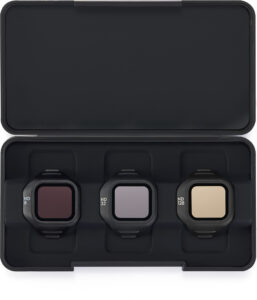
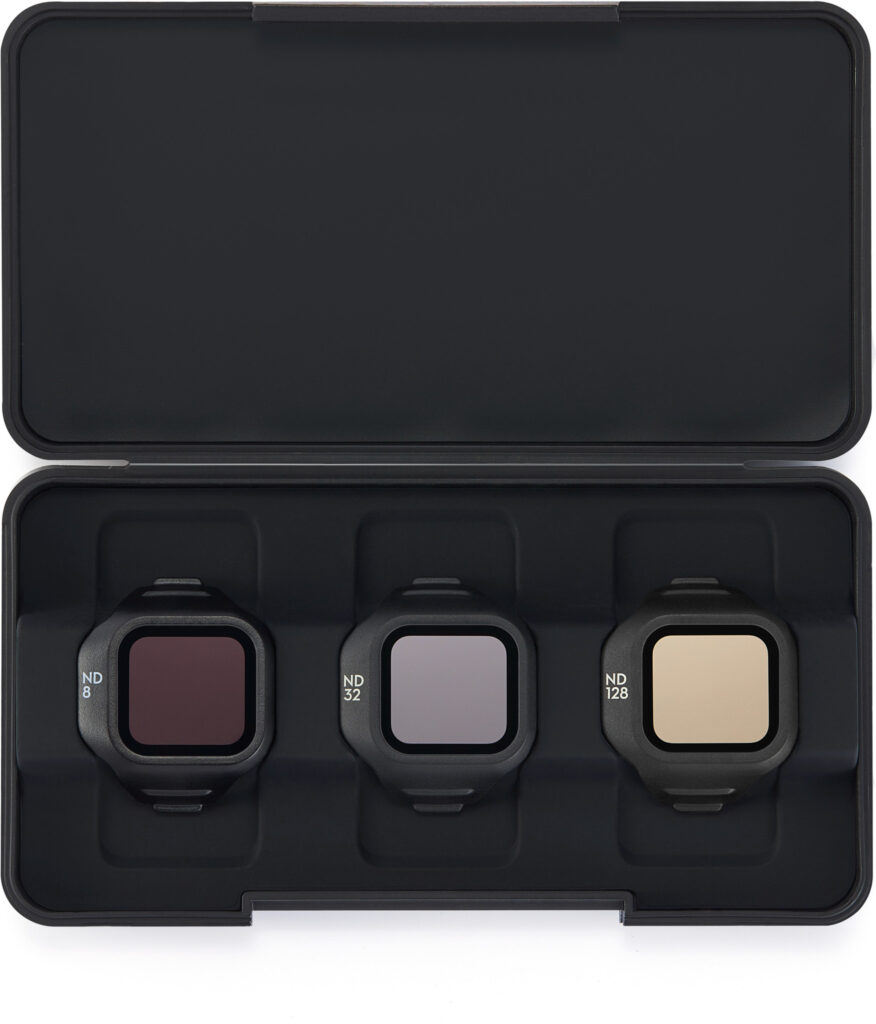
DJI Mini 5 Pro ND filter set (ND8/32/128)
Three filters for three situations: dusk, overcast skies, full sun. According to DJI, each weighs about 1.12 grams, and the set fits only the Mini 5 Pro. It already comes included with the Fly More Combo Plus.
Freewell All Day 6er-Pack for the Mini 5 Pro
According to Freewell, the set ranges from ND16 to ND1000. You will look in vain for a weak strength for evening light. ND512 and ND1000 are too dark for video on bright days; they are meant for long exposures, for example of surf or traffic. If you are not planning shots like that, you are paying for glass that stays in the box.
Freewell Bright Day 6er-Pack ND/PL
Each of these filters has a polarizer built in, from ND8/PL to ND256/PL. Over water and glass facades, that can noticeably reduce reflections. The catch: when the drone turns in flight, the polarization changes, and with it the brightness of the sky. Calm straight-line flights over a lake can handle that. Orbits, less so.
PolarPro Shutter Collection for the Mavic 4 Pro
PolarPro deliberately limits itself to three filters spaced two stops apart, namely ND4, ND16 and ND64. According to the manufacturer, you reach the in-between ND8 with the ND16 plus one stop more ISO or a wider aperture. According to PolarPro, the filters are matched to the gimbal and optics of the Mavic 4 Pro. In terms of price, the set belongs to the upper class; DJI offers its own set for the Mavic 4 Pro with ND8 to ND64 in a similar class.
K&F Concept ND set for the Mavic 4 Pro
Four filters from ND8 to ND64, mounted like the original lens protector. K&F cites optical glass with 28 coating layers and around 5.5 grams per filter, one price class below PolarPro and DJI. What is missing is an ND128 for sunny days at noon. In very bright light, you will have to use a faster shutter speed after all.
K&F Concept Nano-X Variable ND2–ND32
The affordable entry point for a mirrorless camera. According to K&F, the filter adjusts continuously from one to five stops, and the frame locks at both ends so the dark cross does not appear. One detail from the product description is easy to overlook: the regular lens cap no longer fits on the filter; the 67 mm model needs a 72 mm cap.
PolarPro VND Edition II 2–5 Stops
PolarPro’s Peter McKinnon edition adjusts between two and five stops. According to the manufacturer, the rotation is firmly limited, a noticeable click marks each stop, and there should be no vignetting down to a 16 mm focal length. For occasional vacation clips, the extra cost is hard to justify.
Which camera comes with the right thread is covered in our advice on mirrorless cameras (in German). For video at high bit rates, the card also has to be fast enough; more on that in the piece on memory cards (in German).
Which filter for which bag?
Mini 5 Pro and mostly video? Then the DJI set with ND8, ND32 and ND128; three filters cover the whole day. If long exposures with the Mini appeal to you too, Freewell All Day is a good fit, ideally supplemented with a weak ND8 for the evening. With lots of water in the frame, go for the Freewell Bright Day with polarizer and fly calm paths.
On the Mavic 4 Pro, the PolarPro Shutter Collection is enough if three graded filters will do. On a tighter budget, the set from K&F Concept. For your first filter on a mirrorless camera, take the variable K&F Nano-X in the thread size of your largest lens; if you shoot a lot of wide-angle, the PolarPro VND Edition II.
And as a rule of thumb: as few strengths as possible, but one dark enough for the midday sun.
Before the drone takes off with a filter, it is worth checking the guide to the drone map, which shows where you are allowed to fly.
Frequently asked questions
Why do you need an ND filter for video?
An ND filter is neutral gray glass that absorbs light and allows longer shutter speeds. According to the 180-degree rule, the shutter speed should be roughly the reciprocal of twice the frame rate, so 1/50 s at 25 frames. Movement then blurs the way it does in the cinema instead of looking choppy at 1/4000 s.
Which ND strength do you need in the midday sun?
A drone camera with an f/1.8 aperture ends up at about 1/8000 s in full sun. Getting to 1/50 s takes a good seven stops, which corresponds to an ND128. On cloudy days ND16 or ND32 is enough, at dusk ND4 or ND8.
What do ND8, ND32 or ND1000 mean?
The number follows a simple logic: ND8 halves the light three times, so it amounts to three stops. ND16 is four, ND32 five, ND64 six, ND128 seven and ND1000 about ten stops. ND512 and ND1000 are too dark for video on bright days and are meant for long exposures.
Fixed or variable ND filter?
Fixed filters have exactly one strength and a simple optical design. A variable ND consists of two polarizing glasses that are rotated against each other. That is convenient, but at strong settings and with wide-angle lenses a dark cross can appear in the image. Good models therefore limit the rotation with hard stops.
Is an ND/PL filter worth it on a drone?
Combination filters made of ND and polarizer reduce reflections from water and glass and make foliage more saturated. On a drone, however, their effect changes with every turn relative to the sun, and with it the brightness of the sky. Calm straight-line flights over a lake can handle that; for long pans, a plain ND is more consistent.
Do ND filters fit every drone or camera?
Drone filters are built for exactly one model; DJI explicitly approves the Mini 5 Pro set only for this model, partly because the gimbal has to carry the weight. On a camera, the diameter is printed on the lens with the ⌀ symbol. With several lenses, buy for the largest thread and use step-up rings.
Sources
- DJI Store: Mini 5 Pro ND Filter Set (ND8/32/128)
- DJI Store: Mavic 4 Pro ND Filters Set (ND8/16/32/64)
- Freewell: Filters for the DJI Mini 5 Pro
- PolarPro: Mavic 4 Pro Filters
- PolarPro: VND Filter Peter McKinnon Edition II
- K&F Concept: ND filter set for DJI Mavic 4 Pro
- K&F Concept: ND2–ND32 Nano-X series
- PolarPro: How Shutter Speed Affects Video (180-degree rule)
Where to buy
- DJI Mini 5 Pro ND-FiltersetCheck price at Amazon.deCheck price at Amazon.co.ukCheck price at Amazon.nlCheck price at Amazon.com.beCheck price at Amazon.frCheck price at Amazon.itCheck price at Amazon.esCheck price at Amazon.plCheck price at Amazon.seAvailable in Germany: Amazon.de
- Freewell All Day 6er-PackCheck price at Amazon.deCheck price at Amazon.co.ukCheck price at Amazon.nlCheck price at Amazon.com.beCheck price at Amazon.frCheck price at Amazon.itCheck price at Amazon.esCheck price at Amazon.plCheck price at Amazon.seAvailable in Germany: Amazon.de
- Freewell Bright Day 6er-Pack ND/PLCheck price at Amazon.deCheck price at Amazon.co.ukCheck price at Amazon.nlCheck price at Amazon.com.beCheck price at Amazon.frCheck price at Amazon.itCheck price at Amazon.esCheck price at Amazon.plCheck price at Amazon.seAvailable in Germany: Amazon.de
- PolarPro Shutter CollectionCheck price at Amazon.deCheck price at Amazon.co.ukCheck price at Amazon.nlCheck price at Amazon.com.beCheck price at Amazon.frCheck price at Amazon.itCheck price at Amazon.esCheck price at Amazon.plCheck price at Amazon.seAvailable in Germany: Amazon.de
- K&F Concept ND-Set für Mavic 4 ProCheck price at Amazon.deCheck price at Amazon.co.ukCheck price at Amazon.nlCheck price at Amazon.com.beCheck price at Amazon.frCheck price at Amazon.itCheck price at Amazon.esCheck price at Amazon.plCheck price at Amazon.seAvailable in Germany: Amazon.de
- K&F Concept Nano-X Variabler NDCheck price at Amazon.deCheck price at Amazon.co.ukCheck price at Amazon.nlCheck price at Amazon.com.beCheck price at Amazon.frCheck price at Amazon.itCheck price at Amazon.esCheck price at Amazon.plCheck price at Amazon.seAvailable in Germany: Amazon.de
- PolarPro VND Edition II 2-5 StopsCheck price at Amazon.deCheck price at Amazon.co.ukCheck price at Amazon.nlCheck price at Amazon.com.beCheck price at Amazon.frCheck price at Amazon.itCheck price at Amazon.esCheck price at Amazon.plCheck price at Amazon.seAvailable in Germany: Amazon.de