Contents12 sections
This guide was first published in German on handgetestet.de.
Can I drink from this stream? With a good filter, usually yes, but not everywhere without an additional step. For trips in the Alps, in Scandinavia or on German long-distance hiking trails, in our view a 0.1-micron hollow fiber filter such as the Sawyer Squeeze is enough; according to the manufacturer, it removes bacteria and protozoa. If, on the other hand, you travel through regions with poor sewage disposal, you need protection against viruses. An ordinary filter does not provide it.
What does a filter actually retain?
The pore size is what matters, and specifically the absolute pore size, not an average. The US health authority CDC roughly distinguishes as follows: a filter with an absolute pore size of 1 micron or smaller retains parasites such as Giardia and Cryptosporidium, but not all bacteria. From 0.3 microns down, bacteria and parasites are retained. Viruses are not.
Viruses are simply too small. According to the CDC’s travel medicine handbook, portable microfilters do not reliably remove enteric viruses such as noroviruses. Only ultrafilters with pores of around 0.01 microns should retain viruses, bacteria and parasites together. MSR calls its device in this class a purifier (in German: Wasserentkeimer).
What many people overlook when buying: a filter is not a laboratory. Sawyer states openly that its filter removes neither salt nor metals, pesticides or other dissolved chemicals. Water downstream of a sewage treatment plant, a mine or intensively fertilized fields therefore remains a problem.
And what about viruses on long-distance travel?
There are three ways to deal with them. The oldest is also the most reliable. The CDC advises bringing water to a rolling boil for one minute, or three minutes above about 2,000 meters. This kills viruses, bacteria and parasites. If you already carry a camping stove, all you need for drinking water at camp is enough fuel.
The second way combines a microfilter with chemical disinfection. According to the CDC, chlorine and iodine work well against viruses and bacteria, but poorly against parasites. Chlorine dioxide kills Giardia, but is only partially effective against Cryptosporidium. That is exactly why filter and tablet complement each other: the filter catches the parasites, the chemicals take care of the viruses. Cloudy water, however, binds part of the disinfectant, so it should be clear beforehand.
The third way is a virus filter such as the MSR Guardian. It works without tablets or waiting time, but weighs many times as much as a filter bottle. Before a trip to the tropics, an appointment for travel medicine advice is a must anyway; in its instructions, Katadyn recommends allowing four to six weeks for this.
Bottle, squeeze pouch or pump?
A filter bottle is the quickest to hand. Dip, screw on, drink. For day hikes and runs, that is enough. As soon as you need four liters in the evening for cooking and breakfast, though, the squeezing becomes tedious.
Squeeze filters such as the Sawyer Squeeze sit on a pouch or a standard disposable bottle. If you hang the pouch from a branch, the water runs through by gravity while you pitch the tent. This design is the most sensible compromise for multi-day trips, not least because it takes up hardly any space in your hiking backpack.
A pump plays to its strengths at sources where no bottle fits: shallow trickles, puddles in the rock, muddy banks. It is also more convenient for groups. It is heavier and has more parts that need looking after.
6 water filters for the trail compared
Sawyer Squeeze
A hollow fiber filter with an absolute 0.1 microns that, according to Sawyer, removes 99.99999 percent of bacteria and 99.9999 percent of protozoa. The package includes two pouches, a cleaning plunger and a tubing set for gravity operation; the thread fits standard 28-millimeter disposable bottles. When the flow rate drops, you backflush, and with clean water.
Sawyer Mini
Same filter fineness, smaller housing. Sawyer lists around 57 grams for the filter, plus a pouch holding just under half a liter, a syringe and a drinking straw. The thread also fits 28-millimeter bottles; according to Sawyer, it does not belong on a faucet. We would not use it as the main filter for two people, but as a backup, yes.
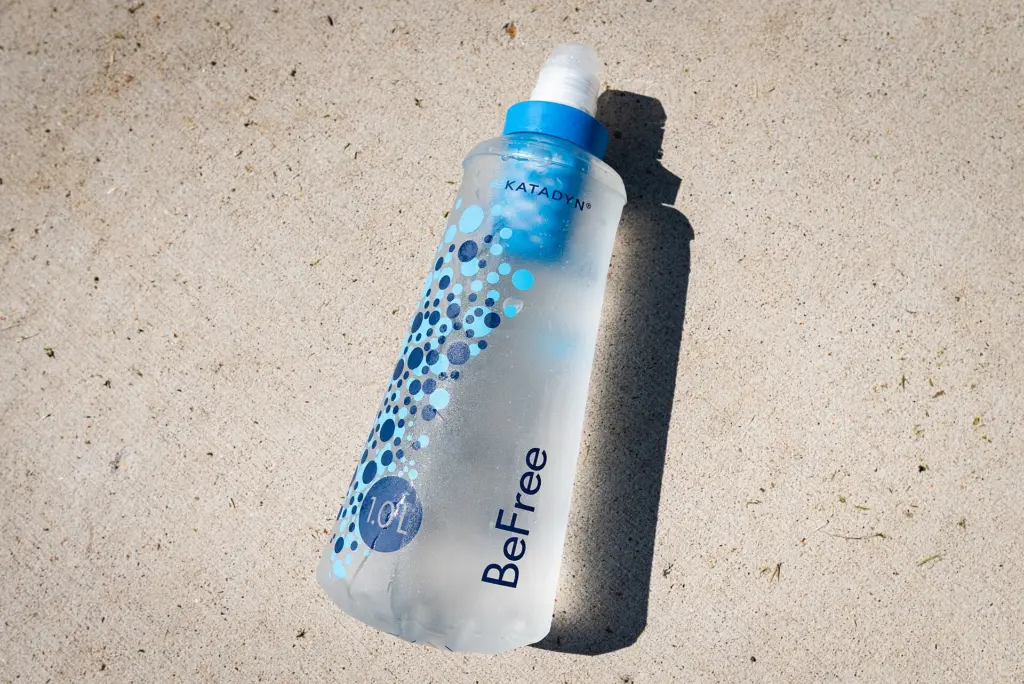
Katadyn BeFree 1.0L
A soft one-liter pouch with a screwed-in filter, according to Katadyn weighing just 73 grams, with up to two liters per minute and a capacity of up to 1,000 liters depending on water quality. It is cleaned by shaking it in water, without tools. The manufacturer itself intends it for clear water and occasional use. It is not meant for muddy ponds.
LifeStraw Peak Squeeze 1L
Here LifeStraw uses a 0.2-micron membrane filter that handles up to 2,000 liters. After that, according to the manufacturer, it simply stops letting water through. That removes any uncertainty about whether the cartridge is still working. This microfilter does not help against viruses either, as LifeStraw itself states.
Katadyn Hiker Pro
The classic hand pump. According to the instructions, a floating prefilter keeps out particles larger than 130 microns, and the cartridge removes 99.9999 percent of bacteria as well as 99.9 percent of Giardia and Cryptosporidium. Katadyn reckons with about 48 pump strokes per liter. The cartridge lasts 750 liters, or up to 1,150 liters with the included filter protector. Before longer storage, the filter should be disinfected.
MSR Guardian
The only virus filter in this comparison. MSR specifies a pore size of 0.02 microns and cites the US military test standard NSF P248 for viruses, bacteria, protozoa and sediment. At 490 grams, it weighs as much as several filter bottles combined, but according to the manufacturer it cleans itself with every pump stroke and is designed to withstand frost. For a week in the Allgäu region, that is overkill. For months in Southeast Asia or Latin America, it is not.
How we would decide
- Multi-day trip in Central Europe or Scandinavia: Sawyer Squeeze. Versatile, light, can be cleaned in the field.
- Day hike, trail run: Katadyn BeFree or LifeStraw Peak Squeeze, if the sources are clear.
- Group at a mountain lake: Katadyn Hiker Pro, because one person can pump for everyone.
- Long-distance travel with uncertain hygiene: MSR Guardian, or a light microfilter plus chlorine dioxide, and boiling if necessary.
One more word about winter. Sawyer states that a filter that has been used once should be replaced after freezing, because damage cannot be seen from the outside, and it does not provide a warranty for this. With filter bottles and squeeze filters, the rule is therefore: on cold nights, the filter belongs in your jacket pocket or sleeping bag.
Frequently asked questions
Does an outdoor water filter also filter out viruses?
Ordinary microfilters do not. According to the CDC's travel medicine handbook, they do not reliably remove enteric viruses such as noroviruses. Only ultrafilters with pores of around 0.01 microns should retain viruses, bacteria and parasites together. In this comparison, the MSR Guardian, at 0.02 microns, is the only virus filter.
What pore size does a water filter need?
The absolute pore size is what matters. According to the CDC, a filter with 1 micron or smaller retains parasites such as Giardia and Cryptosporidium, but not all bacteria. From 0.3 microns down, bacteria and parasites are retained, but viruses are not. The hollow fiber filters in this comparison work at 0.1 microns.
Does a water filter also remove chemicals?
No. Sawyer states openly that its filter removes neither salt nor metals, pesticides or other dissolved chemicals. Water downstream of a sewage treatment plant, a mine or intensively fertilized fields therefore remains a problem, even with a filter.
How long do you need to boil water?
The CDC advises bringing water to a rolling boil for one minute, or three minutes above about 2,000 meters. This kills viruses, bacteria and parasites. It is the oldest and at the same time the most reliable method, but it requires enough fuel for the stove.
Filter bottle, squeeze filter or pump?
A filter bottle is the quickest to hand for day hikes and runs. A squeeze filter such as the Sawyer Squeeze is the most sensible compromise for multi-day trips; hung from a branch, it filters by gravity. A pump plays to its strengths at shallow trickles and muddy banks and is more convenient for groups.
What happens if a water filter freezes?
Sawyer states that a filter that has been used once should be replaced after freezing, because damage cannot be seen from the outside, and it does not provide a warranty for this. On cold nights, the filter therefore belongs in your jacket pocket or sleeping bag. According to the manufacturer, the MSR Guardian is designed to withstand frost.
Sources
- CDC: Water treatment for hiking, camping and travel
- CDC Yellow Book: Water Disinfection for Travelers
- Sawyer: Squeeze
- Sawyer: Mini
- Sawyer help: Squeeze, frost and backflushing
- Katadyn: BeFree 1.0L
- Katadyn: Hiker Pro user manual (PDF)
- LifeStraw: How the filters work
- LifeStraw: Filter replacement for the Peak series
- MSR: Guardian purifier
Where to buy
- Sawyer SqueezeCheck price at Amazon.deCheck price at Amazon.co.ukCheck price at Amazon.nlCheck price at Amazon.com.beCheck price at Amazon.frCheck price at Amazon.itCheck price at Amazon.esCheck price at Amazon.plCheck price at Amazon.seAvailable in Germany: Amazon.de
- Sawyer MiniCheck price at Amazon.deCheck price at Amazon.co.ukCheck price at Amazon.nlCheck price at Amazon.com.beCheck price at Amazon.frCheck price at Amazon.itCheck price at Amazon.esCheck price at Amazon.plCheck price at Amazon.seAvailable in Germany: Amazon.de
- Katadyn BeFree 1.0LCheck price at Amazon.deCheck price at Amazon.co.ukCheck price at Amazon.nlCheck price at Amazon.com.beCheck price at Amazon.frCheck price at Amazon.itCheck price at Amazon.esCheck price at Amazon.plCheck price at Amazon.seAvailable in Germany: Amazon.de
- LifeStraw Peak Squeeze 1LCheck price at Amazon.deCheck price at Amazon.co.ukCheck price at Amazon.nlCheck price at Amazon.com.beCheck price at Amazon.frCheck price at Amazon.itCheck price at Amazon.esCheck price at Amazon.plCheck price at Amazon.seAvailable in Germany: Amazon.de
- Katadyn Hiker ProCheck price at Amazon.deCheck price at Amazon.co.ukCheck price at Amazon.nlCheck price at Amazon.com.beCheck price at Amazon.frCheck price at Amazon.itCheck price at Amazon.esCheck price at Amazon.plCheck price at Amazon.seAvailable in Germany: Amazon.de
- MSR GuardianCheck price at Amazon.deCheck price at Amazon.co.ukCheck price at Amazon.nlCheck price at Amazon.com.beCheck price at Amazon.frCheck price at Amazon.itCheck price at Amazon.esCheck price at Amazon.plCheck price at Amazon.seAvailable in Germany: Amazon.de
Still undecided?
Keep comparing at your own pace – every article in this category is checked monthly for new and discontinued models.