Contents14 sections
This guide was first published in German on handgetestet.de.
If you buy an overlock to sew T-shirt hems like the ones from the store, you will be disappointed. That hem, with two parallel lines of stitching on top and the thread mesh underneath, is sewn by a coverstitch machine, not an overlock. Still, the place to start is a 2/3/4-thread overlock (also called a serger) with adjustable differential feed; from our selection, the Juki MO-654DEN fits best. It trims, sews and finishes jersey in a single pass. The coverstitch machine comes along once hems become your main work.
If you do not yet have a regular sewing machine, you are better off starting there: an overlock cannot sew buttonholes, zippers or straight seams. Our sewing machine guide explains which basic machine goes with it.
Overlock, coverstitch, combination machine: which does what?
The overlock works at the edge. A knife trims off the seam allowance, and needles and loopers wrap a thread mesh around the freshly cut edge. According to Bernina, an overlock can handle up to four or five threads at once, and it is precisely this interlocking that makes the seam stretchy enough for knits, jersey and stretch fabrics.
The coverstitch machine, by contrast, sews flat within the fabric. Bernina describes the coverstitch as a flat, elastic hem with three or four threads, the kind familiar from T-shirts, and as a flat joining seam for swimwear, lingerie and sportswear, where nothing should chafe against the skin. A pure overlocker can do neither coverstitch nor chain stitch. Combination machines can do both.
Two, three or four threads?
The number of threads determines what the machine can do. Brother explains it on the M343D data sheet like this: the 3-thread stitch trims, finishes and joins with one needle; the 4-thread stitch adds an extra safety seam with the second needle. For shirts, leggings and children’s clothing, that is the standard seam. Two threads sound like less, but they bring their own stitches. Juki’s overview of the MO-600N series lists 2-thread overcasting, the 2-thread rolled hem and the 2-thread flatlock. These let you finish thin fabrics cleanly and lightly. If you only sew jersey together, you will not miss this. If you want to finish chiffon scarves or selvages, you will.
Differential feed: the control against ripples
An overlock has two feed dogs, one behind the other. Differential feed lets the front one push more or less fabric than the rear one, as the Juki MO-654DEN manual puts it. If it pushes more, the fabric is slightly eased; if it pushes less, the fabric is stretched.
The Juki manual gives specific values for this. Wool knit and heavy hand knits: from N to 1.5 to 2. Thin jersey: from N to 1.5. Woven fabric stays at N. Georgette, satin, linen and poplin tend to pucker and get 0.7. If you set the control to 1.5 to 2 and the stitch length to 4 mm, you can even gather a single layer of light fabric, for example for sleeve caps or lace edges.
Our position: no adjustable differential feed, no overlock for jersey. All six machines below have it.
Threading: order beats technology
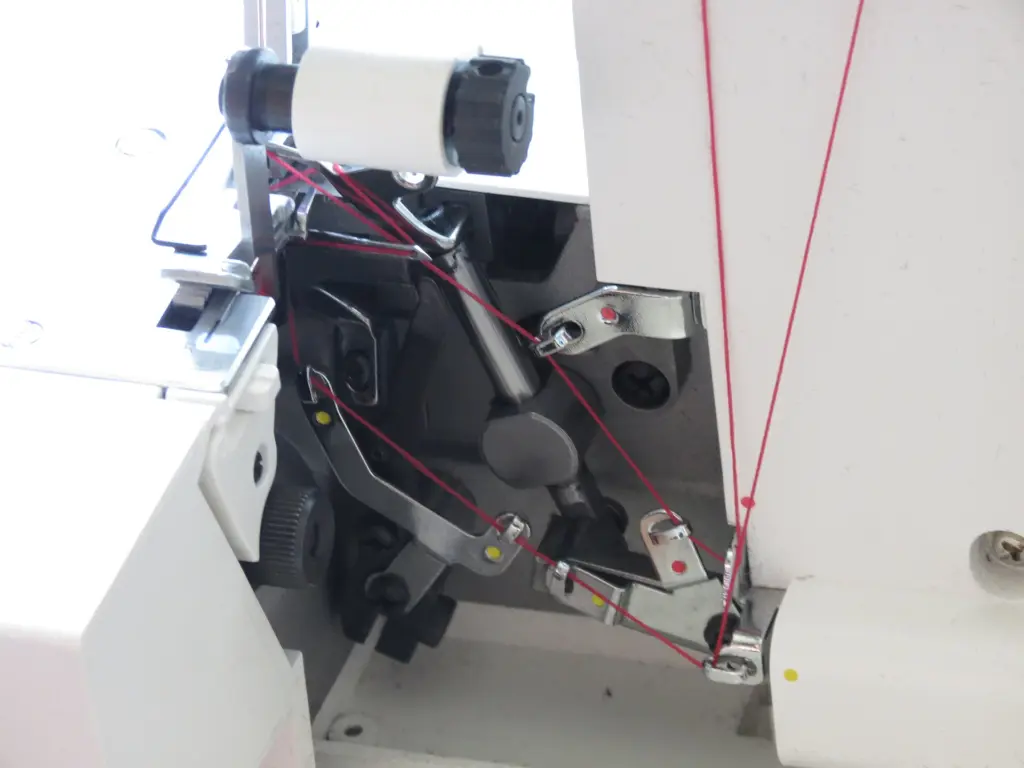
Four threads, two loopers, two needles. That is intimidating, but it follows a fixed order. For the MO-654DEN, Juki specifies: upper looper first (blue), then lower looper (red), then the right needle (green), and finally the left needle (yellow). Before that, turn off the power switch, turn the needles all the way up and fold up the upper knife. The colors are marked on the machine.
The lower looper is the tricky part. That is why it pays to check the data sheet: the Brother M343D, Juki MO-654DEN and Bernina L 460 have a threading aid for the lower looper. The Pfaff admire air 5000 and Bernina L 890 thread both loopers with air pressure. The needles remain manual work even on those, with a built-in threader. If threading a regular sewing machine already frustrates you, take a look at the air systems. If you enjoy tinkering, you will manage with the color code and tweezers.
Knives, needles, care: what the manuals require
The knife cuts everything that ends up under the foot. The Juki manual expressly warns against sewing with pins in the fabric: the knife or needle can break. So use clips instead of pins. For changing needles, threading and changing the foot, Juki requires the power switch to be set to „O“, and for removing covers, the plug must also be pulled. On the Juki, the upper knife can be folded up, and on the Brother M343D it can be disengaged, if you only want to sew and not cut.
Needles are not a one-size-fits-all part. For the MO-654DEN, Juki specifies household needles 130/705H in size 75/11 and, for heavy fabrics, a JL×2 on the left. According to Juki, a needle that is too thin can break in denim. Pfaff includes needles of type HAx1 SP in sizes 11 and 14 with the admire air 5000. So before buying replacements, always read the manual for your own model. As for care: pull the plug and remove dust and lint regularly. According to the manufacturer, the Juki only needs oil now and then, and only at the marked points. After sewing, a good steam iron (in German) helps overlock seams lie flat.
Six machines compared
| Model | Type and threads | Threading | Key specs according to the manufacturer | Best for |
|---|---|---|---|---|
| Juki MO-654DEN | Overlock, 2/3/4 threads, 1 or 2 needles | Lower looper threader, needle threader | Differential 0.7 to 2.0; stitch length 1 to 4 mm; up to 1,500 stitches/min; 7.0 kg | Getting started with all stitches |
| Brother M343D | Overlock, 3/4 threads | Lower looper threading aid, color code | Continuously adjustable differential; free arm; upper knife can be disengaged; 3-year manufacturer warranty | Jersey seams without the need for 2 threads |
| Pfaff admire air 5000 | Overlock, 2/3/4 threads, 15 stitches | Air threading of the loopers, needle threader | up to 1,300 stitches/min; 7.8 kg | If you do not want to thread loopers by hand |
| Bernina L 460 | Overlock, 2/3/4 threads, 16 stitches | Lower looper threader, manual needle threader | Cutting width 3 to 9 mm; stitch length 0.8 to 4 mm; up to 1,500 stitches/min; 9.8 kg | Frequent sewists who want a knee lifter |
| Brother CV3550 | Coverstitch, 2 to 5 threads, 3 needles | Lower looper threading system, color code | Differential; free arm; 155 mm work space | Hems on shirts and cuffs |
| Bernina L 890 | Combination: overlock, cover, chain stitch, 27 stitches | Air threader for the loopers, touchscreen | Coverstitch 3 or 6 mm; up to 1,350 stitches/min; 13.4 kg | One machine for everything, little space |
Juki MO-654DEN
The Juki offers everything a household overlock needs, without extras: 2, 3 and 4 threads, a built-in rolled hem, flatlock, differential from 0.7 to 2.0 and a threader for the lower looper. The manual is unusually specific, with differential values for each fabric and a troubleshooting table. For getting started, this is our first choice. At 7.0 kg, it remains manageable enough for the dining table.
Brother M343D
Brother focuses on 3 and 4 threads, a free arm for sleeves and pant legs and a rolled hem without changing the foot or needle plate. Presser foot pressure and differential are continuously adjustable. What is missing is 2-thread operation. If you mostly join jersey, you will never notice.
Pfaff admire air 5000
On the Pfaff, a lever threads the looper threads with air; for the needles, there is a built-in threader. On top of that come 15 stitches with 2, 3 or 4 threads. The convenience sits exactly where threading by hand takes the most patience: at the lower looper. At 1,300 stitches per minute, it is slightly slower than the Juki and the Bernina L 460, according to the manufacturer. For everyday hobby sewing, that is secondary.
Bernina L 460
On the L 460, Bernina lets you adjust thread tension, cutting width, stitch length and differential while sewing. According to the manufacturer, Micro Thread Control (mtc) makes protruding thread loops disappear with a lever, and the knee lifter of the Free Hand System raises the foot while both hands stay on the fabric. According to Bernina, it has no free arm, and at 9.8 kg it is considerably heavier than the Juki. This is a machine for people who sew every week.
Brother CV3550
The CV3550 is not an overlock but a dedicated coverstitch machine. According to Brother, it sews triple, wide and narrow coverstitch, chain stitch and top cover stitches, where the thread mesh also sits on top. When the foot is raised, the thread tension releases so the fabric can be removed without pulling. It only makes sense once the overlock is already in place.
Bernina L 890
Overlock, coverstitch, chain stitch and combination stitches in one machine: according to Bernina, the L 890 combines 27 stitches, air threading of the loopers and a color touchscreen. In return, it weighs 13.4 kg and is best left in one place on the table. According to the accessories list, it comes with separate feet for overlock and coverstitch as well as a dedicated coverstitch cover, so switching between modes means converting the machine. If you need both every day, two machines are more convenient.
Which machine suits which sewing room
- First overlock, jersey and the occasional rolled hem: Juki MO-654DEN.
- Only sewing shirts and leggings together, free arm desired: Brother M343D.
- Threading is the biggest hurdle: Pfaff admire air 5000.
- Sewing every week, adjusting settings mid-seam: Bernina L 460.
- Hems should look store-bought: Brother CV3550 as a complement to the overlock.
- One spot, one machine, converting is not a problem: Bernina L 890.
Frequently asked questions
What is the difference between an overlock and a coverstitch machine?
The overlock works at the edge: a knife trims off the seam allowance, and needles and loopers wrap a stretchy thread mesh around the cut edge. The coverstitch machine sews flat within the fabric, for example the elastic hem on T-shirts. A pure overlocker can do neither coverstitch nor chain stitch.
Do I need an overlock with two, three or four threads?
For shirts, leggings and children's clothing, the 4-thread stitch with an additional safety seam is the standard seam. Two threads bring their own stitches, such as the 2-thread rolled hem and flatlock for thin fabrics. If you only sew jersey together, you will not miss them; if you want to finish chiffon scarves, you will.
What is differential feed on an overlock for?
It lets the front feed dog push more or less fabric than the rear one. That way, fabric is slightly eased or stretched, and jersey does not ripple. The Juki manual gives 1.5 for thin jersey; woven fabric stays at N. Without this control, no overlock for jersey.
How do you thread an overlock?
In a fixed order. For the MO-654DEN, Juki specifies: upper looper first, then lower looper, then the right needle and finally the left needle, with the power switch off beforehand. The colors are marked on the machine. The Pfaff admire air 5000 and Bernina L 890 thread both loopers with air pressure.
Which needles does an overlock need?
That depends on the model; needles are not a one-size-fits-all part. For the MO-654DEN, Juki specifies household needles 130/705H, and Pfaff includes needles of type HAx1 SP with the admire air 5000. According to Juki, a needle that is too thin can break in denim. Read the manual before buying replacements.
Is a combination overlock and coverstitch machine worth it?
If space is tight and switching over is not a problem. According to the manufacturer, the Bernina L 890 combines overlock, coverstitch and chain stitch, but it weighs 13.4 kg. Switching between modes involves changing to separate feet. If you need both every day, two machines are more convenient.
Sources
- Juki: MO-644DN/654DEN user manual (PDF, in English)
- Juki: MO-600N series catalog (PDF)
- Juki: Overlock comparison list
- Brother: M343D data sheet (PDF)
- Brother: CV3550 product sheet (PDF, in English)
- Pfaff admire air 5000 in the manufacturer’s shop (in English)
- Bernina: Complete catalog 2024/2025 (PDF, in English)
- Bernina: L 450/L 460 brochure (PDF, in English)
Where to buy
- Juki MO-654DENCheck price at Amazon.deCheck price at Amazon.co.ukCheck price at Amazon.nlCheck price at Amazon.com.beCheck price at Amazon.frCheck price at Amazon.itCheck price at Amazon.esCheck price at Amazon.plCheck price at Amazon.seAvailable in Germany: Amazon.de
- Brother M343DCheck price at Amazon.deCheck price at Amazon.co.ukCheck price at Amazon.nlCheck price at Amazon.com.beCheck price at Amazon.frCheck price at Amazon.itCheck price at Amazon.esCheck price at Amazon.plCheck price at Amazon.seAvailable in Germany: Amazon.de
- Pfaff admire air 5000Check price at Amazon.deCheck price at Amazon.co.ukCheck price at Amazon.nlCheck price at Amazon.com.beCheck price at Amazon.frCheck price at Amazon.itCheck price at Amazon.esCheck price at Amazon.plCheck price at Amazon.seAvailable in Germany: Amazon.de
- Bernina L 460Check price at Amazon.deCheck price at Amazon.co.ukCheck price at Amazon.nlCheck price at Amazon.com.beCheck price at Amazon.frCheck price at Amazon.itCheck price at Amazon.esCheck price at Amazon.plCheck price at Amazon.seAvailable in Germany: Amazon.de
- Brother CV3550Check price at Amazon.deCheck price at Amazon.co.ukCheck price at Amazon.nlCheck price at Amazon.com.beCheck price at Amazon.frCheck price at Amazon.itCheck price at Amazon.esCheck price at Amazon.plCheck price at Amazon.seAvailable in Germany: Amazon.de
- Bernina L 890Check price at Amazon.deCheck price at Amazon.co.ukCheck price at Amazon.nlCheck price at Amazon.com.beCheck price at Amazon.frCheck price at Amazon.itCheck price at Amazon.esCheck price at Amazon.plCheck price at Amazon.seAvailable in Germany: Amazon.de