Contents13 sections
This guide was first published in German on handgetestet.de.
A pH meter is only as accurate as its last calibration. If you buy one and then leave it dry in a drawer for two years, it will measure nonsense afterward, no matter how many decimal places the display shows. For an aquarium, pool and hydroponics together, we consider the Dostmann PC 6 Tester Kit the most sensible purchase: besides pH it also measures conductivity, salinity and ORP (redox), and buffer solutions plus storage solution come right in the case. If you only need to keep an eye on the pool, you can get by with less.
Five meters compared
| Model | Measures | pH accuracy according to the manufacturer | Best for |
|---|---|---|---|
| Dostmann PC 6 Tester Kit | pH, conductivity, TDS, salt, ORP, temperature | ±0.01 | Aquarium, pool, hydroponics in one device |
| Hanna HI98129 | pH, conductivity up to 3,999 µS/cm, TDS, temperature | ±0.05 | Freshwater aquarium, watering water |
| Hanna HI98121 | pH, ORP, temperature | ±0.05 | Pool with chlorine or salt system |
| Hanna HI981074 | pH, temperature | ±0.1 | Pool and hot tub, simple |
| ELV Digitales pH-Wert-Messgerät mit Dual-Display | pH, temperature | ±0.2 | Occasional checks, small budget |
One more decimal place sounds like lab quality. For a pool, you can do without it. Hanna gives pH 7.2 to 7.4 as the target range for pool water, because chlorine only works well against germs at the right pH; a meter with ±0.1 hits that window. In an aquarium or with nutrient solutions, on the other hand, the second decimal place can help.
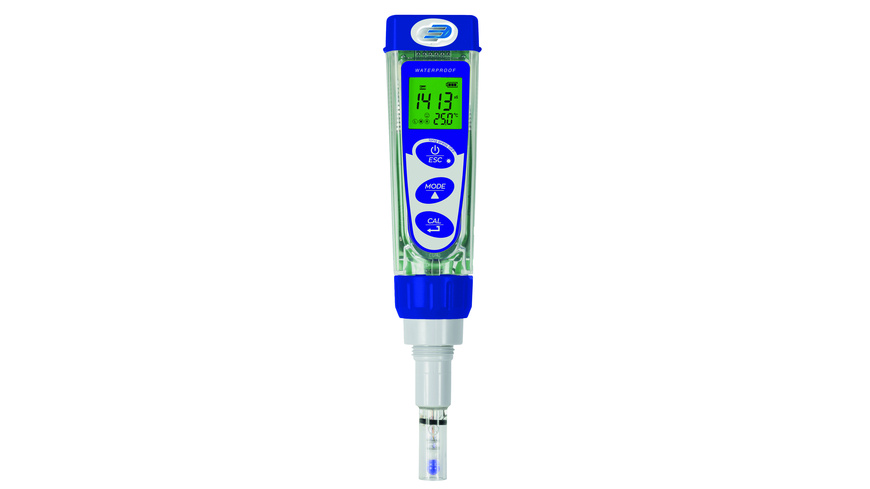
Dostmann PC 6 Tester Kit
The kit is an IP67 waterproof pen with a replaceable sensor. According to Dostmann, the pH range runs from −2 to 16, temperature is compensated automatically, and a smiley on the display shows when the reading is stable. It can be calibrated at up to three points. Useful for aquarium keepers: in its manual, Dostmann calculates that one degree of German hardness corresponds to roughly 30 µS/cm of conductivity, with an error of two to three French degrees. That is enough for a rough hardness check. Drawbacks: the kit sits in a considerably higher price class than simple pH pens, and the retailer page and the manual contradict each other on the battery specification.
Hanna HI98129
Designed for fresh water. The pH electrode has a cloth junction which, according to Hanna, you pull out by 2 to 3 millimeters as soon as it is dirty and the readings drift. Once the strip is used up, only the electrode is replaced. Conductivity tops out at 3,999 µS/cm. That is not enough for seawater.
Hanna HI98121
Instead of conductivity, this pen measures the oxidation-reduction potential (ORP), according to Hanna with ±2 mV and factory-calibrated. Hanna lists the meter in its selection for pools and hot tubs; there, the ORP value gives an indication of how effectively the disinfection is working at the moment. You have to buy the storage solution for the electrode separately.
Hanna HI981074
Two buttons and one coin cell that, according to Hanna, lasts around 800 hours. A pool on the weekend needs nothing more. Starter sachets with pH 4.01 and 7.01 are included, the storage solution is not.
ELV Digitales pH-Wert-Messgerät mit Dual-Display
The entry point: a digital pH meter with dual display from ELV (German retailer). ELV specifies ±0.2 pH at 25 degrees, the electrode is replaceable, and power comes from four LR44 coin cells. That is enough for a garden pond or a quick look at the pool water. You have to buy calibration fluids separately.
Calibration: how often, and with what?
For daily use, Dostmann recommends calibrating every morning, and before each measurement if you use the meter rarely. ELV says the same for its pen. That sounds strict, but it only takes a few minutes: first pH 7 buffer, briefly swirl the electrode in water, then pH 4 buffer. It should be at least two points, Dostmann advises. If you mostly measure in the alkaline range, for example in a pool with hard water, add pH 10 on meters with three-point calibration.
For occasional users, single 20-milliliter sachets, like the ones Hanna offers, are often more practical than large bottles that then sit open in the cupboard for months.
The electrode needs to stay moist
The glass sensor is the most delicate part. ELV states explicitly: the protective cap should hold storage solution or pH 7 buffer, never tap water or distilled water. A dried-out electrode responds sluggishly or not at all. White crystals on the cap, on the other hand, are normal according to ELV. If a measurement takes a very long time, rinsing under running water for 10 to 15 minutes or using a cleaning solution often helps. Store the meter at room temperature, not in the garden shed over the winter.
What public pools go by
There are no official limits for your own pool. A useful point of reference, however, is the 2026 recommendation of the German Environment Agency (Umweltbundesamt) for public pools. For pool water, it specifies 0.3 to 0.6 milligrams of free chlorine per liter, and 0.7 to 1.0 in hot tubs. Depending on the treatment, the pH should be between 6.5 and 7.2 or 7.5. For the redox voltage, the agency requires at least 750 millivolts in fresh water at pH 6.5 to 7.3, measured against a silver/silver chloride reference electrode. If the pH is higher, the requirement rises to 770 millivolts.
Two things follow from this. First, chlorine effectiveness and the ORP value depend on pH; if you just keep pouring in chlorine without knowing the pH, you are working blind. Second, the agency shows how professionals handle measuring devices: a pool’s permanently installed pH electrode should be checked daily with a handheld meter. For the ORP value, the recommendation accepts a measurement uncertainty of plus/minus 40 millivolts. A pocket meter with ±2 mV, as Hanna specifies for the HI98121, is well below that, provided the electrode and calibration are in order.
Three mistakes that distort readings
The first is already mentioned above: storing the electrode dry or in tap water. The second: calibrating with expired or opened buffer solutions. Then the reference is off, and every decimal place is a guess. The third: reading too early. According to Dostmann, the PC 6 shows a smiley when the reading is stable; with other meters, wait until the display stops wandering.
Frequently asked questions
Aren’t test strips good enough?
For a rough look, yes. The German Environment Agency also permits photometric methods in public pools, but for daily checks it relies on electrometric measurement with a handheld meter.
What does the ORP value tell you?
It shows how strongly the water oxidizes, in other words how effectively the disinfection is working at the moment. Values can only be compared if the reference electrode is stated, as the German Environment Agency explicitly points out.
How often does the electrode need replacing?
The manufacturers do not give a fixed figure here. A sign of wear is sluggish or drifting readings that do not improve even after cleaning and calibration. On the Dostmann, the Hanna HI98129 and the ELV, the electrode can be replaced individually.
Does temperature matter?
Yes, pH depends on temperature. According to Dostmann, the PC 6 compensates for it automatically; ELV specifies its accuracy at 25 degrees.
Which meter for what?
- Aquarium, pool and plants with one device, plus a rough hardness estimate: Dostmann PC 6 Tester Kit.
- Only a freshwater aquarium or watering water with conductivity: Hanna HI98129.
- Pool with chlorine, keeping an eye on disinfection: Hanna HI98121.
- Pool, pH only, as simple as possible: Hanna HI981074.
- Measuring now and then, spending little: ELV Digitales pH-Wert-Messgerät mit Dual-Display.
A meter is no substitute for working filtration. If the pH in the pool keeps wandering, check the sand filter system and the pump’s running time. If you are still planning, you will find the basics in our guide to the above-ground pool. And if you actually want to use conductivity to check the hardness of your tap water, you should measure carefully anyway before getting a water softener.
Frequently asked questions
How often do you need to calibrate a pH meter?
For daily use, Dostmann recommends calibrating every morning, and before each measurement if you use it rarely; ELV says the same. It only takes a few minutes: first pH 7 buffer, briefly swirl the electrode in water, then pH 4 buffer. It should be at least two points.
How accurate does a pH meter for the pool need to be?
A second decimal place is not necessary for a pool. Hanna gives pH 7.2 to 7.4 as the target range for pool water, and a meter with ±0.1 hits that window. In an aquarium or with nutrient solutions, on the other hand, the higher accuracy can help.
How do you store a pH electrode properly?
Moist. According to ELV, the protective cap should hold storage solution or pH 7 buffer, never tap water or distilled water. A dried-out electrode responds sluggishly or not at all. Store the meter at room temperature, not in the garden shed over the winter.
What does ORP measurement do for a pool?
The ORP (redox) value gives an indication of how effectively the disinfection is working at the moment. That is why Hanna lists the HI98121 in its selection for pools and hot tubs; it measures pH, ORP and temperature. You have to buy the storage solution separately.
Can you determine water hardness from conductivity?
Roughly, yes. In its manual, Dostmann calculates that one degree of German hardness corresponds to roughly 30 µS/cm of conductivity, with an error of two to three French degrees. That is enough for a rough hardness check in an aquarium.
Sources
- ELV: Dostmann PC 6 Tester Kit
- Dostmann: Tester Kit series operating manual
- Dostmann: Tester series data sheet
- ELV: Digitales pH-Wert-Messgerät mit Dual-Display
- ELV: Operating manual for the pH meter with dual display
- Hanna Instruments: HI98129
- Hanna Instruments: HI98121
- Hanna Instruments: HI981074
- German Environment Agency (Umweltbundesamt): Hygiene requirements for pools and their monitoring (2026, PDF)
Where to buy
- Dostmann PC 6 Tester KitView at ELVAvailable in Germany: ELVCheck price at Amazon.deCheck price at Amazon.co.ukCheck price at Amazon.nlCheck price at Amazon.com.beCheck price at Amazon.frCheck price at Amazon.itCheck price at Amazon.esCheck price at Amazon.plCheck price at Amazon.seAvailable in Germany: Amazon.de
- Hanna HI98129Check price at Amazon.deCheck price at Amazon.co.ukCheck price at Amazon.nlCheck price at Amazon.com.beCheck price at Amazon.frCheck price at Amazon.itCheck price at Amazon.esCheck price at Amazon.plCheck price at Amazon.seAvailable in Germany: Amazon.de
- Hanna HI98121Check price at Amazon.deCheck price at Amazon.co.ukCheck price at Amazon.nlCheck price at Amazon.com.beCheck price at Amazon.frCheck price at Amazon.itCheck price at Amazon.esCheck price at Amazon.plCheck price at Amazon.seAvailable in Germany: Amazon.de
- Hanna HI981074Check price at Amazon.deCheck price at Amazon.co.ukCheck price at Amazon.nlCheck price at Amazon.com.beCheck price at Amazon.frCheck price at Amazon.itCheck price at Amazon.esCheck price at Amazon.plCheck price at Amazon.seAvailable in Germany: Amazon.de
- ELV Digitales pH-Wert-Messgerät mit Dual-DisplayView at ELVAvailable in Germany: ELV