Contents15 sections
This guide was first published in German on handgetestet.de.
A water softener is not a health device. It protects pipes, water heaters and fixtures, nothing more. If you live in an area with medium or hard water and are annoyed by limescale-clogged shower heads and a hot water tank full of deposits, a certified ion exchanger such as the Grünbeck softliQ:SE18 is a solid solution for a household of up to four people. With soft water, you do not need one.
What actually happens in the basement
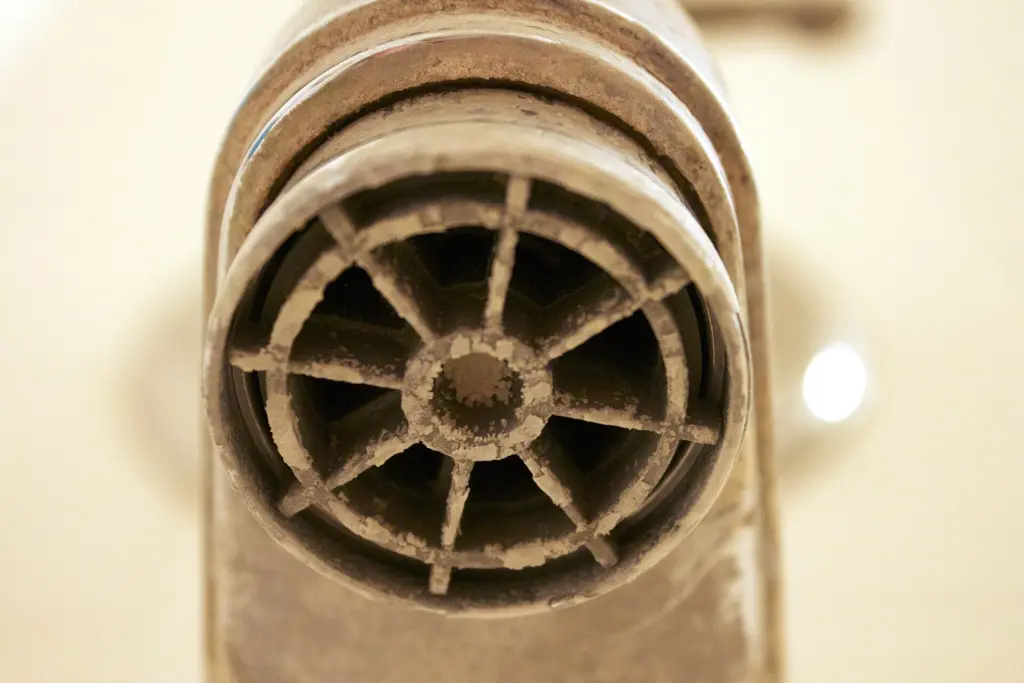
Hardness comes from dissolved calcium and magnesium. When the water is heated, some of it precipitates as limescale: on the heating element, in the tankless water heater, in the aerator. A water softener removes these ions. To do this, the water flows through a column of resin beads loaded with sodium. Calcium and magnesium stick to the resin, and sodium goes into the water. Once the resin is exhausted, the system flushes it with brine and recharges it. Manufacturers call this process regeneration, and it explains why every one of these systems needs salt, power and a drain connection.
After the exchange, the water is initially fully softened. For drinking water, the DVGW (German Technical and Scientific Association for Gas and Water) does not consider this appropriate. A blending valve therefore mixes in hard water until the desired residual hardness is reached. As a guideline value, the association gives 8.4 °dH (German degrees of hardness), the boundary of the „soft“ range. Calcium should not fall below 0.5 mmol/l, or around 3 °dH.
Measure first, then buy
Your water supplier must publish the hardness range at least once a year. That is what Section 9 of the German Detergents and Cleaning Agents Act requires. The ranges are clearly defined: soft below 1.5 millimoles of calcium carbonate per liter, medium 1.5 to 2.5, hard above 2.5. Converted, the boundaries are about 8.4 and 14 °dH.
You can check your own value with a drop test. Fill the tube to the mark, add the titration solution drop by drop, shake, count. When the color changes from red to green, the number of drops corresponds to the hardness in °dH. You will need the same test again later, this time downstream of the system, to check the setting.
According to the DVGW, softening makes sense in the medium and hard ranges when malfunctions in appliances are to be expected. It is not necessary for health reasons. The German consumer advice center (Verbraucherzentrale) attests that tap water is of very good quality, even when it contains lime, and Stiftung Warentest, the German consumer testing organization, described calcium and magnesium in drinking water as desirable as early as 2009.
Sodium, salt and wastewater
For every degree of hardness the system removes, the sodium content rises by 8.2 mg/l. That is the figure the DVGW gives. A sample calculation for a region with 20 °dH: setting the system to 8 °dH removes 12 degrees and increases sodium by just under 100 mg/l. The German Drinking Water Ordinance allows 200 mg/l, and the sodium already present counts toward that. You will find the starting value in your supplier’s water analysis.
The regeneration salt does not disappear. Wastewater treatment plants do not hold it back, and it ends up in rivers. The DVGW therefore recommends softening only as much as necessary and not including the garden connection at all. On the plus side, detergent consumption drops: theoretically up to 30 percent, the association writes, provided you dose according to the new hardness range. On the washing machine, you change the hardness setting accordingly.
Scale protection without salt: what the devices do
In addition to ion exchangers, there are scale protection devices that work without salt and without wastewater. They do not remove anything from the water. According to the DVGW, they form tiny seed crystals to which the hardness minerals attach instead of building up on heating surfaces. The hardness therefore stays the same, and detergent consumption does not drop. Effectiveness is tested according to the German standard DIN 3607.
Whether a device lives up to its promises is disputed. In issue 1/2000, Stiftung Warentest tested physical water conditioners: only three worked, and ten were rated „poor.“ According to the organization, it has had no new findings on this technology since then. For us, that means: a salt-free device is only an option with a test mark, and if you want measurably softer water, you need an ion exchanger. A pitcher filter, in turn, only softens the water for your tea; our guide to water filters (in German) explains the differences.
Systems and accessories according to manufacturer data
| Model | Type | Key specs according to the manufacturer | Best for |
|---|---|---|---|
| Grünbeck softliQ:SE18 | Single-column system, Wi-Fi | 5 l resin, up to 35 kg salt, 0.15 to 0.55 kg salt per regeneration, 1.8 m³/h | 1 to 4 people |
| Judo i-soft SAFE+ | Two columns, leak protection | 50 kg salt tank, around 200 g salt and 25 l water per regeneration, 1.8 m³/h | Households that want continuous soft water and a shut-off |
| BWT Perla One | Single-column system, Wi-Fi/LAN | up to 32 kg salt, 0.26 to 0.76 kg salt per regeneration, 1.7 m³/h | medium-hard water, lower demand |
| SYR LEX Plus 10 Connect | Single-column system, app | 7.5 l resin, 25 kg salt, approx. 0.95 kg salt per regeneration, 1.5 m³/h | Single-family home |
| Grünbeck total hardness water test kit | Drop test | 1 drop = 1 °dH, color change from red to green | everyone, before buying and for checks |
| BWT Perla Tabs | Regeneration salt | Tablets, min. 99.6% sodium chloride, DIN EN 973 grade A | Operators of any system |
Grünbeck softliQ:SE18
According to Grünbeck, the smallest system in the SE series is designed for one to four people. It regenerates only the capacity that has been used and takes only as much salt as necessary; for hygiene reasons, it performs a full flush after three days at the latest. The data sheet lists a DIN/DVGW registration number, and a drop test is included. It measures 815 × 360 × 430 mm, and 1,060 mm high with the lid open. For up to twelve people, there is the larger SE24 with 9 l of resin. During regeneration, hard water flows through; that is worth knowing.
Judo i-soft SAFE+
Two columns work alternately, so according to Judo, soft water is available around the clock. We find the built-in leak protection more interesting: it shuts off the line when adjustable limits are exceeded, and up to ten floor sensors can be connected. If you are already thinking about water leak detectors, you get both in one device here. According to the instructions, the device is tested to DIN EN 14743 and DIN 19636-100 and carries the DIN-DVGW mark. Part of the care remains with the operator: a visual check every two months, and checking the siphon and leak-tightness every six months.
BWT Perla One
BWT itself positions the Perla One for medium-hard water and lower demand, for example upstream of a water heater. Due to its design, it does not go below about 20 percent of the incoming hardness. The AQA Watch function is practical: it reports long, small flows as a possible drip loss.
SYR LEX Plus 10 Connect
According to the data sheet, its capacity is enough to partially soften all the water in a single-family home. At 0.95 kg per regeneration, it uses more salt per cycle than the Grünbeck, but it has more resin. At a mains pressure of 5 bar or more, SYR requires a pressure reducer upstream. The instructions list the maintenance precisely: check the hardness yourself every quarter, and have the chlorine cell and seals replaced by a specialist company every two years.
Grünbeck total hardness water test kit
A tube and a bottle of titration solution. It measures in °dH or °f (French degrees), depending on which mark you fill it to. Before buying, it confirms your supplier’s value; afterward, it shows whether the blending is set correctly.
BWT Perla Tabs
Regeneration salt in tablet form, made from evaporated salt with at least 99.6 percent sodium chloride. BWT specifies DIN EN 973 grade A, the standard for salt used in drinking water treatment. Judo likewise requires tablets to DIN EN 973 for the i-soft.
Installation: not yourself, and not just anywhere
Under Section 12 (2) of the German Ordinance on General Conditions for the Supply of Water (AVBWasserV), installation may only be carried out by the water supplier or by an installation company listed in a supplier’s installer register. The German consumer advice center puts it more plainly: do not install such systems yourself. Ask the company directly whether it is registered. To find one, the DVGW refers you to your supplier’s list.
The installation site needs quite a few things. A protective filter with 80 to 150 µm upstream of the system, as German standard DIN 1988-200 requires anyway. An outlet with a permanent power supply. A drain connection where the flushing and overflow hoses end with an air gap according to DIN EN 1717, so that no wastewater can be siphoned back; according to the DVGW, the system itself must have a built-in backflow preventer. Plus a frost-free room that must not get warmer than 25 °C for drinking water. A boiler room at 28 degrees in winter is therefore ruled out. If the drain is higher than the system, a saltwater-resistant lifting station becomes necessary.
Maintenance: the part in the brochure’s fine print
According to the DVGW, DIN EN 806-5 specifies the following for water softeners: inspection every two months, maintenance every six months. Manufacturers translate this differently. Judo has the operator carry out checks every two months and every six months, and sends its customer service once a year. SYR specifies annual maintenance by a professional installer, and every six months in multi-family buildings. And according to Judo and SYR, anyone who does not keep to the intervals risks their warranty. So factor in the maintenance contract from the start.
One small thing to finish. Once the system is running, the hardness settings of your household appliances are no longer correct. After installation, switch all appliances to the new value, including the fully automatic espresso machine (in German).
How we would decide
- Soft water below 8.4 °dH: no system. A drop test confirms this.
- One to four people with hard water: Grünbeck softliQ:SE18, installed by a registered specialist company.
- Larger household, want a shut-off in case of water damage: Judo i-soft SAFE+ or the Grünbeck SE24.
- Only medium-hard water, protection for the water heater: BWT Perla One.
- Scale protection without salt: only with a test mark according to DIN 3607 and without expecting softer water.
Frequently asked questions
At what water hardness is a water softener worthwhile?
According to the DVGW (German Technical and Scientific Association for Gas and Water), in the medium and hard ranges, when malfunctions in appliances are to be expected. Soft means below about 8.4 °dH (German degrees of hardness), hard above about 14 °dH. Your water supplier must publish the hardness range at least once a year; a drop test gives you your own reading.
Is softened water healthier?
No, softening is not necessary for health reasons. The German consumer advice center (Verbraucherzentrale) attests that tap water is of very good quality, even when it contains lime. Stiftung Warentest, the German consumer testing organization, described calcium and magnesium in drinking water as desirable. The DVGW does not consider fully softened drinking water appropriate and gives 8.4 °dH as a guideline value.
How much sodium does a water softener add to the water?
According to the DVGW, the sodium content rises by 8.2 mg/l for every degree of hardness removed. Setting the system from 20 °dH to 8 °dH increases sodium by just under 100 mg/l. The German Drinking Water Ordinance allows 200 mg/l, and the sodium already present according to your supplier's analysis counts toward that.
Do salt-free scale protection devices work?
That is disputed. They do not remove anything from the water; according to the DVGW, they form seed crystals, and the hardness stays the same. In 2000, Stiftung Warentest found only three devices that worked, while ten were rated poor. For us, a salt-free device is only an option with a test mark according to the German standard DIN 3607.
Can you install a water softener yourself?
No. Under Section 12 of the German Ordinance on General Conditions for the Supply of Water (AVBWasserV), only the water supplier or a company listed in the installer register may install it. At the installation site, you need a protective filter, a permanent power supply, a drain connection with an air gap and a frost-free room that does not get warmer than 25 °C.
How often does a water softener need servicing?
According to the DVGW, DIN EN 806-5 specifies inspection every two months and maintenance every six months. Judo sends its customer service once a year, and SYR specifies annual maintenance by a professional installer. According to Judo and SYR, anyone who does not keep to the intervals risks the warranty, so a maintenance contract belongs in the calculation.
Sources
- DVGW compact info: water treatment in drinking water installations (March 2024)
- AVBWasserV Section 12
- German Detergents and Cleaning Agents Act, Section 9
- German Drinking Water Ordinance, Annex 3 (sodium)
- Verbraucherzentrale: water treatment in the home
- Stiftung Warentest: physical water conditioners (2000)
- Stiftung Warentest: filter and softening systems (2009)
- Grünbeck: softliQ:SE product data sheet
- Grünbeck: softliQ:SD operating instructions (hardness measurement)
- Judo: i-soft SAFE+
- Judo: i-soft SAFE+ installation and operating instructions
- BWT: Perla One
- BWT: Perla One product data sheet
- BWT: regeneration agent data sheet (Perla Tabs)
- SYR: LEX Plus 10 Connect data sheet
- SYR: LEX Plus 10 Connect operation and maintenance
Where to buy
- Grünbeck softliQ:SE18Check price at Amazon.deCheck price at Amazon.co.ukCheck price at Amazon.nlCheck price at Amazon.com.beCheck price at Amazon.frCheck price at Amazon.itCheck price at Amazon.esCheck price at Amazon.plCheck price at Amazon.seAvailable in Germany: Amazon.de
- Grünbeck softliQ:SE24Check price at Amazon.deCheck price at Amazon.co.ukCheck price at Amazon.nlCheck price at Amazon.com.beCheck price at Amazon.frCheck price at Amazon.itCheck price at Amazon.esCheck price at Amazon.plCheck price at Amazon.seAvailable in Germany: Amazon.de
- Judo i-soft SAFE+Check price at Amazon.deCheck price at Amazon.co.ukCheck price at Amazon.nlCheck price at Amazon.com.beCheck price at Amazon.frCheck price at Amazon.itCheck price at Amazon.esCheck price at Amazon.plCheck price at Amazon.seAvailable in Germany: Amazon.de
- BWT Perla OneCheck price at Amazon.deCheck price at Amazon.co.ukCheck price at Amazon.nlCheck price at Amazon.com.beCheck price at Amazon.frCheck price at Amazon.itCheck price at Amazon.esCheck price at Amazon.plCheck price at Amazon.seAvailable in Germany: Amazon.de
- SYR LEX Plus 10 ConnectCheck price at Amazon.deCheck price at Amazon.co.ukCheck price at Amazon.nlCheck price at Amazon.com.beCheck price at Amazon.frCheck price at Amazon.itCheck price at Amazon.esCheck price at Amazon.plCheck price at Amazon.seAvailable in Germany: Amazon.de
- Grünbeck Wasserprüfeinrichtung GesamthärteCheck price at Amazon.deCheck price at Amazon.co.ukCheck price at Amazon.nlCheck price at Amazon.com.beCheck price at Amazon.frCheck price at Amazon.itCheck price at Amazon.esCheck price at Amazon.plCheck price at Amazon.seAvailable in Germany: Amazon.de
- BWT Perla TabsCheck price at Amazon.deCheck price at Amazon.co.ukCheck price at Amazon.nlCheck price at Amazon.com.beCheck price at Amazon.frCheck price at Amazon.itCheck price at Amazon.esCheck price at Amazon.plCheck price at Amazon.seAvailable in Germany: Amazon.de