Contents12 sections
This guide was first published in German on handgetestet.de.
Lumens, laser, HDR? Later. First, bring a folding ruler into the living room. How much space remains between the wall and a possible location decides which type of projector is even an option. For a classic home theater with permanent mounting, a 4K projector with good color accuracy such as the BenQ W2720i is a solid choice. If you lack the long throw distance, there is no way around an ultra short throw model, such as the Epson EH-LS650 or the Hisense PL2, which sit directly in front of the wall.
In between are flexible devices with smart TV and a swiveling stand, such as the XGIMI Horizon S Max and the Dangbei MP1 Max. The Samsung The Freestyle 2nd Gen is a handy second projector for dark rooms. It does not replace a large home theater.
What the folding ruler tells you
The throw ratio indicates how far away the projector has to be for a given image width. At 1.2:1, a 100-inch image needs about 2.7 meters. Ultra short throw projectors with ratios around 0.25:1 get by with a few centimeters and sit on the low media console instead of on the ceiling.
These devices do come with one condition, though. They only show their strength on a suitable contrast screen that absorbs light from above. A white wall works too, but in daylight the image looks paler. Plan the screen in from the start.
Three kinds of lumens
ANSI lumens, ISO lumens, LED lumens. The figures are produced by different methods and cannot be compared directly; LED lumens usually come out considerably higher. In general, a bright room needs more light. In a darkened room, considerably less is enough.
4K, HDR, smart TV and sound
Many 4K projectors produce full resolution via pixel shift. They move pixels very quickly so that a 4K image appears on the screen even though the chip itself has fewer pixels. That is not false labeling but common technology. As for the light source, replacing lamps is a thing of the past: according to the manufacturers, laser and LED last 20,000 hours and longer.
HDR is more complicated. Almost all devices handle HDR10 and HLG, while Dolby Vision and HDR10+ are additional formats used by streaming services. You should know beforehand which ones your services use. With Google TV or Android TV, many apps run directly on the projector, and official Netflix support is by no means a given. On some devices, the system sits on an included HDMI stick.
That leaves sound. The built-in speakers are enough for everyday use; a real cinema feel is more likely to come from a soundbar or AV receiver, ideally via HDMI with eARC.
Six projectors from 550 to 3,600 lumens
| Model | Brightness (manufacturer) | Design and distance | Best for |
|---|---|---|---|
| BenQ W2720i | 2,500 ANSI lumens, 4 LEDs | Classic, 1.0–1.3:1 with zoom | Permanent home theater mounting, film fans |
| Epson EH-LS650 | 3,600 lumens, laser | Ultra short throw, 0.25–0.62:1 | Living rooms without ceiling mounting |
| Hisense PL2 | 2,700 ANSI lumens, laser | Ultra short throw, 0.22:1 | Big picture up to 150 inches in front of the wall |
| XGIMI Horizon S Max | 3,100 ISO lumens, laser and LED | Classic, 1.2:1, stand | Flexible setup, Dolby Vision |
| Dangbei MP1 Max | 3,100 ISO lumens, laser and LED | Classic, 1.2:1, stand | Large image up to 300 inches, Google TV |
| Samsung The Freestyle 2nd Gen | 550 LED lumens, LED | Portable, 30–100 inches, Full HD | Second device, bedroom, on the go |
BenQ W2720i: for film fans with permanent mounting
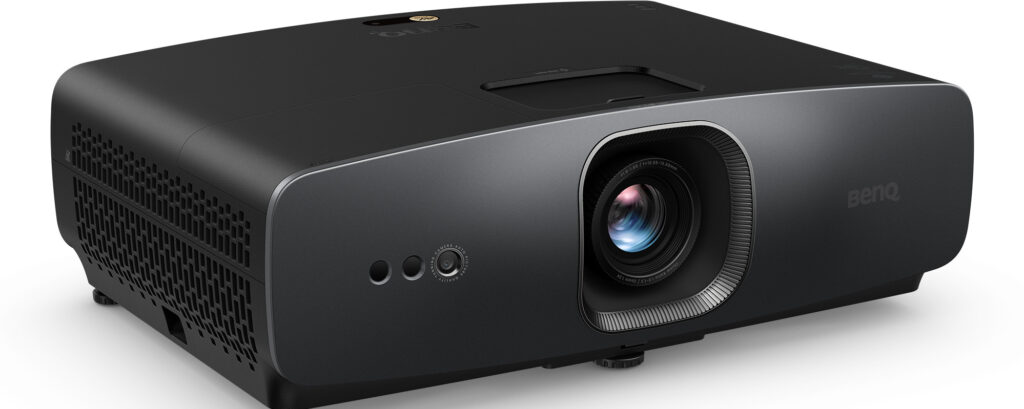
A classic home theater projector for the ceiling or a shelf. BenQ states 2,500 ANSI lumens from four LEDs, 90 percent coverage of the DCI-P3 cinema color space and factory calibration. Thanks to 1.3x zoom and a small vertical lens shift, setup does not have to be accurate to the centimeter. According to BenQ, a distance of about 2.7 meters is enough for 120 inches. Android TV comes via an included stick, and it passes the sound on to your audio system via eARC.
Epson EH-LS650: instead of a TV
It sits directly in front of the wall, where the TV would otherwise be. Epson specifies 3,600 lumens for white and color and relies on 3LCD technology with a laser. The image ranges from 60 to 120 inches. According to Epson, for 77 inches the device sits only about 43 centimeters from the wall. Android TV and a Yamaha sound system with a subwoofer are built in, but for HDR formats Epson lists only HDR10 and HLG.
Hisense PL2: up to 150 inches from the TV stand
An ultra short throw laser for very large images from 80 to 150 inches. Hisense states 2,700 ANSI lumens and a throw ratio of 0.22:1. VIDAA serves as the smart system with Netflix, Prime Video and Disney+, and a 30-watt sound system is built in.
In daylight, a high-contrast image requires a special screen. At 150 inches, that is no small expense.
XGIMI Horizon S Max: flexible and with Dolby Vision
Here, laser and LED together form the light source, which according to XGIMI reaches 3,100 ISO lumens. Dolby Vision is supported, along with IMAX Enhanced certification. With the integrated stand, you can aim the image at the wall or the ceiling. Autofocus and automatic keystone correction speed up setup. The system is Android TV.
Dangbei MP1 Max: the largest image in the comparison
The MP1 Max also combines a triple laser with LED and, according to the manufacturer, reaches 3,100 ISO lumens. The image can be stretched from 40 to 300 inches, and 100 inches requires a distance of about 2.7 meters. Because the stand rotates all the way around and tilts far upward, even the ceiling becomes a screen. Google TV with the official Netflix app is on board, and for HDR, Dangbei relies on HDR10+ and HLG.
Samsung The Freestyle 2nd Gen: small, light, low on brightness
About 0.8 kilograms, Full HD, 30 to 100 inches. The Freestyle runs on Samsung’s Tizen smart TV system and can be powered by a USB-C power bank with at least 60 watts. Samsung specifies the brightness in LED lumens, and even that figure is far below that of the large models. In a dark room, that works. In the living room in the afternoon, it does not. According to buyer reports, the image quality is right, but the low brightness in bright rooms draws criticism.
Which projector for which room
A permanent home theater in a room you can darken speaks for the BenQ W2720i, because zoom, lens shift and factory calibration pay off with ceiling mounting. If the projector is to replace the TV in the living room, the Epson EH-LS650 is the obvious solution. It sits on the TV stand, needs hardly any distance and brings its own sound. If you want the maximum image size without ceiling mounting, go for the Hisense PL2 with up to 150 inches directly in front of the wall.
Want flexible placement and Dolby Vision? Then the XGIMI Horizon S Max with its stand, autofocus and many HDR formats. For a giant image with Google TV, the Dangbei MP1 Max fits, with a very large image range and a swiveling stand. And as a second device for on the go, there is the Samsung The Freestyle 2nd Gen, light and usable with a power bank, but only for dark rooms.
What the TV stand, wall distance and screen require with a laser TV is calculated in our guide to the ultra short throw projector.
What ambient light does to contrast and what a curtain achieves is covered in our guide to the projector in a bright living room.
Why the HDMI input on the projector matters more than ARC is explained in our guide to the soundbar with a projector.
Frequently asked questions
How much distance does a projector need for 100 inches?
That depends on the throw ratio. At 1.2:1, a 100-inch image needs about 2.7 meters, as with the Dangbei MP1 Max. Ultra short throw projectors with ratios around 0.25:1 get by with a few centimeters and sit on the TV stand instead of on the ceiling.
Can ANSI, ISO and LED lumens be compared?
Not directly. The figures are produced by different methods, and LED lumens usually come out considerably higher. In general, a bright room needs more light, while a darkened room needs considerably less. The Samsung The Freestyle 2nd Gen, for example, states 550 LED lumens and is only suitable for dark rooms.
Is 4K via pixel shift real 4K?
Pixel shift moves pixels very quickly so that a 4K image appears on the screen even though the chip itself has fewer pixels. That is not false labeling but common technology in many 4K projectors.
Does an ultra short throw projector need a special screen?
It only shows its strength on a contrast screen that absorbs light from above. A white wall works too, but in daylight the image looks paler. That is why the screen belongs in the plan from the start; at 150 inches, as with the Hisense PL2, it is no small expense.
Which HDR formats should a projector support?
Almost all devices handle HDR10 and HLG. Dolby Vision and HDR10+ are additional formats used by streaming services, so check beforehand which ones your services use. In this comparison, the XGIMI Horizon S Max offers Dolby Vision, the Dangbei MP1 Max relies on HDR10+ and HLG, and the Epson EH-LS650 lists only HDR10 and HLG.
Are a projector's built-in speakers enough?
For everyday use, they are. A real cinema feel is more likely to come from a soundbar or AV receiver connected via HDMI with eARC. The exception is the Epson EH-LS650, which has a built-in Yamaha sound system with a subwoofer.
Sources
- BenQ: W2720i specifications
- Epson: EH-LS650B specifications
- Hisense: Laser Cinema PL2
- Hisense: Introduction of the PL2
- XGIMI: Horizon S Max
- Dangbei: MP1 Max
- Samsung: The Freestyle 2nd Gen
Where to buy
- BenQ W2720iView at CoolblueAvailable in Germany: CoolblueCheck price at Amazon.deCheck price at Amazon.co.ukCheck price at Amazon.nlCheck price at Amazon.com.beCheck price at Amazon.frCheck price at Amazon.itCheck price at Amazon.esCheck price at Amazon.plCheck price at Amazon.seAvailable in Germany: Amazon.de
- Epson EH-LS650 (weiß)Check price at Amazon.deCheck price at Amazon.co.ukCheck price at Amazon.nlCheck price at Amazon.com.beCheck price at Amazon.frCheck price at Amazon.itCheck price at Amazon.esCheck price at Amazon.plCheck price at Amazon.seCheck price at Amazon.comAvailable in Germany: Amazon.de
- Hisense PL2 Laser CinemaCheck price at Amazon.deCheck price at Amazon.co.ukCheck price at Amazon.nlCheck price at Amazon.com.beCheck price at Amazon.frCheck price at Amazon.itCheck price at Amazon.esCheck price at Amazon.plCheck price at Amazon.seCheck price at Amazon.comCheck price at Amazon.ca
- XGIMI Horizon S MaxCheck price at Amazon.deCheck price at Amazon.co.ukCheck price at Amazon.nlCheck price at Amazon.com.beCheck price at Amazon.frCheck price at Amazon.itCheck price at Amazon.esCheck price at Amazon.plCheck price at Amazon.seCheck price at Amazon.comCheck price at Amazon.ca
- Dangbei MP1 MaxCheck price at Amazon.deAvailable in Germany: Amazon.deCheck price at Amazon.nlCheck price at Amazon.com.beCheck price at Amazon.frCheck price at Amazon.itCheck price at Amazon.esCheck price at Amazon.plCheck price at Amazon.comCheck price at Amazon.ca
- Samsung The Freestyle 2nd GenCheck price at Amazon.deCheck price at Amazon.co.ukCheck price at Amazon.nlCheck price at Amazon.com.beCheck price at Amazon.frCheck price at Amazon.itCheck price at Amazon.esCheck price at Amazon.plCheck price at Amazon.seCheck price at Amazon.comCheck price at Amazon.ca