Contents13 sections
This guide was first published in German on handgetestet.de.
A Christmas star made of 4 mm poplar plywood, a gear for a wooden model, the letters for a door sign. For work like this, a benchtop machine with around 400 mm of throat depth and a variable stroke rate is usually enough, such as the Scheppach SD1600V. If, on the other hand, you cut large fretwork pictures from a single piece, you need a deeper throat, and if you only cut small parts for a model railroad, you can get by with considerably less. So the real buying decision is made at the workpiece, not at the motor.
How large can the workpiece be?
The throat depth is the distance between the saw blade and the rear arm of the machine. It limits how far you can turn a panel before it hits something. At 406 mm, the figure from Einhell, Scheppach and Holzmann, you can still reach the center of a panel a good 80 cm wide. Proxxon specifies exactly 460 mm for the DS 460, Hegner 365 mm for the Multicut-1. The small DS 230/E comes to 300 mm.
Cutting height is rarely the bottleneck for fretwork. A puzzle made of 6 mm plywood or a nativity figure made of 18 mm pine is far below the 50 to 60 mm that the larger machines handle according to their manufacturers. The more interesting figure is with the table tilted. At 45 degrees, Einhell specifies only 20 mm, Scheppach 22 mm and Holzmann 27 mm.
What does a variable stroke rate do?
The stroke rate indicates how many times per minute the blade moves up and down. Einhell regulates the TC-SS 405 E continuously from 400 to 1,600 strokes, Scheppach and Holzmann from 500 to 1,700. Proxxon takes a different approach with the DS 460 and offers two fixed speeds of 900 and 1,400 strokes. According to the manufacturer, the small DS 230/E ranges from 150 to 2,500 strokes. The Einhell and Holzmann manuals simply say to set the stroke rate according to the material. The manufacturers reveal nothing more. Our view: if you want to cut acrylic glass or brass as well as wood, choose a machine with variable speed so you can try out for yourself what the material can take.
A detail that surprises beginners: the teeth only cut on the downstroke. That is why, according to the Einhell and Holzmann manuals, the blade must always be clamped so that the teeth point toward the table. If it is the wrong way around, the blade yanks the workpiece upward.
Pinned blade or pinless fretsaw blade?
This is where you find out how pleasant the machine is to use day to day. Pinned blades have a cross pin at each end and can be hooked in quickly. Plain fretsaw blades without pins, by contrast, are clamped. For interior cutouts, meaning a window in the middle of a panel, you drill a hole, thread the blade through and only then tension it. That is also how Einhell describes it. A pinned blade needs a larger hole for this because the pin has to go through too. With delicate fretwork patterns that have dozens of small windows, that makes a real difference.
According to the manufacturers, Scheppach and Holzmann take both types of blade, and so does Proxxon with the DS 460. Einhell includes two adapters for pinless blades. How quickly a change goes depends on the clamping. Scheppach relies on a quick-release lever. On the DS 460, Proxxon slides the table back by 80 mm so the lower arm is freely accessible.
Expect some wear at first. Einhell openly states that some blades are sure to break while you are learning. Scheppach cites incorrect tension and turning the workpiece too fast as causes. According to Scheppach, you check the tension by sound: a plucked blade should give a high-pitched tone.
Six scroll saws and their key specs
| Model | Throat depth | Cutting height in wood (90°) | Strokes per minute | Best for |
|---|---|---|---|---|
| Proxxon DS 230/E | 300 mm | Softwood up to 40 mm | 150–2,500 | Model making, small parts, limited space |
| Einhell TC-SS 405 E | 406 mm | 52 mm | 400–1,600 | Getting started with fretwork |
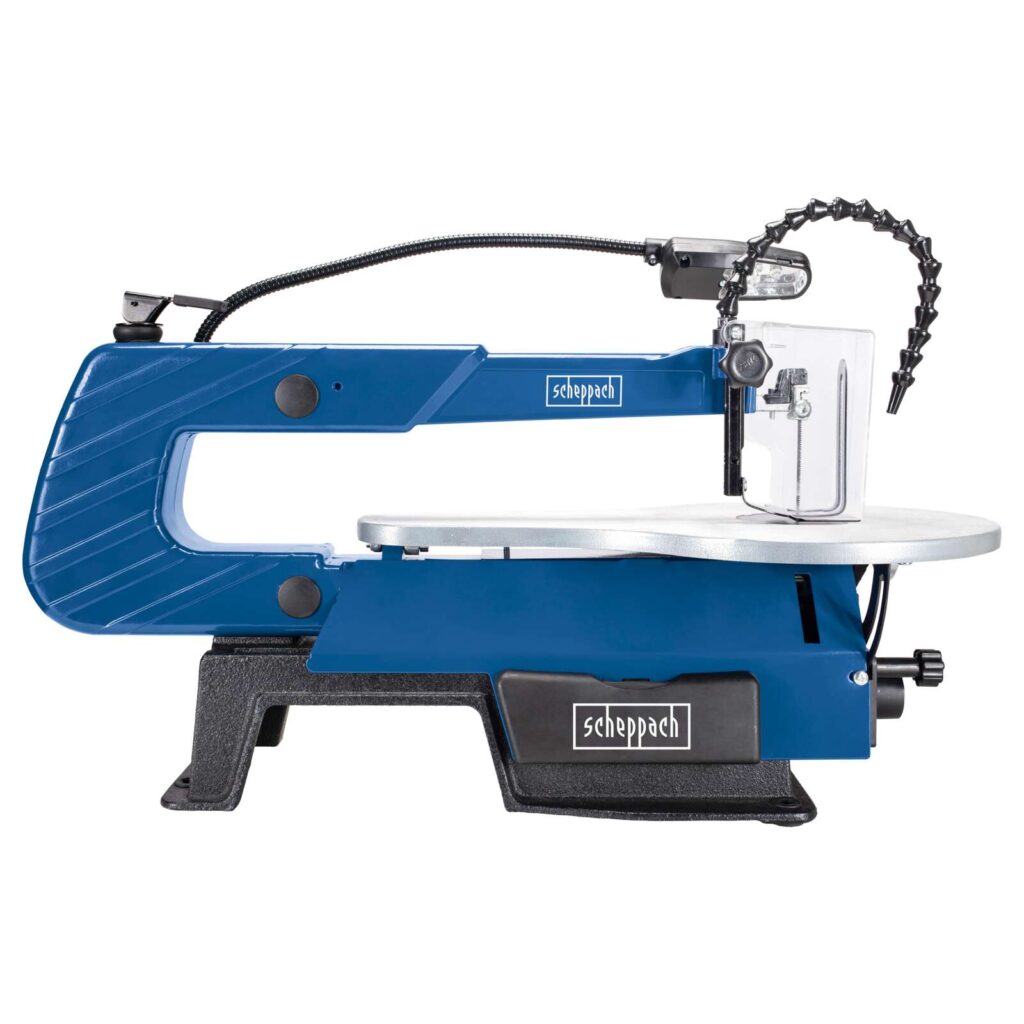
| Scheppach SD1600V | 406 mm | 50 mm | 500–1,700 | Hobby use with frequent blade changes |
| Holzmann DKS21PRO | 406 mm | 57 mm | 500–1,700 | Thicker parts, large table surface |
| Hegner Multicut-1 | 365 mm | 50 mm | Depends on version | Adjustable stroke, heavy frame |
| Proxxon DS 460 | 460 mm | 60 mm | 900 or 1,400 | Large patterns, non-ferrous metal |
Proxxon DS 230/E: small, but with a purpose of its own
Around 2 kg, a table of 160 by 160 mm, 300 mm of throat depth. Proxxon gives the limits as softwood up to 40 mm, hardwood up to 10 mm and non-ferrous metal up to 2 mm. This is a machine for ribs, boards and small parts on the hobby table, not for an A3-size fretwork picture.
Einhell TC-SS 405 E: solid basic equipment
Einhell specifies 406 mm of throat depth, 52 mm of cutting height and a table of 408 by 250 mm that tilts up to 45 degrees. A 36 mm dust extraction port is included. According to the manual, changing blades is more cumbersome than on the Scheppach: loosen the tensioning screw, unscrew the side cover, unhook the blade at the top and bottom. If you rarely change blades, you can live with that.
Scheppach SD1600V: the convenient middle ground
The SD1600V combines the key specs of the Einhell with a more convenient blade change. Scheppach specifies 406 mm of throat depth, 50 mm of cutting height, 500 to 1,700 strokes and a weight of 12.5 kg. The holder takes blades with and without pins, and tensioning is done with a quick-release lever. Added to that are an LED light and a blower nozzle that blows chips off the cutting line. That is enough for Christmas decorations, signs and wooden toys. An 18 mm board does not use even half of the 50 mm cutting height.
Holzmann DKS21PRO: more table, more height
Same throat depth, same stroke-rate range as the Scheppach. Holzmann, however, specifies 57 mm of cutting height, still 27 mm at 45 degrees, and a table of 320 by 482 mm. According to the spec sheet, the weight is 12 kg. Here too, blades with and without pins fit. The manual recommends screwing the saw firmly to a workbench through four holes to reduce vibration. You should follow this advice with any machine of this size.
Hegner Multicut-1: the step toward a workshop machine
According to the operating manual, the Multicut-1 has 365 mm of throat depth, 50 mm of cutting height, a table that tilts by 45 degrees and a weight of around 16 kg. The stroke can be switched between 12 and 15 mm, and tensioning is done with a lever. When buying, pay attention to the exact version, because the Multicut-1 comes in several variants. For occasional fretwork, this is more machine than you need.
Proxxon DS 460: for large patterns and metal
The largest throat depth in this overview. Proxxon specifies 460 mm, 60 mm of cutting capacity in wood and 10 to 15 mm in non-ferrous metals, plus an 18 mm stroke, a 205 W brushless motor and a weight of 20 kg. The table tilts from minus 5 to plus 50 degrees with detents and fine adjustment. Blades with and without pins fit. If you cut inlays, large wall pictures or brass parts for model making, you get noticeably more room here. For the star in the window, you do not need it.
What you should know about safety
A scroll saw looks harmless because the blade is so thin. The manuals see it differently. Einhell and Holzmann require safety glasses, hearing protection and a dust mask. Hegner specifies that the machine must be connected to dust extraction when cutting chipboard, because this produces harmful dust. Holzmann also points out that local regulations may set a minimum age for operating the machine and that children must be kept away from the running machine. Pull the power plug before every blade change. And: according to Holzmann, you should not cut workpieces that are too small to hold safely by hand at all.
Straight cuts in thick boards are not the strength of these machines anyway. For that, a jigsaw (in German) is the better tool or, for curves in thick wood, a band saw (in German). Files, tweezers and knives for finishing work can be found in our guide to model-making tools (in German).
How we would decide
- Fretwork, decorations and toys made of plywood: Scheppach SD1600V, because of the quick-release tensioning and blades with and without pins.
- Same kind of work, but thicker parts and more support surface: Holzmann DKS21PRO.
- Occasional use without frequent blade changes: Einhell TC-SS 405 E.
- Model making with small parts at the desk: Proxxon DS 230/E.
- Large patterns, inlays or brass: Proxxon DS 460.
- Regular use with adjustable stroke and a heavy frame: Hegner Multicut-1.
Frequently asked questions
How much throat depth does a scroll saw need?
The throat depth limits how far you can turn a panel before it hits the rear arm. With 406 mm, you can still reach the center of a panel a good 80 cm wide. The Proxxon DS 460 offers 460 mm, the small DS 230/E 300 mm.
What does a variable stroke rate do?
The stroke rate indicates how many times per minute the blade moves up and down. The manuals advise setting it according to the material. If you want to cut acrylic glass or brass as well as wood, choose a machine with variable speed so you can try out what the material can take.
What is the difference between a pinned blade and a pinless fretsaw blade?
Pinned blades have a cross pin at each end and can be hooked in quickly. Plain fretsaw blades are clamped. For interior cutouts, a pinned blade needs a larger drilled hole because the pin has to go through too. With delicate patterns that have many windows, that makes a real difference.
Why do blades break so often when using a scroll saw?
Einhell openly states that some blades will break while you are learning. Scheppach cites incorrect tension and turning the workpiece too fast as causes. You can check the tension by sound: a plucked blade should give a high-pitched tone. The teeth must point toward the table.
Which scroll saw is suitable for model making?
For ribs, boards and small parts on the hobby table, the Proxxon DS 230/E at around 2 kg with 300 mm of throat depth is the right fit. If you cut large patterns, inlays or brass parts, the Proxxon DS 460 with its 460 mm gives you noticeably more room.
What protective equipment do you need at a scroll saw?
Einhell and Holzmann require safety glasses, hearing protection and a dust mask. When cutting chipboard, Hegner specifies dust extraction. Pull the power plug before every blade change, and according to Holzmann, workpieces that are too small should not be cut at all.
Sources
- Proxxon: DS 230/E scroll saw
- Proxxon: DS 460 two-speed scroll saw
- Scheppach: SD1600V scroll saw with spec sheet and notes
- Einhell Service: TC-SS 405 E, technical data
- Einhell: original operating manual, scroll saw, item no. 43.090.40 (PDF)
- Holzmann: DKS21PRO scroll saw
- Holzmann: DKS21PRO operating manual (PDF)
- Hegner: operating manual for Multicut-1, 2S, SE and Quick
Where to buy
- Scheppach SD1600VView at scheppachAvailable in Germany: scheppachCheck price at Amazon.deCheck price at Amazon.co.ukCheck price at Amazon.nlCheck price at Amazon.com.beCheck price at Amazon.frCheck price at Amazon.itCheck price at Amazon.esCheck price at Amazon.plCheck price at Amazon.seAvailable in Germany: Amazon.de
- Holzmann DKS21PROCheck price at Amazon.deCheck price at Amazon.co.ukCheck price at Amazon.nlCheck price at Amazon.com.beCheck price at Amazon.frCheck price at Amazon.itCheck price at Amazon.esCheck price at Amazon.plCheck price at Amazon.seAvailable in Germany: Amazon.de
- Einhell TC-SS 405 ECheck price at Amazon.deCheck price at Amazon.co.ukCheck price at Amazon.nlCheck price at Amazon.com.beCheck price at Amazon.frCheck price at Amazon.itCheck price at Amazon.esCheck price at Amazon.plCheck price at Amazon.seAvailable in Germany: Amazon.de
- Proxxon DS 230/ECheck price at Amazon.deCheck price at Amazon.co.ukCheck price at Amazon.nlCheck price at Amazon.com.beCheck price at Amazon.frCheck price at Amazon.itCheck price at Amazon.esCheck price at Amazon.plCheck price at Amazon.seAvailable in Germany: Amazon.de
- Proxxon DS 460Check price at Amazon.deCheck price at Amazon.co.ukCheck price at Amazon.nlCheck price at Amazon.com.beCheck price at Amazon.frCheck price at Amazon.itCheck price at Amazon.esCheck price at Amazon.plCheck price at Amazon.seAvailable in Germany: Amazon.de
- Hegner Multicut-1Check price at Amazon.deCheck price at Amazon.co.ukCheck price at Amazon.nlCheck price at Amazon.com.beCheck price at Amazon.frCheck price at Amazon.itCheck price at Amazon.esCheck price at Amazon.plCheck price at Amazon.seAvailable in Germany: Amazon.de