Contents13 sections
This guide was first published in German on handgetestet.de.
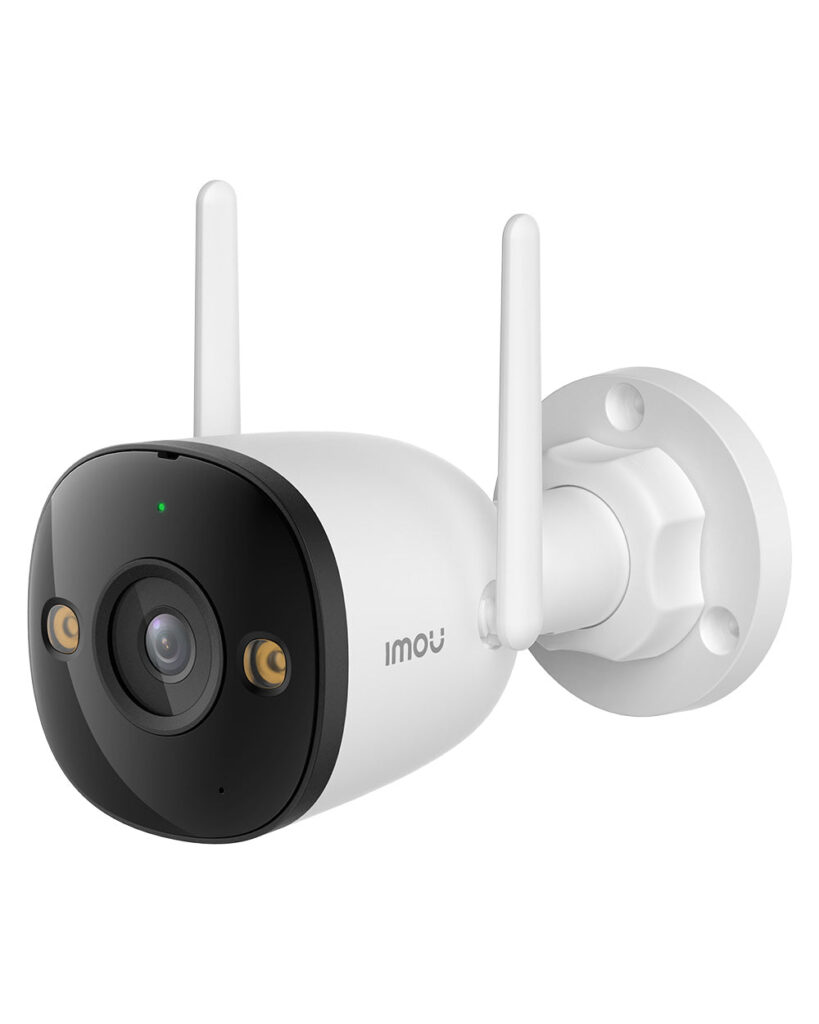
You do not mount a security camera on a wall so much as on a property line. Only once it is clear what the image may show do height, angle and cable route make sense. For fixed mounting on your own house with power within reach, we consider the Imou Bullet 3 the most sensible choice: it does not pan, is rated IP67 according to its data sheet and accepts a network cable as well as Wi-Fi. The buying criteria are in our guide to the outdoor security camera. This one is about mounting.
For everyone: first the boundary, then the drill hole
The Datenschutzkonferenz (the conference of German data protection authorities) puts it briefly: the right to observe ends at your own property line. The street, sidewalk and parking lot are off-limits to private individuals in residential areas, and so is a strip of the neighbor’s yard. According to the Verbraucherzentrale (German consumer advice center), this usually applies to shared driveways as well. Even a dummy camera can cause trouble.
This leads to a rule that argues against the appeal of a pan-and-tilt head. According to the Verbraucherzentrale, the boundary is most reliably respected with fixed cameras, because a rotating one could be pointed elsewhere at any time. That alone can, in individual cases, give rise to injunction claims. How much area a lens covers can be calculated in advance: the Bullet 3 with a 2.8 mm lens sees 94 degrees, so at a distance of 5 m it covers a width of around 10.7 m. On a row house with a 6 m wide yard, that puts neighboring land in the frame on both sides if the camera faces straight ahead from the middle.
So: have someone hold the camera in place temporarily, check the live image on your phone, and only then drill. The „Configurable Region“ in the Imou data sheet relates to detection. It does not say that it masks parts of the image, and the Datenschutzkonferenz still considers masking that can be undone to be a recording of personal data anyway. What counts is the camera’s orientation. Even if you only film your own lawn, the Verbraucherzentrale still recommends a sign for visitors.
For homeowners with power on the wall: height, angle, rain
No standard prescribes a fixed mounting height for private cameras, but some manufacturers give figures. EZVIZ recommends 1.8 to 2.2 m above the ground for the LC3, and ELV (German electronics retailer) lists 1.8 to 2 m for Steinel’s light camera. That works as a guide for other models too. The higher the camera, the steeper the view and the more you see the top of a head instead of a face. The lower it is, the easier it is for any hand to reach the housing.
Tilt the camera down far enough that no sky remains in the frame. That also keeps out the most difficult light. If the lens faces west into the low sun in the evening, the exposure adjusts to the bright background, and a face in front of it becomes a dark patch. The same applies to a streetlight in the frame.
Rain is mainly an issue for the connections. IP67 describes the camera housing, not the open plug at the end of the cable. The Bullet 3 comes with a waterproof connector. Plug and power supply belong under the roof overhang or indoors, and the cable runs downward from the camera first so that water drips off instead of traveling into the wall feedthrough. Work on the 230-volt mains remains a job for a qualified electrician.
According to Imou, the wall should bear three times the camera’s weight, which for the 523 g Cruiser SC means a good 1.5 kg. In concrete, there is hardly any way around a rotary hammer, and up top you are better off on a stable ladder than on a garden chair.
For anyone who only wants to run one cable
Power over Ethernet carries power and data over the same line. That saves you an outdoor outlet, but requires a PoE switch or recorder indoors and a continuous network cable. For the RLC-510A, Reolink specifies Cat5 or higher and the 802.3af standard. If you are planning several cameras, think about a kit with a recorder right away.
For tenants and walls without power
According to the German police, burglary protection in a rented apartment requires the landlord’s consent. A battery camera saves you the cable, but not the question of what is in the frame. Before you drill, the signal at the mounting spot is decisive: measure it with your phone at exactly that spot, as described in our guide to Wi-Fi for security cameras. A solar panel needs direct sun, which often means a different wall than the camera.
Five cameras by mounting type
| Model | Design | Connection | Horizontal field of view | Protection rating according to manufacturer |
|---|---|---|---|---|
| Imou Bullet 3 | fixed | 12 V power supply, Wi-Fi 2.4 GHz or LAN | 94° (2.8 mm), 78° (3.6 mm) | IP67 |
| Imou Cruiser SC 8MP | pan-and-tilt, 355° | PoE or 12 V power supply, Wi-Fi 2.4 GHz or LAN | 89° | „weatherproof,“ no IP rating in the data sheet |
| Imou AOV Air | fixed, battery | 5,000 mAh battery, solar panel, Wi-Fi 2.4/5 GHz | 94° | IP67 |
| Imou Cell Go | fixed, battery | 5,000 mAh battery, Wi-Fi 2.4 GHz | 98° | IP65 |
| Reolink RLC-510A | fixed | PoE 802.3af or 12 V power supply, LAN | 80° | IP67 |
Imou Bullet 3
For us, the standard case on a house wall: fixed viewing direction, 290 g, operation from minus 30 to plus 50 degrees Celsius, spotlight and 110 dB siren according to the manufacturer. The network cable is the way out if Wi-Fi is weak outdoors. Downsides: the data sheet does not mention PoE, so a power supply is still needed even in LAN mode, and the two antennas make the housing conspicuous.
Imou Cruiser SC 8MP
At 8 megapixels it has the highest resolution, and according to the quick start guide it runs on a PoE switch or recorder. But if you need its panning range, you have to take responsibility for it: it rotates 355 degrees, and that is exactly what the Verbraucherzentrale warns against. It makes sense on a large property whose boundaries the image does not reach. More on this in our guide to pan-and-tilt cameras.
Imou AOV Air
The battery camera with a solar panel for spots without a power line, with 2.4 and 5 GHz. With 15 m of night vision, it reaches half as far as the Bullet 3, and battery operation means it will have to come down again at some point or needs sun.
Imou Cell Go
The inexpensive solution when drilling is ruled out, because a magnetic mount is included. That calls for compromises: 3 megapixels, 7 m of night vision, only 4 GB of internal storage and 2.4 GHz only. And whatever hangs on a magnet can also be removed by a stranger with one grab.
Reolink RLC-510A
Fixed mounting, standards-compliant PoE, usable without a subscription: for anyone running cables anyway, this is the no-nonsense alternative. Reolink advises against operating it with recorders from other manufacturers. It has no spotlight and no Wi-Fi, and night vision stays black and white.
So the camera stays on the wall
Strangers should not be able to get at networked devices, and according to the BSI (German Federal Office for Information Security), LAN ports should not be freely accessible. For mounting, that means: route the cable through the wall directly behind the housing or run it in conduit, with the plugs indoors. A memory card in the housing disappears along with the camera. If you still need recordings after a camera has been taken down, also store them on a recorder or in the cloud.
And the camera does not replace a lock. For the police, mechanical security comes first. So start with window security. According to the police, dummy cameras do not provide adequate security.
How we would decide
- Power within reach, property with clear boundaries: Imou Bullet 3, carefully aimed.
- A cable can be laid, several cameras planned: Reolink RLC-510A on a PoE switch.
- Large property that a single image cannot cover: Imou Cruiser SC 8MP.
- No power line, but sun on the wall: Imou AOV Air with panel.
- Rented apartment, drilling ruled out, small budget: Imou Cell Go, knowing that it is easy to remove.
Dust, dead zones and boarders‘ horses in the frame are covered in our guide Camera in the horse stable.
Frequently asked questions
What may a private security camera film?
According to the Datenschutzkonferenz (the conference of German data protection authorities), the right to observe ends at your own property line. The street, sidewalk, parking lot and neighbor's yard are off-limits to private individuals, and according to the Verbraucherzentrale (German consumer advice center), shared driveways usually are too. Check the live image on your phone before you drill.
Is a pan-and-tilt camera allowed on a residential house?
It is tricky. According to the Verbraucherzentrale, the boundary is most reliably respected with fixed cameras, because a rotating one could be pointed elsewhere at any time. That alone can, in individual cases, give rise to injunction claims. A pan-and-tilt camera is better suited to a large property whose boundaries the image does not reach.
At what height should a security camera be mounted?
Some manufacturers give figures: EZVIZ recommends 1.8 to 2.2 m for the LC3, and 1.8 to 2 m is given for Steinel's light camera. The higher it is, the more you see the top of a head instead of a face; the lower it is, the easier it is for any hand to reach the housing. Tilt the camera so that no sky remains in the frame.
How do I protect cables and plugs from rain?
IP67 describes the camera housing, not the open plug at the end of the cable. Plug and power supply belong under the roof overhang or indoors, and the cable runs downward from the camera first so that water drips off. Work on the 230-volt mains remains a job for a qualified electrician.
What speaks for a camera with Power over Ethernet?
PoE carries power and data over the same line and saves you an outdoor outlet. You need a PoE switch or recorder indoors and a continuous network cable. The Reolink RLC-510A works to the 802.3af standard; if you plan several cameras, a kit with a recorder is worth a look.
What applies to tenants who want to install a camera?
According to the German police, burglary protection in a rented apartment requires the landlord's consent. A battery camera saves you the cable, but not the question of what is in the frame. The Imou Cell Go holds by magnet without drilling, but strangers can also remove it with one grab.
Sources
- Datenschutzkonferenz: Guidance on video surveillance
- Verbraucherzentrale: Film only your own property
- Police, K-Einbruch: Frequently asked questions
- BSI: Setting up a smart home securely
- Imou: Bullet 3 (in English)
- Imou: Bullet 3, data sheet (in English)
- Imou: Cruiser SC 8MP, data sheet (in English)
- Imou: Cruiser SC, quick start guide
- Imou: AOV Air (in English)
- Imou: Cell Go, data sheet (in English)
- Reolink: RLC-510A
- EZVIZ: LC3, user manual
- ELV: Steinel XLED CAM1
- Homematic IP Außenlichtkamera (outdoor light camera), instructions
Where to buy
- Imou Bullet 3View at ImouAvailable in Germany: ImouCheck price at Amazon.deCheck price at Amazon.co.ukCheck price at Amazon.nlCheck price at Amazon.com.beCheck price at Amazon.frCheck price at Amazon.itCheck price at Amazon.esCheck price at Amazon.plCheck price at Amazon.seAvailable in Germany: Amazon.de
- Imou Cruiser SC 8MPView at ImouAvailable in Germany: Imou
- Imou AOV AirView at ImouAvailable in Germany: Imou
- Imou Cell GoView at ImouAvailable in Germany: Imou
- Reolink RLC-510ACheck price at Amazon.deCheck price at Amazon.co.ukCheck price at Amazon.nlCheck price at Amazon.com.beCheck price at Amazon.frCheck price at Amazon.itCheck price at Amazon.esCheck price at Amazon.plCheck price at Amazon.seAvailable in Germany: Amazon.de