Contents11 sections
This guide was first published in German on handgetestet.de.
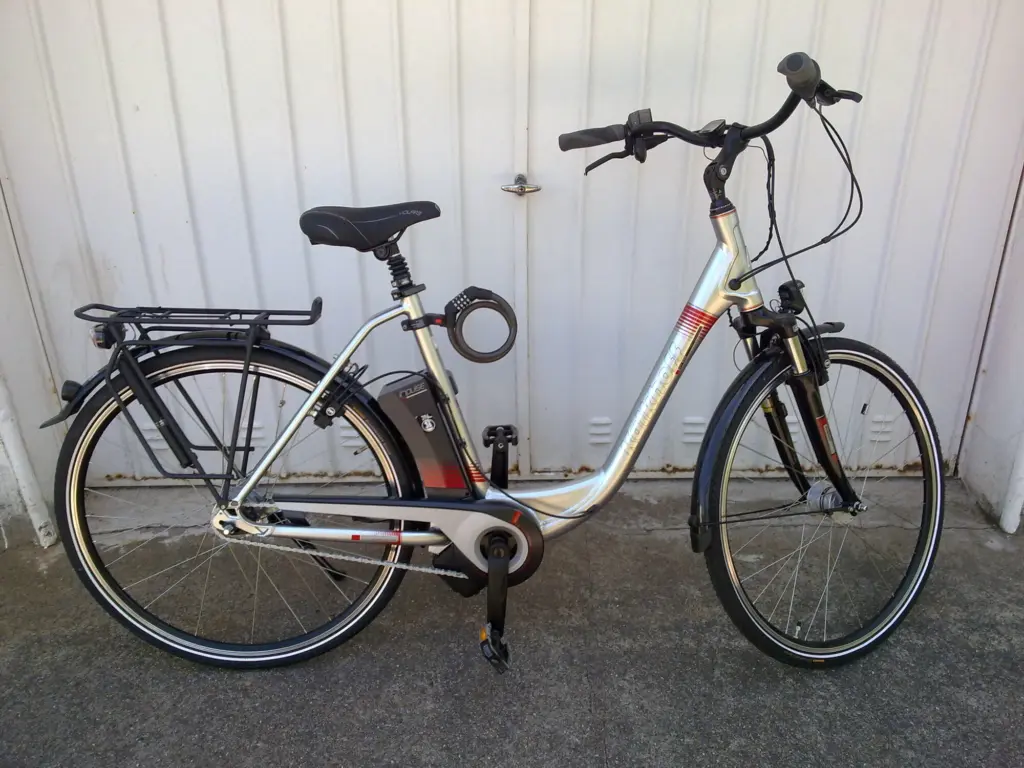
A step-through e-bike does without the top tube, and that is exactly where the real buying question begins. The low step-through is there on every bike of this design. The differences show up in the frame under load, in the weight on the basement stairs and in the payload. We deliberately do not give a single top recommendation: the two bikes the ADAC, the German automobile club, rated „good“ can no longer be found on offer in the tested version today. If you want to carry a lot, look first at the Fischer CITA 4.3i; if you have to carry every kilo yourself, look at the Deruiz Quartz.
What is missing when the top tube is missing
A classic diamond frame forms a triangle from the top tube, down tube and seat tube. With a wave frame, what remains of that is a curve. Forces from the handlebars, saddle and rear rack run almost entirely through the down tube, and a manufacturer has to compensate for that with thicker profiles and more material. Part of the extra weight is therefore a design principle, not carelessness.
You notice it on the road. In its July 2024 test of ten affordable step-through bikes, the ADAC explicitly looks at riding stability, tendency to wobble and post-oscillation, plus durability tests on the frame with out-of-the-saddle pedaling and horizontal forces. No bike failed. The quality still varied widely, and for the Fischer Cita 2.2i, the club specifically highlights the stable frame.
No spec sheet lists a measure of stiffness. The maximum permitted total weight is only of limited use for this, as two figures from the same test show: the Heybike EC 1-ST weighs 20.8 kilograms and may carry 150 kilograms, exactly as much as the Fischer CITA 4.3i, yet it only reached „adequate“ overall. Before buying, the only thing that helps is a test ride, loaded and with the saddle at full height. The ADAC advises riding the first lap without the motor, because otherwise the drive clouds your critical view of the bike. Take any unrest in the steering at speed with full panniers seriously; it will not go away after you buy.
Knees and hips: what the step-through can do
The frame makes getting on and off easier, as the ADAC also confirms. Nothing more. Whether cycling suits your condition is something to clarify with a doctor first.
For the buying decision, the moment of starting off counts, because that is when the most force goes into the pedal. Eight of the ten tested bikes had a cadence-controlled drive. It does not register how hard you pedal and kicks in with a delay, which makes starting on a hill more laborious. A torque sensor responds to the pedal stroke itself. In its system manual, Fischer also recommends low gears when starting off and 60 to 90 crank revolutions per minute. A hub gear fits well with this, since you can shift down while standing at a red light. With a derailleur, you have to remember to do that before you stop.
Frame size still matters despite the low step-through. If you sit too low, your knee bends more. The Fischer bikes come in 43 and 50 centimeters, the Prophete only in 48. The ADAC recommends a specialist bike shop for matching the bike to your height, and with a mail-order bike that means: clarify the size beforehand instead of hoping after delivery.
Two calculations on weight
First, the payload. Calculate maximum permitted total weight minus the bike’s own weight. For the Zündapp Z502, the ADAC determined 120 minus 24.1 kilograms, which leaves about 96 kilograms. A person weighing 82 kilograms, clothing and helmet at 3 kilograms, and a week’s groceries at 12 kilograms add up to 97. That would already overload the bike. For the Prophete Geniesser 3.3, according to the manufacturer, it is 140 minus 27.6, so a good 112 kilograms. Fischer states 150 kilograms for the CITA 4.3i, but no own weight. If we take the 28.8 kilograms of the Cita 2.2i as an assumption, it would be about 121.
Second, carrying. Eight kilograms separated the lightest and the heaviest bike in the ADAC test. On flat roads, the motor feels it; on the basement stairs, you feel it alone. Without a ground-level parking spot, this number therefore comes before all others; suitable solutions are shown in our guide to bike sheds for heavy bikes. The rear rack counts too: two bikes at 28 kilograms each make 56 kilograms, which you should check against the tongue load, as explained in our guide to hitch-mounted bike racks.
Five step-through e-bikes compared
| Model | Drive | Battery and charging time | Weight specs | Best for |
|---|---|---|---|---|
| Fischer CITA 4.3i | Bafang M210 mid-drive motor, 65 Nm | 630 Wh, 350 minutes | 150 kg permitted, own weight not stated | High payload, hills |
| Fischer CITA 2403 | Front hub motor, 40 Nm | 459 Wh, 290 minutes | 150 kg permitted, own weight not stated | Flat city routes |
| Prophete Geniesser 3.3 | Enovation mid-drive motor, 70 Nm, torque sensor | 360 Wh, 3.5 hours | 27.6 kg, 140 kg permitted | Short trips, fast charging |
| Deruiz Quartz | Rear hub motor, 55 Nm, torque sensor (according to the Amazon listing) | 644 Wh (according to the listing) | about 24.6 kg (according to the listing) | Anyone who has to lift the bike often |
| F.lli Schiano E-Moon | Front hub motor, 40 Nm (according to the listing) | 468 Wh (according to the listing) | Payload about 96 kg according to the ADAC | Tight budget, lighter riders |
Fischer CITA 4.3i
The mid-drive motor and suspension seat post are familiar from the Cita 2.2i, which the ADAC praised for its drive and comfort. Instead of that bike’s rim brakes, this one has Shimano hydraulic disc brakes. It was not tested by the ADAC itself. According to the manufacturer, the battery can be removed from the side. The model page does not reveal the own weight or the sensor type; both should be clarified before buying.
Fischer CITA 2403
Same series, but with a 40 Nm front hub motor. That should be enough for flat routes, less so on inclines.
Prophete Geniesser 3.3
Of the five, the only bike for which the manufacturer states all the key figures: torque sensor, weight, payload, charging time. At 3.5 hours, it hits exactly the upper limit the ADAC considers sensible, because the 360 Wh battery stays small. The claim of up to 110 kilometers is best read as a best-case figure. For shorter people, a 48-centimeter frame size may be too much, and the model page does not mention a second size. A Prophete bike was in the ADAC test in 2024, but with a 418 Wh battery and rim brakes, so a different model.
Deruiz Quartz
Look closely. The Quartz that the ADAC rated 2.5 had mechanical disc brakes and no torque sensor. Today’s offer on Amazon lists both differently, namely hydraulic brakes and a torque sensor. That may be better, but it is a different bike, and the verdict does not carry over. At about 24.6 kilograms, it would be the lightest bike in our table for which a figure is available. We cannot state a payload for this 28-inch version.
F.lli Schiano E-Moon
The least expensive bike in the ADAC test, verdict „satisfactory.“ The compromises are clear: rim brakes, which the club considers rather outdated, and about 96 kilograms of payload. On Amazon, several versions are sold under this name, so check the battery and brakes in each individual listing.
How we would decide
Before you choose a model, three questions should be settled: where will the bike be parked, how much do you weigh with luggage, and are there inclines at the start of your route? Stairs point to the Deruiz Quartz, provided the listing data is enough for you. Heavy payload and hills point to the Fischer CITA 4.3i. If you only run errands around town and want a fully documented drive, the Prophete Geniesser 3.3 is the right choice. The Fischer CITA 2403 remains the pick for flat terrain. We advise against the F.lli Schiano E-Moon if you and your luggage together come to more than 90 kilograms.
Basics on bike types and budget are in our guide to buying an e-bike, and the differences between front, rear and mid-drive motors in our motor comparison. On two bikes, the ADAC found the plasticizer DEHP in the grips or saddle. If you are unsure, you can have both replaced at a specialist bike shop.
Frequently asked questions
Is a step-through frame less stable than a diamond frame?
Without a top tube, the forces run almost entirely through the down tube, and manufacturers compensate with thicker tube profiles. In the ADAC (German automobile club) test of ten affordable step-through bikes, none failed, but the quality varied widely. Take a test ride, loaded and with the saddle at full height.
How do you calculate an e-bike's payload?
Subtract the bike's own weight from the maximum permitted total weight. For the Zündapp Z502, according to the ADAC, that leaves about 96 kilograms. A person weighing 82 kilograms, clothing and helmet, plus a week's groceries add up to 97, so the bike would be overloaded. The Prophete Geniesser 3.3 leaves a good 112 kilograms.
Does a step-through e-bike help with knee or hip problems?
The frame makes getting on and off easier, as the ADAC also confirms, nothing more. Whether cycling suits your condition is something to clarify with a doctor first. A torque sensor helps when starting off, and Fischer recommends low gears and 60 to 90 crank revolutions per minute.
Why does the weight of a step-through e-bike matter?
Eight kilograms separated the lightest and the heaviest bike in the ADAC test. On flat roads the motor makes up for it; on the basement stairs you carry it alone. It also matters on a rear rack: two bikes at 28 kilograms each make 56 kilograms of tongue load.
What frame size does a step-through e-bike need?
Even with a low step-through, it still matters, because if you sit too low, your knee bends more. The Fischer bikes come in 43 and 50 centimeters, the Prophete only in 48. The ADAC recommends a specialist bike shop for fitting; with a mail-order bike, clarify the size beforehand.
Does the ADAC verdict on the Deruiz Quartz apply to today's offer?
Not automatically. The Quartz rated 2.5 had mechanical disc brakes and no torque sensor. Today's offer lists hydraulic brakes and a torque sensor. That may be better, but it is a different bike, and the verdict does not carry over.
Sources
- ADAC (German automobile club): What can affordable step-through pedelecs do? (July 2024)
- ADAC press release on the test
- Fischer: CITA 4.3i, model year 2025
- Fischer: CITA 2403, model year 2025
- Fischer: 2025 model overview
- Fischer: 2025 system manual
- Prophete: Geniesser 3.3
Where to buy
- Fischer CITA 4.3iCheck price at Amazon.deCheck price at Amazon.co.ukCheck price at Amazon.nlCheck price at Amazon.com.beCheck price at Amazon.frCheck price at Amazon.itCheck price at Amazon.esCheck price at Amazon.plCheck price at Amazon.seAvailable in Germany: Amazon.de
- Fischer CITA 2403Check price at Amazon.deCheck price at Amazon.co.ukCheck price at Amazon.nlCheck price at Amazon.com.beCheck price at Amazon.frCheck price at Amazon.itCheck price at Amazon.esCheck price at Amazon.plCheck price at Amazon.seAvailable in Germany: Amazon.de
- Prophete Geniesser 3.3Check price at Amazon.deCheck price at Amazon.co.ukCheck price at Amazon.nlCheck price at Amazon.com.beCheck price at Amazon.frCheck price at Amazon.itCheck price at Amazon.esCheck price at Amazon.plCheck price at Amazon.seAvailable in Germany: Amazon.de
- Deruiz QuartzCheck price at Amazon.deCheck price at Amazon.co.ukCheck price at Amazon.nlCheck price at Amazon.com.beCheck price at Amazon.frCheck price at Amazon.itCheck price at Amazon.esCheck price at Amazon.plCheck price at Amazon.seAvailable in Germany: Amazon.de
- F.lli Schiano E-MoonCheck price at Amazon.deCheck price at Amazon.co.ukCheck price at Amazon.nlCheck price at Amazon.com.beCheck price at Amazon.frCheck price at Amazon.itCheck price at Amazon.esCheck price at Amazon.plCheck price at Amazon.seAvailable in Germany: Amazon.de