Contents14 sections
This guide was first published in German on handgetestet.de.
On stage, the microphone that leads in the studio rarely wins. For the rehearsal room, a bar stage or a street festival, we recommend a dynamic handheld microphone such as the Shure SM58; for recording in a quiet room, a condenser microphone on a stand. That sounds obvious. It still decides whether your voice carries through the evening or gets lost in the squeal of the monitor speaker.
Moving coil or condenser: what is behind it?
A dynamic microphone converts sound into voltage via a coil moving in a magnetic field. The design is rugged and delivers a low output level. Shure states a sensitivity of 1.6 mV per pascal for the SM58, while Audio-Technica states 14.1 mV for the AT2020 condenser microphone. That is almost nine times as much.
In practice, that means two things. With a dynamic model, the mixing desk or interface has to provide more gain, and a condenser microphone needs 48-volt phantom power via the XLR cable. Neumann states a current draw of 3.5 mA for the KMS 105, Audio-Technica typically 2 mA for the AT2020. Which interface has enough headroom is explained in our guide to audio interfaces for the home studio (in German).
We compared how clearly the two designs differ in the studio ourselves: in our Shure SM7B vs. Neumann TLM 103 test, the dynamic SM7B sounded hollow next to the large-diaphragm condenser but played to its strength wherever no acoustically treated room is available.
Why polar pattern matters more on stage than frequency range
Feedback occurs when the microphone picks up its own monitor again. A cardioid such as the SM58 is least sensitive at the rear, which is why, according to Shure, the monitor speaker should sit directly behind the microphone. A supercardioid such as the Beta 58A rejects the sides more strongly. Its least sensitive point, however, is not directly at the rear: Shure recommends placing the monitor and PA speaker at an angle of 60 degrees to the back.
This is a typical mistake when switching. You buy the supercardioid for its greater feedback headroom but leave the monitor where it stood for the cardioid. Shure itself writes that the advantage only applies if the monitors are aligned for a supercardioid.
A second point concerns distance. Directional microphones boost low frequencies the closer the mouth gets. At a distance of about 6 mm, according to Shure, the boost is 6 to 10 dB around 100 Hz. Under 15 cm, the voice therefore sounds full and bass-heavy; between 15 and 60 cm, more natural. Quiet passages close, loud ones a bit farther away: that way you can even out the volume right at the mouth before the desk has to step in.
A condenser on stage: when does it make sense?
There are handheld microphones with a condenser capsule that are explicitly built for the stage. Neumann describes the KMS 105 as a stage vocal microphone with high feedback resistance, low handling noise and strong rejection of sound from the rear. According to the data sheet, the capsule handles 150 dB of sound pressure. It requires a channel with phantom power. Before the gig, check whether the input on the desk supplies 48 volts; otherwise a condenser microphone stays silent.
Wireless on stage: which frequency are you allowed to use?
A wireless microphone transmits on a fixed frequency, and in Germany that is regulated. In its general assignment for short-range devices (Vfg. 91/2025, valid until 12/31/2035), the German Federal Network Agency (Bundesnetzagentur) has generally assigned, among others, the ranges 821.5 to 832 MHz and 863 to 865 MHz for PMSE audio devices, which include wireless microphones. Between 863 and 865 MHz, a maximum transmit power of 10 mW is permitted.
For the Shure BLX system, these versions are called S8 (823 to 832 MHz) and T11 (863 to 865 MHz). Shure describes both as license-free and all other frequency versions as requiring registration. So pay attention to the code after the model name when buying. A set with H8E transmits between 518 and 542 MHz and, according to Shure, therefore requires registration. For a whole band, the number of channels also matters: Shure states that up to four systems in the T11 band and up to seven in the S8 band can run license-free in parallel.
7 vocal microphones at a glance
| Model | Type and polar pattern | Key specs according to the manufacturer | Best for |
|---|---|---|---|
| Shure SM58 | Dynamic, cardioid | 50–15,000 Hz, 1.6 mV/Pa, 330 g | Rehearsal room, first gigs, rental |
| Shure Beta 58A | Dynamic, supercardioid | 50–16,000 Hz, 2.6 mV/Pa, 278 g | Loud stages with a fixed monitor position |
| Sennheiser e 935 | Dynamic, cardioid | 40–18,000 Hz, 2.8 mV/Pa, 355 g | Live vocals with hum protection |
| Neumann KMS 105 | Condenser, supercardioid | 20–20,000 Hz, 48 V phantom, 150 dB max. | Stage professionals with their own gear |
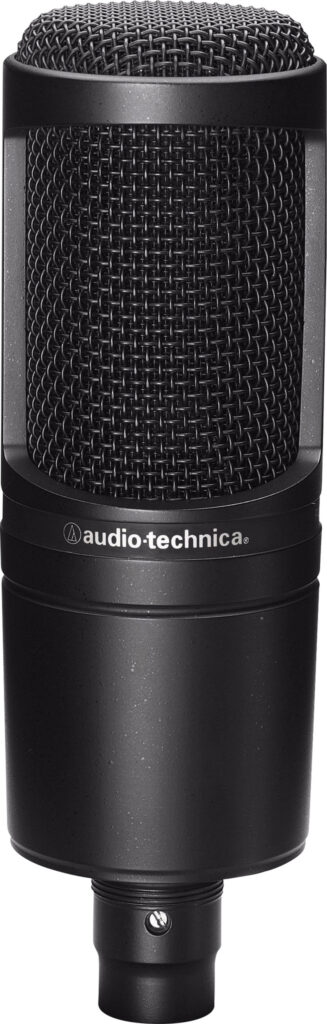
| Audio-Technica AT2020 | Condenser, cardioid, side-address | 20–20,000 Hz, 48 V phantom, 345 g | Vocal recording at home via XLR |
| RØDE NT1 5th Generation | Condenser, large-diaphragm, cardioid | 4 dBA self-noise, XLR and USB-C | Home studio with or without an interface |
| Shure BLX24E/SM58 (T11) | Wireless, analog, SM58 head | 863–865 MHz, 2 × AA up to 14 h | Singers who move around on stage |
Shure SM58
Shure’s dynamic cardioid is tailored to the voice. A spherical steel mesh grille, a built-in pop filter and a pneumatic shock-mounted capsule against handling noise. According to Shure, the frequency range ends at 15,000 Hz, and the midrange is boosted for vocals. If you need a switch, go for the SM58S version.
Shure Beta 58A
The sibling with a supercardioid pattern and a neodymium magnet. Shure states around 4 dB more output than the SM58, a slightly wider frequency range and a hardened grille. More output helps with desks that have limited gain. On stage, though, the switch only pays off if someone realigns the monitors.
Sennheiser e 935
According to the data sheet, Sennheiser’s dynamic cardioid reaches up to 18,000 Hz and delivers 2.8 mV/Pa. A hum compensation coil is meant to reduce electrical interference, and the capsule is mounted to isolate it from structure-borne noise. At 355 g, it feels heavier in the hand than the two Shure models.
Neumann KMS 105
A condenser handheld microphone for the stage, with a supercardioid pattern and a multi-layer wire mesh as a pop filter without foam. Neumann states 20 to 20,000 Hz, 4.5 mV/Pa and suitability for both in-ear and conventional monitoring. In a rehearsal room with changing desks, that is more of a burden. If you play with your own gear and know the desk, you get a tool for big stages.
Audio-Technica AT2020
A side-address cardioid condenser microphone for the home studio. Audio-Technica states 20 to 20,000 Hz, 144 dB maximum sound pressure and a self-noise of 20 dB(A). It needs an interface with phantom power. The USB version has its own name, so pay attention to the designation when ordering.
RØDE NT1 5th Generation
A large-diaphragm microphone with a 1-inch capsule and 4 dBA self-noise, plus two outputs. Via XLR it needs 48 volts; via USB-C it connects directly to the computer, with 32-bit float and up to 192 kHz. A compressor, noise gate and high-pass filter are available in Røde’s software. According to the manufacturer, a shock mount, pop filter and both cables are included.
Shure BLX24E/SM58
The set combines the BLX4E receiver with a handheld transmitter that carries the SM58 head. According to Shure, two AA batteries last up to 14 hours, and the manufacturer states a range of up to 100 meters. One press of a button finds a free frequency. For Germany, order the T11 or S8 version.
How we would decide
- You sing in the rehearsal room and on changing stages: Shure SM58. Rugged, with a pop filter in the grille and uncomplicated at the desk.
- The stage is loud: Beta 58A if the speakers are placed for a supercardioid, otherwise the e 935 as a cardioid.
- You tour with your own desk and in-ear monitoring: Neumann KMS 105.
- Vocals at home with an existing interface: Audio-Technica AT2020.
- Vocals at home without an interface or with an eye to later: RØDE NT1 5th Generation.
- You want to move freely: Shure BLX24E/SM58 in T11 or S8.
For recording at a desk, a boom arm holds the studio microphone more steadily than a desktop stand; more on that in our guide to microphone arms. If you speak rather than sing, you will find suitable models in our buying advice for podcast microphones (in German).
Frequently asked questions
What is the difference between a dynamic and a condenser microphone?
A dynamic microphone converts sound via a moving coil, is rugged and delivers a low output level: Shure states 1.6 mV per pascal for the SM58. The AT2020 condenser microphone reaches 14.1 mV but needs 48-volt phantom power via the XLR cable.
How do I prevent feedback on stage?
Feedback occurs when the microphone picks up its own monitor. With a cardioid such as the SM58, the monitor speaker should, according to Shure, sit directly behind it. With a supercardioid such as the Beta 58A, Shure recommends an angle of 60 degrees to the rear; otherwise its advantage is lost.
Which frequencies may a wireless microphone use in Germany?
The German Federal Network Agency (Bundesnetzagentur) has made general assignments for, among others, 821.5 to 832 MHz and 863 to 865 MHz. For the Shure BLX, these versions are called S8 and T11, both license-free according to Shure. A set with H8E transmits between 518 and 542 MHz and requires registration.
Is a condenser microphone suitable for the stage?
There are handheld microphones with a condenser capsule built for that purpose, such as the Neumann KMS 105 with a supercardioid pattern and high feedback resistance. It requires a channel with 48-volt phantom power. In a rehearsal room with changing mixing desks, we consider it more of a burden.
How close should you get to the microphone when singing?
Directional microphones boost low frequencies the closer the mouth gets. Under 15 cm, the voice sounds full and bass-heavy; between 15 and 60 cm, more natural. Singing quiet passages close and loud ones a bit farther away evens out the volume right at the mouth.
Which microphone suits a home studio without an interface?
The RØDE NT1 5th Generation has a USB-C output in addition to XLR, so it connects directly to the computer, with 32-bit float and up to 192 kHz. According to the manufacturer, self-noise is 4 dBA; a shock mount, pop filter and both cables are included.
Sources
- Shure: SM58 and SM58 user guide
- Shure: Beta 58A and Beta 58A user guide
- Shure: Difference between the SM58 and the Beta 58A
- Sennheiser: e 935
- Neumann: KMS 105
- Audio-Technica: AT2020 data sheet
- RØDE: NT1 5th Generation and user guide
- Shure: BLX wireless systems, BLX24/SM58 and BLX user guide
- German Federal Network Agency: General assignment Vfg. 91/2025 (in German)
Where to buy
- Shure SM58Check price at Amazon.deCheck price at Amazon.co.ukCheck price at Amazon.nlCheck price at Amazon.com.beCheck price at Amazon.frCheck price at Amazon.itCheck price at Amazon.esCheck price at Amazon.plCheck price at Amazon.seAvailable in Germany: Amazon.de
- Shure Beta 58ACheck price at Amazon.deCheck price at Amazon.co.ukCheck price at Amazon.nlCheck price at Amazon.com.beCheck price at Amazon.frCheck price at Amazon.itCheck price at Amazon.esCheck price at Amazon.plCheck price at Amazon.seAvailable in Germany: Amazon.de
- Sennheiser e 935Check price at Amazon.deCheck price at Amazon.co.ukCheck price at Amazon.nlCheck price at Amazon.com.beCheck price at Amazon.frCheck price at Amazon.itCheck price at Amazon.esCheck price at Amazon.plCheck price at Amazon.seAvailable in Germany: Amazon.de
- Neumann KMS 105Check price at Amazon.deCheck price at Amazon.co.ukCheck price at Amazon.nlCheck price at Amazon.com.beCheck price at Amazon.frCheck price at Amazon.itCheck price at Amazon.esCheck price at Amazon.plCheck price at Amazon.seAvailable in Germany: Amazon.de
- Audio-Technica AT2020View at CoolblueAvailable in Germany: CoolblueCheck price at Amazon.deCheck price at Amazon.co.ukCheck price at Amazon.nlCheck price at Amazon.com.beCheck price at Amazon.frCheck price at Amazon.itCheck price at Amazon.esCheck price at Amazon.plCheck price at Amazon.seAvailable in Germany: Amazon.de
- RØDE NT1 5th GenerationCheck price at Amazon.deCheck price at Amazon.co.ukCheck price at Amazon.nlCheck price at Amazon.com.beCheck price at Amazon.frCheck price at Amazon.itCheck price at Amazon.esCheck price at Amazon.plCheck price at Amazon.seAvailable in Germany: Amazon.de
- Shure BLX24E/SM58 T11Check price at Amazon.deCheck price at Amazon.co.ukCheck price at Amazon.nlCheck price at Amazon.com.beCheck price at Amazon.frCheck price at Amazon.itCheck price at Amazon.esCheck price at Amazon.plCheck price at Amazon.seAvailable in Germany: Amazon.de