Contents13 sections
This guide was first published in German on handgetestet.de.
You have to register an 11 kW wallbox with the grid operator, but you do not need to have it approved. Where the retrofit usually becomes more expensive than expected is elsewhere: since 2024, every new charger above 4.2 kW must be dimmable, and the words „eligible for subsidies“ in the product name usually get you nothing for a single-family home. Among the models compared here, we consider the Heidelberg Wallbox Energy Control Plus the safest choice, because its data sheet explicitly describes dimmed charging.
Which device suits your solar system and smart home is covered in the guide to buying a wallbox. This guide is about what comes before the drilling: registration, the lease, controllability, money.
Register or get approval: where is the limit?
At 12 kilovolt-amperes. That is what Section 19 of the German Low Voltage Connection Ordinance (NAV) says. Every charging device must be reported to the grid operator before it is put into operation; its consent is only required above that. Do the math yourself: three phases times 230 volts times 16 amps gives 11.04 kVA. A single 11 kW charger therefore stays below the limit.
Households with two cars need to be careful. The threshold applies to the total per electrical installation, and two chargers come to a good 22 kVA. Then the grid operator may take two months to review and must give reasons for a refusal. The same applies to a 22 kW charger.
The specialist company often handles the registration. Under Sections 13 and 19 NAV, only the grid operator or a company listed in its installer directory may make the connection. Ask about this before you get a quote.
How much power do you really need?
Less than the brochure suggests. Take 50 kilometers a day and the 20 kilowatt hours per 100 kilometers from the sample calculation of the Verbraucherzentrale, the German consumer advice center, and you get 10 kWh daily, not counting charging losses. At 11 kW, that is just under an hour. At 3.7 kW, it is less than three hours, and even eight hours overnight deliver around 30 kWh there, or about 150 kilometers.
The control rules under § 14a generally do not apply to installations below 4.2 kW. A single-phase 3.7 kW charger needs no control, but it does not get you a reduced grid fee either. In a rented garage with a weak supply line, that is often the more sensible route.
What does § 14a require of the charger?
It must be dimmable. If the local grid is at risk of overload, the grid operator may, according to the German Federal Network Agency (Bundesnetzagentur), temporarily push the draw down to 4.2 kW, but may not switch it off completely. As the operator, you register the charger, conclude an agreement and choose between direct control and an energy management system. You commission and pay for the metering and control equipment yourself. If you take part, you get a reduced grid fee; the three modules are explained in the article Electricity for heat pump and wallbox (in German).
When buying, an inconspicuous line in the data sheet therefore matters. A simple enable contact only knows charging or not charging; what you need is an input that throttles the charging current. If there is no information on this at all, have the specialist company confirm the control in writing.
Can the landlord say no?
Only in exceptional cases. Under Section 554 of the German Civil Code (BGB), tenants can demand permission for structural changes for charging. Deviating clauses to your disadvantage are invalid. The claim is ruled out if the conversion cannot reasonably be expected of the landlord even after weighing up the interests. The Federal Network Agency applies the right to a parking space rented along with the apartment and makes clear that the costs are yours.
Three things belong on paper before the first hole is drilled: who pays for the supply line, what happens to the charger and cable when you move out, and whether an additional security deposit is due, which the law explicitly provides for. What else comes into play in underground garages and condominium associations is covered in the guide Charging an EV in an apartment building. Without a firm commitment for the parking space, there is the mobile wallbox (in German), but you have to register that too.
Are there still subsidies for an 11 kW charger?
Not from the federal government for a private home. According to the German automobile club ADAC, KfW, the German state-owned development bank, has paid nothing for private wallboxes since 2024. The note „eligible for subsidies“ in some offers is a leftover; the data sheet of the Renz charger even still advertises the old KfW grant.
The federal program from April 2026 only applies to multi-unit buildings with three or more apartments, and at least six parking spaces must be pre-wired. Owners are eligible to apply, not tenants. The call for condominium associations ended on November 2, 2026 due to high demand; according to the program page (as of November 9, 2026), small businesses and private owners of multi-unit buildings could apply until November 10, 2026 at the latest, as long as funds were available. Whether it continues after that is stated on the program page.
At state level, the pickings are slim. Baden-Württemberg provisionally stopped accepting applications in February 2026, and North Rhine-Westphalia now only funds the basic installation at garage and parking facilities. That leaves cities and municipal utilities; ADAC mentions Konstanz and Mainz, for example. Such a grant is often tied to an electricity contract, so factor the tariff into your calculation. And with every program: first the approval notice, then the order.
Five wallboxes by control and access
| Model | Control for § 14a according to the manufacturer | Access | Connection, cable | Best for |
|---|---|---|---|---|
| Heidelberg Wallbox Energy Control Plus | stated as compliant; reduced charging at 6 A via contact or Modbus RTU | only with an add-on such as a key switch or RFID module | up to 11 kW, cable 5 or 7.5 m | Own parking space, minimal tech |
| Renz POWER2CAR STEEL | Enable contact, RS485; dimming not described | no authentication on the device | 3.7 to 11 kW, cable 5 m | Single-phase below 4.2 kW, locked garage |
| Amperfied Wallbox connect.solar pro | stated as compliant | RFID, app | up to 11 kW, MID meter, phase switching | Company car, solar system |
| go-e Charger Gemini 2.0 | listed as a feature on the product page; Modbus TCP, OCPP, interface for the grid operator | RFID, app | up to 11 kW, Type 2 socket, own charging cable needed | Open parking space, tenants planning to move |
| KEBA KeContact P40 Pro | Modbus TCP/RTU, OCPP; no information on § 14a on the product page | RFID | up to 22 kW, calibrated meter, RCD built in | Billing in a multi-unit building |
Heidelberg Wallbox Energy Control Plus
It charges on one, two or three phases, and the current can be set between 6 and 16 amps in steps of two. Amperfied, as the manufacturer, explicitly describes the input for a ripple control signal with reduced charging at 6 amps, alternatively Modbus RTU. On three phases, that works out to a good 4.1 kW. There is no app, and without an add-on the device cannot be secured against unauthorized charging. At an open carport, you should therefore plan for a key switch.
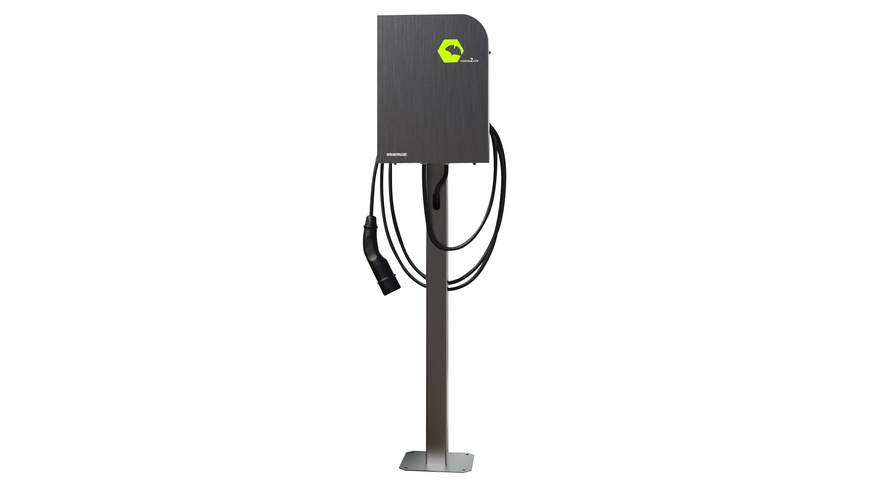
Renz POWER2CAR STEEL
Stainless steel, IP65 protection, 9 kg. Thanks to DC fault detection, according to the manual a type A RCD in the distribution board is sufficient, which saves money compared with type B. The limits are clear: there is no authentication on the device, the charging current is fixed at 10 or 16 amps via DIP switch, and the enable contact only blocks. The 2021 manual does not describe throttling to 4.2 kW. For three-phase 11 kW, we therefore only recommend it if your specialist company confirms controllability in advance. On a single phase at 3.7 kW, the issue does not arise, and there it is a good fit.
Amperfied Wallbox connect.solar pro
The complete package from the same company. According to Amperfied, it includes an MID meter, phase switching for solar charging from 1.4 kW and dynamic load management, plus RFID and an app. For company car drivers who have to bill their electricity, that makes sense. If you have neither a solar system nor an employer to bill, you are paying for features that go unused.
go-e Charger Gemini 2.0
At 1.85 kg, it is a lightweight, with a 1.8-meter connection cable. It hangs on a wall plate and, according to go-e, does not have to be opened during installation, which suits tenants when they move out. RFID is included, and the charging cable can be locked. The distribution board needs a type A RCD. On the product page, go-e lists § 14a of the German Energy Industry Act (EnWG) as a feature and names an interface for grid-supporting control; the data sheet says nothing about it. Clarify in advance how your grid operator controls it anyway. At Amazon, the Gemini 2.0 is currently unavailable (as of November 9, 2026).
KEBA KeContact P40 Pro
According to KEBA, a calibrated meter, RFID and residual current protection are built into the device, which saves space in the distribution board. For a single car, that is plenty. It becomes interesting as soon as electricity has to be billed separately. Set the charger to 11 kW, otherwise the consent requirement applies.
How we would decide
- Own parking space, 11 kW, no interest in apps: Heidelberg Wallbox Energy Control Plus.
- Short distances, single-phase supply line, locked garage: Renz POWER2CAR STEEL at 3.7 kW, with no control requirement at all.
- Open parking space or a move on the horizon: go-e Charger Gemini 2.0, provided the control has been clarified beforehand.
- Company car with billing: Amperfied Wallbox connect.solar pro.
- Shared installation with separate meters: KEBA KeContact P40 Pro.
The order stays the same. First the quote from a registered specialist company that addresses the supply line and control, then the letter to the landlord, and the order last. A charger you have already bought is of little help if the cable to the garage is the real project.
Who pays for damage to the wallbox and charging cable, and what comprehensive insurance covers for the battery, is explained in the guide to car insurance for electric vehicles (in German).
Frequently asked questions
Do I have to register an 11 kW wallbox or get it approved?
Register, yes; approval, no. Under Section 19 of the German Low Voltage Connection Ordinance, every charging device must be reported before it is put into operation; consent is only required above 12 kilovolt-amperes. An 11 kW charger comes to 11.04 kVA. Two chargers or one 22 kW charger are above that, and then the grid operator may take two months to review.
What does § 14a require of a wallbox?
It must be dimmable. If the local grid is at risk of overload, the grid operator may, according to the German Federal Network Agency, temporarily push the draw down to 4.2 kW, but may not switch it off completely. In return, you get a reduced grid fee. A simple enable contact is not enough; what you need is an input that throttles the charging current.
Is a 3.7 kW wallbox enough?
Often, yes. At 50 kilometers a day and 20 kilowatt hours per 100 kilometers, that is 10 kWh daily, less than three hours at 3.7 kW. The control rules under § 14a generally do not apply to installations below 4.2 kW. In a rented garage with a weak supply line, that is often the more sensible route.
Can the landlord prohibit a wallbox?
Only in exceptional cases. Under Section 554 of the German Civil Code (BGB), tenants can demand permission for structural changes for charging. This is only ruled out if the conversion cannot reasonably be expected of the landlord. The costs are yours. Clarify in writing the supply line, removal when you move out and any additional security deposit.
Are there still subsidies for a private wallbox?
Not from the federal government for a private home; according to the German automobile club ADAC, KfW has paid nothing since 2024. The federal program from April 2026 only applies to multi-unit buildings with three or more apartments and to owners. At state level, the pickings are slim, which leaves cities and municipal utilities. As a basic rule: first the approval notice, then the order.
Who is allowed to connect a wallbox?
Under Sections 13 and 19 NAV, only the grid operator or a company listed in its installer directory. The specialist company often handles the registration. First get a quote that addresses the supply line and control, then write to the landlord, and order the charger last.
Sources
- Section 19 NAV (German Low Voltage Connection Ordinance): Notification and consent for charging devices
- Section 554 BGB (German Civil Code): Structural changes for charging
- § 14a EnWG (German Energy Industry Act): Grid-oriented control
- German Federal Network Agency: Questions about wallboxes
- German Federal Network Agency: Controllable consumer devices
- ADAC: Wallbox subsidies 2026
- Federal program for charging in multi-unit buildings: Application
- Verbraucherzentrale: Charging, range, costs
- Amperfied: Energy Control Plus data sheet
- Amperfied: Wallbox connect.solar pro
- Renz: POWER2CAR STEEL operating manual
- Renz: POWER2CAR STEEL data sheet
- ELV: Renz POWER2CAR STEEL (retailer information)
- go-e: Gemini 2.0 data sheet
- go-e: Gemini 2.0 product page
- KEBA: KeContact P40 Pro
Where to buy
- Heidelberg Wallbox Energy Control PlusCheck price at Amazon.deCheck price at Amazon.co.ukCheck price at Amazon.nlCheck price at Amazon.com.beCheck price at Amazon.frCheck price at Amazon.itCheck price at Amazon.esCheck price at Amazon.plCheck price at Amazon.seAvailable in Germany: Amazon.de
- Renz POWER2CAR STEELView at ELVAvailable in Germany: ELV
- Amperfied Wallbox connect.solar proCheck price at Amazon.deCheck price at Amazon.co.ukCheck price at Amazon.nlCheck price at Amazon.com.beCheck price at Amazon.frCheck price at Amazon.itCheck price at Amazon.esCheck price at Amazon.plCheck price at Amazon.seAvailable in Germany: Amazon.de
- go-e Charger Gemini 2.0Check price at Amazon.deCheck price at Amazon.co.ukCheck price at Amazon.nlCheck price at Amazon.com.beCheck price at Amazon.frCheck price at Amazon.itCheck price at Amazon.esCheck price at Amazon.plCheck price at Amazon.seAvailable in Germany: Amazon.de
- KEBA KeContact P40 ProCheck price at Amazon.deCheck price at Amazon.co.ukCheck price at Amazon.nlCheck price at Amazon.com.beCheck price at Amazon.frCheck price at Amazon.itCheck price at Amazon.esCheck price at Amazon.plCheck price at Amazon.seAvailable in Germany: Amazon.de