Contents12 sections
This guide was first published in German on handgetestet.de.
Before you order a single light, there is one question to settle: where does the power come from? For almost any private garden, a low-voltage system with 12 or 24 volts is the sensible choice, for example Paulmann’s Plug & Shine in the warm 2200-kelvin version. It plugs together instead of being wired in, and the cable may lie above ground. 230 volts belongs in the garden when path lights are meant to be permanently installed. But then it is a job for a licensed electrician.
What happens between the socket and the light
A low-voltage system consists of three parts. A transformer plugs into the outdoor socket and turns 230 volts into extra-low voltage. Paulmann works with 24 volts DC, Philips Hue also with 24 volts, Garden Lights with 12 volts. From the transformer, a main cable runs through the beds, and the lights plug into it. Paulmann explicitly advertises that no trenches are needed as with a 230-volt installation. Garden Lights writes that low-voltage cables do not have to be buried and that anyone can connect the system without an installer.
With 230 volts, the situation is different. A light with a Schuko plug (the standard German plug) on an existing outdoor socket does not need a contractor. But as soon as a new line is to run through the lawn to a path light, it becomes work on the house’s electrical installation. In § 13, the German Low Voltage Connection Ordinance (Niederspannungsanschlussverordnung) permits such work only by the grid operator or by an installation company listed in a grid operator’s register of installers. That company determines the cable type, burial depth and circuit protection according to the recognized rules of engineering. Connecting it yourself is not something the ordinance provides for.
Count the watts, measure the meters
You still have to do the math. The transformer sets the limits of the system. Garden Lights advises adding up the wattage of all lights and accessories and then choosing a transformer with 24, 60 or 150 watts, with some headroom for lights added later. Paulmann offers transformers with 30, 75 and 150 VA and sets a second limit: no light may sit more than 50 meters from the transformer. If you have a long plot, plan two feed points instead of an ever longer cable.
An example. Three Paulmann spots from the starter set draw around 18 watts together, and the included transformer is rated at 75 VA. That leaves room for several more spotlights or a bollard light later on. With the Neso set from Garden Lights, three 2-watt spotlights run on a 12-watt transformer. On paper, that leaves room for three more small spots, no more.
And there is one more thing you should know before the cable goes into the bed: the systems are proprietary. Each manufacturer describes extensions only with its own connectors; at Paulmann, plugs and sockets are molded permanently onto the cable. If you start with Garden Lights today, you will be buying Garden Lights again in three years.
Reading protection rating and light color correctly
IP44 means protection against splashing water. That is enough for a spotlight in a bed, as long as it does not sit in a hollow. For the Janko, Brilliant explicitly advises against placing the light in depressions where water can collect. IP65 withstands water jets, IP67 temporary submersion. For spots that sit half-buried in slush in winter, IP67 is the safer choice.
Light color is about more than just atmosphere. In its everyday tips, the German Environment Agency (Umweltbundesamt) generally advises doing without artificial light sources in the garden, because some insects circle lamps until they are exhausted and light pollution disrupts the life rhythms of hedgehogs, birds and bats. The German Federal Agency for Nature Conservation (Bundesamt für Naturschutz) names wavelength, color temperature, light intensity and beam direction as the factors to adjust, along with a limited duration of lighting. In practice, that means few lights, pointed downward or aimed at a specific plant, warm light and a timer that switches off at midnight. That is why Paulmann also offers its Sting set with 2200 kelvin, explaining that, according to studies, warm, long-wavelength light generally attracts fewer nocturnal insects than cool white light.
Six sets and lights compared
| Model | Power | Light according to manufacturer | Protection rating | Best for |
|---|---|---|---|---|
| Paulmann Plug & Shine Sting starter set 2200 K | 24 V, 75 VA transformer | 3 × 6.3 W, 280 lm each, 2200 K | IP67 | Beds and trees, insect-conscious |
| Paulmann Plug & Shine Sting starter set 3000 K | 24 V, 75 VA transformer | 3 × 6.4 W, 270 lm each, 3000 K | IP67 | If you want slightly whiter light |
| Philips Hue Lily 3-pack | 24 V, base unit with power supply | 3 × 8 W, 2000–6500 K and colors | IP65 | Smart homes with a Hue Bridge |
| Garden Lights Neso Set | 12 V, 12 W transformer | 3 × 2 W, 172 lm each, 3000 K, 18° | IP44 | Individual shrubs, small gardens |
| Garden Lights Lunia Set | 12 V, 12 W transformer | 3 pedestal lights, 44 cm tall | IP44 | Marking paths and driveways |
| Brilliant Janko | 230 V, Schuko plug | GU10 LED 3 W, 250 lm, 3000 K | IP44 | One spotlight near the socket |
Paulmann Plug & Shine Sting starter set 2200 K
Three ground-spike spots with 6.3 watts and a rated luminous flux of 280 lumens each, plus a 75 VA transformer and the connection cable. The spotlights are rated IP67 and can be dimmed with a dimmer. The golden light at 2200 kelvin looks noticeably yellower than ordinary warm white. If your garden borders a field or a pond, this version is the obvious choice. Our first pick for flower beds.
Paulmann Plug & Shine Sting starter set 3000 K
The same system with 3000 kelvin, 6.4 watts and 270 lumens per spot, and a 100-degree beam angle. The box contains three lights, a 75 VA transformer and 5 meters of cable with four outlets, so one outlet stays free. Paulmann states a service life of 30,000 hours. If, in addition to plants, you also light up a pale house wall, the slightly whiter light works better.
Philips Hue Lily 3-pack
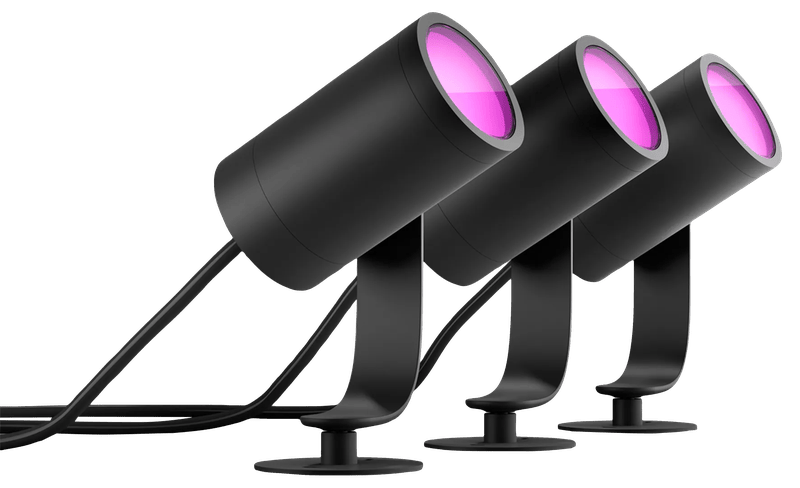
Lily is the low-voltage system from Philips Hue: three aluminum spots with 8 watts, IP65, white light from 2000 to 6500 kelvin and colors. According to the manufacturer, up to five Hue low-voltage lights fit on one base unit. Philips requires a Hue Bridge for the outdoor lights, which is sold separately. If you already have Hue in the house, you get schedules and scenes in the same app. For everyone else, the system is overkill for three spots in a bed. More on connected outdoor lights is in our guide to smart outdoor lighting.
Garden Lights Neso Set
The entry point into the 12-volt system from Garden Lights, a brand of Techmar. Three small black plastic spotlights with 2 watts and 172 lumens each, tightly focused at 18 degrees. Plus 8 meters of main cable with four connections and a 12-watt transformer. IP44, not dimmable, five-year warranty. That is enough for a hedge or a shrub. These spots will not light up a large tree.
Garden Lights Lunia Set
Three slim stainless steel pedestal lights, 44 centimeters tall, with a 12-watt transformer and cable. They are mounted with a ground spike or screwed in place. According to the manufacturer, the light color can be switched between white and warm white. Garden Lights does not state a lumen value. The Lunia marks a path, a tricky step or the edge of the driveway. It is not suitable for lighting up an area.
Brilliant Janko
A single 230-volt ground spike light with a swiveling head made of aluminum and glass. Brilliant includes a 3-watt LED with a GU10 base, 250 lumens and 3000 kelvin, which can be replaced later. The cable is 1.4 meters long and ends in a Schuko plug. That covers one planter next to the patio socket, and not much more. If you want several points of light in the garden, a low-voltage set serves you better.
How we would decide
- Three to six spots in beds and under trees: Paulmann Plug & Shine Sting in 2200 kelvin, or 3000 kelvin for pale facades.
- You already have Hue in the house: Philips Hue Lily, otherwise not.
- Small row-house garden, one shrub and one path: Garden Lights Neso and Lunia on the same 12-volt system, provided the transformer is large enough.
- One spotlight by a planter right at the outdoor socket: Brilliant Janko.
- Permanent 230-volt path lights, a new outdoor socket or underground cable: hire a licensed electrician.
- Garden with no power within reach: our guide to solar garden lights.
Lights for garden ponds are covered in our guide to pond lighting, and waterproof connections for underground cables in our guide to outdoor cable connectors (in German).
Permanent power for the flower bed is covered in our guide to the garden socket post (in German).
How to lay out a low-voltage system with transformer and cable in practice is worked through in our guide planning 24-volt garden lighting.
Hole dimensions, load capacity and the question of the driveway are covered in our guide to in-ground garden lights (in German).
For lights and devices in the bed, we tested a garden socket: our review of the MONZANA 4-way garden socket.
Frequently asked questions
What is the difference between 12, 24 and 230 volts in the garden?
With low voltage, a transformer at the outdoor socket turns 230 volts into extra-low voltage; the lights plug into the main cable, and according to Paulmann no trenches are needed. Paulmann and Hue work with 24 volts, Garden Lights with 12 volts. New 230-volt lines are a job for a registered electrical contractor.
How large does the transformer for garden lighting need to be?
Garden Lights advises adding up the wattage of all lights and choosing a transformer with some headroom. Three Paulmann spots draw around 18 watts on the 75 VA transformer, so there is plenty of room for more. With the Neso set, the 12-watt transformer is only enough for three more small spots.
How far can a light be from the transformer?
Paulmann sets a limit of 50 meters between transformer and light. On long plots, two feed points therefore make more sense than an ever longer cable through the flower beds.
Can you combine garden lights from different manufacturers?
No, the systems are proprietary. Each manufacturer describes extensions only with its own connectors; at Paulmann, plugs and sockets are molded permanently onto the cable. If you start with one system, you stay with that manufacturer when you expand.
What protection rating do garden spotlights need?
IP44 protects against splashing water and is enough for a spotlight in a bed, as long as it does not sit in a hollow. IP65 withstands water jets, IP67 temporary submersion. For spots that sit half-buried in slush in winter, IP67 is the safer choice.
Which light color is insect-friendly in the garden?
The German Federal Agency for Nature Conservation names color temperature, light intensity, beam direction and duration of lighting as the factors to adjust. In practice, that means few lights, pointed downward, warm light and switching off at midnight. That is why Paulmann offers the Sting set with 2200 kelvin.
Sources
- Paulmann: Plug & Shine Sting starter set 2200 K (94729)
- Paulmann: Sting single spot, insect-friendly (94728)
- Paulmann: Plug & Shine Sting starter set 3000 K (93696)
- Paulmann: Plug & Shine transformers and 50 m system limit
- Paulmann: Plug & Shine installation tip
- Philips Hue: Lily Outdoor 3-pack
- Garden Lights: Connecting garden lighting
- Garden Lights: Neso Set
- Garden Lights: Lunia Set
- Brilliant: Janko LED outdoor ground spike light
- German Low Voltage Connection Ordinance (Niederspannungsanschlussverordnung), § 13
- German Environment Agency: Gardening with beneficial insects
- German Federal Agency for Nature Conservation: Causes of threat and need for action
Where to buy
- Paulmann Plug & Shine Sting Basisset 2200 KCheck price at Amazon.deAvailable in Germany: Amazon.de
- Paulmann Plug & Shine Sting Basisset 3000 KCheck price at Amazon.deAvailable in Germany: Amazon.de
- Philips Hue Lily 3er-PackCheck price at Amazon.deAvailable in Germany: Amazon.deView at CoolblueAvailable in Germany: Coolblue
- Garden Lights Neso SetCheck price at Amazon.deAvailable in Germany: Amazon.de
- Garden Lights Lunia SetCheck price at Amazon.deAvailable in Germany: Amazon.de
- Brilliant JankoCheck price at Amazon.deAvailable in Germany: Amazon.de