Contents11 sections
This guide was first published in German on handgetestet.de.
With 3D pens, the purchase usually goes wrong at one single point. Parents buy a hot-extrusion pen for a child of elementary school age because it offers more colors and more technology. At home, it then turns out that the nozzle gets hotter than 200 degrees Celsius. For children under 14, there is therefore hardly any way around cold extrusion, for example the 3Doodler Start+. Teenagers and adults are better served by a pen for 1.75 mm filament with adjustable temperature.
How does a pen like this actually work?
At its core, like a tiny 3D printer without the mechanics. A plastic strand is heated, pushed out while soft and hardens in the air. What sets the pens apart is the temperature. And with it, the material.
For cold extrusion, the 3Doodler Start+ uses proprietary, low-melting strands 2.5 mm in diameter. According to the manufacturer, the pen has no hot parts and is intended for children aged six and up. The catch: only the manufacturer’s own material fits.
According to the manufacturers, hot-extrusion pens for PLA and ABS operate at roughly 160 to 235 degrees Celsius, depending on the material. That produces firmer, finer lines, and refill packs are available in large numbers and at low prices. The nozzle, however, then gets as hot as a soldering iron.
When it comes to diameter, 1.75 mm has become the widespread standard, matching many third-party packs. The 3Doodler Create+, by contrast, needs its own thicker strands. If you simply want to buy any filament as a refill, you need to know this before you order. Also helpful are a display showing the temperature, since it makes switching between PLA and ABS easier, and stepless feed control. Fine lines come more easily with it.
What happens to the air in the room?
A word on safety and air. In 2020, the German Federal Institute for Risk Assessment (BfR) reported that fused deposition releases volatile substances and very fine particles, and that it had explicitly examined 3D printing pens as well. The higher the temperature, the more particles were released. According to the BfR, there is still little information on possible health effects. In practice, that means: work next to an open window, choose the lowest suitable temperature and do not let children tinker unsupervised. Going by the manufacturers‘ age ratings, a hot-extrusion pen belongs in the hands of teenagers at the earliest anyway.
Five 3D pens currently offered on Amazon
3Doodler Start+: cool enough for children’s hands
For parents of younger children, the Start+ is the first one we name. According to 3Doodler, there are no hot parts, and the manufacturer states that the material is non-toxic, BPA-free and home-compostable. In return, the system is closed. Refills come only from the manufacturer, and the lines look coarser than with a PLA pen. For children between six and about 13, that is a fair trade.
3Doodler Create+: the big brother with its own material
According to the manufacturer, the Create+ melts PLA at 180 to 190 degrees Celsius, and ABS and the flexible Flexy at 200 to 220 degrees. 3Doodler advises not to touch freshly extruded material during the first five seconds and only approves the pen for ages 14 and up. The manufacturer offers interchangeable nozzles as a separate set. Inexpensive 1.75 mm packs are ruled out. The Create+ needs the thicker strands from 3Doodler.
SCRIB3D P1: display and clear temperature ranges
According to the manufacturer, the P1 lets you set the temperature between 160 and 210 degrees Celsius for PLA and between 210 and 235 degrees for ABS. The set includes three PLA colors, a power adapter and a stencil book. The display shows what is currently set. If you want to get started with hot extrusion, this is a solid, easy-to-follow solution.
MYNT3D Super: slim and finely adjustable
It processes 1.75 mm PLA and ABS. Its strength is the stepless feed rate, which according to MYNT3D can also be adjusted while drawing. It does not have a display, though. A specialist review by 3DSourced therefore considers it, together with its slim shape, less suitable for children. Adults who touch up edges on models or add fine decoration get along well with it.
Tecboss 3D pen with LCD: lots of features, little documentation
On Amazon, Tecboss sells a pen with an LCD, ABS and PLA modes, several speed levels and a sleep mode when not in use. That is what the seller information says. A detailed manufacturer page with a data sheet could not be found, and buyers criticize the brief instructions. As a starter pen for adults, that may be enough. As a gift for a child, probably not.
And Myriwell? On Amazon, the name mainly shows up as a compatibility note on filament packs. Price comparison sites now list the well-known models RP-100B and RP-200B as outdated. A current model with reliable data could not be confirmed. That is why it is not in the table.
What does the hobby cost in the long run?
The pen itself is quickly bought. The material is where the money goes. Many suppliers offer 1.75 mm PLA in large color sets, and retailers often advertise compatibility with almost any pen. One supplier, for example, gives 190 to 230 degrees Celsius as the best range for its strands. If a pen only processes PLA at 160 degrees, it may struggle with them. A quick look at the instructions saves you clogged nozzles.
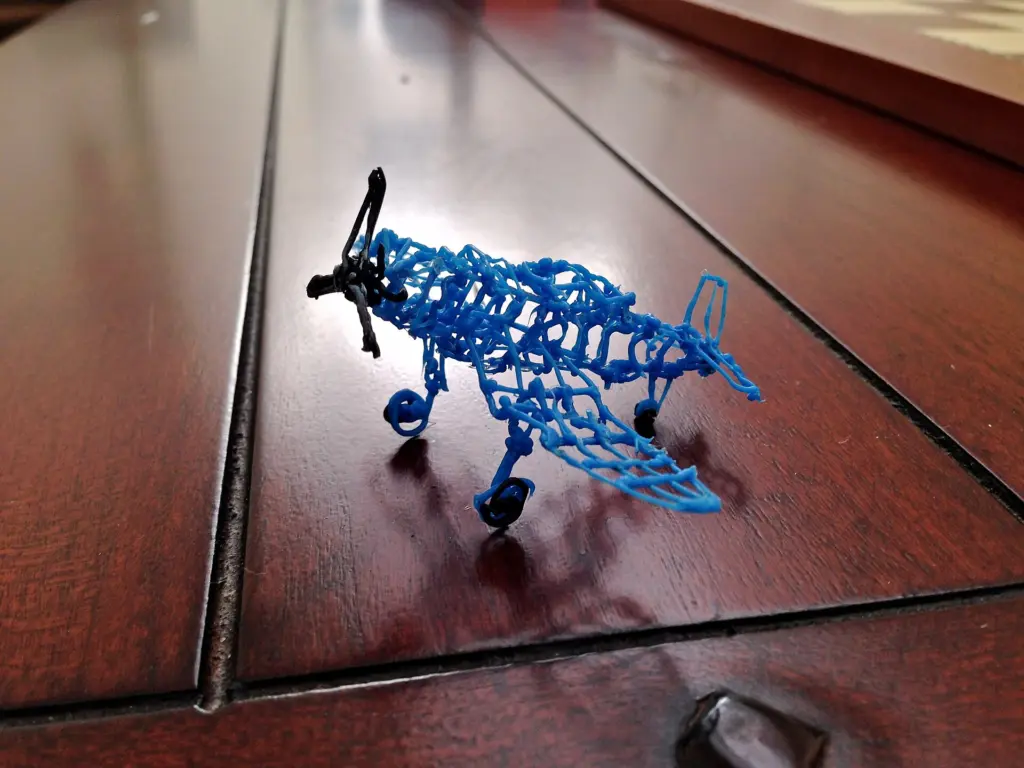
Template booklets and a silicone mat with printed patterns are good for practice. Flat pieces are traced on the mat, peeled off and joined into a figure. That is also how the well-known airplane and building models are made. Suitable files, knives and glue for the next step are covered in our model building tools guide (in German). For younger tinkerers, a science kit can be a good addition.
Which 3D pen for whom?
For a child between 6 and 13, we recommend the 3Doodler Start+. Cold extrusion, no hot metal, but a fixed material system.
Teenagers aged 14 and up who want to build sturdy models have two options. With the SCRIB3D P1, you can buy inexpensive 1.75 mm PLA as refills. With the Create+, you stay within the 3Doodler system. For detail work and touch-ups, adults should go for the MYNT3D Super with its stepless feed rate.
If you are just curious and do not want to spend much, buy a simple pen such as the one from Tecboss, knowing that the data sheet and instructions are thin. And if what you really want is to print entire components, you do not need a pen but a 3D printer. The pen cannot replace it.
Frequently asked questions
What age is a 3D pen suitable for?
That depends on the method. According to the manufacturer, the cold-extrusion 3Doodler Start+ is intended for ages six and up and has no hot parts. Hot-extrusion pens reach more than 200 degrees Celsius at the nozzle, which is why the 3Doodler Create+ is only approved from age 14. For children under 14, there is hardly any way around cold extrusion.
What is the difference between cold extrusion and hot extrusion?
Cold extrusion uses proprietary strands with a low melting point, 2.5 mm in diameter on the 3Doodler Start+, and only works with the manufacturer's own material. Hot-extrusion pens process PLA and ABS at roughly 160 to 235 degrees Celsius, depending on the material. That produces firmer, finer lines, and refill packs are available in large numbers.
Which filament fits a 3D pen?
When it comes to diameter, 1.75 mm has become the widespread standard, matching many third-party packs. The 3Doodler Create+, by contrast, needs its own thicker strands. Also pay attention to temperature: some strands are specified for 190 to 230 degrees Celsius, and a pen that only processes PLA at 160 degrees may struggle with them.
Is a 3D pen a health concern?
In 2020, the German Federal Institute for Risk Assessment (BfR) reported that fused deposition releases volatile substances and very fine particles, including with 3D printing pens. The higher the temperature, the more particles. According to the BfR, there is still little information on health effects. So work next to an open window, choose a low temperature and do not leave children unsupervised.
Which 3D pen is suitable for fine details?
The MYNT3D Super processes 1.75 mm PLA and ABS and has a stepless feed rate that, according to the manufacturer, can also be adjusted while drawing. It does not have a display, though. It suits adults who touch up edges on models or add fine decoration; it is less suitable for children.
Does a 3D pen replace a 3D printer?
No. At its core, a 3D pen works like a tiny 3D printer without the mechanics, but if you want to print entire components, you need a 3D printer. With the pen, figures are mostly built from flat pieces that are traced on a silicone mat, peeled off and joined together.
Sources
- 3Doodler: Is the 3Doodler Start safe for children?
- 3Doodler: PLA and ABS temperatures on the Create+
- 3Doodler: Start+ pens
- BfR (German Federal Institute for Risk Assessment): 3D printing, a „dusty“ affair? (Communication 050/2020, in German)
- 3DSourced: MYNT3D Super 3D Pen Review
- e-catalog: Myriwell RP200B and RP100B
Where to buy
- 3Doodler Start+Check price at Amazon.deCheck price at Amazon.co.ukCheck price at Amazon.nlCheck price at Amazon.com.beCheck price at Amazon.frCheck price at Amazon.itCheck price at Amazon.esCheck price at Amazon.plCheck price at Amazon.seAvailable in Germany: Amazon.de
- 3Doodler Create+Check price at Amazon.deCheck price at Amazon.co.ukCheck price at Amazon.nlCheck price at Amazon.com.beCheck price at Amazon.frCheck price at Amazon.itCheck price at Amazon.esCheck price at Amazon.plCheck price at Amazon.seAvailable in Germany: Amazon.de
- SCRIB3D P1Check price at Amazon.deCheck price at Amazon.co.ukCheck price at Amazon.nlCheck price at Amazon.com.beCheck price at Amazon.frCheck price at Amazon.itCheck price at Amazon.esCheck price at Amazon.plCheck price at Amazon.seAvailable in Germany: Amazon.de
- MYNT3D SuperCheck price at Amazon.deCheck price at Amazon.co.ukCheck price at Amazon.nlCheck price at Amazon.com.beCheck price at Amazon.frCheck price at Amazon.itCheck price at Amazon.esCheck price at Amazon.plCheck price at Amazon.seAvailable in Germany: Amazon.de
- Tecboss 3D-Stift mit LCDCheck price at Amazon.deCheck price at Amazon.co.ukCheck price at Amazon.nlCheck price at Amazon.com.beCheck price at Amazon.frCheck price at Amazon.itCheck price at Amazon.esCheck price at Amazon.plCheck price at Amazon.seAvailable in Germany: Amazon.de
Still undecided?
Keep comparing at your own pace – every article in this category is checked monthly for new and discontinued models.