Price dropping? We'll let you know
Contents12 sections
This guide was first published in German on handgetestet.de.
On-camera microphones rarely fail because of their sound. Because of the cable, they do. The microphone sits on the hot shoe, the plug fits into the jack, and the audio track still stays silent, because cameras and smartphones expect differently wired jacks. If you film with a mirrorless camera and a phone, the most sensible place to start, in our view, is a lightweight directional microphone without its own battery, such as the Røde VideoMic GO II. For outdoor shoots or long days of filming, a model with a rechargeable battery, gain control and headphone output is worth it instead.
Three contacts or four: why the jack decides
Cameras almost always have a 3.5 mm jack for TRS plugs with three contacts. Smartphones with a headphone jack, on the other hand, expect TRRS with four contacts. Without the right cable, the microphone stays silent there or hums. Good manufacturers include both cables. And newer phones? They have no headphone jack at all anymore. Then it comes down to USB-C, either with a microphone that outputs digitally itself or via an adapter.
What a shotgun tube can and can’t do
Most on-camera mics are supercardioids with an interference tube, commonly called shotguns. They favor what happens in front of the lens and attenuate the sides. They are no miracle workers. The farther the speaker stands from the camera, the more of the room and surroundings you hear as well. For interviews, a wireless microphone kit for video belongs in your bag.
Power, gain, wind and weight
Small models run on the camera’s microphone bias voltage, known as plug-in power, and need nothing else. Larger ones use AA or AAA batteries or a rechargeable battery that charges via USB-C. Batteries can be swapped on the go. A drained rechargeable battery cannot.
Gain is all about the camera’s noise. Many cameras produce audible hiss when their preamp is turned up high. If the microphone has its own gain stage, it delivers more signal, and the camera can stay lower.
Indoors, foam is enough as a windshield. Outdoors, even a light breeze causes low-frequency rumble, and only a furry windshield helps against it. That leaves weight: on a small camera or a gimbal, every gram counts, and a long tube quickly pokes into the frame of a wide-angle lens.
Six on-camera microphones and their key specs
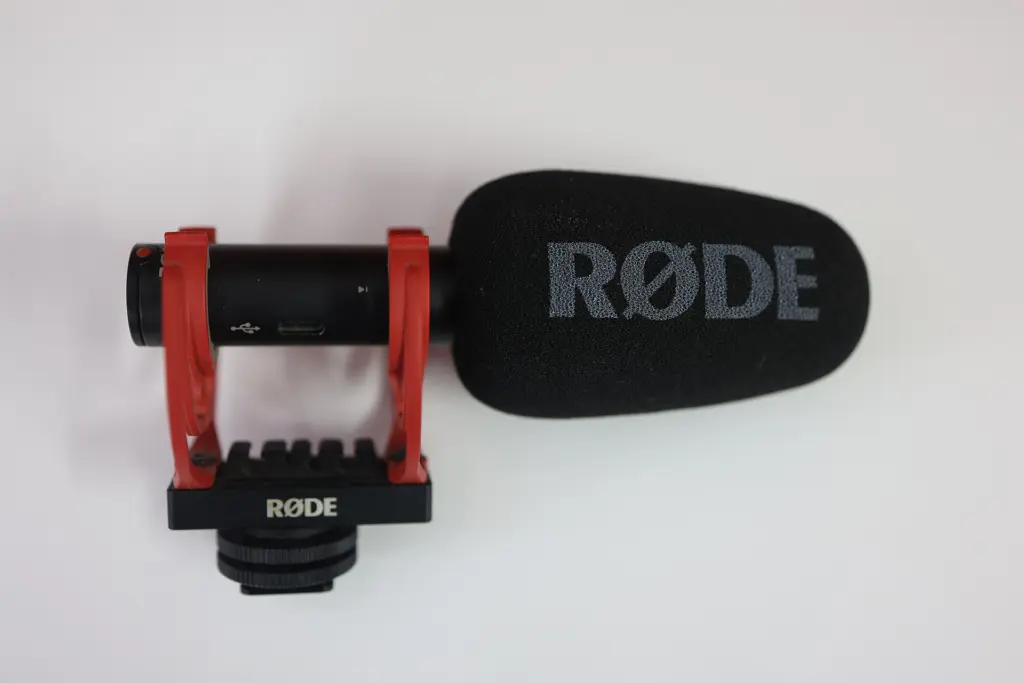
Røde VideoMic GO II
According to Røde, the microphone itself weighs just 33 grams, and it needs no battery. Besides the 3.5 mm jack for the camera, it has a USB-C output for smartphone, tablet and computer. The box contains a TRS cable and a foam windshield; according to the data sheet, the USB-C cable has to be bought separately. There is no gain control, so you set the volume on the camera. For vlogs and indoor recording, we consider that a sensible compromise.
Røde VideoMic NTG
Considerably more technology, packed into a 94-gram aluminum housing. Røde lists continuously variable gain, a selectable high-pass filter (75 or 150 Hz), a 20 dB pad and a safety channel that records a quieter second track. According to Røde, the output detects by itself whether a camera or a mobile device is connected. When the USB output is in use, the jack becomes a headphone output. Occasional filmmakers, however, pay for a lot of technology here that they will hardly use.
Sennheiser MKE 400 (2nd generation)
Sennheiser built the windshield and shock mount right into the housing. On top of that come three-level sensitivity, a low-cut filter and a headphone output with its own volume control. According to the manufacturer, two AAA cells last for more than 100 hours. Both coiled cables, TRS and TRRS, are included. The microphone switches on and off with the camera, which helps anyone who tends to forget to switch it off.
Deity V-Mic D4 Mini
At 28 grams according to the manufacturer, the lightest model here, powered by the camera’s plug-in power. Deity includes TRS and TRRS cables as well as a furry windshield. What stands out is the additional 3.5 mm input. A lavalier microphone or wireless receiver lands on the camera’s second channel that way, with no Y-cable needed. There is no gain control, filter or rechargeable battery. In this price range, that is acceptable.
Saramonic Vmic5
A full-length shotgun tube with a supercardioid pattern and a built-in 2000 mAh battery that, according to Saramonic, lasts up to 150 hours and charges via USB-C. Two-stage gain (0 and +10 dB), a 150 Hz filter and a headphone output are part of the feature set, and foam and furry windshields come in the box. On wide-angle lenses and gimbals, the longer tube tends to get in the way.
Shure VP83 LensHopper
A single AA cell. According to Shure, it lasts up to 130 hours, and you can get a replacement at any gas station. Gain switches in three stages (−10, 0 and +20 dB), and a low-cut filter can be engaged. Shure offers a furry windshield separately. According to the description, the microphone is intended for cameras and mobile recorders; on a smartphone, you would need a TRRS adapter.
Which microphone for which shoot?
- Vlogging with a camera and occasionally a phone: Røde VideoMic GO II, plus the USB-C cable if needed. Our vlogging camera guide presents cameras with a microphone jack.
- Small budget, small camera: Deity V-Mic D4 Mini. If a wireless microphone comes along later, use the second input.
- Outdoors and traveling: Sennheiser MKE 400, thanks to the built-in windshield and swappable batteries.
- Long shooting days, monitoring via headphones: Saramonic Vmic5 or Shure VP83, depending on whether you prefer a rechargeable battery or an AA cell.
- Camera, computer and safety track in one: Røde VideoMic NTG.
Still, take a look at your own camera. Not every model has a microphone jack, and some entry-level devices only adjust the level automatically. A separate guide describes which mirrorless camera comes with a clean audio input.
For recording at the desk rather than on the camera, our Shure SM7B vs. Neumann TLM 103 review compares two studio microphones with audio samples.
Frequently asked questions
Why doesn't my camera microphone work on my smartphone?
Cameras almost always have a 3.5 mm jack for TRS plugs with three contacts, while smartphones with a headphone jack expect TRRS with four contacts. Without the right cable, the microphone stays silent or hums. Newer phones without a headphone jack need a microphone with a digital USB-C output or an adapter.
What can a directional microphone on the camera do, and what can't it do?
On-camera mics with an interference tube favor what happens in front of the lens and attenuate the sides. The farther away the speaker stands, however, the more of the room and surroundings you hear as well. For interviews, a wireless microphone kit belongs in your bag.
Does a camera microphone need batteries?
Small models run on the camera's microphone bias voltage, known as plug-in power, and need nothing else. Larger ones use AA or AAA batteries or a rechargeable battery charged via USB-C. Batteries can be swapped on the go; a drained rechargeable battery cannot.
What is gain control on a microphone for?
Many cameras produce audible hiss when their preamp is turned up high. If the microphone has its own gain stage, it delivers more signal and the camera can stay lower. The Røde VideoMic GO II has no such control; the volume is set on the camera.
Which windshield is enough for recording outdoors?
Indoors, foam is enough. Outdoors, even a light breeze causes low-frequency rumble, and only a furry windshield helps against it. On the Sennheiser MKE 400, the windshield is built right into the housing; Deity and Saramonic include a furry windshield.
Which camera microphone suits a small budget?
For small cameras and a small budget, the Deity V-Mic D4 Mini at 28 grams according to the manufacturer is a good fit. It runs on plug-in power, and TRS and TRRS cables are included. Via the additional 3.5 mm input, a wireless receiver lands on the camera's second channel. There is no gain control, filter or rechargeable battery.
Sources
- Røde: VideoMic GO II
- Røde: VideoMic GO II data sheet
- Røde: VideoMic NTG
- Sennheiser: MKE 400
- Deity: V-Mic D4 Mini
- Saramonic: Vmic5
- Shure: VP83 LensHopper
Where to buy
- Røde VideoMic GO IICheck price at Amazon.deCheck price at Amazon.co.ukCheck price at Amazon.nlCheck price at Amazon.com.beCheck price at Amazon.frCheck price at Amazon.itCheck price at Amazon.esCheck price at Amazon.plCheck price at Amazon.seAvailable in Germany: Amazon.de
- Deity V-Mic D4 MiniCheck price at Amazon.deCheck price at Amazon.co.ukCheck price at Amazon.nlCheck price at Amazon.com.beCheck price at Amazon.frCheck price at Amazon.itCheck price at Amazon.esCheck price at Amazon.plCheck price at Amazon.seAvailable in Germany: Amazon.de
- Røde VideoMic NTG€209.00≈ £174.08≈ CHF 193.18≈ PLN 922.07≈ SEK 2,328.89≈ DKK 1,562.15≈ NOK 2,216.34≈ CZK 5,096.67≈ HUF 76,996≈ RON 1,117.46≈ ISK 28,633≈ $229.23≈ CA$327.92 at Coolblue · As of 19.11.View at CoolblueAvailable in Germany: Coolblue
- Sennheiser MKE 400 (2. Generation)Check price at Amazon.deCheck price at Amazon.co.ukCheck price at Amazon.nlCheck price at Amazon.com.beCheck price at Amazon.frCheck price at Amazon.itCheck price at Amazon.esCheck price at Amazon.plCheck price at Amazon.seAvailable in Germany: Amazon.de
- Saramonic Vmic5Check price at Amazon.deCheck price at Amazon.co.ukCheck price at Amazon.nlCheck price at Amazon.com.beCheck price at Amazon.frCheck price at Amazon.itCheck price at Amazon.esCheck price at Amazon.plCheck price at Amazon.seAvailable in Germany: Amazon.de
- Shure VP83 LensHopperCheck price at Amazon.deCheck price at Amazon.co.ukCheck price at Amazon.nlCheck price at Amazon.com.beCheck price at Amazon.frCheck price at Amazon.itCheck price at Amazon.esCheck price at Amazon.plCheck price at Amazon.seAvailable in Germany: Amazon.de
Still undecided?
Keep comparing at your own pace – every article in this category is checked monthly for new and discontinued models.