Contents10 sections
This guide was first published in German on handgetestet.de.
The espresso tastes sour, the next attempt bitter, and nobody knows why. That’s how many weeks with a first espresso machine begin. Usually it isn’t the machine but the grind size, dose and tamping. That’s exactly where espresso machines with a built-in grinder and tamping aid come in. For most beginners, we consider the Sage Barista Express Impress the most sensible route: it grinds, corrects the dose and tamps the coffee with consistent force, while you froth the milk yourself. If you want to spend as little as possible, look at the SMEG EGF03.
Classic espresso machines with a separate grinder, from single boilers to dual boilers, are compared in our guide to espresso machines. This one is about machines that combine the grinder and brew group in one housing and help with dosing and tamping.
Grinding, dosing, tamping: where the mistakes happen
An espresso depends on three steps before any water flows. If the grounds are too coarse, the shot runs through too fast. If there’s too little in the basket, it lacks body. And if the tamping is uneven, the water finds the easiest path. In its espresso machine test, Stiftung Warentest, Germany’s leading consumer testing organization, explicitly names tamping as a factor that affects the result.
A built-in grinder only solves the first part. What happens next is decisive. With the SMEG and the De’Longhi, you tamp yourself, using the included tamper or a tamper and dosing funnel respectively. The two Impress models from Sage tamp via a lever with a fixed 10 kilograms and twist by 7 degrees while doing so. The Oracle Jet handles grinding, dosing and tamping entirely by itself.
More automation means a shorter learning curve. But it also means less room to maneuver if you want to experiment later.
What we paid attention to in the comparison
The number of grind settings says more than you’d think. According to Sage, the Oracle Jet offers 45 settings, the Barista Touch Impress 30, the Barista Express Impress 25, and the La Specialista Touch has 15. The SMEG has only three: extra fine, fine and medium. For an espresso you can fine-tune, that’s not much. If you change beans often, you’ll notice.
The portafilter itself comes in two sizes. Sage uses 54 millimeters on the Impress models; the Oracle Jet and the SMEG have 58 millimeters. Baskets and tampers have to match the diameter. Which accessories you need and which you don’t is covered in our guide to espresso accessories (in German).
And then there’s the milk. A manual steam wand takes practice but rewards it with control. Automatic systems such as Sage’s Auto MilQ froth between 40 and 75 °C in eight texture levels, according to the manufacturer. For super-automatic machines, Stiftung Warentest advises rinsing the milk system after every milk drink. We would do the same with an automatic steam wand.
Five espresso machines with a grinder at a glance
| Model | Tamping | Grind settings | Milk | Best for |
|---|---|---|---|---|
| Sage Barista Express Impress | lever, 10 kg | 25 | manual steam wand | beginners who froth milk themselves |
| SMEG EGF03 | tamper by hand | 3 | manual steam wand, 2 levels | small budget, retro look |
| Sage Barista Touch Impress with cold extraction | lever, 10 kg | 30 | Auto MilQ, 40 to 75 °C | milk drinks at the push of a button |
| De’Longhi La Specialista Touch EC9455.M | tamper with dosing funnel | 15 | Auto LatteArt, 4 temperatures | touchscreen at a lower price |
| Sage Oracle Jet | automatic | 45 | Auto MilQ, 40 to 75 °C | convenience without compromise, 58 mm basket |
Sage Barista Express Impress: learns as it doses
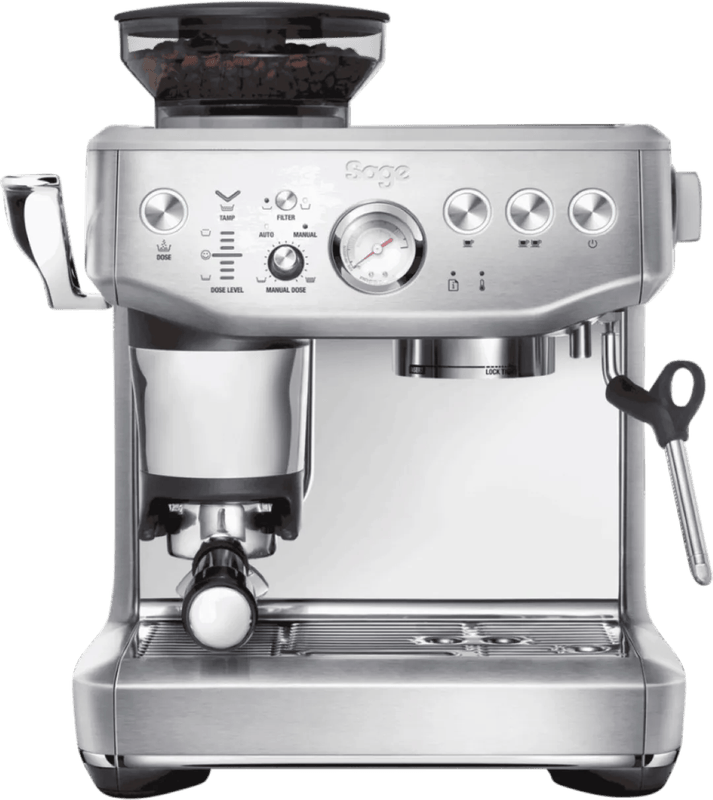
The special part is the lever next to the grinder. After each grind and tamp, according to Sage, the machine reads whether there’s too much or too little coffee in the basket, shows it on a gauge and adjusts the next dose. A PID control holds the water temperature at 93 °C, and brewing happens at 9 bar after a low-pressure pre-infusion. You froth the milk yourself with the steam wand; a 480 ml milk jug is included. The manual recommends starting the grinder at setting 16 of 25 and working your way from there. Bean hopper with 250 grams, water tank with 2 liters, a footprint of 33 by 38 centimeters.
SMEG EGF03: lots of manual work, solid technology
Under the rounded hood are a dual thermoblock that heats up in 90 seconds according to SMEG, a pressure gauge and four pre-infusion profiles. The portafilter measures 58 millimeters, and the water tank holds 2.4 liters. Tamping is done by hand. The weak point is the grinder with only three settings, adjusted by turning the bean hopper. If you value design and like to tinker, you’ll still find a decent foundation here.
Sage Barista Touch Impress: touchscreen and cold coffee
The same tamping mechanism as the Express Impress, plus a touchscreen, the automatic Auto MilQ milk system and cold extraction. According to Sage, cold brew takes less than three minutes and cold espresso just under two. According to the manufacturer, the 30-setting grinder comes from Baratza. Auto MilQ has settings for cow’s, oat, soy and almond milk. If you make cappuccino for several people, this saves you the most time.
De’Longhi La Specialista Touch: Bean Adapt instead of a lever
De’Longhi relies on a technology called Bean Adapt, which according to the manufacturer adjusts grind size, dose and temperature to the beans you’re using. Tamping is done with a tamper and dosing funnel, not a lever. The 3.5-inch color display offers ten drinks, including cold brew. The Auto LatteArt steam wand has four temperatures and five textures. With 15 grind settings, there’s less fine-tuning than with Sage.
Sage Oracle Jet: when it should just work
According to Sage, the Oracle Jet grinds 22 grams of fresh coffee directly into the 58 mm portafilter and tamps automatically. The hardened steel grinder has 45 settings, and the brewing temperature can be set degree by degree. Once the espresso is done, the milk can start by itself if you like. This is the most convenient machine on this list. At 42 centimeters wide, it’s also the largest, and by far the most expensive.
Which machine suits you
- You want to learn espresso without despairing over dose and tamping: Sage Barista Express Impress.
- The budget is tight, the kitchen should look good, and you like to tinker: SMEG EGF03.
- Several cappuccinos in the morning, little time: Sage Barista Touch Impress.
- You want a touchscreen, but not at a Sage price: De’Longhi La Specialista Touch.
- As few steps as possible and the larger basket: Sage Oracle Jet.
None of these machines works without maintenance. The brew group, baskets and steam wand regularly need water and a brush, and descaling is part of it too. If you’d rather do nothing yourself, a super-automatic machine serves you better. The difference is explained in our guide super-automatic or espresso machine (in German).
Without a grinder, things get slimmer: how a small espresso machine holds up in everyday use over the years is shown in our long-term test of the De’Longhi Dedica.
Frequently asked questions
Why does my espresso taste sour or bitter?
Usually it isn't the machine but the grind size, dose and tamping. Grounds that are too coarse run through too fast, too little in the basket robs the espresso of body, and uneven tamping lets the water find the easiest path. Tamping aids like those on the Sage Impress models address exactly that.
How many grind settings does an espresso machine with a grinder need?
The more, the finer you can adjust. According to Sage, the Oracle Jet offers 45 settings, the Barista Touch Impress 30, the Barista Express Impress 25, and the La Specialista Touch has 15. The SMEG has only three. If you change beans often, you'll notice.
Which espresso machine froths milk automatically?
The Sage Barista Touch Impress and the Oracle Jet have Auto MilQ, which according to the manufacturer froths between 40 and 75 °C in eight texture levels. The De'Longhi La Specialista Touch uses Auto LatteArt with four temperatures. Rinse the milk system after every milk drink.
What size is the portafilter?
Sage uses 54 millimeters on the Impress models; the Oracle Jet and the SMEG have 58 millimeters. Baskets and tampers must match the diameter, so keep that in mind when buying accessories. If you want the larger basket and as few steps as possible, you'll end up with the Sage Oracle Jet.
Espresso machine with a grinder or a super-automatic?
None of these machines works without maintenance. The brew group, baskets and steam wand regularly need water and a brush, and descaling is part of it. If you'd rather do nothing yourself, a super-automatic machine serves you better. More automation also means less room to experiment.
Sources
- Sage: the Barista Express Impress
- Sage: the Barista Touch Impress with cold extraction
- Sage: the Oracle Jet
- De’Longhi: La Specialista Touch EC9455.M
- SMEG: espresso machine with built-in grinder EGF03CREU
- Stiftung Warentest: espresso machines tested
- Stiftung Warentest: cleaning super-automatic coffee machines (July 27, 2026)
Where to buy
- Sage Barista Express ImpressView at CoolblueAvailable in Germany: Coolblue
- SMEG EGF03View at CoolblueAvailable in Germany: Coolblue
- Sage Barista Touch Impress mit KaltextraktionView at CoolblueAvailable in Germany: Coolblue
- De'Longhi La Specialista Touch EC9455.MView at CoolblueAvailable in Germany: Coolblue
- Sage Oracle JetView at CoolblueAvailable in Germany: Coolblue