Contents14 sections
This guide was first published in German on handgetestet.de.
A tiller does not replace the spade everywhere. If you want to loosen an existing vegetable bed in spring and work in compost, a battery cultivator with a width of 30 to 45 cm will do the job well. For larger areas and firm soil, we would go for a gas machine with reverse gear, such as the Stihl MH 585. And if you are fighting couch grass or ground elder, leave the tiller in the shed for now.
Is a tiller actually good for the soil?
Partly. The rotating tines break up clods, mix in compost and fertilizer and leave a fine, crumbly seedbed. With perennial root weeds, that goes wrong. Georg Henkel of the home and allotment garden advisory service at the Schleswig-Holstein Chamber of Agriculture in Germany describes how the tiller chops the roots of couch grass, bindweed and ground elder into many small pieces, each of which grows into a new plant. His advice: turn the soil with a digging fork and pick out the roots, consistently, for two to three years.
Then there is soil life. A technical article for agriculture, provided by the Bavarian State Research Center for Agriculture (LfL), describes earthworms as sensitive to cultivation and recommends shallow, non-inverting cultivation so that soil structures are preserved. For the garden, that means: better to loosen shallowly once in spring than to till deep often.
Which working width suits my garden?
The width should match the narrowest bed, not the largest area. Between two rows of leeks, 85 cm is no use. That is why split tine sets are so practical: Stihl specifies the MH 585 at 85 cm or 60 cm, Einhell the GP-CR 36/45 at 30 to 45 cm, depending on whether four or six tines are fitted. According to the manufacturer, the small Honda FG 205 works a width of up to 45 cm and has side discs that are meant to protect young plants from flying soil.
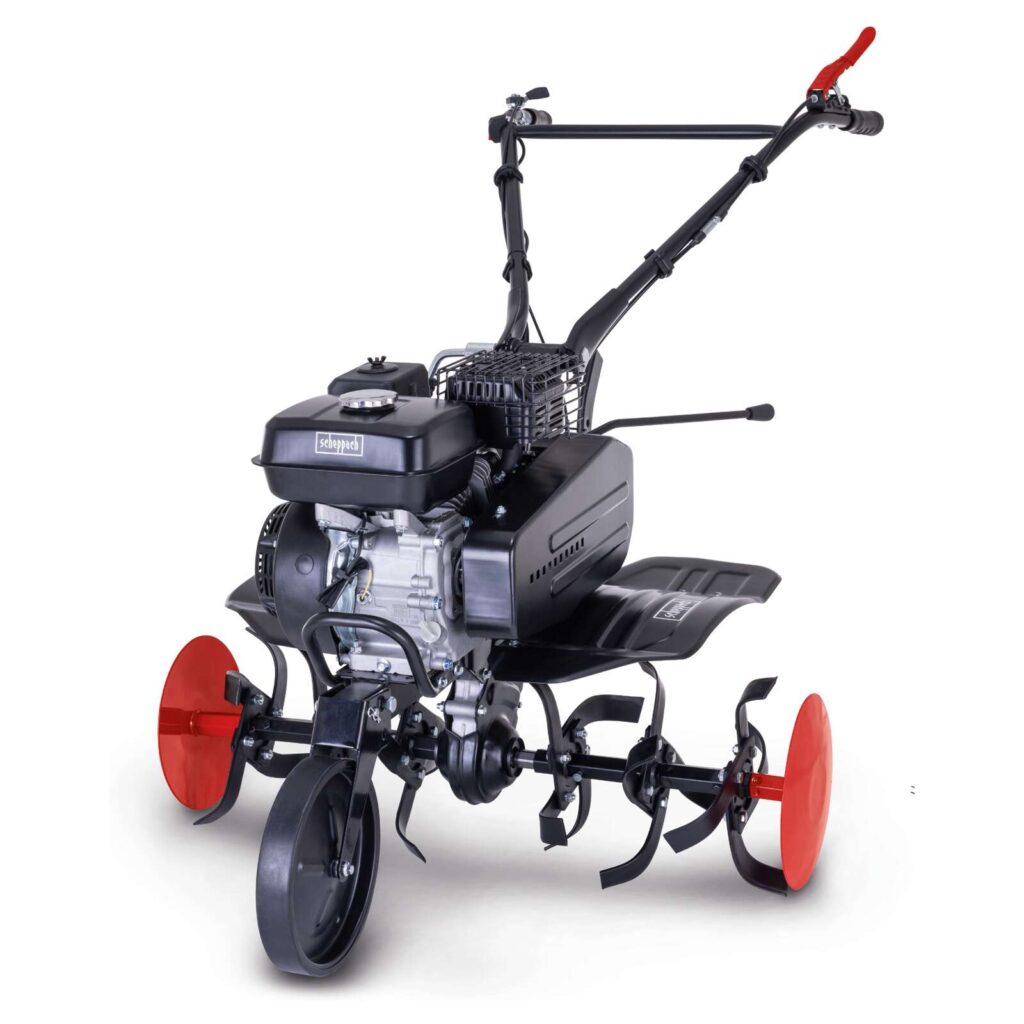
Weight is just as important. You can carry an 8.5 kg battery cultivator over the lawn edge into the raised bed. The Scheppach MTP750 weighs 67.5 kg without fuel and oil, according to the manufacturer. It needs transport wheels and a level path to the bed.
Battery or gas?
Battery cultivators are light and need neither oil nor gasoline. Their limit is run time. Einhell quotes about 35 minutes for the GE-CR 30 Li with two 4.0 Ah batteries, and around 20 minutes at low speed for the larger GP-CR 36/45 with the same setup. Both run on two 18-volt batteries from the Power-X-Change system, which are not included in the box. If you already use the system, you save on that purchase. More on this in our guide to battery systems.
Einhell itself adds one restriction. The GE-CR 30 Li is intended for vegetable and flower beds, not for breaking up turf. If a patch of lawn is to become a new bed, a gas machine is the more realistic choice. Stihl explicitly advertises the MH 585 for digging over firm soil as well.
Do I need a reverse gear?
On heavy machines, yes. From around 40 kg, we would insist on it. Pulling a heavy machine back by hand at the end of a bed takes strength and is risky. In its manual, Scheppach urges extreme caution when working in reverse and when pulling the machine toward you. The Stihl MH 585 and Scheppach MTP750 have a reverse gear; the Honda FG 205 only goes forward. For the Güde GF 3060.1, the manufacturer’s data lists no reverse gear. Watch out for one word in German spec sheets: „Reversierstarter“ means the recoil starter, not a reverse gear.
Six tillers and their key specs
| Model | Power source | Working width / depth | Weight, reverse gear | Best for |
|---|---|---|---|---|
| Stihl MH 585 | Gas, 149 cm³ | 85 or 60 cm / n/a | 44 kg, yes | Medium-sized vegetable gardens, firm soil |
| Honda FG 205 | Gas, 49 cm³, 1.3 kW | up to 45 cm / 26 cm | 21 kg, no | Small beds, work between rows |
| Einhell GE-CR 30 Li | Battery, 2 × 18 V | 30 cm / 20 cm | 8.5 kg, n/a | Loosening existing beds |
| Einhell GP-CR 36/45 Li E BL | Battery, 2 × 18 V, brushless | 30–45 cm / 23 cm | 23.8 kg, n/a | Medium to large beds without gas |
| Güde GF 3060.1 | Gas, 173 cm³, 3.0 kW | 59 cm / 26 cm | 36.5 kg, n/a | Small to medium areas |
| Scheppach MTP750 | Gas, 212 cm³, 4.2 kW | 75 cm / 31 cm | 67.5 kg, yes | Large areas, vegetable plots |
All specifications according to the manufacturer. „n/a“ means the manufacturer does not state a value.
Stihl MH 585
The MH 585 suits gardens where several vegetable beds are dug over every spring. Stihl itself mentions medium-sized areas and larger beds. The tine set can be split from 85 to 60 cm, the reverse gear helps when turning at the end of a bed, and at 44 kg it is still maneuverable. According to Stihl, the depth stop has three settings; it slows the forward drive and lets the tines work more intensively. Stihl does not state the working depth.
Honda FG 205
Small, 21 kg, with a 49 cm³ four-stroke engine. Honda intends the FG 205 for seedbeds in small flower and vegetable beds and for weeding between beds. It has no reverse gear. At that weight, you can live with it.
Einhell GE-CR 30 Li
The lightest machine on this list: 8.5 kg, four tines with a 200 mm diameter, 30 cm width. That is enough for raised beds and vegetable beds that are already loose. Einhell rules out turf.
Einhell GP-CR 36/45 Li E BL
The bigger sibling, with a brushless motor and electronically adjustable speed. According to Einhell, up to four batteries can be fitted; with four 4.0 Ah batteries, the manufacturer quotes about 40 minutes at low speed. At 23.8 kg, it is no longer a lightweight. It makes sense for larger beds if you do not want a gas machine in the shed and already have the batteries.
Güde GF 3060.1
Six tines with a 270 mm diameter, 59 cm width and 26 cm depth. Güde states a consumption of about 0.97 liters per hour with a 1.2-liter tank, so you will need to refuel after a little over an hour. The manufacturer does not list a reverse gear.
Scheppach MTP750
Two forward gears, one reverse gear, 212 cm³ and a working depth of 31 cm. This is a machine for vegetable plots and large gardens, not for the bed behind a row house. Scheppach states hand-arm vibration of 11.08 and 15.42 m/s², Honda 12.5 m/s² for the FG 205. With values like these, plan for breaks.
How do I work safely with a tiller?
The Scheppach manual for gas tillers is clear. Before tilling, collect stones, wire, glass and branches, and do not work over buried lines. Wear sturdy safety shoes, long pants and gloves, plus hearing protection and safety glasses, and never work barefoot or in sandals. Children, bystanders and animals should keep at least 23 m away. If the tiller hits a large stone or root stock, it can jump forward or upward. Before cleaning the tines, switch off the engine and pull the spark plug cap. We present suitable models in our guide to work gloves.
And the neighbors? The German Equipment and Machinery Noise Protection Ordinance (32. BImSchV) lists tillers under 3 kW in its annex under number 40. In residential areas, they may not be run at all on Sundays and public holidays, and not between 8 p.m. and 7 a.m. on weekdays. Stricter rules of the German federal states remain unaffected, according to Section 7 (3). None of the gas machines is quiet. Honda, Stihl, Güde and Scheppach state a sound power level of 93 dB(A).
How we would decide
- Vegetable garden with several beds, including firmer soil: Stihl MH 585.
- Small beds and raised beds that are already loose: Einhell GE-CR 30 Li if you have Power-X-Change batteries, otherwise the Honda FG 205.
- Larger beds, but no gasoline in the shed: Einhell GP-CR 36/45 Li E BL with four batteries.
- Vegetable plot or large self-sufficiency garden: Scheppach MTP750, because of its weight and reverse gear.
- Couch grass and ground elder in the bed: first the digging fork and picking out the roots; the tiller comes later.
Frequently asked questions
Should you till beds with couch grass or ground elder?
Better not. The tiller chops the roots of couch grass, bindweed and ground elder into many pieces, each of which grows into a new plant, warns the Schleswig-Holstein Chamber of Agriculture in Germany. Its advice: turn the soil with a digging fork and pick out the roots, consistently, for two to three years.
What working width should a garden tiller have?
The width depends on the narrowest bed, not on the largest area. Split tine sets help: the Stihl MH 585 works at 85 or 60 cm, the Einhell GP-CR 36/45 at 30 to 45 cm. Between two rows of leeks, 85 cm is no use.
Battery or gas: which suits my garden?
Battery cultivators are light and need neither oil nor gasoline; their limit is run time, about 35 minutes with two batteries for the GE-CR 30 Li. According to Einhell, it is not meant for breaking up turf. For a new bed made from lawn or for firm soil, a gas machine is the more realistic choice.
Does a tiller need a reverse gear?
On heavy machines, yes; from around 40 kg we consider it necessary, because pulling a heavy machine back at the end of a bed takes strength and is risky. The Stihl MH 585 and Scheppach MTP750 have one. Watch out: "Reversierstarter" in a German spec sheet means the recoil starter, not a reverse gear.
Does tilling harm soil life?
Earthworms are considered sensitive to cultivation. A technical article provided by the Bavarian State Research Center for Agriculture (LfL) recommends shallow, non-inverting cultivation so that soil structures are preserved. For the garden, that means: better to loosen shallowly once in spring than to till deep often.
How do I work safely with a gas tiller?
First collect stones, wire, glass and branches, and do not work over buried lines. Wear safety shoes, long pants, gloves, hearing protection and safety glasses. According to Scheppach, children and animals should keep at least 23 m away. Before cleaning the tines, switch off the engine and pull the spark plug cap.
Sources
- Stihl: MH 585 gas tiller
- Honda: FG 205 tiller
- Einhell: GE-CR 30 Li-Solo battery cultivator
- Einhell: GP-CR 36/45 Li E BL-Solo battery cultivator
- Güde: GF 3060.1 gas garden tiller
- Scheppach: MTP750 gas tiller
- Scheppach: original operating manual for gas tillers (PDF)
- 32. BImSchV, Section 7 and annex
- Schleswig-Holstein Chamber of Agriculture, Georg Henkel: Verunkrautete Beete wieder im Griff (getting weedy beds back under control, PDF)
- LfL Bavaria: Zehn Tonnen Leben pro Hektar (ten tons of life per hectare, dlz, PDF)
Where to buy
- Stihl MH 585Check price at Amazon.deCheck price at Amazon.co.ukCheck price at Amazon.nlCheck price at Amazon.com.beCheck price at Amazon.frCheck price at Amazon.itCheck price at Amazon.esCheck price at Amazon.plCheck price at Amazon.seAvailable in Germany: Amazon.de
- Honda FG 205Check price at Amazon.deCheck price at Amazon.co.ukCheck price at Amazon.nlCheck price at Amazon.com.beCheck price at Amazon.frCheck price at Amazon.itCheck price at Amazon.esCheck price at Amazon.plCheck price at Amazon.seAvailable in Germany: Amazon.de
- Einhell GE-CR 30 LiCheck price at Amazon.deCheck price at Amazon.co.ukCheck price at Amazon.nlCheck price at Amazon.com.beCheck price at Amazon.frCheck price at Amazon.itCheck price at Amazon.esCheck price at Amazon.plCheck price at Amazon.seAvailable in Germany: Amazon.de
- Einhell GP-CR 36/45 Li E BLCheck price at Amazon.deCheck price at Amazon.co.ukCheck price at Amazon.nlCheck price at Amazon.com.beCheck price at Amazon.frCheck price at Amazon.itCheck price at Amazon.esCheck price at Amazon.plCheck price at Amazon.seAvailable in Germany: Amazon.de
- Güde GF 3060.1Check price at Amazon.deCheck price at Amazon.co.ukCheck price at Amazon.nlCheck price at Amazon.com.beCheck price at Amazon.frCheck price at Amazon.itCheck price at Amazon.esCheck price at Amazon.plCheck price at Amazon.seAvailable in Germany: Amazon.de
- Scheppach MTP750View at scheppachAvailable in Germany: scheppachCheck price at Amazon.deCheck price at Amazon.co.ukCheck price at Amazon.nlCheck price at Amazon.com.beCheck price at Amazon.frCheck price at Amazon.itCheck price at Amazon.esCheck price at Amazon.plCheck price at Amazon.seAvailable in Germany: Amazon.de