Contents12 sections
This guide was first published in German on handgetestet.de.
A heat gun rarely fails because it lacks heat. It fails because the heat cannot be dosed finely enough. All six tools in this guide reach between 550 and 650 °C. The difference lies in the low settings, the airflow and the nozzles. In many hobby workshops, a tool with a control dial such as the Steinel PRO HM 2120 E is therefore all you need. If you regularly work on heat-shrink tubing, film and plastic with repeatable settings, you are better served by the Bosch GHG 23-66 and its display.
How many degrees do you really need?
Fewer than you might think. Bosch stores four programs in the GHG 23-66 at the factory, and the values speak for themselves: 250 °C for bending plastic pipes, 350 °C for plastic welding, 450 °C for stripping paint and 550 °C for soft soldering. No factory program goes above 550 °C. What matters more is how low you can go and how precisely you can hit the values in between.
According to Steinel, heat-shrink tubing shrinks by about half its diameter, and the result is even when you use a reflector nozzle that surrounds the tubing with air from all sides. With adhesive film, stickers or old carpet edges, the only goal is to soften the adhesive. A tool with just two fixed settings is too coarse for that, because the hot setting quickly attacks paint and the plastic underneath as well.
On a control dial, the numbers are only guide values. Steinel states a possible deviation of up to 20 °C up or down for the dial on its tools. On the GHG 23-66, Bosch measures the temperature at the nozzle outlet and shows it on the display until the target value is reached. Both manufacturers recommend the same approach: start at a large distance and a low setting, test on a hidden spot, and only then adjust.
Which nozzles should be included?
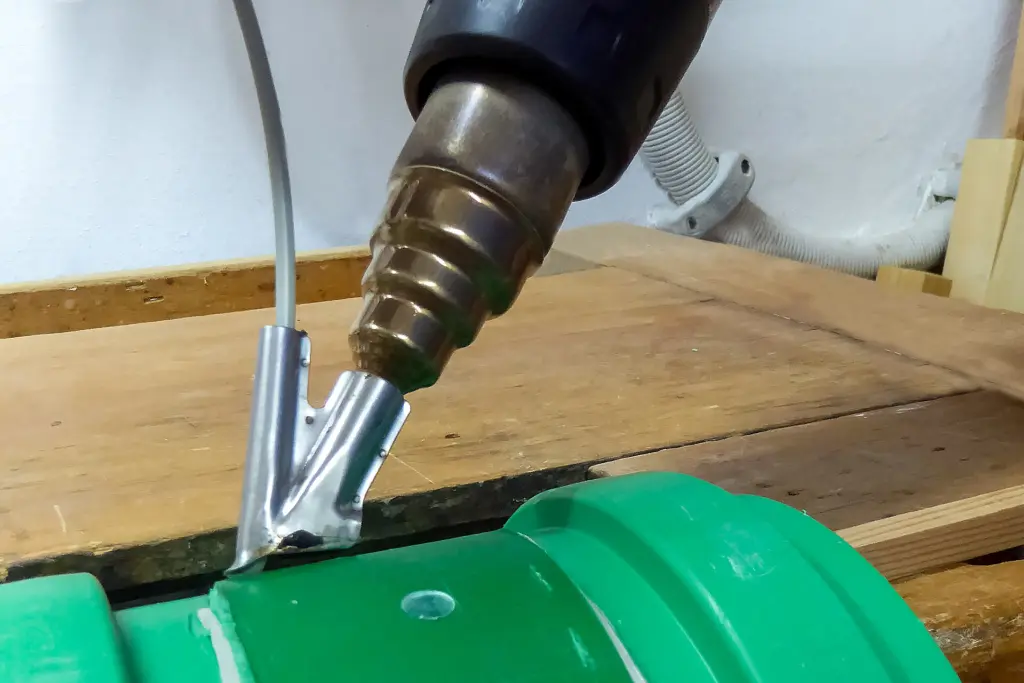
Every tool works without a nozzle, just not precisely. For paint on large surfaces, there is the surface or wide slot nozzle. On window frames, Bosch explicitly requires the glass protection nozzle, otherwise the glass may crack. The reflector nozzle is for heat-shrink tubing and soldering pipes, and the reducer nozzle concentrates the air for spot work. If you want to weld plastic, you also need a welding shoe and welding rod made of the same material as the workpiece.
Checking the exact version saves trouble. The Steinel PRO HM 2120 E in the folding box comes without nozzles, while the case version of the Bosch GHG 23-66 includes a glass protection nozzle and a surface nozzle. Einhell puts four nozzles in the box.
What about old paint and hidden cavities?
This is where it gets serious. According to a procedure description published by the Berufsgenossenschaft Holz und Metall (the German statutory accident insurer for the wood and metal trades) and recognized by the German Committee on Hazardous Substances (Ausschuss für Gefahrstoffe), white lead was used in paints into the 1960s, and in East Germany until the mid-1980s. Sanding and thermal methods can turn it into lead-containing dust and fumes. For an old front door or wooden windows from that period, our view is: have a sample tested first and, if in doubt, use a chemical stripper instead of heat.
The second danger is invisible. Bosch warns in the manual that heat can be conducted to concealed combustible materials and ignite them. This means things like insulation behind wood paneling, dust in joints or bird nests under the roof overhang. So never aim the airflow at one spot for long. Soften the paint briefly and lift it off, because according to Bosch, too much heat burns it and makes it harder to scrape off. Plastics, paints and varnishes can give off toxic or highly flammable gases; Bosch therefore requires a well-ventilated workplace, and Steinel explicitly warns of toxic gases. A pipe that could be a gas line is never heated. And the tool is never left unattended while it is switched on.
Six heat guns side by side
| Model | Temperature and adjustment | Airflow, weight | Best for |
|---|---|---|---|
| Steinel PRO HM 2120 E | 80–630 °C, control dial with 9 settings | 150–500 l/min in 3 settings, 0.84 kg, 3 m cable | Renovation and workshop |
| Bosch GHG 23-66 Professional | 50–650 °C in 10 °C steps, display, 4 memory slots | 150–500 l/min in 10 settings, 0.67 kg | Shrinking, film, plastic |
| Metabo HG 20-600 | 80–600 °C, continuously variable via dial | 150–500 l/min in 3 settings, 0.62 kg, 2.2 m cable | Paint and wood |
| Makita HG6031VK | 50–600 °C adjustable | 250/500 l/min in 2 settings, 0.67 kg, 2 m cable | Trade use with case |
| Bosch UniversalHeat 600 | 3 fixed settings: 50, 300, 600 °C | 200/350/500 l/min, 0.53 kg | Occasional jobs |
| Einhell TE-HA 2000 E | 50–550 °C via dial, cold setting | 250/500 l/min, 0.61 kg, 3 m cable | Getting started with a nozzle set |
Steinel PRO HM 2120 E
According to Steinel, the tool regulates from 80 to 630 °C via a dial with nine settings, plus three airflow settings. The 3 m cable helps on facades and windows when the outlet is far away. There is no display, and with the folding-box version you have to buy the nozzles separately. For paint, heat-shrink tubing and plastic pipes, this range of settings is entirely sufficient in our view.
Bosch GHG 23-66 Professional
A lot of control for little weight. Temperature in 10 °C steps from 50 to 650 °C, airflow in ten settings, four storable combinations and a readout of the actual temperature at the nozzle outlet. If it overheats, the heating element switches off while the fan keeps running. If you strip a door only once a year, you will make little use of all this.
Metabo HG 20-600
Metabo relies on a continuously variable dial from 80 to 600 °C and three airflow settings, with a ceramic heating element and a large, non-slip base according to the manufacturer. At 0.62 kg, it is light enough for overhead work on soffits.
Makita HG6031VK
With 1,800 W and two airflow settings, the Makita is more simply built; according to the manufacturer, the temperature can be set between 50 and 600 °C. A thermal fuse and overheating protection are on board, and Makita supplies the K version in a carrying case. A solid work tool if coarse airflow control is enough for you.
Bosch UniversalHeat 600
One switch, three positions: 50 °C, 300 °C and 600 °C, each with a fixed airflow. At 0.53 kg, it is the lightest tool here, and the heat shield can be removed for tight spots. That is enough for paint on a garden chair. For film and thin plastic, the range between the settings is missing.
Einhell TE-HA 2000 E
Einhell regulates the temperature via a dial up to 550 °C and combines it with a three-position airflow switch, with 250 l/min on the lower two positions. A cold setting cools the nozzle down before you change it, and four nozzles are included. The 550 °C is enough for paint and heat-shrink tubing. For soft soldering, it gets tight.
Which tool suits which job?
- Renovating windows, doors and facades, plus occasional heat-shrink tubing: Steinel PRO HM 2120 E, with nozzles to suit the project.
- Cable harnesses, film, plastic welding with fixed values: Bosch GHG 23-66 Professional.
- Lots of overhead work on soffits: Metabo HG 20-600 with its 0.62 kg.
- A few pieces of furniture a year: Bosch UniversalHeat 600 or Einhell TE-HA 2000 E; the Einhell has the finer dial.
You can find more on the topic in our soldering station guide if fine electronics work is coming up, in the painting tools guide (in German) for the new coat, and in the random orbital sander guide for surfaces free of hazardous coatings.
For circuit boards, the hardware-store heat gun is the wrong tool; the guide to the SMD hot-air soldering station shows what to use instead.
Frequently asked questions
How hot does a heat gun need to get?
Less than you might think. Bosch stores programs in the GHG 23-66 with 250 °C for bending plastic pipes, 350 °C for plastic welding, 450 °C for stripping paint and 550 °C for soft soldering. What matters more is how low the tool goes and how precisely you can hit the values in between.
How accurate is the temperature on the control dial?
The numbers are only guide values; Steinel states a possible deviation of up to 20 °C up or down. The Bosch GHG 23-66, by contrast, measures at the nozzle outlet and shows the value on its display. Both manufacturers advise starting at a large distance and a low setting on a hidden spot.
Which nozzles does a heat gun need?
For paint on large surfaces, the surface or wide slot nozzle; on window frames, the glass protection nozzle, otherwise the glass may crack. The reflector nozzle surrounds heat-shrink tubing from all sides, and the reducer nozzle concentrates the air. Check the exact version: the Steinel in the folding box comes without nozzles.
Can I strip old paint with a heat gun?
Be careful with old coatings: white lead was used in paints into the 1960s, and in East Germany until the mid-1980s. Heating can release lead-containing dust and fumes. Have a sample tested first and, if in doubt, use a chemical stripper instead of heat.
What fire risks come with working with hot air?
Bosch warns that heat can be conducted to concealed combustible materials, such as insulation behind paneling or bird nests under the roof overhang. Never aim the airflow at one spot for long, make sure there is ventilation, and never leave the tool unattended while it is switched on.
Is a heat gun with fixed settings enough?
For paint on a garden chair, yes. The Bosch UniversalHeat 600 has three fixed settings of 50, 300 and 600 °C. For film and thin plastic, however, the range in between is missing, because the hot setting quickly attacks paint and the plastic underneath as well.
Sources
- Steinel: PRO HM 2120 E
- Steinel: HG 2120 E / HG 2320 E operating instructions (PDF)
- Bosch Professional: GHG 23-66
- Bosch: GHG 20-63 / GHG 23-66 original operating instructions (PDF)
- Bosch: UniversalHeat 600
- Metabo: HG 20-600
- Makita: HG6031VK
- Einhell: TE-HA 2000 E
- BGHM/AGS: Stripping procedure for lead-containing coatings on wood (procedure description under the German technical rule TRGS 420)
Where to buy
- Steinel PRO HM 2120 ECheck price at Amazon.deCheck price at Amazon.co.ukCheck price at Amazon.nlCheck price at Amazon.com.beCheck price at Amazon.frCheck price at Amazon.itCheck price at Amazon.esCheck price at Amazon.plCheck price at Amazon.seAvailable in Germany: Amazon.de
- Bosch Professional GHG 23-66Check price at Amazon.deCheck price at Amazon.co.ukCheck price at Amazon.nlCheck price at Amazon.com.beCheck price at Amazon.frCheck price at Amazon.itCheck price at Amazon.esCheck price at Amazon.plCheck price at Amazon.seAvailable in Germany: Amazon.de
- Metabo HG 20-600 (MetaBOX)Check price at Amazon.deCheck price at Amazon.co.ukCheck price at Amazon.nlCheck price at Amazon.com.beCheck price at Amazon.frCheck price at Amazon.itCheck price at Amazon.esCheck price at Amazon.plCheck price at Amazon.seAvailable in Germany: Amazon.de
- Makita HG6031VKCheck price at Amazon.deCheck price at Amazon.co.ukCheck price at Amazon.nlCheck price at Amazon.com.beCheck price at Amazon.frCheck price at Amazon.itCheck price at Amazon.esCheck price at Amazon.plCheck price at Amazon.seAvailable in Germany: Amazon.de
- Bosch UniversalHeat 600Check price at Amazon.deCheck price at Amazon.co.ukCheck price at Amazon.nlCheck price at Amazon.com.beCheck price at Amazon.frCheck price at Amazon.itCheck price at Amazon.esCheck price at Amazon.plCheck price at Amazon.seAvailable in Germany: Amazon.de
- Einhell TE-HA 2000 ECheck price at Amazon.deCheck price at Amazon.co.ukCheck price at Amazon.nlCheck price at Amazon.com.beCheck price at Amazon.frCheck price at Amazon.itCheck price at Amazon.esCheck price at Amazon.plCheck price at Amazon.seAvailable in Germany: Amazon.de