Contents17 sections
This guide was first published in German on handgetestet.de.
The box says 5,600 liters per hour, and for many buyers, that very number decides the purchase. However, it only applies when the water falls out of the pipe with almost no back pressure. For toilet flushing, the washing machine and the garden from a cistern, we consider a home water pump with a pressure tank, prefilter, check valve and dry-run protection the solid choice, for example the Gardena pressure tank unit 5600 SilentComfort. If you only water a few beds, you do not need that much technology.
Three designs, one question: what switches the pump?
A garden pump runs as long as you switch it on. With the Gardena garden pump 5200 Silent, this is done with a foot switch. There is no further control, and that has consequences: according to the manual, the pump may run against a closed pressure side for no more than five minutes, because otherwise the water in the housing heats up. For watering with the hose in your hand, that is enough.
A pressure tank pump works with a pressure switch and a tank. At T.I.P., the switch is factory-set to a cut-in pressure of 1.6 bar and a cut-out pressure of 3 bar. In between, the tank supplies the water. You open the tap, the pressure drops, the motor starts and refills the tank until 3 bar is reached. Without a tank, every short flush of the toilet would start the motor. T.I.P. allows a maximum of 40 starts per hour, Grundfos states 25 for the SCALA1. With a diaphragm tank, the air pressure also has to be right: T.I.P. requires a pre-charge pressure of 1.5 bar and recommends checking it regularly.
An automatic pump does without a large tank. Its electronics start the pump as soon as water is drawn and stop it when nothing flows anymore. According to the manufacturer, the Gardena 5000 SilentComfort weighs 7.2 kg, the pressure tank unit 5600 SilentComfort with its 25-liter tank 17.3 kg.
Liters per hour are only half the truth
Every centrifugal pump has a performance curve. The higher the pressure it has to build, the less water arrives. T.I.P. publishes these values for the HWW 4500 INOX on its product page: a maximum of 4,350 l/h, 3,900 l/h at a 10 m delivery head, 3,500 l/h at 20 m, 2,500 l/h at 30 m, and only 750 l/h at 40 m. According to the manual, the maximum values in the data sheet were determined with a free, unrestricted inlet and outlet.
A rule of thumb is enough for the conversion. Ten meters of delivery head correspond to roughly one bar, and the manufacturers‘ figures show this too: Gardena states 39 m and 3.9 bar for the 5200 Silent, Kärcher 50 m and 5 bar for the BP 4.900 Home. A bathroom on the second floor, a good 5 m above the pump, therefore already costs around half a bar. So do not just compare the flow rate, but ask how much is left at 2 to 3 bar.
Eight meters of suction height is a limit, not a target
A suction pump does not really pull the water up. Air pressure pushes it into the line. In its training materials, the Lower Saxony Academy for Fire and Disaster Protection (Niedersächsische Akademie für Brand- und Katastrophenschutz) calculates a theoretical 10.33 m at sea level. Altitude, warmer water and friction eat into that. In its example for 600 m above sea level and a water temperature of 20 °C, 7.79 m remain in practice.
Gardena, Kärcher, Einhell and Grundfos therefore state a maximum of 8 m for their devices, while T.I.P. states 9 m. You should not push that limit. Grundfos recommends a suction line larger than 1 inch from a suction height of 4 m or a line length of 10 m, and does the math: at a suction height of 2.5 m, the line should be no longer than 25 m. T.I.P. advises a 25 percent larger diameter from 4 m. And Gardena points out that the stated self-priming height is only reached if the pump has been filled to the brim beforehand. If the water level in the well is deeper than about 7 m, a deep well pump or submersible pressure pump belongs in the shaft.
Prefilter and check valve: small parts with a big effect
Sand is the natural enemy of every centrifugal pump. Gardena warns in its manual of faster wear and recommends an additional pump prefilter for very sandy water, while Grundfos recommends a filter on the suction side or a floating intake. Just as important is the check valve at the start of the suction line. T.I.P. requires it together with an intake filter and wants it at least 0.3 m below the water surface so that no air is drawn in. Without it, the suction line drains after every stop.
The devices come with different equipment from the factory. Gardena builds a prefilter and check valve into the 5600 SilentComfort, and Einhell supplies the GE-AW 1246 N FS with a prefilter including a check valve and a dirt indicator. According to the data sheet, the Kärcher BP 4.900 Home includes a check valve, while Kärcher lists the prefilter as an accessory. With T.I.P., you buy the prefilter separately. It is best to clean the filter at short intervals; for rainwater systems, the Leipzig water utility (Leipziger Wasserwerke) recommends doing so monthly. If you only have a barrel at the downspout instead of a cistern, you will find the more suitable solution in the rain barrel guide (in German).
Noise level: check the distance first
With pumps, decibel values are rarely stated on the same basis. For the HWW 4500 INOX, T.I.P. states a guaranteed sound power level of 86 dB and a sound pressure level of 78.9 dB. Gardena measures the garden pump 5200 Silent at 61 dB at 1 m and 47 dB at 5 m, and the 5600 SilentComfort at 42 dB(A) at 5 m. Grundfos states less than 55 dB(A) for the SCALA1. Little of this is directly comparable. Still, a trend emerges: according to the manufacturers, the water-cooled Gardena unit without a fan and the Grundfos are considerably quieter than the T.I.P., whose motor, according to its manual, must be installed with sufficient ventilation.
Well water has no place in the drinking water line
The technical information sheet of the Leipzig water utility (as of 08/25) states that a direct connection between the drinking water system and a private supply system is not permitted under the German Drinking Water Ordinance (Trinkwasserverordnung), DIN EN 1717 and the German standard DIN 1988-100. Topping up is only done via a free outlet, lines are labeled, and draw-off points carry the label „Not drinking water.“ In Leipzig, the system is reported to the utility in advance and built by a contracted installation company. The public health office of the Aachen city region (Gesundheitsamt Städteregion Aachen) also requires a licensed installer and notification of commissioning. The manuals draw the same line: Gardena writes that the pump must not be connected to the drinking water supply, and T.I.P. rules out installation in the public drinking water network. Separation via a gate valve or pipe separator is not enough. The Leipzig information sheet rules that out as well.
Drain it before the first frost
Freezing residual water bursts pump housings. T.I.P. requires a frost-free installation site of at least 5 °C and draining the pump and tank during longer breaks. For the garden pump, Gardena describes exactly how: pull the plug, open the pressure side, loosen the filler cap and drain screw, tilt the pump about 80 degrees, then store it dry and protected from frost. Einhell and Kärcher have a drain screw or a drain valve for this purpose. The device can stay in a basement. Not in a garden shed.
Seven pumps compared
| Model | Design | Flow rate / pressure (max.) | Suction height | Best for |
|---|---|---|---|---|
| Gardena garden pump 5200 Silent | Garden pump, foot switch | 5,300 l/h / 3.9 bar | 8 m | Watering and lawn sprinklers |
| Gardena Home & Garden automatic pump 5000 SilentComfort | Automatic pump without tank | 5,000 l/h / 4.3 bar | 8 m | Garden and individual consumers, little space |
| Gardena pressure tank unit 5600 SilentComfort | Pressure tank pump, 25 l tank | 5,600 l/h / 4.7 bar | 8 m | Cistern for house and garden, quiet |
| Kärcher BP 4.900 Home | Pressure tank pump, 24 l tank | < 4,900 l/h / 5 bar | 8 m | Non-potable water in the house |
| Einhell GE-AW 1246 N FS | Automatic pump with prefilter | 4,600 l/h / 5 bar | 8 m | Wells with some sand |
| T.I.P. HWW 4500 INOX | Pressure tank pump, 22 l tank | 4,350 l/h / 5 bar | 9 m | Robust stainless steel technology, installed away from living areas |
| Grundfos SCALA1 3-45 | Compact pressure booster | 3.59 m³/h nominal / 44 m | 8 m | Quiet continuous operation in the house |
Gardena garden pump 5200 Silent
The simplest solution in this list: 600 W, up to 5,300 l/h and 3.9 bar according to the manufacturer, switched on by foot. According to the manual, a drinking water connection is off-limits, and for a toilet or washing machine it lacks automatic control. According to the listing on Amazon, it is priced clearly below the pressure tank pumps.
Gardena Home & Garden automatic pump 5000 SilentComfort
An automatic pump with 700 W, 5,000 l/h and 4.3 bar, plus dry-run and overheating protection according to the manufacturer. Without a tank, however, it switches on with every draw, which in a house with many short draws is less elegant than a unit with storage.
Gardena pressure tank unit 5600 SilentComfort
For a cistern supplying the house, this is our favorite. Gardena states 900 W, 5,600 l/h, 4.7 bar, a 25-liter steel tank with a diaphragm, and an integrated prefilter, check valve and dry-run protection. The pump is water-cooled and works without a fan; the manufacturer states 42 dB(A) at a distance of 5 m.
Kärcher BP 4.900 Home
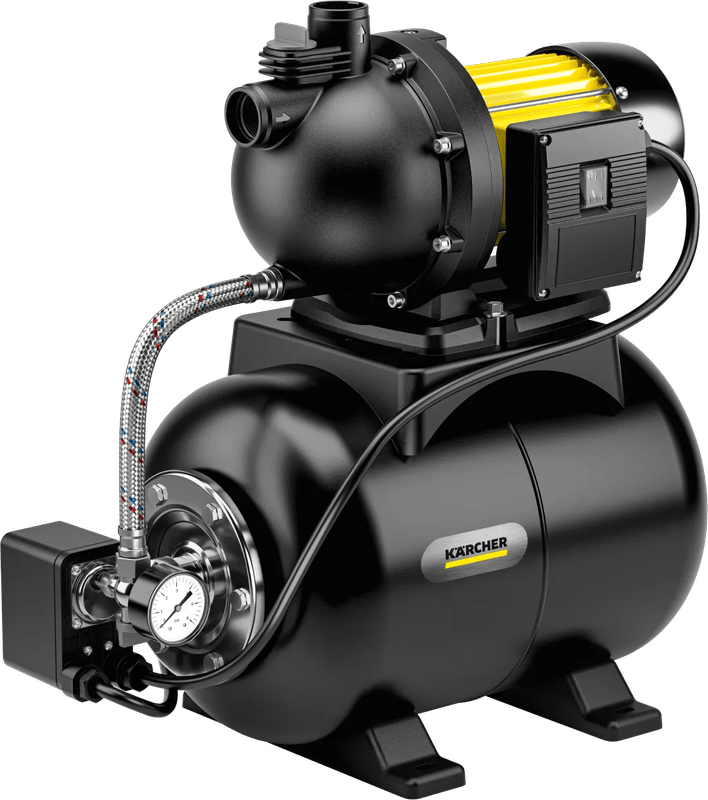
A classic pressure tank pump with 1,150 W, a 24-liter pressure expansion tank, a pressure gauge and a thermal fuse. Kärcher states a working pressure of 1.5 to 3.5 bar and includes a check valve. According to the data sheet, the flange and shaft are made of stainless steel.
Einhell GE-AW 1246 N FS
This automatic pump comes from the factory with what you need for well water: a prefilter with a check valve and dirt indicator, plus dry-run protection. Einhell states 1,200 W, 4,600 l/h and 5 bar. The manufacturer currently sells it through retail partners rather than in its own shop.
T.I.P. HWW 4500 INOX
A stainless steel housing, a 22-liter tank with an EPDM diaphragm and a product page that discloses what arrives at which delivery head. It is not quiet: T.I.P. itself states a guaranteed sound power level of 86 dB. A prefilter and dry-run protection are only available as accessories. In the garage that hardly matters, under the bedroom it does.
Grundfos SCALA1 3-45
Grundfos states a nominal point of 3.59 m³/h at 25 m, a maximum delivery head of 44 m, 8 bar system pressure and less than 55 dB(A); dry-run protection and Bluetooth are built in. It is also intended for boosting pressure from a storage tank or the mains and has drinking water approvals. The connection rules above still apply: whether and how it may be connected to the mains is up to the installer.
How we would decide
- Garden only, hose in hand: a garden pump such as the Gardena 5200 Silent. Pair it with a sturdy hose; see our garden hose guide (in German).
- Garden with automatic control and little space: a Home & Garden automatic pump. If you want timed watering, combine it with a water timer.
- Cistern for toilet, washing machine and garden: Gardena pressure tank unit 5600 SilentComfort, alternatively the Kärcher BP 4.900 Home plus prefilter.
- Well with some sand: Einhell GE-AW 1246 N FS because of the prefilter and dirt indicator.
- Quiet continuous operation in the house, with a licensed installer hired anyway: Grundfos SCALA1.
We run a multifunction pump in continuous operation ourselves: our review of the T.I.P. WPF S shows its performance and a size comparison of the three model sizes.
Frequently asked questions
What is the difference between a pressure tank pump and an automatic pump?
A pressure tank pump works with a pressure switch and a tank: when the pressure drops as you open the tap, the motor starts and refills the tank. That way, not every short flush of the toilet starts the pump. An automatic pump does without a large tank; its electronics switch on with every draw.
How meaningful is the flow rate on the box?
The maximum value only applies with an almost free outflow. The more pressure the pump has to build, the less water arrives: according to the manufacturer, the T.I.P. HWW 4500 INOX delivers a maximum of 4,350 l/h, and still 2,500 l/h at a 30 m delivery head. Ten meters of delivery head correspond to roughly one bar. Ask how much is left at 2 to 3 bar.
How deep can a home water pump draw water?
Most manufacturers state a maximum of 8 m, T.I.P. states 9 m. You should not push that limit, because altitude, warmer water and friction eat into it. Grundfos recommends a suction line larger than 1 inch from a suction height of 4 m. If the water level is deeper than about 7 m, a deep well pump or submersible pressure pump belongs in the shaft.
Do I need a prefilter and a check valve?
Sand is the natural enemy of every centrifugal pump, which is why Gardena and Grundfos recommend a filter on the suction side. The check valve at the start of the suction line prevents the line from draining after every stop; T.I.P. wants it at least 0.3 m below the water surface. Gardena and Einhell include both at the factory.
Can I connect well water to the drinking water line?
No. According to the information sheet of the Leipzig water utility (Leipziger Wasserwerke), a direct connection between the drinking water system and a private supply system is not permitted, not even via a gate valve or pipe separator. Topping up is only done via a free outlet, and draw-off points carry the label "Not drinking water." Depending on the location, the utility or the public health office requires notification and a licensed installer.
What should I keep in mind with a home water pump before winter?
Freezing residual water bursts pump housings. T.I.P. requires a frost-free installation site of at least 5 °C and draining the pump and tank during longer breaks. For this, Gardena describes opening the drain screw and the filler cap and tilting the pump. The device can stay in a basement, but not in a garden shed.
Sources
- Gardena: pressure tank unit 5600 SilentComfort (in German)
- Gardena: Home & Garden automatic pump 5000 SilentComfort (in German)
- Gardena: garden pump 5200 Silent (in German)
- Gardena: operating manual garden pump 5000/5200/5400 Silent (PDF)
- Kärcher: BP 4.900 Home (in German)
- Kärcher: BP 4.900 Home product data sheet (PDF, in German)
- Einhell: GE-AW 1246 N FS (in German)
- T.I.P.: HWW 4500 INOX (in German)
- T.I.P.: operating manual HWW 3000/4500 INOX (PDF, in German)
- Grundfos: SCALA data booklet (PDF)
- Leipziger Wasserwerke: technical information sheet on private supply systems (PDF, in German)
- Public health office, Aachen city region: operating rainwater harvesting systems (PDF, in German)
- Lower Saxony Academy for Fire and Disaster Protection: pump operator course, suction height (PDF, in German)
Where to buy
- Gardena Hauswasserwerk 5600 SilentComfortCheck price at Amazon.deCheck price at Amazon.co.ukCheck price at Amazon.nlCheck price at Amazon.com.beCheck price at Amazon.frCheck price at Amazon.itCheck price at Amazon.esCheck price at Amazon.plCheck price at Amazon.seAvailable in Germany: Amazon.de
- Gardena Gartenpumpe 5200 SilentCheck price at Amazon.deCheck price at Amazon.co.ukCheck price at Amazon.nlCheck price at Amazon.com.beCheck price at Amazon.frCheck price at Amazon.itCheck price at Amazon.esCheck price at Amazon.plCheck price at Amazon.seAvailable in Germany: Amazon.de
- Gardena Haus- & Gartenautomat 5000 SilentComfortCheck price at Amazon.deCheck price at Amazon.co.ukCheck price at Amazon.nlCheck price at Amazon.com.beCheck price at Amazon.frCheck price at Amazon.itCheck price at Amazon.esCheck price at Amazon.plCheck price at Amazon.seAvailable in Germany: Amazon.de
- Kärcher BP 4.900 HomeCheck price at Amazon.deCheck price at Amazon.co.ukCheck price at Amazon.nlCheck price at Amazon.com.beCheck price at Amazon.frCheck price at Amazon.itCheck price at Amazon.esCheck price at Amazon.plCheck price at Amazon.seAvailable in Germany: Amazon.deView at CoolblueAvailable in Germany: Coolblue
- Einhell GE-AW 1246 N FSCheck price at Amazon.deCheck price at Amazon.co.ukCheck price at Amazon.nlCheck price at Amazon.com.beCheck price at Amazon.frCheck price at Amazon.itCheck price at Amazon.esCheck price at Amazon.plCheck price at Amazon.seAvailable in Germany: Amazon.de
- T.I.P. HWW 4500 INOXCheck price at Amazon.deCheck price at Amazon.co.ukCheck price at Amazon.nlCheck price at Amazon.com.beCheck price at Amazon.frCheck price at Amazon.itCheck price at Amazon.esCheck price at Amazon.plCheck price at Amazon.seAvailable in Germany: Amazon.de
- Grundfos SCALA1 3-45Check price at Amazon.deCheck price at Amazon.co.ukCheck price at Amazon.nlCheck price at Amazon.com.beCheck price at Amazon.frCheck price at Amazon.itCheck price at Amazon.esCheck price at Amazon.plCheck price at Amazon.seAvailable in Germany: Amazon.de