Contents11 sections
This guide was first published in German on handgetestet.de.
You buy an instant camera once. You buy the film again and again, and that is exactly where, after six months, it becomes clear whether the purchase was a good one. For getting started, we therefore recommend the Fujifilm instax mini 13: simple technology, the most widespread film format and comparatively low costs per photo. If you want bigger pictures, choose the format first and only then the camera.
Three questions before you look at a model
Every instant camera is tied to exactly one film system. If you want to switch later, you need a new camera. Color and design are therefore secondary.
How big should the picture be? According to Fujifilm, instax mini exposes 62 × 46 mm, roughly credit card size. SQUARE comes to 62 × 62 mm, WIDE to 62 × 99 mm. Polaroid i-Type and 600 film deliver the large square original format. Polaroid Go film is considerably smaller.
How much can a photo cost? An analysis of prices in the manufacturers‘ German online shops (as of September 2026) comes to a clear result. An i-Type photo costs more than twice as much as an instax mini photo. SQUARE is on par with mini, WIDE about a tenth above, Go film around a third above. In addition, a Polaroid pack holds eight photos, an instax pack ten.
Analog or hybrid? Analog cameras print every picture you take. Hybrid models first save digitally and print only what you select. That saves film. But it also takes away some of the chance element that many people love about instant photos.
Power is a minor point. The simple instax models run on AA batteries, Polaroid and the hybrid cameras on a built-in battery charged via USB.
Hardly anyone does the math beforehand. At two hundred photos a year, with Polaroid i-Type film you quickly end up spending more on packs than the camera cost. With instax mini, it stays at less than half of that.
Seven current instant cameras side by side
| Model | Film and picture size | Technology according to the manufacturer | Who it’s for |
|---|---|---|---|
| Fujifilm instax mini 13 | instax mini, 62 × 46 mm | 2 × AA for approx. 100 photos, self-timer 2 or 10 s, selfie mirror | Beginners, parties, gifts |
| Fujifilm instax SQUARE 2 | instax SQUARE, 62 × 62 mm | 4 × AA for approx. 300 photos, three distance modes, warm/cool color filter | Anyone who wants square pictures without Polaroid prices |
| Fujifilm instax WIDE 400 | instax WIDE, 62 × 99 mm | 4 × AA for approx. 100 photos, close-up lens included, tripod thread | Groups, landscapes, family celebrations |
| Fujifilm instax mini Evo | instax mini, 62 × 46 mm | Hybrid, microSD, 3-inch display, battery for approx. 100 prints | Anyone who only wants to print selected photos |
| Polaroid Now Generation 3 | Polaroid i-Type and 600 | Autofocus with two zones, battery for up to 15 packs, 448 g | Anyone who wants the classic large Polaroid |
| Polaroid Go Generation 3 | Polaroid Go film only | Battery for up to 15 packs, selfie mirror, 252 g | The Polaroid look for your jacket pocket |
| Leica Sofort 2 | instax mini (also Leica film) | Hybrid, microSD, print by selection, app control | Design-conscious buyers with a bigger budget |
Fujifilm instax mini 13
On sale since June 2026, a careful update of the mini 12. The main new feature is the self-timer with 2 or 10 seconds, plus a small angle accessory on the wrist strap. The camera sets exposure and flash itself. You switch it on by twisting the lens, and there is no further control. If you just want to snap away, you are more likely to see that as an advantage.
Fujifilm instax SQUARE 2
Square, so between mini and WIDE. According to the analysis mentioned above, it costs no more per photo than mini. The SQUARE 2 has three distance ranges from 30 cm and a switch for a warmer or cooler color tone. According to Fujifilm, it manages around 300 photos on four AA cells. At 450 g, though, it is also noticeably heavier than the mini 13.
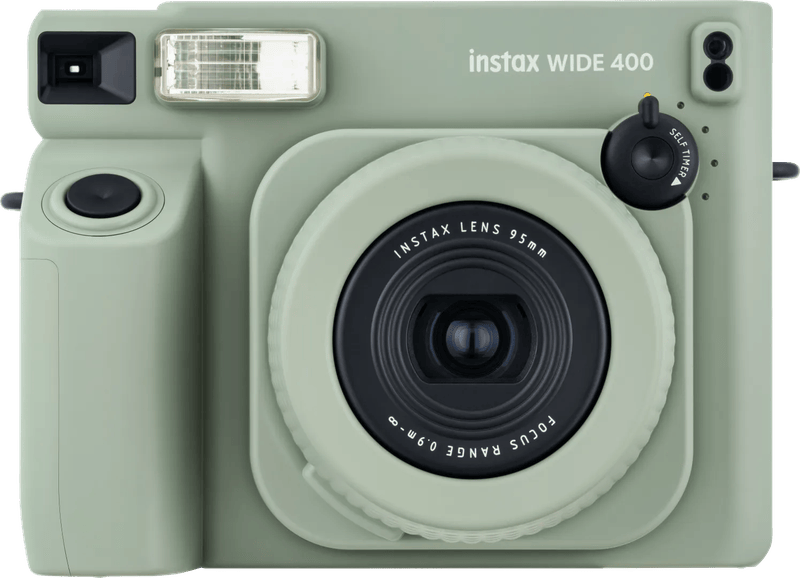
Fujifilm instax WIDE 400
Twice as wide as mini. You notice that immediately in group shots. You can set the self-timer to four to ten seconds, and a close-up lens is included. The data sheet reveals one weakness: according to Fujifilm, the flash reaches only 0.9 to 3 meters, which gets tight in a large, dark hall. And at 616 g, the camera is more likely to go in a bag than in a jacket.
Fujifilm instax mini Evo
Here, the picture is first taken digitally, on a 1/5-inch sensor. It appears on the display and only goes onto mini film if you want it to. Photos are stored internally (approx. 45 pictures) or on microSD, and the camera can also print photos from your smartphone. Fujifilm now also offers a mini Evo 2 with a larger touch display and a higher-resolution sensor, but it sits one price class higher. For landscape format, Fujifilm offers the WIDE Evo as a hybrid variant for WIDE film, also considerably more expensive.
Polaroid Now Generation 3
When someone says „Polaroid,“ they usually mean this format. The third generation of the Now takes i-Type and 600 film and, according to the manufacturer, switches between two focus zones via autofocus. According to Polaroid, one battery charge lasts for up to 15 packs. The pictures are large and have their own look. But they cost by far the most. If you take a lot of pictures, you pay considerably more here for the same party fun.
Polaroid Go Generation 3
Polaroid calls the Go the smallest analog instant camera in the world. Around 252 g, which makes it lighter than the mini 13. According to Polaroid, the third generation has a new lens and a stronger flash. It takes only Go film, and its pictures are small. If you are here for the large Polaroid prints, this format won’t make you happy.
Leica Sofort 2
The Sofort 2 is also a hybrid camera. It prints on instax mini film or, alternatively, on Leica’s own packs. According to Leica, there are ten lens effects and ten film effects to choose from; photos are stored on microSD, and only what you select gets printed. Digital Camera World classifies it as a reworked instax mini Evo. It costs several times as much as a mini 13. What you mainly pay for is design and name.
Kodak plays on the sidelines. Models such as the Smile+ print on ZINK paper without ink, and the Mini Shot 3 Retro uses dye sublimation on 7.6 × 7.6 cm. Essentially, these are digital cameras with a built-in printer, not real instant film. They don’t deliver the typical film look.
Which type are you?
Parties, kids, a gift: that is what the instax mini 13 is made for, with affordable film, almost no controls and a self-timer for group photos. If groups and landscapes are your focus, take the instax WIDE 400, as long as the weight doesn’t bother you. The SQUARE 2 is easier to handle.
Polaroid fans go for the Now Generation 3, as long as the number of pictures stays manageable. On the go, the Go Generation 3 will do, with a smaller picture. Without film, but with the same appeal of only looking at the results later, the cameras in the retro digicam guide do the job.
Economical, but with high standards? Then the instax mini Evo. Only the successful shots get printed, and every picture is also available digitally. That leaves the Leica Sofort 2 for anyone to whom a beautiful body means a lot. Technically, it offers little over the mini Evo; that is worth knowing.
Would you rather print from your smartphone or are you looking for a proper camera? Then the guide to mirrorless cameras and the guide to vlogging cameras point the way. Prints from your smartphone without a new camera at all are covered in the guide to photo printers.
Frequently asked questions
What picture sizes are there for instant cameras?
According to Fujifilm, instax mini exposes 62 × 46 mm, roughly credit card size. SQUARE comes to 62 × 62 mm, WIDE to 62 × 99 mm. Polaroid i-Type and 600 film deliver the large square original format; Polaroid Go film is considerably smaller.
How much does a photo cost with instax compared with Polaroid?
According to an analysis of prices in the manufacturers' German online shops (as of September 2026), an i-Type photo costs more than twice as much as an instax mini photo. SQUARE is on par with mini, WIDE about a tenth above. A Polaroid pack holds eight photos, an instax pack ten.
What is a hybrid instant camera?
Hybrid models such as the instax mini Evo or the Leica Sofort 2 first take the picture digitally and print only what you select. That saves film, and every photo is also available digitally. But it also takes away some of the chance element that many people love about instant photos.
Which instant camera is suitable for group photos?
The instax WIDE 400 exposes twice as wide as mini, which you notice immediately in group shots. A close-up lens is included, and the self-timer can be set to four to ten seconds. According to Fujifilm, the flash reaches only 0.9 to 3 meters, and at 616 g the camera is heavy.
What power supply do instant cameras need?
The simple instax models run on AA batteries; according to Fujifilm, the instax mini 13 takes two AA cells for about 100 photos. Polaroid and the hybrid cameras have a built-in battery that is charged via USB. For the Polaroid Now and Go, one battery charge lasts for up to 15 packs, according to the manufacturer.
Who is the Polaroid Now Generation 3 for?
For anyone who wants the classic large Polaroid format. It takes i-Type and 600 film and, according to the manufacturer, switches between two focus zones via autofocus. The pictures have their own look, but they cost by far the most. If you take many photos a year, the packs quickly exceed the price of the camera.
Sources
- Fujifilm: instax mini 13
- Fujifilm: instax SQUARE 2
- Fujifilm: instax WIDE 400
- Fujifilm: instax mini Evo
- Fujifilm: instax mini Evo 2
- Fujifilm: instax WIDE Evo
- Polaroid: Now Generation 3
- Polaroid: Go Generation 3
- Leica: Sofort 2
- Digital Camera World: Leica Sofort 2
- m8d.io: Cost per instant photo (as of September 2026)
Where to buy
- Fujifilm instax mini 13Check price at Amazon.deCheck price at Amazon.co.ukCheck price at Amazon.nlCheck price at Amazon.com.beCheck price at Amazon.frCheck price at Amazon.itCheck price at Amazon.esCheck price at Amazon.plCheck price at Amazon.seAvailable in Germany: Amazon.deView at CoolblueAvailable in Germany: Coolblue
- Fujifilm instax SQUARE 2Check price at Amazon.deCheck price at Amazon.co.ukCheck price at Amazon.nlCheck price at Amazon.com.beCheck price at Amazon.frCheck price at Amazon.itCheck price at Amazon.esCheck price at Amazon.plCheck price at Amazon.seAvailable in Germany: Amazon.de
- Fujifilm instax WIDE 400 (grün)Check price at Amazon.deCheck price at Amazon.co.ukCheck price at Amazon.nlCheck price at Amazon.com.beCheck price at Amazon.frCheck price at Amazon.itCheck price at Amazon.esCheck price at Amazon.plCheck price at Amazon.seAvailable in Germany: Amazon.de
- Fujifilm instax mini EvoCheck price at Amazon.deCheck price at Amazon.co.ukCheck price at Amazon.nlCheck price at Amazon.com.beCheck price at Amazon.frCheck price at Amazon.itCheck price at Amazon.esCheck price at Amazon.plCheck price at Amazon.seAvailable in Germany: Amazon.de
- Polaroid Now Generation 3Check price at Amazon.deCheck price at Amazon.co.ukCheck price at Amazon.nlCheck price at Amazon.com.beCheck price at Amazon.frCheck price at Amazon.itCheck price at Amazon.esCheck price at Amazon.plCheck price at Amazon.seAvailable in Germany: Amazon.de
- Polaroid Go Generation 3Check price at Amazon.deCheck price at Amazon.co.ukCheck price at Amazon.nlCheck price at Amazon.com.beCheck price at Amazon.frCheck price at Amazon.itCheck price at Amazon.esCheck price at Amazon.plCheck price at Amazon.seAvailable in Germany: Amazon.de
- Leica Sofort 2Check price at Amazon.deCheck price at Amazon.co.ukCheck price at Amazon.nlCheck price at Amazon.com.beCheck price at Amazon.frCheck price at Amazon.itCheck price at Amazon.esCheck price at Amazon.plCheck price at Amazon.seAvailable in Germany: Amazon.de