Contents13 sections
This guide was first published in German on handgetestet.de.
Many speedlights are bought by guide number, and that very number tells you the least about whether a unit suits your camera. More important are the right mount for your system, a built-in wireless receiver and a lithium battery. If you are getting started today, the Godox V860III in the right camera version serves you well, because it meets all three criteria and can later work off-camera without any modifications. You only need to spend more if you care about staying in your camera maker’s own system.
Before we get to individual units, a little technology is worth it. Three terms appear on every box. Understand them, and you won’t end up buying twice.
Guide number: a calculation aid, not a performance promise
The guide number describes how far a flash reaches at full power. The formula is old and simple: guide number divided by aperture gives the distance in meters, calculated at ISO 100. With guide number 60, a flash at f/4 therefore lights a subject 15 meters away, and at f/8 still 7.5 meters away. If you double the ISO to 200, the range grows by a factor of 1.4; at ISO 400, it doubles.
So much for the theory. Manufacturers, however, like to measure the guide number at the reflector’s longest zoom setting, usually 200 mm. The flash then concentrates its light like a spotlight. At 24 mm wide angle, the same energy is spread over a much larger area, and the actual guide number drops considerably. Canon, for example, specifies guide number 60 at 200 mm for the Speedlite EL-5, but only 14 with the wide-angle diffuser flipped down for 14 mm.
Round-head flashes such as the Godox V1 Pro or the Profoto A10 are therefore often rated in watt-seconds. Both state 76 Ws. Comparing that with a guide number is misleading, because the light has a different shape: softer, broader, without a hard spot. If you bounce the flash off a white ceiling, you lose a lot of light along the way. That is where reserves count.
TTL: the flash before the flash
TTL stands for „through the lens.“ Just before the actual exposure, the flash fires a weak pre-flash, the camera evaluates the reflected light through the lens and sets the required power. This happens in milliseconds. You only see one flash.
Every camera maker speaks its own language here. Canon calls its method E-TTL II, Nikon i-TTL, and Sony and Fujifilm have their own protocols. That is why almost every third-party flash comes in several versions, identified by the letter after the model name: C for Canon, N for Nikon, S for Sony, F for Fujifilm, O for OM System and Panasonic. A V860III-C on a Sony camera will at best fire in manual mode. This mix-up is the classic reason for returns.
Closely related is high-speed sync, or HSS for short. Normally, the shutter speed with flash cannot be faster than about 1/200 to 1/250 second. With HSS, the flash emits a rapid series of pulses instead of a single burst of light, and you can fill in at 1/2000 second in sunshine with the aperture wide open. This costs a lot of power. Here, a strong battery pays off.
Wireless explained: why the flash wants to get away from the camera
Light straight from the hot shoe looks flat. Even a flash standing one meter to the side on a light stand and firing through an umbrella gives a face shape and shadow. For that, the unit has to fire remotely, and today that is done almost exclusively by radio in the 2.4 GHz band. Older optical methods need line of sight to the sensor and fail in sunlight or around corners. Radio works through softboxes, around pillars and over 30 meters and more.
Things get tricky with the system. Godox transmits in its own X system, Canon in RT radio, and Sony and Profoto also use their own protocols. These worlds do not understand each other. If you start with a Godox flash, it therefore makes sense to stay with Godox, but you can then mix flashes for Canon, Nikon and Sony with the same trigger. A transmitter such as the Godox X3 on the camera controls the power of each flash individually, sorted into groups, without you having to walk over to the stand.
If you mainly shoot video, flashes won’t make you happy. Video needs light that stays on continuously; we have written up separately what continuous lights and video lights can do.
Lithium battery or four AA cells?
Here the market has split into two camps. The Godox V860III, V1 Pro, Canon EL-5 and Profoto A10 run on their own lithium-ion battery. According to Godox, the V860III manages around 480 flashes at full power and the V1 Pro about 500; Canon states about 350 for the EL-5, and Profoto up to 450 for the A10. The recycle time between two full-power flashes drops to just over a second or less.
AA cells have an advantage you only appreciate when traveling. You can get them at any gas station. The Sony HVL-F60RM2 and the Godox TT685II rely on four AA cells, ideally rechargeable NiMH batteries. On the other hand, recycling takes longer, and at a wedding you change cells more often. Our advice: if you use flash regularly, go with lithium. If you shoot at family gatherings twice a year, AA will do just fine.
Five units, sorted by design
Godox V860III: the standard choice
A classic speedlight with a zoom reflector for 20–200 mm, swiveling 330 degrees and tilting up to 120 degrees. Godox states 76 Ws, guide number 60 and a recycle time of about 1.5 seconds. Wireless is built in, so the unit can act as a transmitter itself or be fired remotely. We measure all the others against this combination of price range, battery and system openness.
Godox V1 Pro: round light
The round head spreads light wider and softer than a rectangular reflector; according to Godox, the zoom range covers 28–105 mm. New compared with its predecessor is a detachable add-on called the SU-1, which serves as a small fill flash toward the front while the main head points at the ceiling. The battery charges directly in the flash via a USB-C port. For weddings and events, this is our pick. For sports photography with long focal lengths, it is not.
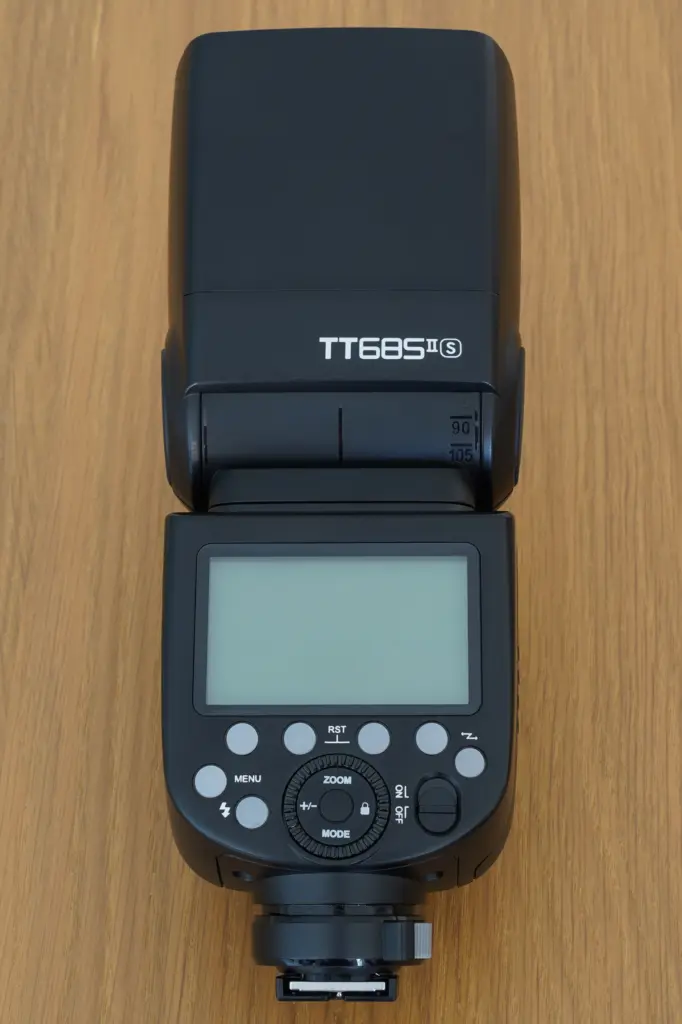
Godox TT685II: AA cells, same wireless system
Technically the older brother of the V860III, just with AA cells. According to retailer information, it has guide number 60, HSS up to 1/8000 second and X wireless on board. As a second or third flash in a kit that only occasionally sits on a stand, it is entirely sufficient.
Sony HVL-F60RM2: the original for Alpha cameras
Sony states guide number 60, a wireless range of about 30 meters and up to 15 controllable units in five groups. Its burst capability is remarkable: according to Sony, the flash can handle 200 firings at ten frames per second. It is powered by four AA cells and weighs around 439 grams without cells. The price is far above Godox. For sports photographers with a Sony body, that can pay off; for occasional users, hardly.
Godox X3: the trigger that holds everything together
Not a flash, but the remote control for it. According to Godox, the X3 weighs about 48 grams, has a touchscreen and controls groups A through F. Its built-in battery lasts about seven days in standby. If you use two flashes off-camera, you don’t strictly need it, because a V860III can also transmit itself. It is still more convenient.
Canon, Profoto, Nissin: what else is out there
Canon’s Speedlite EL-5 is built for the multi-function shoe of newer EOS R models and, according to Canon, has guide number 60 and a lithium battery. On some of its country websites, Canon already lists it as no longer available, and there is now a version 2. Whether, and in which version, it will remain available in Germany is unclear. We therefore have not included it in the table. If you buy it, check Canon’s compatibility list against your own camera first.
The Profoto A10 is a premium round-head flash with 76 Ws, built-in AirTTL wireless and Bluetooth for the Profoto app. According to the user guide, the radio reaches up to 300 meters for triggering and up to 100 meters for TTL. On Amazon.de, it is currently only patchily available new and not in all camera versions, which is why it is missing from the table. It remains interesting for owners of Profoto studio flashes. Nissin offers the i60A, a compact AA flash with its own wireless system; here too, availability fluctuates, and it does not communicate with Godox or Canon.
Which flash for which kind of photography?
- First flash, no matter which brand your camera is: Godox V860III in the right version. Fits any common mirrorless camera (in German) with a hot shoe.
- Weddings, parties, indoor portraits: Godox V1 Pro for its softer light and the add-on flash.
- Off-camera light with two units: a V860III or an X3 on the camera, plus a TT685II on a stand.
- Sony professionals shooting bursts: HVL-F60RM2, if the budget allows.
In the end, it is not the guide number that decides. It is the wireless system you commit to.
Frequently asked questions
What does a flash's guide number tell you?
Guide number divided by aperture gives the range in meters at ISO 100. With guide number 60, a flash therefore reaches 15 meters at f/4. Manufacturers usually measure at the 200 mm zoom setting, though. At wide angle, the value drops considerably; for the Canon EL-5 with its wide-angle diffuser for 14 mm, it falls to 14.
Does every speedlight fit every camera?
Not with full functionality. Every manufacturer uses its own TTL protocol, which is why third-party flashes come in versions identified by a letter: C for Canon, N for Nikon, S for Sony, F for Fujifilm, O for OM System and Panasonic. A V860III-C on a Sony camera will at best fire in manual mode.
Lithium battery or AA cells for a flash?
Lithium batteries recycle faster and last longer; according to Godox, the V860III manages around 480 full-power flashes. AA cells, as used by the Godox TT685II or the Sony HVL-F60RM2, are available everywhere, on the other hand. If you use flash regularly, choose lithium; for two family gatherings a year, AA cells are enough.
Why does a flash need wireless?
Light straight from the hot shoe looks flat. If the flash stands off to the side on a stand, a face gets shape and shadow. Wireless in the 2.4 GHz band works through softboxes and around corners, while optical methods need line of sight. The wireless systems from Godox, Canon, Sony and Profoto are not compatible with each other.
What is HSS in flash photography?
HSS stands for high-speed sync. Instead of a single burst of light, the flash emits a rapid series of pulses, so you can also use shutter speeds faster than about 1/200 to 1/250 second, for example 1/2000 second in sunshine with the aperture wide open. This costs a lot of power, so a strong battery pays off here.
Which flash for weddings and indoor portraits?
The Godox V1 Pro with its round head spreads light wider and softer than a rectangular reflector. The SU-1 add-on fills in toward the front while the main head points at the ceiling. The battery charges via USB-C directly in the flash. It is less suited to sports photography with long focal lengths.
Sources
- Godox: V860III, support and user manuals
- Godox: V1Pro, specifications
- Godox: X3, specifications
- Profoto: A10 AirTTL user guide
- Canon Europe: Speedlite EL-5, specifications
- Sony: HVL-F60RM2, specifications
Where to buy
- Godox V860III (V860III-S für Sony)Check price at Amazon.deCheck price at Amazon.co.ukCheck price at Amazon.nlCheck price at Amazon.com.beCheck price at Amazon.frCheck price at Amazon.itCheck price at Amazon.esCheck price at Amazon.plCheck price at Amazon.seAvailable in Germany: Amazon.de
- Godox V1 ProCheck price at Amazon.deCheck price at Amazon.co.ukCheck price at Amazon.nlCheck price at Amazon.com.beCheck price at Amazon.frCheck price at Amazon.itCheck price at Amazon.esCheck price at Amazon.plCheck price at Amazon.seAvailable in Germany: Amazon.de
- Godox TT685IICheck price at Amazon.deCheck price at Amazon.co.ukCheck price at Amazon.nlCheck price at Amazon.com.beCheck price at Amazon.frCheck price at Amazon.itCheck price at Amazon.esCheck price at Amazon.plCheck price at Amazon.seAvailable in Germany: Amazon.de
- Sony HVL-F60RM2Check price at Amazon.deCheck price at Amazon.co.ukCheck price at Amazon.nlCheck price at Amazon.com.beCheck price at Amazon.frCheck price at Amazon.itCheck price at Amazon.esCheck price at Amazon.plCheck price at Amazon.seAvailable in Germany: Amazon.de
- Godox X3 FunkauslöserCheck price at Amazon.deCheck price at Amazon.co.ukCheck price at Amazon.nlCheck price at Amazon.com.beCheck price at Amazon.frCheck price at Amazon.itCheck price at Amazon.esCheck price at Amazon.plCheck price at Amazon.seAvailable in Germany: Amazon.de
Still undecided?
Keep comparing at your own pace – every article in this category is checked monthly for new and discontinued models.