Contents14 sections
This guide was first published in German on handgetestet.de.
On a portable charger, the only permitted adapter is the one its manufacturer approves for exactly that device. That sounds strict, but it is what the manuals from NRGkick, go-e and Juice say. If you own an NRGkick 16A, the NRGkick Set 16A Standard (EU) is the simplest option, because it covers red, blue and Schuko (the standard German household outlet) and the charger detects each attachment on its own. For everyone else, the same principle applies with the original from your own brand.
Which charger suits you in the first place is covered in the guide to the charging cable for electric cars. Here, it is only about the piece between the charger and the outlet.
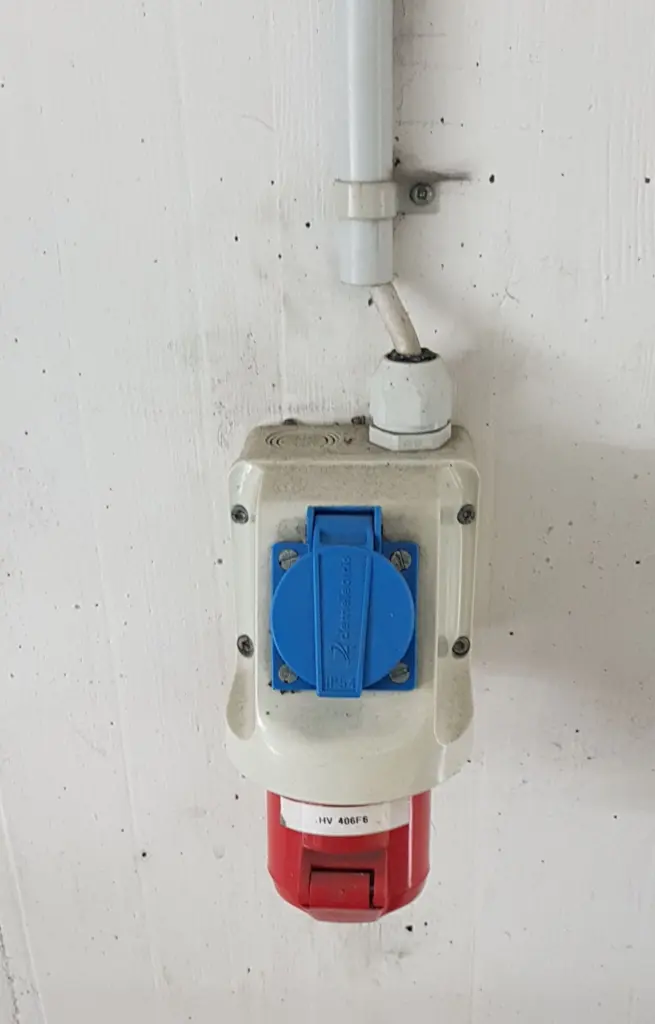
Red or blue: what is the difference?
The color indicates the voltage. Red CEE outlets carry three phases at 400 volts, blue ones a single phase at 230 volts. That results in the values cited by the ADAC, the German automobile club, and the manufacturers:
- Red 16 A: up to 11 kW
- Red 32 A: up to 22 kW
- Blue 16 A, the camping outlet: up to 3.7 kW
- Blue 32 A: up to 7.4 kW
- Schuko: 1.8 to 3 kW depending on the device
So red is not better; it is simply meant for a different grid. In the garage and on the farm, you will usually find red; at campsites, according to the ADAC, typically blue. There, ask the operator whether charging is allowed and how the outlet is protected. Our guide to motorhome accessories shows the right cables for the campsite, but only the charger’s own adapter belongs on the electric car.
Are CEE outlets suitable for continuous use? The ADAC describes red and blue as better protected and rated for continuous current. The Swiss industry association Electrosuisse is more cautious and writes that they, too, are not suitable for continuous operation. In practice, that means CEE is clearly better than Schuko but does not replace an inspection of the outlet.
How does the charger detect the adapter?
That depends on the system. NRGkick describes automatic detection that prevents the attachment’s maximum current from being exceeded. Juice calls it current detection: the adapter reports its rating, the charger adjusts, and the household plugs of the Celsius series additionally monitor the temperature. With go-e, the 22 kW charger automatically reduces the current to 16 amps with the original red 16 A adapter. Single-phase go-e adapters are set to 6 amps at the factory until you have checked the country setting in the app.
There is one thing this does not do. The detection knows the plug, but not the wiring and not the circuit breaker behind it. NRGkick therefore specifically points out that you should never set more than the supply line and plug connection can handle. If the circuit protection is unknown, both NRGkick and go-e say to use the lowest charging current.
Why not a homemade adapter?
Imagine a charger with a fixed red plug and, in front of it, an adapter piece to Schuko. The charger notices nothing. It keeps delivering the set current, in the worst case 16 amps for hours. The German Technical Guideline for charging infrastructure from DKE, the German standards body for electrical engineering, and its partners describes what can happen then: protective contact outlets can only handle the maximum current for a limited time, a hotspot forms at aged contacts and terminals, and the fire risk increases.
The reverse is no better. If a 32 A charger is connected to a red 16 A outlet via a makeshift adapter, the limit that the original adapter triggers is missing.
The manufacturers are correspondingly clear:
- Juice prohibits all other adapters and explicitly names third-party travel adapters.
- NRGkick only allows supplied or approved attachments and prohibits your own modifications.
- go-e requires original adapters. According to its warranty terms, the claim is void if a third-party special adapter is involved.
On top of that, the guideline advises against extension cords, power strips, cable reels and travel adapters for safety reasons. In Switzerland, the rules are even tighter: Electrosuisse states that standard travel adapters are not allowed there, and go-e prohibits its adapter cables in Switzerland altogether. So read the manual before traveling to a neighboring country.
And if there is only Schuko?
Then the adapter is an emergency solution. The ADAC advises charging at a household outlet only as an exception and at reduced power. go-e considers a maximum of 10 amps advisable, and the NRGkick Schuko attachment is rated for 13 amps. The weight of the charger must not hang on the outlet. If the outlet gets hot, go-e says to reduce the current; NRGkick requires it to be replaced. For continuous use, you are better off having a dedicated outlet installed. According to the NRGkick manual, charging is only intended on an installation that has been inspected by a qualified electrician. How to assess length and cross-section for other devices is explained in the article on the cable reel (in German). It has no place on the charger.
Seven solutions by charger and outlet
| Model | Fits | Outlet and power | Best for |
|---|---|---|---|
| NRGkick Set 16A Standard (EU) | NRGkick 16A and 32A | Red 16 A (11 kW), Blue 16 A (3.7 kW), Schuko 13 A (3 kW) | changing charging locations |
| NRGkick Steckeraufsatz 16A 3Pol | NRGkick 16A and 32A | Blue 16 A, up to 3.7 kW | Camping |
| NRGkick Steckeraufsatz Typ E+F Schuko 13A | NRGkick 16A and 32A | Schuko, up to 3 kW | Emergencies at friends‘ houses |
| go-e Adapterset Gemini flex 11 kW | Gemini flex and flex 2.0, 11 kW | Red 32 A (11 kW), Blue 16 A (3.7 kW), Schuko (2.3 kW at 10 A) | Owners of the 11 kW charger |
| go-e Adapterset Gemini flex 22 kW | Gemini flex and flex 2.0, 22 kW | Red 16 A, Blue 16 A, Schuko | Owners of the 22 kW charger |
| Juice Booster Adapter CEE16 blau | Juice Booster 3 air | Blue 16 A, up to 3.7 kW according to the Amazon listing | Camping with Juice |
| EVDANCE Mobile Wallbox 11 kW | its own charger, adapter depending on version | according to the seller, red 16 A, partly with a Schuko adapter | only after reviewing the documentation |
NRGkick Set 16A Standard (EU)
Three attachments in one package: red 16 A, blue 16 A and Schuko 13 A. Exactly the outlets you will come across on the road in Germany. Not included is the Type 2 attachment for charging stations, and for red 32 A you need the NRGkick 32A with its own attachment. Plug attachments have a protective cap that you should put back on after use; otherwise the protection rating no longer applies.
NRGkick Steckeraufsatz 16A 3Pol
The single attachment for the blue outlet, useful if you already own the red one and are heading to a campsite for the first time.
NRGkick Steckeraufsatz Typ E+F Schuko 13A
More expensive than the CEE attachments, even though it cannot deliver more than 3 kW. In France, Norway, Finland, Switzerland and Denmark, the manual prescribes lower current limits. There are separate country-specific attachments for that.
go-e Adapterset Gemini flex 11 kW
Three short adapter cables of around 30 centimeters with IP55 protection, made in Austria. You only need the set for outlets other than red 16 A, because that plug is already on the charger. Switzerland is off-limits, and in the United Kingdom, so is the household adapter.
go-e Adapterset Gemini flex 22 kW
The counterpart for the larger charger, just with red 16 A instead of red 32 A. Check the version before ordering; the two sets are not interchangeable.
Juice Booster Adapter CEE16 blau
One of more than 30 self-detecting adapters for the Booster. A wrong pick is possible: according to the manual, the device rejects the Type 2 adapter of the older Booster 2; the right one has a yellow dot on the connector.
EVDANCE Mobile Wallbox 11 kW
According to the seller, this charger has a fixed red plug and, depending on the version, a Schuko adapter. Whether it detects that adapter is not known to us, and for its single-phase Schuko devices the seller advertises 16 amps, which is well above the manufacturer recommendations above. That is why we do not recommend it. Review the manual and test marks before buying. For unknown brands, the ADAC advises checking the manufacturer and address on the rating plate as well as the declaration of conformity. If the current can be adjusted, it belongs far down on Schuko.
How to recognize the right adapter
- It comes from your charger’s manufacturer and is listed in its manual.
- After plugging in, the charger reports the correct maximum current.
- You know how the outlet is protected; otherwise you charge at the lowest current.
If one of the three points is missing, the adapter stays in the box. For a new permanent solution, the guide to buying a wallbox will help.
You can find the right charger in the guide to the portable wallbox.
Frequently asked questions
What is the difference between a red and a blue CEE outlet?
The color indicates the voltage. Red outlets carry three phases at 400 volts, up to 11 kW at 16 A. Blue outlets carry one phase at 230 volts; the 16 A camping outlet delivers up to 3.7 kW. Red is not better, it is simply meant for a different grid.
How does a portable charger detect the adapter?
NRGkick and Juice describe automatic detection: the adapter reports its rating and the charger adjusts to it. But the detection only knows the plug, not the wiring and the circuit breaker behind it. If the circuit protection is unknown, both NRGkick and go-e say to use the lowest charging current.
Why not use a homemade CEE adapter?
A charger with a fixed red plug does not notice an adapter piece to Schuko and keeps delivering the set current. According to the German Technical Guideline, a hotspot forms at aged contacts and the fire risk increases. Juice, NRGkick and go-e only allow original adapters; with go-e, the warranty is void otherwise.
How much power can you charge with at a Schuko outlet?
Only as an exception and at reduced power, advises the ADAC. go-e considers a maximum of 10 amps advisable, and the NRGkick Schuko attachment is rated for 13 amps. If the outlet gets hot, reduce the current; NRGkick requires it to be replaced. For continuous use, have a dedicated outlet installed.
Are CEE outlets suitable for continuous operation?
The ADAC describes red and blue as better protected and rated for continuous current. The Swiss industry association Electrosuisse is more cautious and does not consider them suitable for continuous operation either. CEE is therefore clearly better than Schuko but does not replace an inspection of the outlet.
How can you tell that an adapter is the right one?
It comes from the charger's manufacturer and is listed in its manual. After plugging in, the charger reports the correct maximum current. And you know how the outlet is protected; otherwise you charge at the lowest current. If one point is missing, the adapter stays in the box.
Sources
- ADAC: Portable wallboxes tested (07/04/2024)
- ADAC: Plug types and charging cables (08/07/2025)
- DKE and partners: Technical Guideline for Electric Mobility Charging Infrastructure, version 4.1 (PDF)
- Electrosuisse: Finding the right connection (PDF)
- NRGkick: Operating instructions (PDF)
- NRGkick: Plug attachments
- go-e: Gemini flex installation and operating instructions (PDF)
- go-e: Adapterset Gemini flex 22 kW
- go-e: Adapterset Gemini flex 11 kW
- Juice Technology: Juice Booster 3 air manual (PDF)
Where to buy
- NRGkick Set 16A Standard (EU)Check price at Amazon.deCheck price at Amazon.co.ukCheck price at Amazon.nlCheck price at Amazon.com.beCheck price at Amazon.frCheck price at Amazon.itCheck price at Amazon.esCheck price at Amazon.plCheck price at Amazon.seAvailable in Germany: Amazon.de
- NRGkick Steckeraufsatz 16A 3PolCheck price at Amazon.deCheck price at Amazon.co.ukCheck price at Amazon.nlCheck price at Amazon.com.beCheck price at Amazon.frCheck price at Amazon.itCheck price at Amazon.esCheck price at Amazon.plCheck price at Amazon.seAvailable in Germany: Amazon.de
- NRGkick Steckeraufsatz Typ E+F Schuko 13ACheck price at Amazon.deCheck price at Amazon.co.ukCheck price at Amazon.nlCheck price at Amazon.com.beCheck price at Amazon.frCheck price at Amazon.itCheck price at Amazon.esCheck price at Amazon.plCheck price at Amazon.seAvailable in Germany: Amazon.de
- go-e Adapterset Gemini flex 11 kWCheck price at Amazon.deCheck price at Amazon.co.ukCheck price at Amazon.nlCheck price at Amazon.com.beCheck price at Amazon.frCheck price at Amazon.itCheck price at Amazon.esCheck price at Amazon.plCheck price at Amazon.seAvailable in Germany: Amazon.de
- go-e Adapterset Gemini flex 22 kWCheck price at Amazon.deCheck price at Amazon.co.ukCheck price at Amazon.nlCheck price at Amazon.com.beCheck price at Amazon.frCheck price at Amazon.itCheck price at Amazon.esCheck price at Amazon.plCheck price at Amazon.seAvailable in Germany: Amazon.de
- Juice Booster Adapter CEE16 blauCheck price at Amazon.deCheck price at Amazon.co.ukCheck price at Amazon.nlCheck price at Amazon.com.beCheck price at Amazon.frCheck price at Amazon.itCheck price at Amazon.esCheck price at Amazon.plCheck price at Amazon.seAvailable in Germany: Amazon.de
- EVDANCE Mobile Wallbox 11 kWView at EVDANCEAvailable in Germany: EVDANCE