Contents11 sections
This guide was first published in German on handgetestet.de.
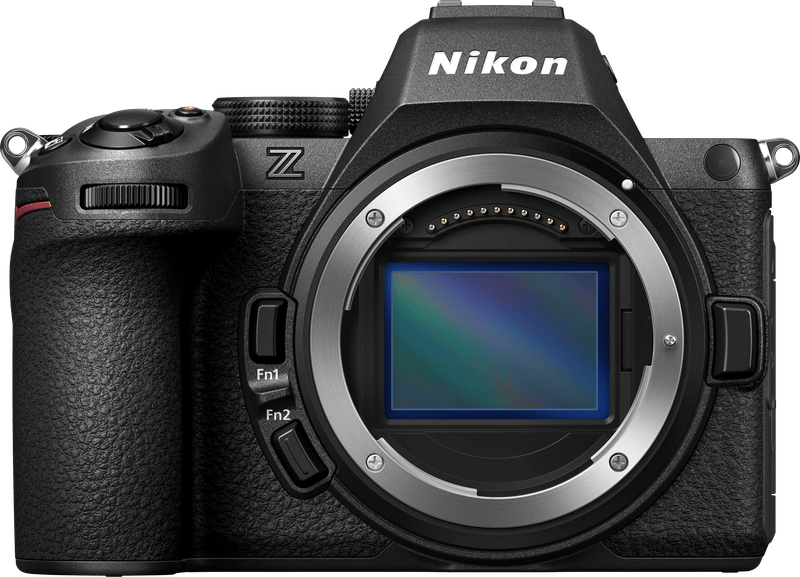
Many people move to full frame because they want better image quality in low light, and then buy the most expensive camera their budget allows. For photos with occasional video, a solid entry-level body is enough; the money belongs in a good lens. We recommend the Nikon Z5II to most upgraders: sensor-shift stabilization, two card slots, autofocus down to −10 EV. If you need to save, the older Nikon Z5 gives you the same sensor size at a considerably lower price.
This guide is aimed at photographers moving up from APS-C or a smartphone who are looking for an entry-level or mid-range body. The top models for photo and video, such as the Canon EOS R6 Mark III or the Sony Alpha 7 V, are covered in our mirrorless camera guide (in German).
Mount first, then body
You rarely keep a camera body longer than five or six years. Lenses often stay twice as long. If you buy a Nikon today, you commit to the Z mount; with Canon, to RF. Both systems are large enough that you won’t miss anything. Still, it is worth looking at which focal lengths you really need and what they cost. Our guides to Nikon Z lenses (in German) and Canon RF lenses (in German) will help.
A third full-frame system is the L-Mount from Panasonic, Sigma and Leica. We use it ourselves: the Lumix S5IIX impressed us in our hands-on review with its image quality, even in low light, and in our hands-on check, the Sigma 35mm F1,4 DG HSM Art ran on the Lumix S1.
Our editorial rule of thumb: budget at least a third of your camera budget for your first fast lens. A full-frame sensor reveals every weakness of cheap optics. A 50 mm prime with an f/1.8 aperture often does more for portraits and evening shots than stepping up to the next body.
Four points that matter on the spec sheet
Megapixels are no longer a differentiator in this class. All six cameras below are between 24.2 and 24.5 million pixels. That is enough for A3 prints and for cropping. Other figures are more interesting.
- In-body stabilization: It keeps even old or unstabilized primes steady. All models except the Canon EOS R8 have it.
- Two card slots: If you shoot weddings or paid assignments, you write every image twice. A faulty card then won’t cost you any shots.
- Battery life: For the R8, Canon specifies around 220 shots with the viewfinder according to the CIPA standard. A spare battery is a necessity there, not an accessory.
- Video: 4K at 60 frames per second is now standard. Whether the camera crops the frame to do so is in the fine print.
A word on memory cards. The Nikon Z6III accepts CFexpress Type B in addition to SD; the other models work with UHS-II SD cards, and the Z f also with microSD. Which card suits your camera is explained in our memory card guide (in German).
Six full-frame cameras side by side
| Model | In-body stabilization | Card slots | Weight with battery and card | Best for |
|---|---|---|---|---|
| Nikon Z5 | Yes, 5-axis | 2 × SD | approx. 675 g | Entry on a small budget |
| Nikon Z5II | Yes, up to 7.5 stops | 2 × SD | approx. 700 g | Upgraders, travel, family |
| Canon EOS R8 | No | 1 × SD | approx. 461 g | Traveling light, Canon lenses |
| Nikon Z f with NIKKOR Z 40 mm f/2 | Yes, up to 8 stops | SD and microSD | approx. 710 g | Fans of classic controls |
| Nikon Z6III | Yes, 5-axis | CFexpress/XQD and SD | approx. 760 g | Sports, wildlife, video |
| Canon EOS R6 Mark II | Yes, up to 8 stops | 2 × SD | approx. 670 g | Weddings, events, Canon upgraders |
The stop ratings come from the manufacturers and apply under CIPA test conditions: for Nikon at the center of the frame, for Canon with a specific stabilized lens. At the edge of the frame and with other lenses, the effect is smaller.
Nikon Z5: the affordable entry point
The Z5 is the predecessor of the Z5II, but Nikon still sells it new. According to Nikon, it has 24.3 megapixels, 5-axis stabilization and two SD slots. Its limits show in speed and video: around 4.5 frames per second, 4K only up to 30p, autofocus down to −3 EV. That is enough for landscape, architecture and portraits. For children and dogs playing in the yard, less so.
Nikon Z5II: the camera for most upgraders
Compared with the Z5, Nikon has stepped up almost everywhere. The manufacturer specifies up to 7.5 stops of stabilization at the center of the frame, autofocus down to −10 EV and up to 30 frames per second with pre-release capture. The monitor now swivels and tilts, and 4K runs at up to 60p, though with a crop at that rate. Nikon does not include a charger. For travel, family and evening light, it is our first choice because it has hardly any weaknesses you would notice in everyday use.
Canon EOS R8: light, but with compromises
At 461 grams including battery and card, the R8 is the lightest camera in this comparison. With the electronic shutter, it manages up to 40 frames per second. In return, it lacks in-body stabilization and a second card slot, and the battery is small. Canon now already lists an EOS R8 Mark II. The original R8 is therefore mainly interesting when the price gap is large.
Nikon Z f: dials instead of menus
The Z f looks like a film camera from the eighties but, according to Nikon, has stabilization of up to 8 stops and a dedicated black-and-white switch. You set the shutter speed on its own dial. The second card slot accepts only microSD, which is enough for dual recording but awkward. The kit includes the compact 40 mm lens with an f/2 aperture. Part of what you are buying here is a feeling. If you like to shoot deliberately, you won’t regret it.
Nikon Z6III: fast and strong for video
The partially stacked sensor reads out faster than a conventional one. Nikon specifies up to 120 frames per second and pre-release capture that saves images up to one second before the shutter button is fully pressed. The viewfinder has 5.76 million dots and, according to Nikon, up to 4,000 cd/m² brightness, and 6K RAW video can be recorded internally. For bird and sports photography, the extra cost pays off. For vacation photos, it doesn’t.
Canon EOS R6 Mark II: rugged for long days
For the R6 Mark II, Canon specifies up to 8 stops of stabilization, two SD slots and up to 12 frames per second with the mechanical shutter, 40 with the electronic one. Using the monitor, the battery lasts around 760 shots in power-saving mode according to Canon, considerably more than the R8. Its successor, the R6 Mark III, has been available since late 2025. The Mark II remains a solid choice for weddings and events as long as it is considerably cheaper in stores.
Which camera suits which photographer
You shoot while traveling, in everyday family life and like to shoot in the evening? Get the Nikon Z5II. It is the most balanced body in this comparison and leaves room in the budget for a good lens.
Tight budget, mostly static subjects: the Nikon Z5 is enough. Don’t pocket the difference to the Z5II; put it into a fast prime instead.
Weight is everything, for example when hiking? Then the Canon EOS R8, with a spare battery in your bag. Moving subjects, wildlife, sports or serious video point to the Nikon Z6III. If you already own Canon lenses and photograph events, the EOS R6 Mark II will serve you well. And the Z f? You buy it because you enjoy handling it. That is a legitimate reason.
One more tip when buying: check whether the offer includes a charger. According to Nikon, the Z5II does not come with one.
Frequently asked questions
Which full-frame camera is good for beginners?
The Nikon Z5II has hardly any weaknesses you would notice in everyday use: up to 7.5 stops of stabilization, an articulating monitor, 4K at up to 60p. For landscape, architecture and portraits, the older Z5 is also enough, but less so for children and dogs at play.
Body or lens, where should the money go?
Into the lens. You rarely keep a camera body longer than five or six years, while lenses often last twice as long. Budget at least a third of your camera budget for your first fast lens, because a full-frame sensor reveals every weakness of cheap optics.
Do you need two card slots?
If you shoot weddings or paid assignments, you write every image twice, so a faulty card won't cost you any shots. For vacations and family, it is not a must. The Canon EOS R8 has only one slot, and the Nikon Z f accepts only microSD in its second slot.
Is the lightweight Canon EOS R8 worth it?
At 461 grams, it is the lightest camera in this comparison. In return, it lacks in-body stabilization and a second card slot, and Canon rates it at only around 220 shots with the viewfinder according to CIPA. A spare battery is a must. It is mainly interesting when the price gap is large.
Which full-frame camera for sports and wildlife?
The Nikon Z6III. Its partially stacked sensor reads out faster; Nikon specifies up to 120 frames per second and pre-release capture up to one second before the shutter is pressed. 6K RAW video can be recorded internally. For vacation photos, the extra cost is not worth it.
Sources
- Nikon: Z5II specifications (online manual)
- Nikon: Z5II, product page
- Nikon Germany: Z5II body, contents of the box
- Nikon: Specifications Z 5 (online manual)
- Nikon Germany: Z 5
- Nikon: Z6III specifications (online manual)
- Nikon: Z6III, product page
- Nikon: Z f, product page
- Canon: EOS R8 specifications (user manual)
- Canon: EOS R8 Mark II support
- Canon: EOS R6 Mark II specifications (user manual)
- Canon Camera Museum: EOS R6 Mark II
Where to buy
- Nikon Z5IIView at CoolblueAvailable in Germany: Coolblue
- Nikon Z5View at CoolblueAvailable in Germany: Coolblue
- Canon EOS R8View at CoolblueAvailable in Germany: Coolblue
- Nikon Z f mit NIKKOR Z 40 mm f/2View at CoolblueAvailable in Germany: Coolblue
- Nikon Z6IIIView at CoolblueAvailable in Germany: Coolblue
- Canon EOS R6 Mark IIView at CoolblueAvailable in Germany: Coolblue