Contents13 sections
This guide was first published in German on handgetestet.de.
A purely electric unit in a bathroom that has long been connected to central heating: with heated towel radiators, that is the purchase people are most likely to regret. With a hot water heating system, a water-filled model usually makes more sense, with a retrofitted heating element for spring and fall if needed. Purely electric, on the other hand, makes sense where there is no heating pipe: in the guest toilet, in a converted attic bathroom, in a rented apartment with an old finned radiator.
Before you compare models, four questions should be settled. They carry more weight than color and shape.
First, figure out where the heat comes from
The first concerns the energy source: hot water, electric or both. Kermi distinguishes between purely electric operation without a heating circuit and „supplementary electric,“ in which the radiator stays on the heating circuit and additionally gets an electric kit. At Zehnder, this hybrid is called mixed mode.
Second, the connection layout. Center connection, side connection or from below on both sides? If the layout does not match the existing pipes, a simple swap quickly turns into a construction site.
Third, the flow temperature. With a heat pump or condensing boiler, considerably cooler water often flows through the radiators, and then the output rating at low temperatures is what counts, not the standard value. That leaves, fourth, the controls. With electric units, the heating element determines comfort and consumption. A simple plug-in element heats until someone switches it off.
How many watts a bathroom needs, and what the data sheet says
Bathrooms are heated warmer than living spaces. For 24 degrees Celsius, the German nonprofit energy advisory co2online gives a guideline of around 95 watts per square meter in buildings from 1995 onward, 116 watts for buildings from 1983 to 1994 and 142 watts for older houses. A six-square-meter bathroom from 1990 would therefore come to just under 700 watts. That is a rule of thumb. For new builds or renovations, a heat load calculation by a qualified contractor is part of the job.
The real stumbling block is in the data sheet. For the largest Toga, Zehnder lists 1796 watts at the standard rating of 75/65/20 °C, but only 913 watts at 55/45/20 °C. Almost half is missing, then, as soon as the heating runs cooler. If you have a heat pump, calculate with the lower figure and plan the radiator one size larger. Many people now control the rest of the house with smart radiator thermostats (in German); in the bathroom, that works on the hot water valve just the same.
Electricity in the bathroom belongs in professional hands
For electrical equipment in rooms with a bathtub or shower, the German standard DIN VDE 0100-701 and its protection zones apply. Zehnder sums it up in its price list as follows: in zones 0 and 1, meaning in and directly at the bathtub or shower, no radiators with a heating element may be installed or connected. In zone 2 it is permitted if the heating element and connection have at least IPX4 protection. If the unit is plugged in, the outlet must be outside zones 0, 1 and 2. Kermi additionally requires an on-site residual current device with a tripping current of no more than 30 mA.
A new junction box or hardwiring is not a DIY job. Under Section 13 of the German Low Voltage Connection Ordinance (NAV), work on the electrical installation behind the house connection may only be carried out by the grid operator or a registered installation company. You can mount the radiator on the wall yourself; the electrician handles the power.
Mixed mode: the heating element in a hot water radiator
A heating element in a water-filled radiator sounds simple, but there are rules. Heating element manufacturer Bemm writes in its instructions that the radiator must remain connected on the water side to the system’s expansion vessel, even in electric mode. The valves in the return line should only be closable with a tool, so that no one shuts them off by accident and excess pressure builds up. And: if the heating system is running or the radiator valve is open, the heat from the element travels into the pipe network instead of the towel.
The element’s output must match the radiator size. According to Bemm, an element that is too powerful can damage both the element and the radiator through overheating and excess pressure. Manufacturers such as Zehnder therefore assign a fixed heating element size to each model. For spring and fall, mixed mode is a sensible solution. As the main heating source in winter, electricity is the more expensive choice.
Six heated towel radiators, properly classified
Schulte Turin: the uncomplicated swap
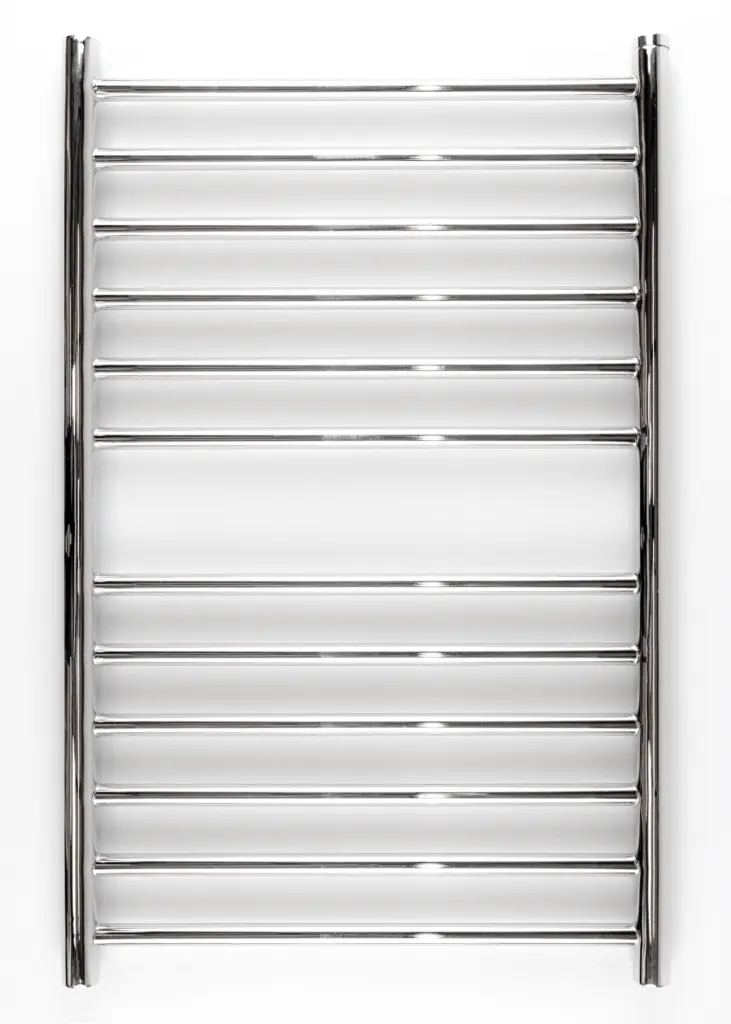
The water-filled Turin comes with a center connection and connections from below on both sides, which makes it easier to swap for an old bathroom radiator. According to the listing, electric operation is possible with an optional heating element. In bathrooms with central heating, this is usually the most sensible route, because the base heat comes cheaply from the heating system.
Zehnder Toga: plenty of choice, clear data sheets
Zehnder offers the Toga for hot water and for mixed mode, in heights from 716 to 1760 millimeters and many colors. Zehnder assigns each model the matching heating element size, from 200 to 1200 watts. That takes the guesswork out of mixed mode. In terms of price, the Toga sits above the home improvement store models.
Arbonia Duolino: built for cool heating water
The Duolino has double crossbars and, according to Arbonia, is suitable for low-temperature applications. That makes it interesting for houses with a heat pump. Supplementary electric operation is optional, and there is also a purely electric version called Duolino Watt. With a depth of 74 millimeters, it sits a little farther out from the wall.
Schulte Turin electric with Heizstab 1
Filled at the factory with a glycol-water mixture and supplied with a heating element, plug-and-play according to Schulte. In the 114 x 60.5 cm size, Schulte specifies 449 watts; the manufacturer currently lists the 170 cm tall version with 600 watts as unavailable. Schulte does not mention a timer for this element. For the six-square-meter bathroom from our calculation above, 449 watts alone are therefore not enough. Warm towels, yes. A cold bathroom in January, hardly.
Schulte Turbo electric with Heizstab 5
The Heizstab 5 comes with a remote control, and Schulte lists the 113.5 x 60 cm version with 600 watts as available. According to the listing, it offers a weekly timer, frost protection and comfort and eco modes. If you want a warm bathroom at six in the morning without leaving the element running all night, this is exactly the timer you need.
ECD Germany electric 400 x 1800
Considerably cheaper than the brand-name models, with a 1200-watt heating element and side connection. Whether the unit comes pre-filled from the factory and which timer functions the element has is not clear from the listing details; you should clarify that with the retailer before ordering. For a guest toilet without heating, a pragmatic choice, nothing more.
Which radiator for which bathroom?
- Bathroom with central heating: Schulte Turin as a hot water model, heating element later if needed.
- Heat pump in the house: Arbonia Duolino or a generously sized Zehnder Toga, calculated with the output at 55/45 °C.
- No heating connection, fixed bathroom times: Schulte Turbo with Heizstab 5 because of the weekly timer.
- Guest toilet, small budget: ECD Germany electric, clarify the controls beforehand.
- Whole room to be heated electrically: A towel radiator is often too weak for that. A better fit then is an infrared heater or fan heater or an oil-filled radiator.
For every one of these models: the power connection in the bathroom is installed by a registered electrical contractor.
Which protection rating applies where and what heated mirrors can do is covered in the guide to infrared heating in the bathroom.
Protection zones, RCD protection and mounting height are covered in the guide to fan heaters for the bathroom.
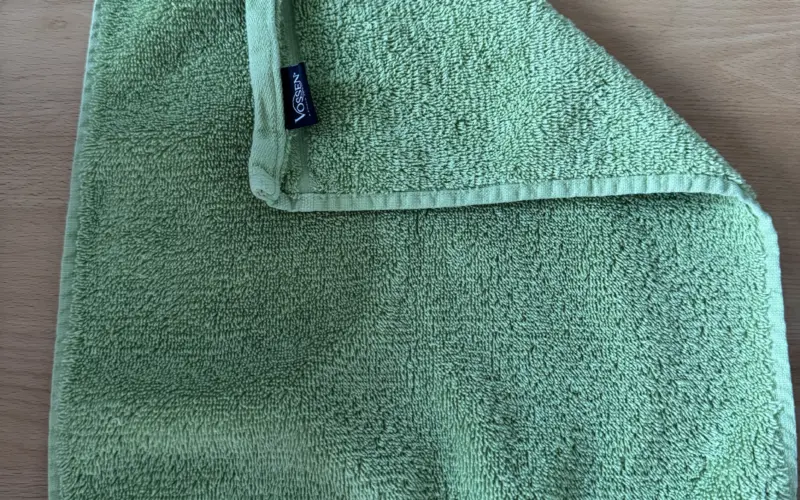
Which towels have been hanging on our radiator for years is shown in the long-term test of Vossen and Ross.
Frequently asked questions
How many watts does a towel radiator need for a bathroom?
For 24 degrees Celsius, co2online gives around 95 watts per square meter in buildings from 1995 onward, 116 watts for buildings from 1983 to 1994 and 142 watts for older houses. A six-square-meter bathroom from 1990 would come to just under 700 watts. For new builds or renovations, a heat load calculation by a qualified contractor is part of the job.
Which towel radiator works with a heat pump?
With a heat pump, cooler water flows through the radiators, so the output at low temperatures is what counts. For the largest Zehnder Toga, it drops from 1796 watts at 75/65/20 °C to 913 watts at 55/45/20 °C. Options are the Arbonia Duolino for low-temperature systems or a generously sized Toga.
Can I connect an electric towel radiator myself?
You can mount the radiator on the wall yourself; the electrician handles the power. Under Section 13 of the German Low Voltage Connection Ordinance (NAV), work on the installation behind the house connection may only be carried out by the grid operator or a registered installation company. In protection zones 0 and 1 at the bathtub or shower, radiators with a heating element are not permitted.
What do I need to consider with mixed mode and a heating element?
According to heating element manufacturer Bemm, the radiator must remain connected to the system's expansion vessel even in electric mode. The element's output must match the radiator size; an element that is too powerful can cause damage through overheating and excess pressure. For spring and fall, mixed mode is sensible; as the main heating source in winter, electricity is more expensive.
Is an electric towel radiator enough to heat the bathroom?
Often not. The electric Schulte Turin with 449 watts is not enough on its own for a six-square-meter bathroom: warm towels, yes; a cold bathroom in January, hardly. If the whole room is to be heated electrically, an infrared heater, a fan heater or an oil-filled radiator is a better fit.
Why does a timer matter for the heating element?
With electric units, the heating element determines comfort and consumption. A simple plug-in element heats until someone switches it off. According to the listing, the Heizstab 5 on the Schulte Turbo offers a weekly timer, frost protection and comfort and eco modes, so the bathroom is warm in the morning without the element running all night.
Sources
- co2online: Calculating radiators (guideline values W/m²)
- Zehnder: Bathroom radiator price list, protection zones under VDE 0100-701
- Zehnder Toga hot water operation
- Zehnder Toga product data sheet
- Kermi: Electric solutions for bathroom and designer radiators
- Kermi price list Credo Half round (II/2025), note on VDE 0100-701 and RCD protection
- Bemm: Installation and operating instructions for electric heating element
- German Low Voltage Connection Ordinance (NAV), Section 13
- Arbonia Duolino
- Schulte Turin with center connection
- Schulte Turin with Heizstab 1
- Schulte Turbo with Heizstab 5
Where to buy
- Schulte TurinCheck price at Amazon.deCheck price at Amazon.co.ukCheck price at Amazon.nlCheck price at Amazon.com.beCheck price at Amazon.frCheck price at Amazon.itCheck price at Amazon.esCheck price at Amazon.plCheck price at Amazon.seAvailable in Germany: Amazon.de
- ECD Germany Badheizkörper elektrisch 400 x 1800 mm 1200 WCheck price at Amazon.deCheck price at Amazon.co.ukCheck price at Amazon.nlCheck price at Amazon.com.beCheck price at Amazon.frCheck price at Amazon.itCheck price at Amazon.esCheck price at Amazon.plCheck price at Amazon.seAvailable in Germany: Amazon.de
- Zehnder TogaCheck price at Amazon.deCheck price at Amazon.co.ukCheck price at Amazon.nlCheck price at Amazon.com.beCheck price at Amazon.frCheck price at Amazon.itCheck price at Amazon.esCheck price at Amazon.plCheck price at Amazon.seAvailable in Germany: Amazon.de
- Arbonia DuolinoCheck price at Amazon.deCheck price at Amazon.co.ukCheck price at Amazon.nlCheck price at Amazon.com.beCheck price at Amazon.frCheck price at Amazon.itCheck price at Amazon.esCheck price at Amazon.plCheck price at Amazon.seAvailable in Germany: Amazon.de
- Schulte Turin elektrisch mit Heizstab 1Check price at Amazon.deCheck price at Amazon.co.ukCheck price at Amazon.nlCheck price at Amazon.com.beCheck price at Amazon.frCheck price at Amazon.itCheck price at Amazon.esCheck price at Amazon.plCheck price at Amazon.seAvailable in Germany: Amazon.de
- Schulte Turbo elektrisch mit Heizstab 5Check price at Amazon.deCheck price at Amazon.co.ukCheck price at Amazon.nlCheck price at Amazon.com.beCheck price at Amazon.frCheck price at Amazon.itCheck price at Amazon.esCheck price at Amazon.plCheck price at Amazon.seAvailable in Germany: Amazon.de
Still undecided?
Keep comparing at your own pace – every article in this category is checked monthly for new and discontinued models.