Contents12 sections
This guide was first published in German on handgetestet.de.
When people buy a Japanese saw for the first time, they often reach for the finest teeth they can find. For a joint in beech, that is the right call; for a spruce roof batten, it is a test of patience. For getting started, we therefore recommend a ryoba with two rows of teeth, such as the Kirschen Feinschnittsäge 4420240 (fine-cut saw): one side for cuts across the grain, the other for cuts along it. A backsaw and a kataba come later, once it is clear what work your workshop really involves.
The reason lies in the design. A Japanese saw cuts on the pull stroke. The blade is put under tension instead of compression, so it can be much thinner than on a European push saw. A thin blade means a narrow kerf, less effort and a cleaner edge. But it also means that if you push hard, you risk bending the blade.
Ryoba, dozuki, kataba: which type for which cut?
The ryoba has teeth on both edges. The coarser side is meant for rip cuts, the finer side for crosscuts. Because there is no back in the way, it can also cut deeper than the blade width, for example when ripping a strip. For DIYers who cut a tenon one day and shorten a shelf board the next, it is the most versatile type.
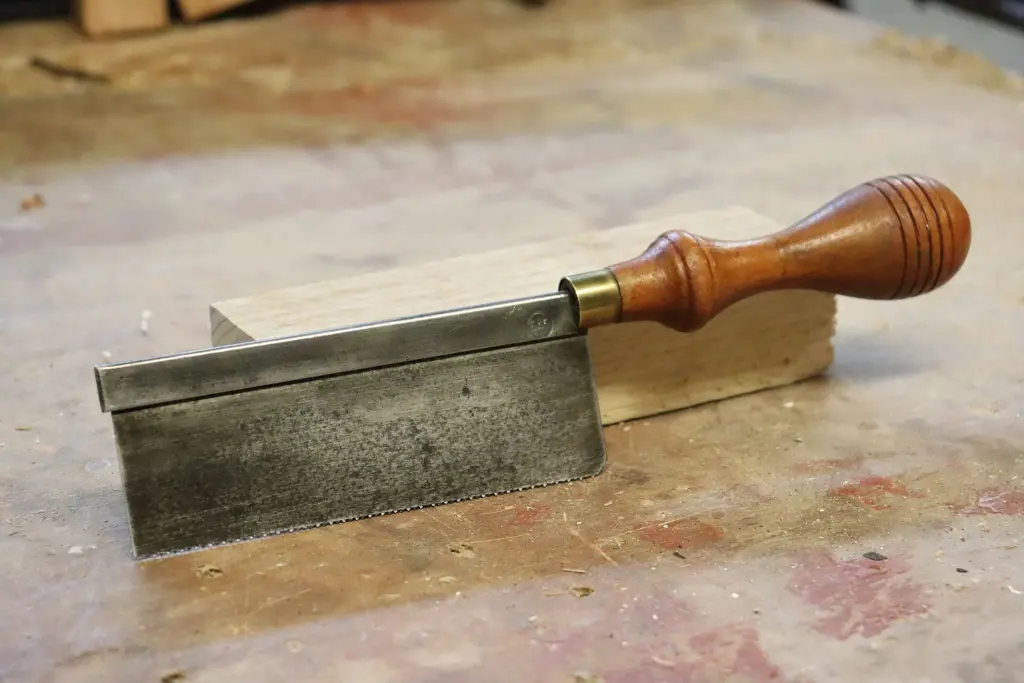
The dozuki has a metal back that keeps the wafer-thin blade stiff. That makes dovetails, miters and tenon shoulders very precise. The back does, however, limit the cutting depth. For the Gyokucho dozuki, the manufacturer gives 35 millimeters of material thickness as the upper limit.
The kataba sits in between. It has only one row of teeth, but no continuous back. That makes it the choice for deep crosscuts, such as cutting square timbers to length, and for flush cuts where a second row of teeth would scratch the surface.
Understanding tooth pitch: TPI, millimeters and the Japanese way of counting
European manufacturers usually state tooth pitch in TPI, meaning teeth per inch. Japanese manufacturers give the distance from tooth tip to tooth tip in millimeters. Converting is easy: 25.4 divided by the pitch in millimeters gives you the TPI. A pitch of 1.7 mm therefore corresponds to about 15 TPI, and a pitch of 1.0 mm to about 25 TPI. Silky, in turn, counts teeth per 30 millimeters.
Our rule of thumb: under 10 TPI for rip cuts and soft construction lumber, 15 to 20 TPI for clean crosscuts in furniture wood, over 20 TPI for fine joints and thin workpieces. The finer the teeth, the smoother the edge and the longer the cut takes. In 40-millimeter oak, you will notice that clearly.
Blade thickness matters at least as much. It determines how wide the kerf is and how delicate the blade is. In our selection, the range runs from 0.3 mm on the Gyokucho dozuki to 0.6 mm on the Bosch. And the replacement blade? All six saws here have interchangeable blades, and on the Kirschen, Silky and Bosch models the teeth are hardened according to the manufacturers. Before you buy, check whether the matching blade is available under its own part number. Otherwise, a dull saw turns into a new purchase.
Six Japanese saws and their key specs
| Model | Type, blade length | Tooth pitch according to the manufacturer | Blade thickness, replacement blade | Best for |
|---|---|---|---|---|
| Kirschen Feinschnittsäge 4420240 | Ryoba, 240 mm | 17 and 9 TPI | not specified, replacement blade 4321240 | Getting started, furniture making and interior work |
| Gyokucho Blue Hard 650 | Ryoba, 240 mm | Pitch 1.7 mm (about 15 TPI) | 0.5 mm, replacement blade S-650 | dry furniture wood, tenons and mortises |
| Silky Hibiki Ryoba 210 | Ryoba, 210 mm | 22 and 10 teeth per 30 mm | Kerf 0.95 mm, replacement blades available | Hardwood, fine joinery |
| Gyokucho Razorsaw Dozuki 370 | Dozuki, 240 mm | Pitch 1.0 mm (about 25 TPI) | 0.3 mm, replacement blade S-370 | Dovetails, miters |
| Bosch Japansäge Kataba 270 mm | Kataba, 270 mm | 17 TPI | 0.6 mm, replacement blade 1600A02ZB8 | Cutting to length, flush cuts |
| Kirschen Mini-Feinschnittsäge 4430185 | Fine-cut saw, 185 mm | 20 TPI | not specified, blade interchangeable | Sawing off dowels and tenons flush |
Kirschen Feinschnittsäge 4420240
Kirschen makes its pull saws according to a Japanese quality process. The 4420240 is a ryoba with a 240 mm blade, 17 TPI on the fine side and 9 TPI on the coarse side. According to the manufacturer, the tooth tips are induction-hardened and the material has 61 HRC. The blade sits in a quick-change system, and the replacement is available as 4321240. There is no information on blade thickness. For a first purchase, it is our pick, because both tooth patterns are practical for everyday use and Kirschen lists the replacement blade as a separate item.
Gyokucho Blue Hard 650
Gyokucho is based in Miki in Hyogo Prefecture and sells its saws under the name Razorsaw. For the Blue Hard 650, the manufacturer states a 240 mm blade length, 0.5 mm blade thickness, 1.7 mm pitch and a 0.83 mm kerf. Gyokucho lists it as a saw for interior finishing and dry wood, and the blade angle is adjustable. For fine work, there is the 651 with a 1.3 mm pitch and a 0.45 mm blade.
Silky Hibiki Ryoba 210
Besides pruning saws, Silky also makes workshop saws. According to the manufacturer, the Hibiki was developed for fine joinery. Silky Europe states a 210 mm blade length, 22 and 10 teeth per 30 mm, which works out to about 19 and 8.5 TPI, and a kerf of 0.95 mm. The teeth are unset and impulse-hardened, and the saw is designed for hardwood. At 210 mm, it is shorter than the other ryobas. On wide boards, that means more strokes.
Gyokucho Razorsaw Dozuki 370
None of the six saws is finer than the 370: 0.3 mm blade, 1.0 mm pitch. According to Gyokucho, the kerf measures just 0.46 mm. Workpieces up to 35 mm thick can be cut cleanly with it; beyond that, the back bottoms out. For rip cuts in very hard wood, Gyokucho offers the 372 with a 1.3 mm pitch. The dozuki is no good as your only saw for cutting to length, but it works well as a second saw alongside a ryoba.
Bosch Japansäge Kataba 270 mm
Bosch relies on SK5 steel, 17 TPI and triple-ground teeth with 61 to 68 HRC. The blade is 0.6 mm thick and 270 mm long, and a short back support is meant to guide it during cross and diagonal cuts. It is changed with a hex key, and the replacement carries the number 1600A02ZB8. If you shorten baseboards and square timbers, you will find the longest blade of the six here. For fine joints, the blade is on the thick side.
Kirschen Mini-Feinschnittsäge 4430185
Small but useful. Kirschen names protruding dowels and tenons that need to be sawn off flush as its application. The 185 mm blade has 20 TPI, is flexible and interchangeable. A tooth guard is included. It is too short to be your main saw. As an addition for furniture making, on the other hand, it is very practical.
Care and storage
Kirschen recommends regularly protecting the blade against rust with a light film of oil. Silky advises keeping the blade clean, noting that resin can be dissolved with olive oil. Hang the saw up or fit the included tooth guard. A 0.3 mm blade has no business lying loose in a toolbox. Clamp the workpiece firmly, on a sturdy workbench (in German) and with suitable clamps (in German).
How we would decide
- One saw for almost everything in everyday DIY: the Kirschen Feinschnittsäge 4420240 as a ryoba.
- Furniture making with a thin blade and narrow kerf: Gyokucho Blue Hard 650, or the finer 651 if you work with a lot of hardwood.
- Lots of oak, ash or walnut: Silky Hibiki, if a 210 mm blade length is enough.
- Dovetails and miters: Gyokucho Dozuki 370 as a second saw.
- Cutting strips and square timbers to length: Bosch Kataba 270 mm.
- Sawing off dowels flush: Kirschen Mini-Feinschnittsäge 4430185.
None of these saws can handle curved contours. For that, a jigsaw (in German) is the right tool.
Frequently asked questions
What is the difference between a ryoba, dozuki and kataba?
The ryoba has teeth on both edges, coarse for rip cuts and fine for crosscuts. The dozuki has a metal back that keeps the thin blade stiff but limits the cutting depth. The kataba has only one row of teeth without a continuous back and is suited to deep crosscuts and flush cuts.
Which tooth pitch do I need for which wood?
As a rule of thumb: under 10 TPI for rip cuts and soft construction lumber, 15 to 20 TPI for clean crosscuts in furniture wood and over 20 TPI for fine joints. The finer the teeth, the smoother the edge, but the longer the cut takes.
How do you convert the Japanese tooth pitch into TPI?
Japanese manufacturers give the distance from tooth tip to tooth tip in millimeters. 25.4 divided by this pitch gives you the TPI. A pitch of 1.7 mm corresponds to about 15 TPI, and a pitch of 1.0 mm to about 25 TPI. Silky, on the other hand, counts teeth per 30 millimeters.
Why does a Japanese saw cut on the pull stroke?
On the pull stroke, the blade is put under tension instead of compression, so it can be much thinner than on a European push saw. That gives you a narrow kerf, less effort and a cleaner edge. If you push hard, though, you risk bending the blade.
How deep does a dozuki cut?
The metal back limits the cutting depth. For the Gyokucho Razorsaw Dozuki 370, the manufacturer gives 35 millimeters of material thickness as the upper limit; beyond that, the back bottoms out. That is why it is no good as your only saw for cutting to length, but it works well as a second saw alongside a ryoba.
How do you care for and store a Japanese saw?
Kirschen recommends a light film of oil against rust, and Silky advises dissolving resin with olive oil. The saw should be hung up or stored with its tooth guard on, not loose in the toolbox. Before buying, check whether the matching replacement blade is available under its own part number.
Sources
- Kirschen: Feinschnittsäge with cork handle, 240 mm
- Kirschen: Mini-Feinschnittsäge with cork handle, 185 mm
- Kirschen: Replacement saw blades
- Gyokucho: Razorsaw Seiun Blue Hard (data table, in Japanese)
- Gyokucho: Razorsaw Dozuki (data table, in Japanese)
- Silky Europe: Hibiki Ryoba 210-22/10
- Bosch: Japansäge Kataba 270 mm
- Bosch: Kataba/Dozuki replacement blade, 270 mm
Where to buy
- Kirschen Feinschnittsäge Ryoba 4420240Check price at Amazon.deCheck price at Amazon.co.ukCheck price at Amazon.nlCheck price at Amazon.com.beCheck price at Amazon.frCheck price at Amazon.itCheck price at Amazon.esCheck price at Amazon.plCheck price at Amazon.seAvailable in Germany: Amazon.de
- Gyokucho Blue Hard 650 Ryoba 240Check price at Amazon.deCheck price at Amazon.co.ukCheck price at Amazon.nlCheck price at Amazon.com.beCheck price at Amazon.frCheck price at Amazon.itCheck price at Amazon.esCheck price at Amazon.plCheck price at Amazon.seAvailable in Germany: Amazon.de
- Silky Hibiki Ryoba 210Check price at Amazon.deCheck price at Amazon.co.ukCheck price at Amazon.nlCheck price at Amazon.com.beCheck price at Amazon.frCheck price at Amazon.itCheck price at Amazon.esCheck price at Amazon.plCheck price at Amazon.seAvailable in Germany: Amazon.de
- Gyokucho Razorsaw Dozuki 370Check price at Amazon.deCheck price at Amazon.co.ukCheck price at Amazon.nlCheck price at Amazon.com.beCheck price at Amazon.frCheck price at Amazon.itCheck price at Amazon.esCheck price at Amazon.plCheck price at Amazon.seAvailable in Germany: Amazon.de
- Bosch Japansäge Kataba 270 mmCheck price at Amazon.deCheck price at Amazon.co.ukCheck price at Amazon.nlCheck price at Amazon.com.beCheck price at Amazon.frCheck price at Amazon.itCheck price at Amazon.esCheck price at Amazon.plCheck price at Amazon.seAvailable in Germany: Amazon.de
- Kirschen Mini-Feinschnittsäge 4430185Check price at Amazon.deCheck price at Amazon.co.ukCheck price at Amazon.nlCheck price at Amazon.com.beCheck price at Amazon.frCheck price at Amazon.itCheck price at Amazon.esCheck price at Amazon.plCheck price at Amazon.seAvailable in Germany: Amazon.de