Contents10 sections
This guide was first published in German on handgetestet.de.
A latte macchiato is mostly milk, and that is exactly where many machines fall short in everyday use. If you drink several glasses a day, choose the milk system first and only then the brand. Among the machines compared here, the strongest case for heavy drinkers is the Siemens EQ700 integral TQ717D03, because its spec sheet lists a 0.7-liter milk container and a 2.4-liter water tank. That is arithmetic, not a judgment of taste. The De’Longhi Rivelia and the Melitta Latticia OT are narrower, though both require more manual work.
How far does a milk container really go?
Let’s assume 180 milliliters of milk per glass. That is our assumption for a glass of about 0.3 liters; feel free to adjust it to your habits. Philips‘ LatteGo container holds 0.26 liters, so one glass and a bit. Siemens‘ 0.7 liters is enough for just under four. At four glasses a day, around 5 liters of milk go through the machine each week.
That leads to the first rule.
If two people each drink two glasses back to back in the morning, you will refill a small container several times and a large one not at all.
For a single person who makes one milky coffee a day, it does not matter. Then the only thing that counts is how quickly the parts are clean again.
Four systems, four kinds of work
Integrated container. The container attaches to the machine, can be removed and goes in the refrigerator. On the TQ717D03, according to the manual, the milk system cleans itself after every drink with a short burst of steam. That does not replace cleaning: there is also a rinse program, and the milk system and container can go in the dishwasher at a maximum of 60 degrees Celsius.
Carafe. De’Longhi spells out the rules clearly. After the last drink, the LatteCrema carafe is rinsed at the push of a button and goes straight into the refrigerator, for no more than two days there. If it has been left out for more than 30 minutes, it has to be taken apart and cleaned completely. That is what the manual for the ECAM22 series with the LatteCrema carafe says. For the Rivelia, check the time limits in the enclosed manual. The principle stays the same: if you forget a carafe on the countertop after breakfast, you have more to do in the evening. Our guide De’Longhi or Jura (in German) compares carafe and milk tube directly.
Tube. It draws straight from the carton; on the Melitta Latticia OT, according to the manual, it goes into a standard milk carton. That saves pouring. After milk drinks, the machine requires a rinse with about 150 milliliters of water, and after roughly 100 milk drinks an additional cleaning with milk system cleaner, which it does not remind you of on its own. You should also regularly take apart and clean the milk unit and tube. According to Melitta, germs form in milk residue within a few days.
Steam wand. The steam wand on simple machines froths milk by hand in a small pitcher. There is nothing wrong with that for a cappuccino on Sunday. For heavy drinkers, we consider it the wrong choice: if we allow two minutes per glass, again an assumption, four glasses a day add up to more than 48 hours a year spent standing next to the machine.
If you only want foam now and then, a separate milk frother (in German) often serves you better than paying extra for automation.
Does your glass fit under the spout?
Measure before you order.
Siemens specifies glasses up to 14 centimeters in the spec sheet for the TQ717D03, De’Longhi 140 millimeters for the Rivelia, and the German consumer testing organization Stiftung Warentest lists it at 14.1 centimeters. We have no reliable figure for Philips and Melitta. So a tall latte glass from your own cupboard may just fail to fit. Stiftung Warentest’s database lists the sister model TQ727D03 at 16.5 centimeters, which would be the one to go for with very tall glasses.
For the foam itself, De’Longhi names a clear condition in its manuals: milk or plant-based drinks should be at refrigerator temperature, around 5 degrees Celsius. If the milk is too warm, large bubbles form or it spurts from the spout. The result also depends on the type and brand.
Before you curse the machine, try a different carton.
Four machines for milky coffee drinkers
| Model | Milk system | Water tank | Spout up to | Best for |
|---|---|---|---|---|
| Siemens EQ700 integral TQ717D03 | Integrated container, 0.7 l | 2.4 l | 14 cm | Several glasses in a row |
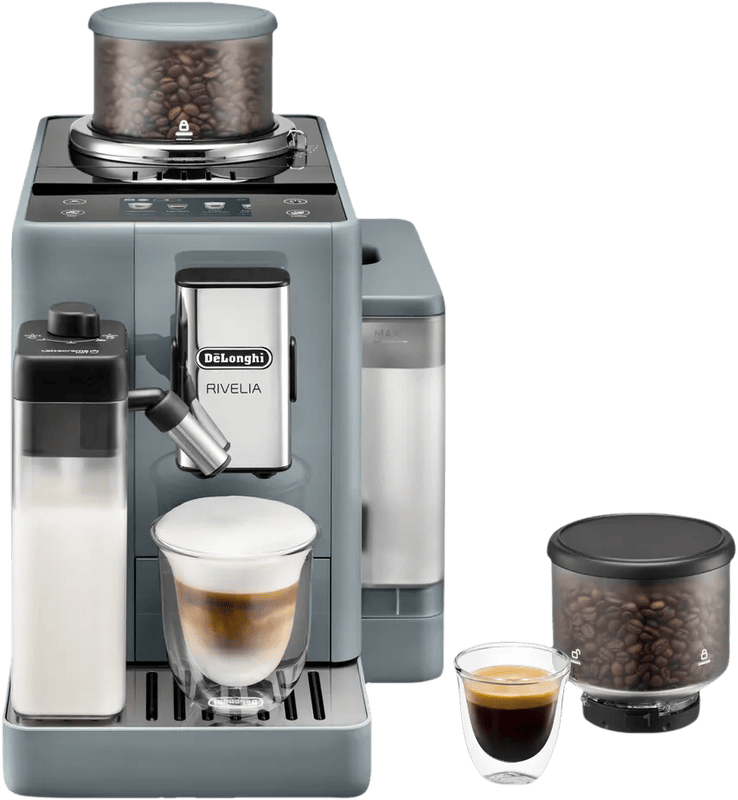
| De’Longhi Rivelia EXAM440.55.G | LatteCrema carafe | 1.4 l | 14 cm | Switching beans, narrow kitchen |
| Philips LatteGo 5500 EP5543/90 | LatteGo, 0.26 l, no tube | 1.8 l | not specified | One or two glasses, quick rinsing |
| Melitta Latticia OT F300-101 | Tube into the milk carton | 1.5 l | not specified | Very little counter space, milk from the carton |
Siemens EQ700 integral TQ717D03
Large container, large tank, 320 grams of beans. The spec sheet lists up to 33 specialties via the machine and app, and the manual allows the milk system and container in the dishwasher. With an adapter sold as an accessory, the machine can also draw from the carton. The milk proportion can be adjusted, which genuinely makes a difference for latte macchiato. On the other side of the ledger is a width of 35.2 centimeters. And there is no publicly available rating of the foam for exactly this model: Stiftung Warentest lists the sister model TQ727D03, with the verdict behind the paywall. This assessment is therefore based on capacity and cleaning effort.
If you are just after the container, you will find the same 0.7 liters on the EQ.500 integral from our general buying guide (in German).
De’Longhi Rivelia EXAM440.55.G
Two interchangeable bean containers of 250 grams each, four user profiles and a width of 24.5 centimeters. If half the household drinks decaf, that is a real argument. For a lot of milky coffee, though, the tank and grounds container are on the small side: 1.4 liters and ten servings. At four glasses a day, the grounds container is full after two to three days.
Philips LatteGo 5500 EP5543/90
Two parts, no tubes. Philips speaks of under ten seconds for cleaning and at the same time openly says that there is no automatic cleaning. So you rinse it yourself, just briefly.
The small container limits back-to-back drinks, which does not matter for one or two glasses a day. Four profiles are included, and 20 specialties according to the manufacturer.
Melitta Latticia OT F300-101
Twenty centimeters wide. That is the answer to a cramped kitchen counter, and according to Melitta the spout can even dispense two coffee-and-milk drinks at once. The tank and bean container remain small at 1.5 liters and 250 grams, and a milk container and milk lance are not included.
Rinsing after the milk round is a fixed part of the routine here.
Which system suits which morning
Two or more latte drinkers who have no desire to keep refilling should go for the Siemens. With little counter space and careful handling of the carafe, the Rivelia is enough. If rinsing should be quick and you stick to one or two glasses, the Philips fits. If the milk comes from the carton anyway and every centimeter counts, that leaves the Melitta.
If you end up drinking espresso more often than milky coffee after all, you can skip all of this and read on in our general buying guide (in German). And in case the machine scales up before the milk becomes a problem: with hard water, our guide to water filters (in German) helps you weigh the options. It is best to buy new glasses only once the machine is in place; our guide to glass sets (in German) explains what matters.
Frequently asked questions
How large should the milk container be for latte macchiato?
Assuming 180 milliliters of milk per glass, Philips' 0.26-liter LatteGo container is enough for one glass and a bit, while Siemens' 0.7 liters covers just under four. If two people each drink two glasses in the morning, you will refill a small container several times and a large one not at all.
Which milk system is the least work?
That depends on your routine. On the Siemens, a burst of steam cleans the system after every drink, and the container and milk system can go in the dishwasher. The De’Longhi carafe has to be rinsed and refrigerated after the last drink. Philips LatteGo consists of two parts with no tube; you rinse it yourself, just briefly.
Will a tall latte glass fit under the spout?
Measure before you order. Siemens specifies glasses up to 14 centimeters for the TQ717D03, De’Longhi 140 millimeters for the Rivelia. No reliable figure is available for Philips and Melitta. For very tall glasses, the German consumer testing organization Stiftung Warentest lists the sister model TQ727D03 at 16.5 centimeters.
Why doesn't the milk foam from my bean-to-cup machine get firm?
According to De’Longhi, milk or plant-based drinks should be at refrigerator temperature, around 5 degrees Celsius. If the milk is too warm, large bubbles form or it spurts from the spout. The result also depends on the type and brand, so try a different carton first.
What do I need to know about the milk tube on the Melitta Latticia OT?
The tube goes straight into the milk carton, which saves pouring. After milk drinks, the machine requires a rinse with about 150 milliliters of water, and after roughly 100 milk drinks a cleaning with milk system cleaner, which it does not remind you of on its own. According to Melitta, germs form in milk residue within a few days.
Is a steam wand enough for latte macchiato?
For a cappuccino on Sunday, yes; for heavy drinkers, the guide considers it the wrong choice. Assuming two minutes per glass and four glasses a day, that adds up to more than 48 hours a year. If you only want foam now and then, a separate milk frother often serves you well.
Sources
- Siemens: EQ700 integral TQ717D03
- Siemens: EQ700 TQ727D03
- Siemens: EQ700 integral and classic
- Siemens: TQ717D03 spec sheet
- Siemens: EQ.700 integral TQ7 user manual
- De’Longhi: Rivelia EXAM440.55.G
- De’Longhi: ECAM22X operating instructions
- Philips: LatteGo 5500 EP5543/90
- Melitta: Latticia OT
- Melitta: Latticia OT operating instructions
- Stiftung Warentest: Rivelia EXAM440.55.B, product features
- Stiftung Warentest: EQ 700 iAroma TQ727D03, product features
Where to buy
- Siemens EQ700 integral TQ717D03Check price at Amazon.deCheck price at Amazon.co.ukCheck price at Amazon.nlCheck price at Amazon.com.beCheck price at Amazon.frCheck price at Amazon.itCheck price at Amazon.esCheck price at Amazon.plCheck price at Amazon.seAvailable in Germany: Amazon.de
- De’Longhi Rivelia EXAM440.55.GView at CoolblueAvailable in Germany: CoolblueCheck price at Amazon.deCheck price at Amazon.co.ukCheck price at Amazon.nlCheck price at Amazon.com.beCheck price at Amazon.frCheck price at Amazon.itCheck price at Amazon.esCheck price at Amazon.plCheck price at Amazon.seAvailable in Germany: Amazon.de
- Philips LatteGo 5500 EP5543/90View at CoolblueAvailable in Germany: CoolblueCheck price at Amazon.deCheck price at Amazon.co.ukCheck price at Amazon.nlCheck price at Amazon.com.beCheck price at Amazon.frCheck price at Amazon.itCheck price at Amazon.esCheck price at Amazon.plCheck price at Amazon.seAvailable in Germany: Amazon.de
- Melitta Latticia OT F300-101Check price at Amazon.deCheck price at Amazon.co.ukCheck price at Amazon.nlCheck price at Amazon.com.beCheck price at Amazon.frCheck price at Amazon.itCheck price at Amazon.esCheck price at Amazon.plCheck price at Amazon.seAvailable in Germany: Amazon.de