Contents12 sections
This guide was first published in German on handgetestet.de.
After switching to a Nikon Z, many people buy a second kit zoom next. That is rarely wise. If you are looking for a standard zoom for many years, at Nikon you almost always end up with the Nikkor Z 24-120 mm f/4 S; if you want something light and affordable, start with the Nikkor Z 40 mm f/2 and add to it later with a purpose.
Between these two poles, the market has opened up considerably in recent years. Tamron, Sigma and Viltrox now make autofocus lenses with a Z mount, and old F lenses keep working via Nikon’s adapter. So we sort by what you want to photograph. The data sheet comes after that.
Before any choice: full frame or DX?
Nikon Z cameras come with a full-frame sensor (FX, e.g. Z5II, Z6III, Zf) and with a smaller DX sensor (Z50II, Zfc, Z30). Both use the same mount. An FX lens therefore fits any Z, while a DX lens on the full-frame camera works only with image cropping. If you shoot DX today and are already planning the switch to full frame, you are better off buying FX glass right away.
Three more questions help decide. At Nikon, the „S“ in the name stands for the higher-end line; for the models mentioned here, that includes sealing against dust and splashes, although Nikon does not guarantee it for every situation. When it comes to maximum aperture, honesty helps: f/4 is enough for travel and family, but for interiors without flash and portraits with a blurred background, f/2 or faster is noticeably more pleasant.
And the weight. A lens that stays at home takes no pictures, and everything from 170 grams to just under two kilos is represented below. With third-party makers, firmware comes into play: how well a lens works with new camera features depends on updates from the lens manufacturer. So check its compatibility list before buying.
If you are still torn between systems, you will find the counterparts among the lenses for Sony E-mount (in German) and the lenses for Canon RF. The camera itself is covered in our mirrorless camera guide.
Six lenses and an adapter for Nikon Z
| Model | Type | Key specs according to manufacturer | Best for |
|---|---|---|---|
| Nikon Nikkor Z 24-120 mm f/4 S | Standard zoom, FX, S-Line | approx. 630 g, 77 mm filter, minimum focus 0.35 m | One lens for almost everything |
| Nikon Nikkor Z 40 mm f/2 | Prime, FX | approx. 170 g, 52 mm filter, minimum focus 0.29 m | Light everyday carry lens |
| Nikon Nikkor Z 180-600 mm f/5.6-6.3 VR | Telephoto zoom, FX | approx. 1,955 g, internal zoom, VR 5.5 stops (CIPA) | Birds, wildlife, sports |
| Nikon FTZ II | Mount adapter F to Z | approx. 125 g, no tripod foot, AF with AF-S/AF-P/AF-I | If you keep using F lenses |
| Tamron 28-75 mm F/2.8 Di III VXD G2 | Standard zoom, FX | constant f/2.8, 67 mm filter, minimum focus 0.18 m | More light than f/4, less reach |
| Sigma 56 mm F1.4 DC DN Contemporary | Prime, DX | 295 g, 55 mm filter, minimum focus 0.5 m | Portraits on the Z50II, Zfc, Z30 |
| Viltrox AF 28 mm F1.8 Z | Prime, FX | approx. 367 g, 55 mm filter, minimum focus 0.37 m | Wide angle with lots of light on a small budget |
One lens for years: Nikkor Z 24-120 mm f/4 S
Fivefold zoom, constant f/4, around 630 grams. According to Nikon, it focuses down to 0.35 meters across the entire zoom range, reaching a reproduction ratio of 1:2.6. Landscapes, city scenes, family celebrations and details are all possible without changing lenses. Only in dim rooms does f/4 get tight. If you often shoot there, add a fast prime as well.
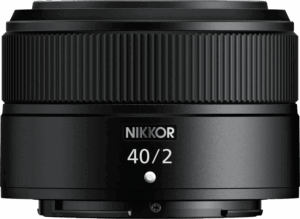
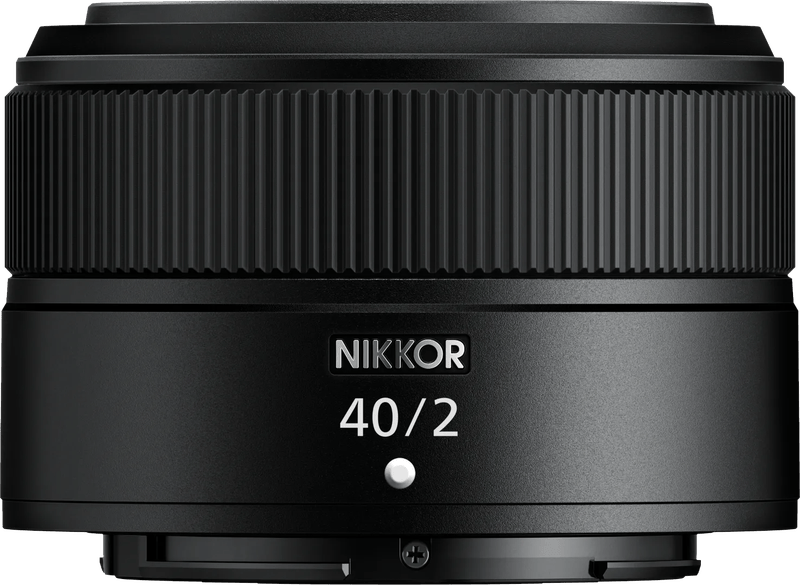
Little weight, little money: Nikkor Z 40 mm f/2
Around 170 grams and, according to Nikon, only about 45 millimeters long. Even so, it is sealed against dust and drips and focuses from 29 centimeters. In the Nikon shop, its price is far below that of the 24-120 S, and there is an „SE“ version with a retro look. It lacks S-Line status as well as in-lens stabilization. A deliberately simple tool, then. That is exactly what makes it likable.
Birds and sports: Nikkor Z 180-600 mm f/5.6-6.3 VR
Just under two kilos is no small matter. In return, you get 600 millimeters, an internal zoom that does not change the lens length when zooming, and a stabilizer that Nikon rates at 5.5 stops according to CIPA; according to the manufacturer, the lens is compatible with the TC-1.4x and TC-2.0x teleconverters. Serious bird photography almost always calls for this class. If you only visit the zoo now and then, you will be lugging it around for nothing.
F lenses in the cupboard: FTZ II
The adapter connects F lenses from the DSLR era to the Z mount. According to Nikon, about 360 F lenses from the AI type onward work with automatic exposure. But only 94 types with their own motor (AF-S, AF-P, AF-I) offer autofocus; older AF and AF-D lenses with screw drive focus manually only. Nikon dropped the tripod foot of the first FTZ. In return, the FTZ II is slimmer at around 125 grams.
Interiors, weddings: Tamron 28-75 mm F/2.8 G2
A constant f/2.8 means a full stop more light than the Nikon zoom, but it lacks focal length at the long end. Tamron states a minimum focusing distance of 0.18 meters at the wide end and a ratio of 1:2.7. That is enough for food or plants up close. Focus is driven by a VXD linear motor. On Amazon.de, availability of the Z version has fluctuated recently, so check the seller and delivery time before ordering.
DX camera and portraits: Sigma 56 mm F1.4 DC DN
This lens is designed for the smaller DX sensor, where it roughly corresponds to an 84-millimeter portrait lens. At 295 grams and f/1.4, the camera stays compact, and the background can be blurred noticeably. On full frame? Out of place, because it does not cover the larger sensor.
Fast glass on a small budget: Viltrox AF 28 mm F1.8 Z
Built for full frame, weighing around 367 grams according to Viltrox, with a 55-millimeter filter thread. For street photography and interiors, it is an affordable way into fast glass. Here, the firmware comes from the lens manufacturer, not from Nikon. If you install every new camera firmware right away, keep an eye on that.
And Samyang?
On Amazon.de, Samyang offers only manual-focus lenses for Nikon Z, such as the MF 14 mm F2.8 Z. For astro and architectural photography, that can be appealing. Be careful with the naming if you expect autofocus: some Samyang „AF“ models sold in stores still have the F mount.
Which lens for which photographer?
- One lens for years on FX: Nikkor Z 24-120 mm f/4 S.
- Small budget, little weight: Nikkor Z 40 mm f/2, adding a zoom later.
- Interiors and weddings: Tamron 28-75 mm G2 or a fast prime such as the Viltrox 28 mm.
- DX camera and portraits: Sigma 56 mm F1.4.
- Animals and sports: Nikkor Z 180-600 mm, but only if the weight is not an obstacle.
- Old F lenses on hand: get the FTZ II first, then check which lenses really need replacing. A new standard zoom usually does more than a set of old primes on an adapter.
Frequently asked questions
Which standard zoom suits the Nikon Z?
For many years, the Nikkor Z 24-120 mm f/4 S with fivefold zoom, a constant f/4 and around 630 grams. It focuses down to 0.35 meters across the entire zoom range. Only in dim rooms does f/4 get tight; there, an additional fast prime helps.
Do DX lenses fit a full-frame Nikon Z?
Yes, but only with image cropping. Both sensor sizes use the same mount, and an FX lens fits any Z. If you shoot DX today and are already planning the switch to full frame, you are better off buying FX glass right away.
Do old F lenses work on the Nikon Z?
With the FTZ II adapter. According to Nikon, about 360 F lenses from the AI type onward work with automatic exposure, but only 94 types with their own motor offer autofocus. Older AF and AF-D lenses with screw drive focus manually only.
Which lens is suitable for interiors and weddings?
The Tamron 28-75 mm F/2.8 G2 offers a constant f/2.8 and thus a full stop more light than the Nikon zoom, but it lacks focal length at the long end. On a small budget, the Viltrox AF 28 mm F1.8 Z is a way into fast glass.
Is the Nikkor Z 180-600 mm worth it for birds?
For serious bird and sports photography, yes, because it almost always calls for this class: 600 millimeters, internal zoom and a stabilizer rated at 5.5 stops. But just under two kilos is no small matter. If you only visit the zoo now and then, you will be lugging it around for nothing.
What should you watch for with third-party lenses?
The firmware. How well they work with new camera features depends on updates from the lens manufacturer, not from Nikon. Check its compatibility list before buying. On Amazon.de, Samyang offers only manual-focus lenses for Nikon Z.
Sources
- Nikon: NIKKOR Z 24-120 mm 1:4 S
- Nikon Imaging: NIKKOR Z 24-120mm f/4 S, specifications
- Nikon: NIKKOR Z 40 mm 1:2
- Nikon Imaging: NIKKOR Z 40mm f/2, specifications
- Nikon: NIKKOR Z 180-600 mm 1:5,6-6,3 VR
- Nikon Imaging: Mount Adapter FTZ II
- Nikon: Mount Adapter FTZ II (German site)
- Tamron: 28-75mm F/2.8 Di III VXD G2 (A063)
- Sigma: 56mm F1.4 DC DN Contemporary
- Viltrox: AF 28mm F1.8 for Nikon Z
Where to buy
- Nikon Nikkor Z 24-120 mm f/4 SCheck price at Amazon.deCheck price at Amazon.co.ukCheck price at Amazon.nlCheck price at Amazon.com.beCheck price at Amazon.frCheck price at Amazon.itCheck price at Amazon.esCheck price at Amazon.plCheck price at Amazon.seAvailable in Germany: Amazon.de
- Nikon Nikkor Z 40 mm f/2View at CoolblueAvailable in Germany: CoolblueCheck price at Amazon.deCheck price at Amazon.co.ukCheck price at Amazon.nlCheck price at Amazon.com.beCheck price at Amazon.frCheck price at Amazon.itCheck price at Amazon.esCheck price at Amazon.plCheck price at Amazon.seAvailable in Germany: Amazon.de
- Nikon Nikkor Z 180-600mm f/5.6-6.3 VRCheck price at Amazon.deCheck price at Amazon.co.ukCheck price at Amazon.nlCheck price at Amazon.com.beCheck price at Amazon.frCheck price at Amazon.itCheck price at Amazon.esCheck price at Amazon.plCheck price at Amazon.seAvailable in Germany: Amazon.de
- Nikon FTZ IICheck price at Amazon.deCheck price at Amazon.co.ukCheck price at Amazon.nlCheck price at Amazon.com.beCheck price at Amazon.frCheck price at Amazon.itCheck price at Amazon.esCheck price at Amazon.plCheck price at Amazon.seAvailable in Germany: Amazon.de
- Tamron 28-75 mm F/2.8 Di III VXD G2Check price at Amazon.deCheck price at Amazon.co.ukCheck price at Amazon.nlCheck price at Amazon.com.beCheck price at Amazon.frCheck price at Amazon.itCheck price at Amazon.esCheck price at Amazon.plCheck price at Amazon.seAvailable in Germany: Amazon.de
- Sigma 56 mm F1.4 DC DN ContemporaryCheck price at Amazon.deCheck price at Amazon.co.ukCheck price at Amazon.nlCheck price at Amazon.com.beCheck price at Amazon.frCheck price at Amazon.itCheck price at Amazon.esCheck price at Amazon.plCheck price at Amazon.seAvailable in Germany: Amazon.de
- Viltrox AF 28 mm F1.8 ZCheck price at Amazon.deCheck price at Amazon.co.ukCheck price at Amazon.nlCheck price at Amazon.com.beCheck price at Amazon.frCheck price at Amazon.itCheck price at Amazon.esCheck price at Amazon.plCheck price at Amazon.seAvailable in Germany: Amazon.de