Contents11 sections
This guide was first published in German on handgetestet.de.
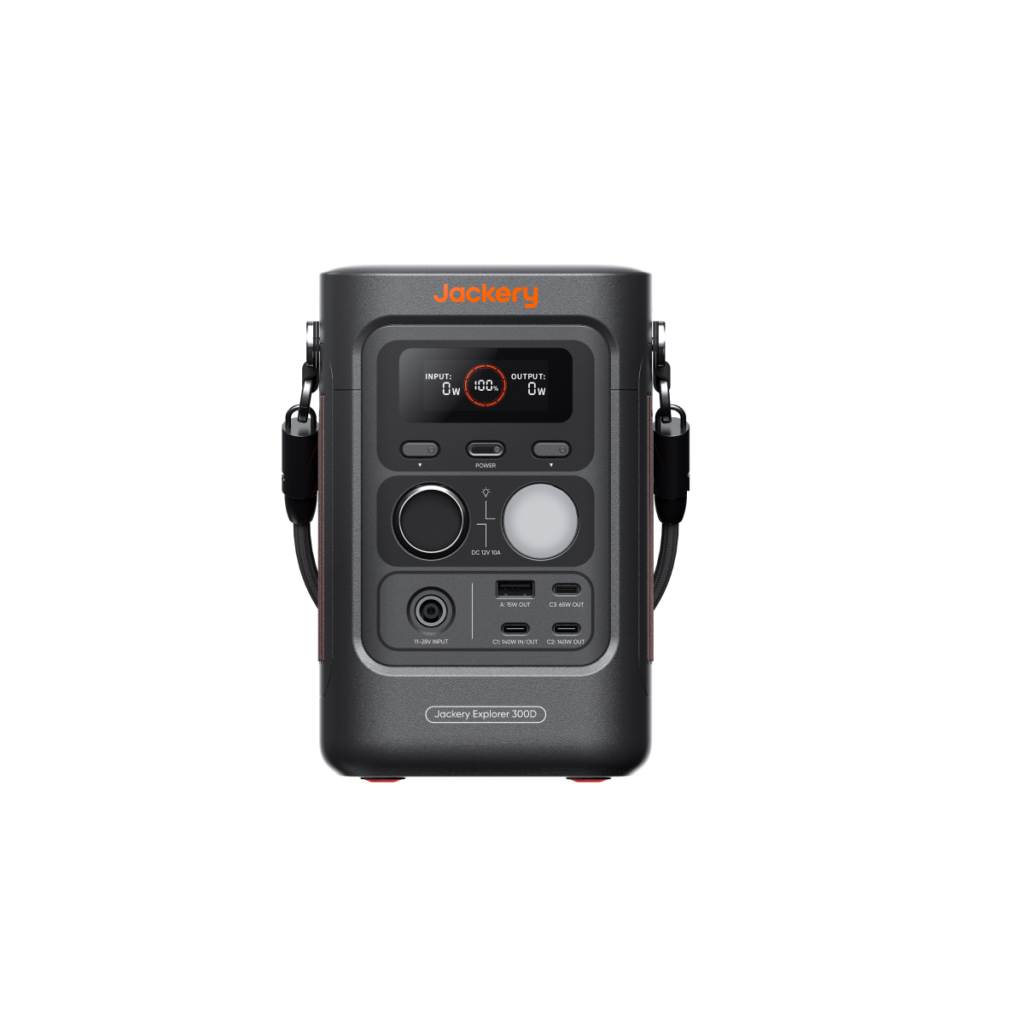
Four of the six stations in this comparison have no AC outlet at all. That sounds like a flaw and is often their advantage, because without an inverter they stay light and quiet. If you already charge your laptop, camera and drone via USB-C, we consider the Jackery Explorer 300D the most sensible buy: 288 watt-hours at 2.5 kilograms. If a 230-volt plug has to go in, take the Explorer 240 v2. And neither of the two is allowed on a plane.
Six small stations compared
| Model | Capacity | Ports | Weight | On a plane |
|---|---|---|---|---|
| Jackery Explorer 300D | 288 Wh, LFP | 3× USB-C (up to 140 W), USB-A, 12 V; no AC outlet | 2.5 kg | no |
| Jackery Explorer 240 v2 | 256 Wh, LFP | AC outlet 300 W, USB-C 100 W, USB-C, USB-A, 12 V | 3.6 kg | no |
| Jackery Explorer 100D | 96 Wh, LFP | 2× USB-C (up to 140 W), USB-A; no AC outlet | 855 g | yes, carry-on |
| Jackery Explorer 100 Plus | 99.2 Wh, LFP | 2× USB-C (up to 100 W), USB-A; no AC outlet | 965 g | yes, carry-on |
| Aqiila Powerbird S140 | 199.8 Wh, lithium-ion | USB-C 140 W, USB-C, 2× USB-A, wireless 15 W; no AC outlet | 1.27 kg | no |
| BLUETTI Elite 30 V2 | 288 Wh, LFP | AC outlet 600 W, USB-C 140 W, 2× USB-A, 12 V | 4.3 kg | no |
Manufacturer and retailer specifications; LFP stands for lithium iron phosphate. The plane column follows the watt-hour limits of the Luftfahrt-Bundesamt (German Federal Aviation Office).
Power bank or power station?
The line is blurry. A power bank with 20,000 mAh and 3.7 volts comes to around 74 watt-hours, the Explorer 100D to 96. Technically, it is a very large power bank with lithium iron phosphate cells and plenty of output; Jackery states 3,000 cycles to 80 percent. For phones and tablets, the pocket-sized solution from our power bank guide is usually enough. A station becomes interesting when two laptops run off the same battery, when a cooler box runs on 12 volts or when a power adapter does need to be supplied after all. None of these stations is enough for a coffee machine or a kettle; for that, there is the overview on buying a power station.
What is allowed in carry-on luggage
The watt-hour rating decides. According to the passenger information of the Luftfahrt-Bundesamt, lithium-ion batteries up to 100 Wh may come along, from 100 to 160 Wh only with the airline’s approval, and above that not at all. Loose batteries and power banks belong in carry-on luggage, never in checked bags. The ICAO table for 2025/2026 published by the office limits power banks to two per person, prohibits charging them on board and advises against charging devices from them on board. Every battery needs short-circuit protection, such as its own pouch.
For this list, that means the 100D and 100 Plus are just below the limit. All the others stay on the ground. Airlines may be stricter, and the office explicitly refers to them for details. So ask before your flight.
Jackery Explorer 300D
Fanless and almost silent, designed according to Jackery for 4,000 cycles to 70 percent remaining capacity. According to calculations by the retailer GreenDrive, a 60-watt laptop runs for around four hours, and a 12-volt compressor cooler box with 45 watts for a good five. The carrying cable doubles as a USB-C charging cable. However, there is no power adapter, and the station has no AC input: for the stated 2.3 hours, you need a 140-watt USB-C charger. There is no app.
Jackery Explorer 240 v2
For the shaver, the old laptop power adapter, the string lights. The AC outlet delivers 300 watts and, according to the retailer, 600 watts peak, and in an emergency Jackery’s UPS function keeps the router running. You pay for that with 1.1 kilograms more weight, less USB output and an operating noise that Jackery specifies at 42 decibels.
Jackery Explorer 100D
The travel solution. At 11.9 by 8.3 by 8.6 centimeters, according to the retailer, it almost fits in a jacket pocket, delivers 140 watts via USB-C and can therefore charge large laptops too. With two devices plugged in, it splits the output into 70 watts each. A 60-watt laptop, however, lasts no more than a good hour on its battery. The box only contains a cable, no power adapter.
Jackery Explorer 100 Plus
The older, cheaper sibling. The manual states 99.2 watt-hours, 2,000 cycles to 80 percent and no more than 128 watts across all outputs. That is enough for a camera and a phone. If you charge a 16-inch laptop, the 100D is the better choice. No charger is included.
Aqiila Powerbird S140
Plenty of capacity per kilo: according to ELV, just under 200 watt-hours at 1.27 kilograms, plus a 120-lumen lamp and a charging pad for the phone. Inside, however, are conventional lithium-ion cells, the specifications list no cycle count, and charging runs via USB-C at no more than 60 watts. For 200 watt-hours, that means more than three hours.
BLUETTI Elite 30 V2
Twice the AC output of the 240 v2: 600 watts, and according to BLUETTI a switchover time of 10 milliseconds. It charges directly from the mains, to 80 percent in 45 minutes according to the manufacturer, and can be controlled via an app. At 4.3 kilograms, however, it is the heaviest in this lineup.
Which one to choose?
- Photography, drones, working outdoors, a tent with a cooler box: Explorer 300D. Suitable batteries and chargers are covered in the guide to drone accessories.
- Devices with a 230-volt plug up to 300 watts: Explorer 240 v2; above that, Elite 30 V2.
- Air travel: Explorer 100D, or the 100 Plus on a tight budget.
- Recharging off-grid: the 300D, 100D and 100 Plus accept no more than 100 watts, so a larger foldable solar panel does nothing for them.
For a compressor cooler, the guide Power station for the cooler box calculates the runtime, and Jackery or Anker Solix covers the brand comparison.
What campers really need is sorted by budget and sleeping setup in the guide Gifts for campers.
Frequently asked questions
Which power station is allowed on a plane?
According to the Luftfahrt-Bundesamt (German Federal Aviation Office), lithium-ion batteries up to 100 Wh are allowed in carry-on luggage, from 100 to 160 Wh only with the airline's approval. The Jackery Explorer 100D with 96 Wh and the 100 Plus with 99.2 Wh are just below that. Airlines may be stricter, so ask before your flight.
What is the difference between a power bank and a power station?
The line is blurry. A power bank with 20,000 mAh comes to around 74 watt-hours, the Explorer 100D to 96. A station becomes interesting when two laptops run off the same battery, a cooler box runs on 12 volts or a power adapter needs to be supplied.
Do I need a power station with an AC outlet?
Only for devices with a 230-volt plug. Without an inverter, stations stay light and quiet; four of the six in the comparison have no AC outlet at all. The Explorer 240 v2 delivers 300 watts, the BLUETTI Elite 30 V2 600 watts. None of them is enough for a coffee machine or a kettle.
How long does a laptop run on a small power station?
According to calculations by the retailer GreenDrive, a 60-watt laptop runs for around four hours on the Explorer 300D, and a 12-volt compressor cooler box with 45 watts for a good five. On the Explorer 100D, a 60-watt laptop lasts no more than a good hour.
How do you charge the Jackery Explorer 300D?
Only via USB-C; the station has no AC input. For the stated 2.3 hours, you need a 140-watt USB-C charger, which is not included. A large foldable solar panel does little good, because the 300D, 100D and 100 Plus accept no more than 100 watts.
Sources
- Jackery product specifications for the Explorer 100 Plus, 100D, 240 v2 and 300D
- Luftfahrt-Bundesamt: Electronic devices with lithium batteries
- Luftfahrt-Bundesamt: ICAO Table 8-1 on dangerous goods in baggage (PDF)
- Jackery: Explorer 300D
- GreenDrive (authorized Jackery retailer): Explorer 300D
- GreenDrive: Explorer 100D
- Jackery: Explorer 100 Plus manual (PDF)
- Berger Camping: Explorer 240 v2 (retailer specifications)
- ELV: Aqiila Powerbird S140 (retailer specifications)
- BLUETTI: Elite 30 V2
Where to buy
- Jackery Explorer 300DView at JackeryAvailable in Germany: JackeryCheck price at Amazon.deCheck price at Amazon.co.ukCheck price at Amazon.nlCheck price at Amazon.com.beCheck price at Amazon.frCheck price at Amazon.itCheck price at Amazon.esCheck price at Amazon.plCheck price at Amazon.seAvailable in Germany: Amazon.de
- Jackery Explorer 240 v2View at JackeryAvailable in Germany: JackeryCheck price at Amazon.deCheck price at Amazon.co.ukCheck price at Amazon.nlCheck price at Amazon.com.beCheck price at Amazon.frCheck price at Amazon.itCheck price at Amazon.esCheck price at Amazon.plCheck price at Amazon.seAvailable in Germany: Amazon.de
- Jackery Explorer 100DView at JackeryAvailable in Germany: Jackery
- Jackery Explorer 100 PlusCheck price at Amazon.deCheck price at Amazon.co.ukCheck price at Amazon.nlCheck price at Amazon.com.beCheck price at Amazon.frCheck price at Amazon.itCheck price at Amazon.esCheck price at Amazon.plCheck price at Amazon.seAvailable in Germany: Amazon.deView at JackeryAvailable in Germany: Jackery
- Aqiila Powerbird S140View at ELVAvailable in Germany: ELV
- BLUETTI Elite 30 V2Check price at Amazon.deCheck price at Amazon.co.ukCheck price at Amazon.nlCheck price at Amazon.com.beCheck price at Amazon.frCheck price at Amazon.itCheck price at Amazon.esCheck price at Amazon.plCheck price at Amazon.seAvailable in Germany: Amazon.de