Contents13 sections
This guide was first published in German on handgetestet.de.
A tap and die set without matching tap drills is only half a set. For the home workshop, we therefore recommend a case that includes hand taps, round dies and the seven drills from 2.5 to 10.2 mm together, such as the Projahn 91009. If you work with stainless steel more often, on the other hand, you need cobalt-alloy tools, and that is a different league.
A typical reason to buy: an M6 screw on the trailer has stripped its thread, or an extra hole on the bike rack needs an internal thread. Then what counts is whether everything the job requires is in the case. That is exactly where the sets differ more than in the piece count on the lid.
What is actually in a tap and die set?
Two kinds of tools. Hand taps cut internal threads into a pre-drilled hole; round dies cut external threads onto a smooth rod. Add tap wrenches for the taps and die stocks for the dies. Common sets cover the metric ISO coarse thread according to DIN 13, the German standard, in seven sizes: M3, M4, M5, M6, M8, M10 and M12.
Hand taps according to DIN 352 usually come as a set of three. Völkel explains the rings on the shank like this: the taper tap with one ring cuts about 50 to 60 percent of the thread depth, the intermediate tap with two rings about 70 to 80 percent, and only the finishing tap without a ring brings the thread to final size. If you stop after the first tap, you do not have a usable thread. Single-cut taps do the job in one pass and, according to Ruko, can also be used in a machine, but they are intended for through holes.
HSS, HSS-G or HSS-E: what does the abbreviation mean?
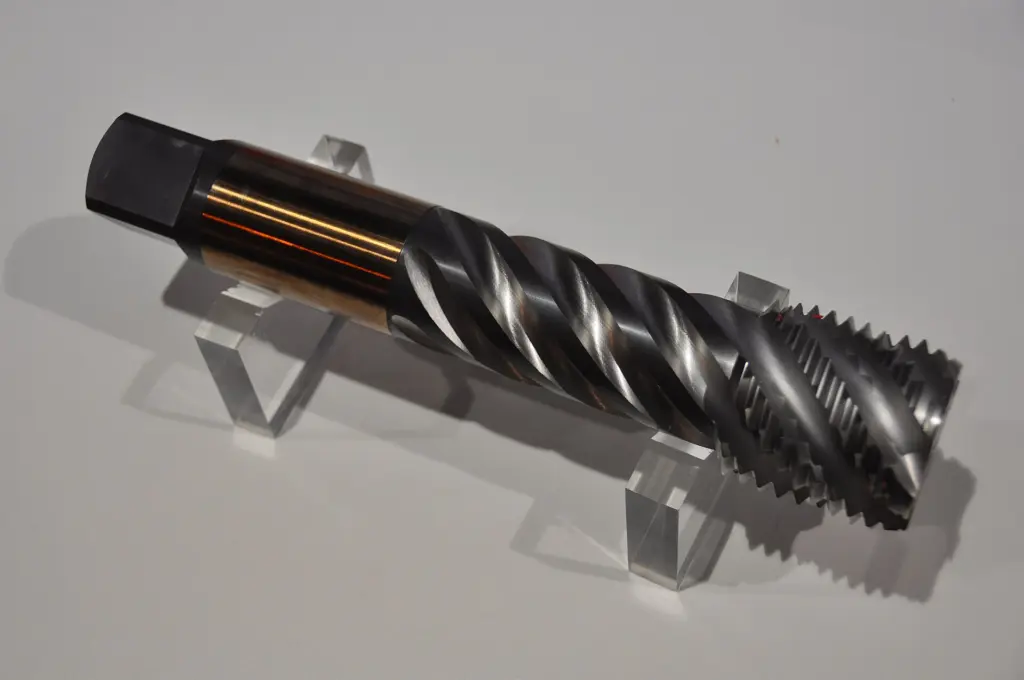
HSS is high-speed steel, tough and intended for normal threading work. According to Völkel, the G in HSS-G stands for „ground“ and describes the finish, not a different steel. HSS-E (also HSS-Co) contains at least 5 percent cobalt and withstands more heat. For stainless steel, Völkel explicitly recommends this alloy, because standard HSS wears faster or is more likely to break there.
For mild steel, aluminum, brass and plastic, HSS is enough. Ruko specifies unalloyed and low-alloy steels up to 800 N/mm² for its HSS sets. For stronger steels and stainless material, the cobalt version is the right choice.
Which tap drill hole goes with which thread?
The rule of thumb for metric coarse threads is nominal diameter minus pitch. Völkel and Ruko give the same values:
| Thread | Pitch | Tap drill |
|---|---|---|
| M3 | 0.5 mm | 2.5 mm |
| M4 | 0.7 mm | 3.3 mm |
| M5 | 0.8 mm | 4.2 mm |
| M6 | 1.0 mm | 5.0 mm |
| M8 | 1.25 mm | 6.8 mm |
| M10 | 1.5 mm | 8.5 mm |
| M12 | 1.75 mm | 10.2 mm |
If the hole is too small, the tap turns stiffly and can break. If it is too large, the thread flanks stay weak. If you do not already have the 3.3, 4.2, 6.8 and 10.2 mm sizes in your drill case, a set without tap drills will stop you on the very first evening. Which other metal drills belong in the workshop is covered in our guide to drill bit sets (in German).
Six sets for M3 to M12 side by side
| Set | Contents according to manufacturer | Material | Best for |
|---|---|---|---|
| Projahn 91009, 40-piece | 21 hand taps, 7 round dies Ø 25 mm, 7 tap drills 2.5–10.2 mm, holder, tap wrench | Taps HSS, dies and tap drills HSS-G | A complete start without extra purchases |
| Ruko 245010, 31-piece | 21 hand taps, 7 round dies Ø 25 mm, 1 holder, 1 tap wrench, no tap drills | HSS | Those who already own matching drills |
| Völkel 49111, 42-piece | 21 hand taps, 7 round dies, 7 twist drills, 5 holders, 2 tap wrenches, metal case | Taps HSS-G, dies HSS | Workshops that value organization |
| Projahn 91024, 37-piece | 21 hand taps, 7 round dies, 5 holders, 2 tap wrenches, thread gauge | Taps HSS, set listed as HSS-G | Repairs with drills you already have |
| Ruko 245004RO, 15-piece | 7 single-cut taps, 7 twist drills 2.5–10.2 mm, 1 tap wrench | Taps HSS, drills HSS-G | Internal threads in through holes only |
| Ruko 245040E, 54-piece | 33 hand taps M3–M20, 11 round dies, 6 holders, 2 tap wrenches | HSS-Co5 (5% cobalt) | Stainless steel and sizes up to M20 |
Projahn 91009
This set includes what is missing for the first thread: seven HSS-G tap drills in exactly the sizes in the table above. All round dies have a 25 mm outer diameter, so a single 25 x 9 holder is enough. The taps are HSS according to DIN 352, the dies HSS-G according to DIN 223. It comes in a plastic case.
Ruko 245010
Same layout for taps and dies, but without tap drills. Ruko cites tolerance ISO 2 (6H), through-hole and blind-hole threads, and steels up to 800 N/mm², malleable cast iron and non-ferrous metals. It makes sense if your drill case already has all the in-between sizes.
Völkel 49111
Here the hand taps are ground (HSS-G), and the round dies are HSS according to DIN EN 22568. Völkel includes five die stocks from 20 x 5 to 38 x 14 mm, two tap wrenches, a thread gauge, a screwdriver and seven twist drills. The metal case keeps everything in its place, and you will notice that at the latest when you are looking for the M4 die for the third time.
Projahn 91024
The version without tap drills, but with five die stocks, two tap wrenches and a thread gauge in a plastic case. A solution for anyone who owns a well-sorted set of metal drills.
Ruko 245004RO
No round dies, no three-tap sequence. According to Ruko, seven single-cut taps and the matching twist drills according to DIN 338 cut the internal thread in one operation, by hand or in a machine. Ruko does not list this set for blind holes. If you only thread through holes in sheet metal and flat steel, it gets you there faster.
Ruko 245040E
The big case goes up to M20 and is made of HSS-Co5. Ruko lists stainless steel and steels up to 1,000 N/mm² as applications. For occasional repairs on the garden fence, that is considerably more tool than you need. If you rework stainless steel railings or boat fittings, though, this is exactly where to start.
Why do first threads fail?
Rarely because of the set. Völkel names the wrong tap drill hole, an angled start, too little lubrication, jammed chips and too much force, which makes the tool break, as common mistakes. For metal, the manufacturer almost always recommends cutting oil. Turn back briefly to break the chips; if it gets stiff, back the tap all the way out, clean it and oil it again. Countersink the hole after drilling, and lightly chamfer the rod for an external thread. Drilling straight is easier with a drill press (in German), and the workpiece belongs firmly in a vise (in German).
How we would decide
- First set, no matching drills at home: Projahn 91009.
- Drills on hand, internal and external threads needed: Ruko 245010 or Projahn 91024.
- Frequent use, more holders, metal case: Völkel 49111.
- Internal threads in through holes only, preferably by machine: Ruko 245004RO.
- Stainless steel or threads up to M20: Ruko 245040E.
One final thought. Fine threads and imperial threads are not included in any of these sets. If you find UNF and BSW on a classic car or bicycle, you are better off buying the matching individual tools specifically.
Frequently asked questions
What belongs in a tap and die set?
Hand taps for internal threads in pre-drilled holes, round dies for external threads on smooth rods, plus tap wrenches and die stocks. Common sets cover metric coarse threads according to DIN 13 in seven sizes from M3 to M12. What matters is whether the tap drills are in the case as well.
Why do taps come in three parts?
Hand taps according to DIN 352 usually come as a set of three. According to Völkel, the taper tap with one ring cuts about 50 to 60 percent of the thread depth, the intermediate tap with two rings about 70 to 80 percent, and only the finishing tap brings the thread to final size. Single-cut taps do it in one pass but are intended for through holes.
What is the difference between HSS, HSS-G and HSS-E?
HSS is high-speed steel for normal threading work. According to Völkel, the G stands for "ground" and describes the finish, not a different steel. HSS-E contains at least 5 percent cobalt and withstands more heat. For mild steel, aluminum, brass and plastic, HSS is enough; for stainless steel, Völkel recommends the cobalt version.
Which tap drill goes with M6?
For M6 with a 1.0 mm pitch, it is the 5.0 mm drill. The rule of thumb is nominal diameter minus pitch, so 6.8 mm for M8 and 8.5 mm for M10. If the hole is too small, the tap turns stiffly and can break. If it is too large, the thread flanks stay weak.
Why do first threads fail?
Rarely because of the set. Völkel names the wrong tap drill hole, an angled start, too little lubrication, jammed chips and too much force as common mistakes. For metal, the manufacturer almost always recommends cutting oil. Turn back briefly to break the chips, countersink the hole and clamp the workpiece firmly in a vise.
Do such sets include fine threads and imperial threads?
None of the sets compared do. If you find UNF and BSW on a classic car or bicycle, you are better off buying the matching individual tools specifically. The sets cover metric coarse threads, with the Ruko 245040E going up to M20.
Sources
- Projahn: HSS-G threading tool set, 40-piece (91009)
- Projahn: HSS-G threading tool set, 37-piece (91024)
- Ruko: HSS threading tool set, 31-piece (245010)
- Ruko: HSS single-cut tap set, 15-piece (245004RO)
- Ruko: HSS-Co5 threading tool set, 54-piece (245040E)
- Völkel: hand taps and round dies, 42-piece set (49111)
- Völkel: frequently asked questions about threading tools
- Völkel: cutting clean threads
- Völkel: tap materials HSS, HSSE and HSSE-PM
Where to buy
- Projahn 91009 Gewinde-Schneidwerkzeug HSS-G 40-tlg.Check price at Amazon.deCheck price at Amazon.co.ukCheck price at Amazon.nlCheck price at Amazon.com.beCheck price at Amazon.frCheck price at Amazon.itCheck price at Amazon.esCheck price at Amazon.plCheck price at Amazon.seAvailable in Germany: Amazon.de
- Ruko 245010 Gewindeschneidwerkzeug-Satz 31-tlg.Check price at Amazon.deCheck price at Amazon.co.ukCheck price at Amazon.nlCheck price at Amazon.com.beCheck price at Amazon.frCheck price at Amazon.itCheck price at Amazon.esCheck price at Amazon.plCheck price at Amazon.seAvailable in Germany: Amazon.de
- Völkel 49111 Handgewindebohrer- und Schneideisen-Satz 42-tlg.Check price at Amazon.deCheck price at Amazon.co.ukCheck price at Amazon.nlCheck price at Amazon.com.beCheck price at Amazon.frCheck price at Amazon.itCheck price at Amazon.esCheck price at Amazon.plCheck price at Amazon.seAvailable in Germany: Amazon.de
- Projahn 91024 Gewinde-Schneidwerkzeug HSS-G 37-tlg.Check price at Amazon.deCheck price at Amazon.co.ukCheck price at Amazon.nlCheck price at Amazon.com.beCheck price at Amazon.frCheck price at Amazon.itCheck price at Amazon.esCheck price at Amazon.plCheck price at Amazon.seAvailable in Germany: Amazon.de
- Ruko 245004RO Einschnittgewindebohrer-Satz 15-tlg.Check price at Amazon.deCheck price at Amazon.co.ukCheck price at Amazon.nlCheck price at Amazon.com.beCheck price at Amazon.frCheck price at Amazon.itCheck price at Amazon.esCheck price at Amazon.plCheck price at Amazon.seAvailable in Germany: Amazon.de
- Ruko 245040E Gewindeschneidwerkzeug-Satz HSS-Co5 54-tlg.Check price at Amazon.deCheck price at Amazon.co.ukCheck price at Amazon.nlCheck price at Amazon.com.beCheck price at Amazon.frCheck price at Amazon.itCheck price at Amazon.esCheck price at Amazon.plCheck price at Amazon.seAvailable in Germany: Amazon.de