Lowest €89.95 (19.11.) · Highest €89.95 (08.11.)
Price watch ELV DDS 130 at ELV
- Today
- €89.95As of 18.11.2026
- Lowest price, 30 days
- €89.95the same on every day measured
- Typical price (median), 30 days
- €89.95
- Days measured
- 1208.11.–19.11.2026
Price dropping? We'll let you know
Contents12 sections
This guide was first published in German on handgetestet.de.
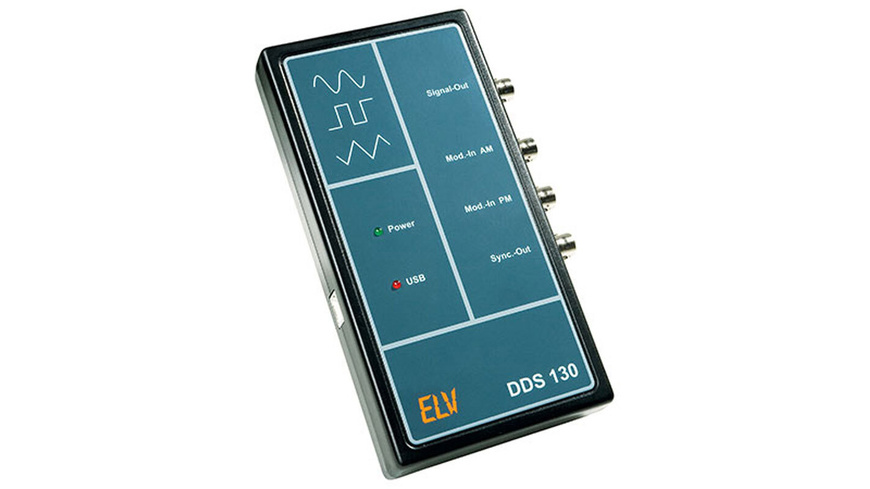
If you want to test an audio amplifier, a filter or a microcontroller input, you need a clean test signal. The function generator provides it. For hobbyists with a PC at their workbench, we consider the ELV Bausatz DDS 130 (a kit from the German electronics retailer ELV) a good entry point: 30 MHz sine, fine steps of 0.25 Hz, sweep and modulation, controlled via USB. If you need a unit with its own screen and more output voltage, go for a ready-made unit from Siglent or Rigol.
Four numbers that matter
Almost all current units work on the DDS principle (direct digital synthesis). A chip calculates the waveform, a digital-to-analog converter outputs it, and a filter smooths out the steps. The key specifications follow from this.
The frequency usually applies only to sine. With the DDS 130, sine goes up to 30 MHz, square up to 25 MHz, and triangle only up to 1 MHz. The output voltage is often overlooked: a generator with 1 volt peak-to-peak is enough for audio inputs, but not for reliably switching 5-volt logic. The number of channels matters as soon as you need two signals with a fixed phase relationship. And the operation: a unit with buttons and a screen, or a circuit board connected to a PC.
A typical stumbling block is the load. Most generators have an output impedance of 50 ohms; Siglent specifies it in the data sheet as 49.5 to 50.5 ohms. If the output is also connected to 50 ohms, such as a terminated coaxial cable, the voltage is halved compared with the reading for a high-impedance load. If you are puzzled by a signal that is only half as large as the setting, this is almost always the explanation. That is why serious data sheets always state which load the specification applies to.
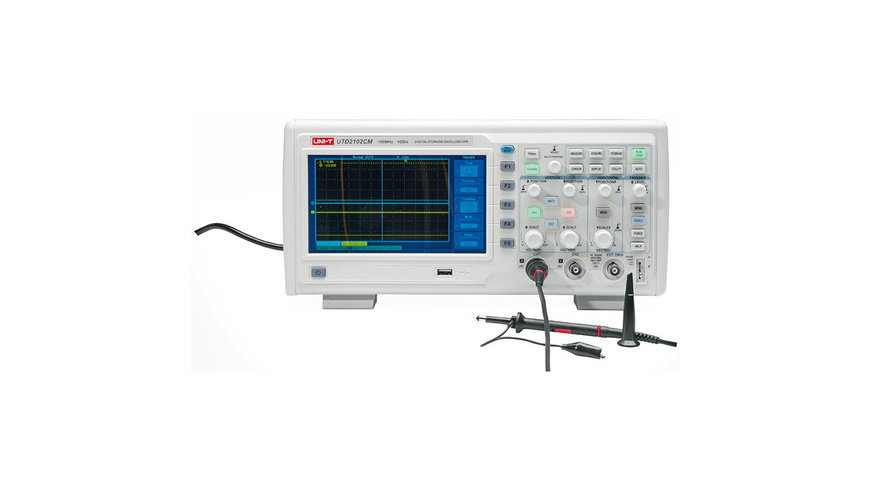
In any case, you can only see the signal with an oscilloscope. Generator and oscilloscope belong together like plug and socket.
Five generators side by side
| Model | Type | Frequency according to the manufacturer | Output | Best for | Offer (affiliate link) |
|---|---|---|---|---|---|
| ELV DDS 130 | Kit, PC control via USB | Sine 0.25 Hz to 30 MHz | up to approx. 1.1 Vpp, 50 Ω | Hobbyists with a soldering iron and a PC | View at ELVAvailable in Germany: ELV€89.95≈ £74.92≈ CHF 83.14≈ PLN 396.84≈ SEK 1,002.31≈ DKK 672.32≈ NOK 953.87≈ CZK 2,193.52≈ HUF 33,138≈ RON 480.94≈ ISK 12,323≈ $98.66≈ CA$141.13 at ELV · As of 18.11. |
| ELV DDS-BOB1 | Kit, breakout board, SPI | up to 1 MHz | direct, DC and AC output | Arduino projects | View at ELVAvailable in Germany: ELV€8.95≈ £7.45≈ CHF 8.27≈ PLN 39.49≈ SEK 99.73≈ DKK 66.90≈ NOK 94.91≈ CZK 218.25≈ HUF 3,297≈ RON 47.85≈ ISK 1,226≈ $9.82≈ CA$14.04 at ELV · As of 18.11. |
| Joy-IT JT-ScopeMega50 | USB oscilloscope with generator | up to 12.5 kHz | up to 3.3 V | Beginners, audio | View at ELVAvailable in Germany: ELVCheck price at Amazon.deCheck price at Amazon.co.ukCheck price at Amazon.nlCheck price at Amazon.com.beCheck price at Amazon.frCheck price at Amazon.itCheck price at Amazon.esCheck price at Amazon.plCheck price at Amazon.seAvailable in Germany: Amazon.de€126.95≈ £105.74≈ CHF 117.34≈ PLN 560.08≈ SEK 1,414.60≈ DKK 948.88≈ NOK 1,346.24≈ CZK 3,095.80≈ HUF 46,768≈ RON 678.76≈ ISK 17,392≈ $139.24≈ CA$199.18 at ELV · As of 18.11. |
| Siglent SDG1032X | Benchtop unit, 2 channels | up to 30 MHz | up to 20 Vpp up to 10 MHz (high impedance) | Workshop, training | Check price at Amazon.deCheck price at Amazon.co.ukCheck price at Amazon.nlCheck price at Amazon.com.beCheck price at Amazon.frCheck price at Amazon.itCheck price at Amazon.esCheck price at Amazon.plCheck price at Amazon.seAvailable in Germany: Amazon.de |
| Rigol DG821 Pro | Compact benchtop unit, 1 channel | up to 25 MHz | 16-bit, powered via USB-C | Mobile use | Check price at Amazon.deCheck price at Amazon.co.ukCheck price at Amazon.nlCheck price at Amazon.com.beCheck price at Amazon.frCheck price at Amazon.itCheck price at Amazon.esCheck price at Amazon.plCheck price at Amazon.seAvailable in Germany: Amazon.de |
ELV DDS 130
The kit comes with a pre-assembled SMD circuit board. According to the assembly instructions, you only have to solder the through-hole parts, the USB socket, four BNC sockets and a shielding enclosure. After that, PC software controls everything: frequency, amplitude, waveform, sweeps from 0.25 Hz to 30 MHz, the FSK, PSK and ASK modulation types, and a task list for automatic signal sequences. Power comes from the USB port. The limit is the level. According to ELV, the output delivers no more than about 1.1 volts peak-to-peak for sine and triangle, and nothing works without a computer. ELV provides the software as a Windows program to download.
ELV DDS-BOB1
A tiny circuit board with the AD9837 DDS chip for sine, triangle and square up to 1 MHz, in steps of 15.25 millihertz. It is controlled via SPI, for example from an Arduino. A filter section can be populated freely. Appealing for breadboard experiments and your own clock generators, but too bare to count as a measuring instrument in the strict sense.
Joy-IT JT-ScopeMega50
Actually a USB oscilloscope with a logic analyzer. According to ELV’s specifications, the built-in generator handles sine, square, triangle and sawtooth up to 12.5 kHz and 3.3 volts. That is enough for audio frequencies. Not for radio or fast digital electronics.
Siglent SDG1032X
The classic benchtop unit has two equivalent channels, 14-bit resolution and 150 million samples per second. According to the data sheet, it delivers 20 volts peak-to-peak into a high-impedance load up to 10 MHz and 10 volts above that, plus AM, FM, PWM and other modulations, LAN and USB. It costs many times as much as the kit and takes up space on the bench.
Rigol DG821 Pro
Rigol has discontinued the older DG800 series; the DG821 Pro is its successor. One channel, 25 MHz, 16-bit, 625 million samples per second and a 7-inch touchscreen. Via USB-C, it can even be powered from a power bank. If you need two channels, take the DG822 Pro.
What else a benchtop unit’s data sheet tells you
Siglent’s SDG1000X series is a good example of which specifications matter beyond frequency. Siglent specifies the frequency accuracy as plus/minus 25 ppm in the first year at 0 to 40 degrees. A sample calculation: at 10 MHz, that is a deviation of up to 250 Hz. For audio, that makes no difference; for aligning a receiver, it is more relevant.
Signal purity is listed in the data sheet as total harmonic distortion. Siglent specifies less than 0.15 percent at 0 dBm output. For pulses, the edge times can be set separately, from 16.8 nanoseconds. The generator stores custom waveforms with 16,000 points, plus a frequency counter from 0.1 Hz to 200 MHz and up to 16 harmonics whose level and phase can be set individually. Sweeps can be linear or logarithmic, upward as well as downward.
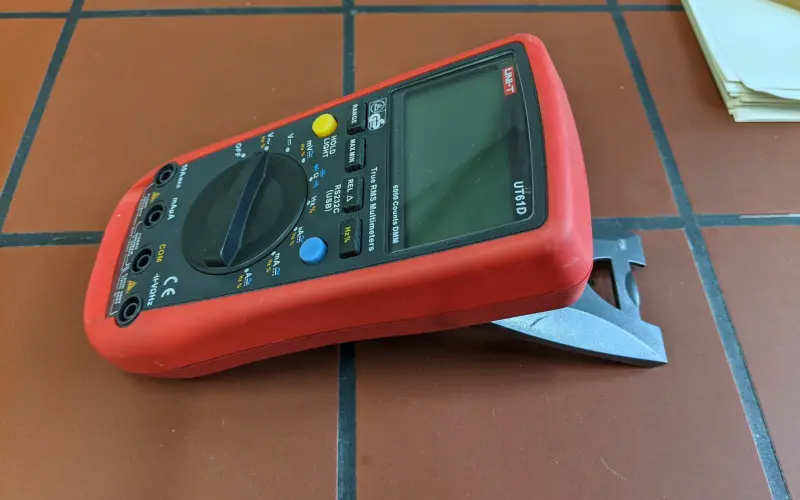
According to Siglent, amplitude accuracy is plus/minus 1 percent plus 1 millivolt, measured with a 10 kHz sine. If you want to verify levels, you need an instrument that is still accurate at this frequency. Multimeters only measure AC voltage up to a frequency stated in the data sheet, so check this value before buying. Which instruments are suitable is shown in our multimeter guide.
Three bad buys you can avoid
First: looking at the sine frequency and expecting the same frequency for square and triangle waves. With the DDS 130, the square wave ends at 25 MHz, and the triangle already at 1 MHz. Second: forgetting the level. With just over 1 volt peak-to-peak, no 5-volt logic switches reliably; for that you need a benchtop unit such as the Siglent with up to 20 volts into a high-impedance load. Third: overlooking the 50-ohm load and being puzzled by half the voltage, as described above.
Kit or ready-made unit?
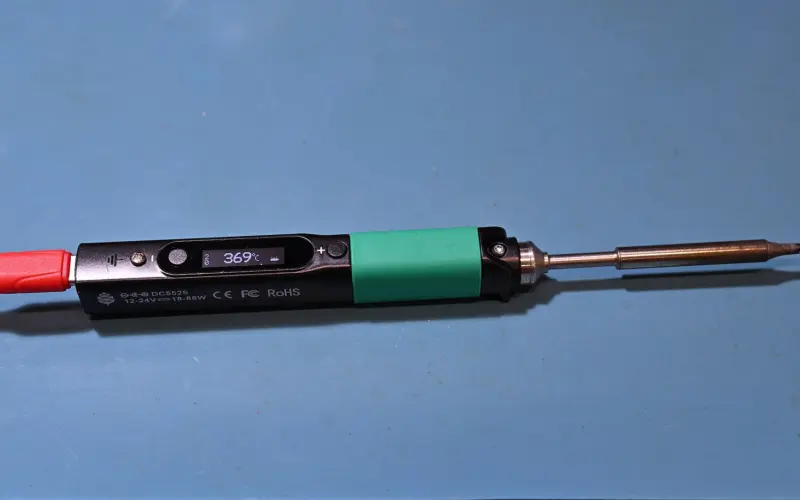
Choose the kit if soldering is part of the fun and there is a computer at your workbench anyway. A temperature-controlled soldering station with a fine tip makes the BNC sockets and the shielding plate considerably more pleasant. The ready-made unit is the better choice as soon as you need higher levels, want to compare two channels or measure without a PC. It saves time. You will learn more with the kit.
- Audio, filters, radio receivers on the PC: ELV DDS 130.
- Your own circuit with a microcontroller: ELV DDS-BOB1.
- Very first measuring instrument, audio frequencies: Joy-IT JT-ScopeMega50.
- Workshop with higher levels and two channels: Siglent SDG1032X.
- Compact and on the go: Rigol DG821 Pro.
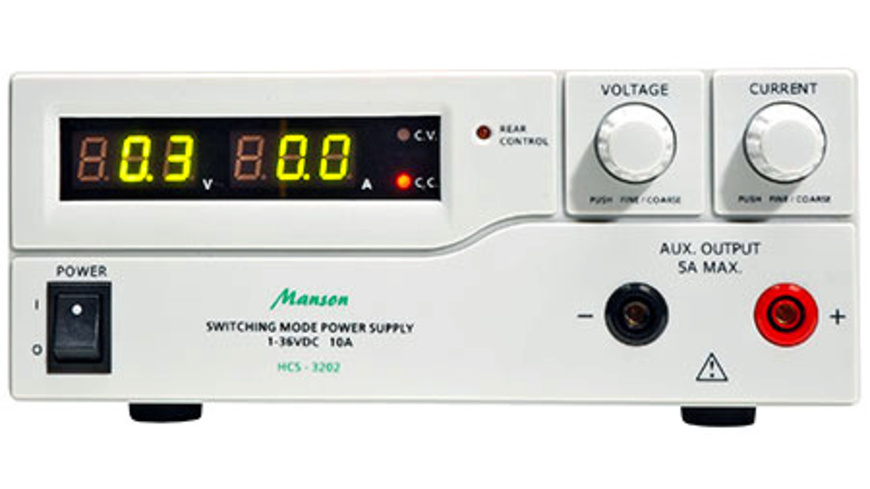
One final note. The generator does not power any circuit; for that, a bench power supply with current limiting sits next to it.
Frequently asked questions
What is a sweep?
The generator automatically runs the frequency across a range. This lets you display the frequency response of a filter or amplifier on the oscilloscope. According to ELV, the DDS 130 sweeps from 0.25 Hz to 30 MHz.
Do I need two channels?
Only if you need two signals with a fixed phase relationship, for example for I/Q experiments or for comparison. The Siglent SDG1032X has two equivalent channels, the Rigol DG821 Pro has one.
What does „arbitrary“ mean?
A freely drawn or loaded waveform instead of sine, square or triangle. How fine it turns out is determined by the memory length, which according to Siglent is 16,000 points for the SDG1000X.
Can the generator power a circuit?
No, it delivers a signal, not operating current. For that, a bench power supply belongs on the bench; see above.
Frequently asked questions
What should you look for when buying a function generator?
Four numbers: the frequency usually applies only to sine, while square and triangle waves end earlier. The output voltage decides whether 5-volt logic switches reliably. The number of channels matters when you need two signals with a fixed phase relationship. Then there is the operation: a benchtop unit with a screen or a circuit board connected to a PC.
Why does my generator show only half the voltage?
It is almost always the load. Most generators have an output impedance of 50 ohms. If the output is also connected to 50 ohms, such as a terminated coaxial cable, the voltage is halved compared with the reading for a high-impedance load. That is why serious data sheets always state the load the specification applies to.
Kit or ready-made function generator?
Choose the kit if soldering is part of the fun and there is a computer at your workbench anyway; you will learn more along the way. The ready-made unit saves time and is the right choice as soon as you need higher levels, two channels or measurements without a PC.
Which function generator is suitable for the workshop?
The Siglent SDG1032X with two equivalent channels, 14-bit resolution, LAN and USB. According to the data sheet, it delivers 20 volts peak-to-peak into a high-impedance load up to 10 MHz. It costs many times as much as the kit and takes up space on the bench.
Do I need an oscilloscope with a function generator?
You can only see the signal with an oscilloscope; the two belong together like plug and socket. As a first instrument for audio frequencies, the Joy-IT JT-ScopeMega50 combines a USB oscilloscope with a generator up to 12.5 kHz. For radio or fast digital electronics, that is not enough.
Sources
- ELV: DDS function generator kit DDS 130
- ELV: DDS 130 assembly and operating instructions (PDF)
- ELV: mini DDS signal generator DDS-BOB1
- ELV: Joy-IT 2-channel oscilloscope with function generator
- Siglent: SDG1000X series
- Siglent: SDG1000X data sheet (PDF)
- Rigol: DG800 Pro
- Rigol: DG800 (model overview with successors)
Where to buy
- ELV DDS 130€89.95≈ £74.92≈ CHF 83.14≈ PLN 396.84≈ SEK 1,002.31≈ DKK 672.32≈ NOK 953.87≈ CZK 2,193.52≈ HUF 33,138≈ RON 480.94≈ ISK 12,323≈ $98.66≈ CA$141.13 at ELV · As of 18.11.View at ELVAvailable in Germany: ELV
- ELV DDS-BOB1€8.95≈ £7.45≈ CHF 8.27≈ PLN 39.49≈ SEK 99.73≈ DKK 66.90≈ NOK 94.91≈ CZK 218.25≈ HUF 3,297≈ RON 47.85≈ ISK 1,226≈ $9.82≈ CA$14.04 at ELV · As of 18.11.View at ELVAvailable in Germany: ELV
- Joy-IT JT-ScopeMega50€126.95≈ £105.74≈ CHF 117.34≈ PLN 560.08≈ SEK 1,414.60≈ DKK 948.88≈ NOK 1,346.24≈ CZK 3,095.80≈ HUF 46,768≈ RON 678.76≈ ISK 17,392≈ $139.24≈ CA$199.18 at ELV · As of 18.11.View at ELVAvailable in Germany: ELVCheck price at Amazon.deCheck price at Amazon.co.ukCheck price at Amazon.nlCheck price at Amazon.com.beCheck price at Amazon.frCheck price at Amazon.itCheck price at Amazon.esCheck price at Amazon.plCheck price at Amazon.seAvailable in Germany: Amazon.de
- Siglent SDG1032XCheck price at Amazon.deCheck price at Amazon.co.ukCheck price at Amazon.nlCheck price at Amazon.com.beCheck price at Amazon.frCheck price at Amazon.itCheck price at Amazon.esCheck price at Amazon.plCheck price at Amazon.seAvailable in Germany: Amazon.de
- Rigol DG821 ProCheck price at Amazon.deCheck price at Amazon.co.ukCheck price at Amazon.nlCheck price at Amazon.com.beCheck price at Amazon.frCheck price at Amazon.itCheck price at Amazon.esCheck price at Amazon.plCheck price at Amazon.seAvailable in Germany: Amazon.de
Still undecided?
Keep comparing at your own pace – every article in this category is checked monthly for new and discontinued models.