Contents13 sections
This guide was first published in German on handgetestet.de.
A hallway, twelve meters of baseboard, four outside corners and two inside corners. With a miter box and a handsaw, that turns into a long Saturday, and at least one corner still ends up with a gap. On a sliding miter saw, it takes two cuts per corner. Our recommendation for DIYers cutting trim, battens and deck boards is the Metabo KGS 216 M: corded, 216 mm blade, 305 mm cutting width according to the manufacturer, and a shadow line that does not need adjusting.
Sounds simple. It is, as long as the saw matches the wood.
Measure your widest board first, then choose the saw
The sliding function determines the width. A plain miter saw only lowers the blade into the wood from above; according to the data sheet, the non-sliding Metabo KS 216 M therefore manages only 120 mm. With slide rails, the same blade size reaches 305 mm at Metabo. That easily fits a 145 mm wide deck board, and a glued-panel shelf as well. If, on the other hand, you only cut roof battens and trim to length, you do not need rails and save space and weight.
Second number: the cutting height. Baseboards are usually cut standing upright against the fence, and then what counts is how high the blade reaches. The machines with a 216 mm blade manage 60 to 70 mm here. According to the manufacturer, the Makita LS1019L with a 260 mm blade manages 91 mm, with narrower workpieces. At a 45-degree miter, the width shrinks by about a third on all of them; that figure is in every data sheet and is the more honest one for frames and trim corners.
Miter and bevel are often confused. Miter means the turntable rotates and the blade stays vertical. Bevel means the saw head tilts to the side. Both together give you a compound miter cut, for example for crown molding. If the head can only tilt to the left, you have to flip the workpiece for some corners. That works, but costs time and patience. According to the manufacturers, Bosch, Makita and Einhell bevel in both directions; Metabo allows only 2 degrees to the right, which is enough for undercuts, and Scheppach bevels only to the left.
Cordless or corded?
In a workshop with an outlet, the corded saw is the sensible choice. On the deck, on a construction site or at a customer’s home, a battery saves you the extension reel. For the Bosch GCM 18V-216 D, the manufacturer itself recommends 8 or 12 Ah batteries for sufficient run time. Packs like that cost extra. Without an existing 18-volt system, the cordless saw therefore rarely pays off; how the platforms differ is explained in our guide to battery systems.
Six sliding miter saws side by side
| Model | Power and blade | Cut at 90° (W × H) | Miter / bevel | Best for |
|---|---|---|---|---|
| Metabo KGS 216 M | Corded, 1,500 W (S6), 216 mm | 305 × 70 mm | 50° / 50° · left 47°, right 2° | DIYers with trim, deck boards, shelf building |
| Bosch GCM 18V-216 D Professional | Battery 18 V, 216 mm | 305 × 70 mm | 48° / 48° · 47° / 47° | Job sites without power, Bosch battery already owned |
| Makita LS1019L | Corded, 1,510 W, 260 mm | 279 × 91 mm or 310 × 68 mm | 60° / 60° · 48° / 48° | Thick square timbers, permanent workshop |
| DeWalt DWS777 | Corded, 1,800 W, 216 mm | 270 × 60 mm | Miter detents 15° to 45° | Frequent trips to the job site |
| Einhell TE-SM 216 Dual | Corded, 1,800 W, 216 mm | 305 × 65 mm | 47° / 47° · 45° / 45° | Occasional users who need compound miters |
| Scheppach HM216SPX | Corded, 2,000 W, 210 mm | 340 × 65 mm | 45° / 45° · left only 45° | Occasional cuts, lower price range |
All figures according to the manufacturers.
Metabo KGS 216 M
13.4 kg, sliding function, 305 mm wide at 70 mm high. Instead of a laser, an LED casts the blade’s shadow onto the wood; Metabo calls this Precision Cut Line, and because the shadow comes from the blade itself, nothing needs readjusting. According to the manufacturer, the box contains a 40-tooth blade, table extensions, a length stop and a clamp. Weakness: the head tilts only 2 degrees to the right.
Bosch GCM 18V-216 D Professional
The cordless version with the same 305 mm width and bevel to both sides up to 47 degrees. According to Bosch, a dual-line laser marks the left and right of the blade. At 16.2 kg, it is heavier than the Metabo, and the battery and charger are not included. For tradespeople with Bosch Professional batteries, a logical addition. Everyone else is buying into a whole system.
Makita LS1019L
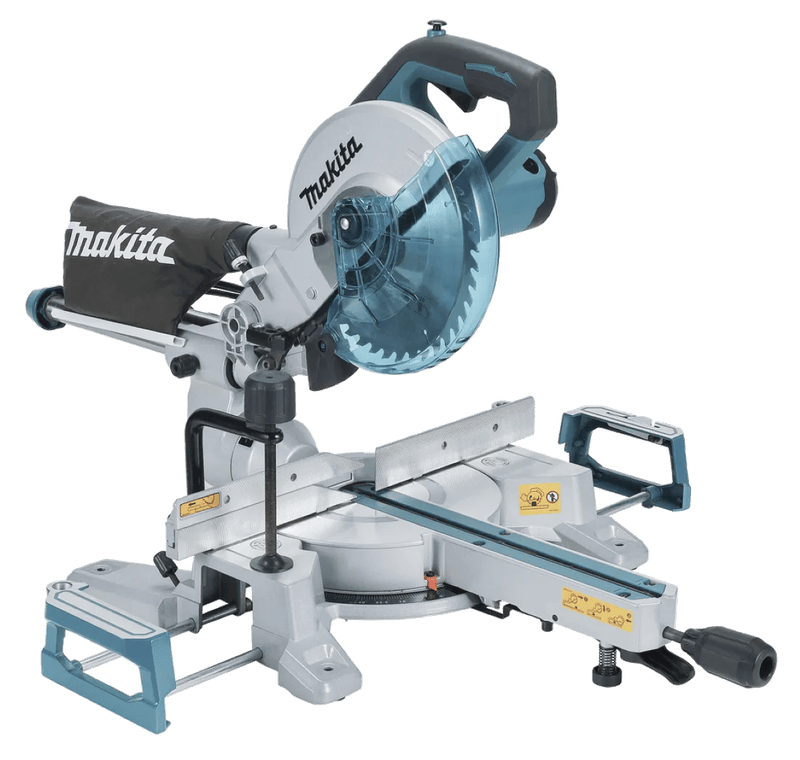
The heavyweight of the group: 26.3 kg, 260 mm blade, up to 91 mm cutting height. According to Makita, the turntable rotates up to 60 degrees to each side, and the head bevels 48 degrees left and right. The Dual-Slide system allows it to be set up close to the wall. If you are cutting beams for a carport to length, you notice the height right away. It is hardly suited to carrying around.
DeWalt DWS777
Here the rails run on the inside, as a telescoping slide with sliding and ball bearings. DeWalt promises plenty of cutting capacity in an easily transportable format and locks the slide and saw head for the trip in the car. DeWalt specifies 270 × 60 mm at 90 degrees, a little less width than the competition. The XPS light works with a shadow line, as on the Metabo. It comes with a 24-tooth blade that is intended more for rough cuts.
Einhell TE-SM 216 Dual
Surprisingly complete on paper: sliding function, 305 × 65 mm, head that bevels to both sides, laser, plus a 60-tooth blade from the factory. Einhell specifies 13.85 kg. For compound miters on crown molding, that is a real argument. In its own online shop, Einhell currently lists the machine as out of stock; it is available from retailers.
Scheppach HM216SPX
At 340 mm at 90 degrees, the greatest width here, even though the blade measures only 210 mm. Two blades are included, with 24 and 48 teeth. The head, however, only bevels to the left, and Scheppach specifies a sound power level of 109.5 dB(A). That makes hearing protection mandatory, not optional.
The blade makes the edge
Many buyers get annoyed about frayed edges on laminate or oak and blame the machine. Usually it is the blade. A 24-tooth blade cuts fast and rough, good for square timbers. Makita explicitly describes clean cuts with little tear-out for its 100-tooth miter saw blades with a small tooth angle. For visible trim corners, you should use at least 48 to 60 teeth. When buying a replacement, check diameter and bore; for all six models, the bore is 30 mm.
Stand and secure footing
The Swiss accident insurance Suva sums it up in its checklist: „The machine stands securely if it does not have to be held while working.“ Long workpieces need their own support, and at least 80 cm of free space should remain around the saw. A sturdy workbench (in German) meets that requirement, as does a folding stand with support arms. A wobbly sawhorse does not.
Suva names three main hazards: reaching under the running blade, flying parts and chips, and hands trapped between workpiece and fence. Its rules are simple. Place the workpiece against the fence and clamp it, keep at least a fist’s width away from the blade when holding it by hand, and do not cut small parts that cannot be secured. Add safety glasses and hearing protection. For long rip cuts in sheet material, a miter saw is the wrong tool anyway; that is what the track saw or circular saw (in German) is for.
How we would decide
- Trim, deck boards, shelves in the house and garden: Metabo KGS 216 M.
- Working without an outlet, with Bosch batteries already on the shelf: Bosch GCM 18V-216 D Professional.
- Square timbers and beams up to 91 mm high: Makita LS1019L, if you have the space and the muscle.
- The saw often has to go in the car: DeWalt DWS777.
- Crown molding with compound miters, but only now and then: Einhell TE-SM 216 Dual.
- A few cuts a year from the lower price range: Scheppach HM216SPX, but plan on a finer blade right away.
According to the manufacturer, the Makita LS0816F is a sliding compound miter saw for 216 mm blades with 1,200 W and a cutting capacity of 65 × 305 mm at 90°, intended for DIYers and occasional use.
Frequently asked questions
Do I need a miter saw with a sliding function?
That depends on your widest board. According to the data sheet, the non-sliding Metabo KS 216 M manages 120 mm; with slide rails, the same blade size reaches 305 mm. That easily fits a 145 mm wide deck board. If you only cut roof battens and trim to length, you do not need rails and save space and weight.
What is the difference between miter and bevel?
For a miter cut, the turntable rotates and the blade stays vertical. For a bevel cut, the saw head tilts to the side. Both together give you a compound miter cut, for example for crown molding. If the head only tilts to the left, you have to flip the workpiece for some corners. According to the manufacturers, Bosch, Makita and Einhell bevel in both directions.
Is a cordless miter saw worth it?
On the deck, on a construction site or at a customer's home, a battery saves you the extension reel. Bosch itself recommends 8 or 12 Ah batteries for the GCM 18V-216 D, and they cost extra. Without an existing 18-volt system, the cordless saw therefore rarely pays off. In a workshop with an outlet, the corded saw is the sensible choice.
Which saw blade gives clean edges on trim?
Frayed edges are usually down to the blade, not the machine. A 24-tooth blade cuts fast and rough, good for square timbers. For visible trim corners, you should use at least 48 to 60 teeth. When buying a replacement, check diameter and bore; for all six models in the comparison, the bore is 30 mm.
How do you set up a miter saw safely?
Suva (the Swiss accident insurance) says: the machine stands securely if it does not have to be held while working. Long workpieces need their own support, and at least 80 cm of free space should remain around the saw. Clamp the workpiece against the fence, keep a fist's width away from the blade, and wear safety glasses and hearing protection.
What cutting height do you need for baseboards?
Baseboards are usually cut standing upright against the fence, so the cutting height matters. Machines with a 216 mm blade manage 60 to 70 mm; according to the manufacturer, the Makita LS1019L with a 260 mm blade manages 91 mm. At a 45-degree miter, the width shrinks by about a third on all of them; that figure is the more honest one for trim corners.
Sources
- Metabo: KGS 216 M, technical data
- Metabo: KS 216 M Set
- Bosch Professional: GCM 18V-216 D
- Makita: LS1019L
- Makita: Circular saw blade 260 × 30 mm, 100 teeth
- DeWalt: DWS777 sliding miter saw 216 mm
- DeWalt UK: DWS777, cutting capacity
- Einhell: TE-SM 216 Dual
- Scheppach: HM216SPX
- Suva: Checklist for miter saws (67125.D)
- Makita LS0816F: Product information
Where to buy
- Metabo KGS 216 MCheck price at Amazon.deCheck price at Amazon.co.ukCheck price at Amazon.nlCheck price at Amazon.com.beCheck price at Amazon.frCheck price at Amazon.itCheck price at Amazon.esCheck price at Amazon.plCheck price at Amazon.seAvailable in Germany: Amazon.de
- Bosch Professional GCM 18V-216 DCheck price at Amazon.deCheck price at Amazon.co.ukCheck price at Amazon.nlCheck price at Amazon.com.beCheck price at Amazon.frCheck price at Amazon.itCheck price at Amazon.esCheck price at Amazon.plCheck price at Amazon.seAvailable in Germany: Amazon.de
- Makita LS1019LCheck price at Amazon.deCheck price at Amazon.co.ukCheck price at Amazon.nlCheck price at Amazon.com.beCheck price at Amazon.frCheck price at Amazon.itCheck price at Amazon.esCheck price at Amazon.plCheck price at Amazon.seAvailable in Germany: Amazon.de
- DeWalt DWS777Check price at Amazon.deCheck price at Amazon.co.ukCheck price at Amazon.nlCheck price at Amazon.com.beCheck price at Amazon.frCheck price at Amazon.itCheck price at Amazon.esCheck price at Amazon.plCheck price at Amazon.seAvailable in Germany: Amazon.de
- Einhell TE-SM 216 DualCheck price at Amazon.deCheck price at Amazon.co.ukCheck price at Amazon.nlCheck price at Amazon.com.beCheck price at Amazon.frCheck price at Amazon.itCheck price at Amazon.esCheck price at Amazon.plCheck price at Amazon.seAvailable in Germany: Amazon.de
- Scheppach HM216SPXView at scheppachAvailable in Germany: scheppachCheck price at Amazon.deCheck price at Amazon.co.ukCheck price at Amazon.nlCheck price at Amazon.com.beCheck price at Amazon.frCheck price at Amazon.itCheck price at Amazon.esCheck price at Amazon.plCheck price at Amazon.seAvailable in Germany: Amazon.de
- Makita LS0816FView at CoolblueAvailable in Germany: Coolblue